

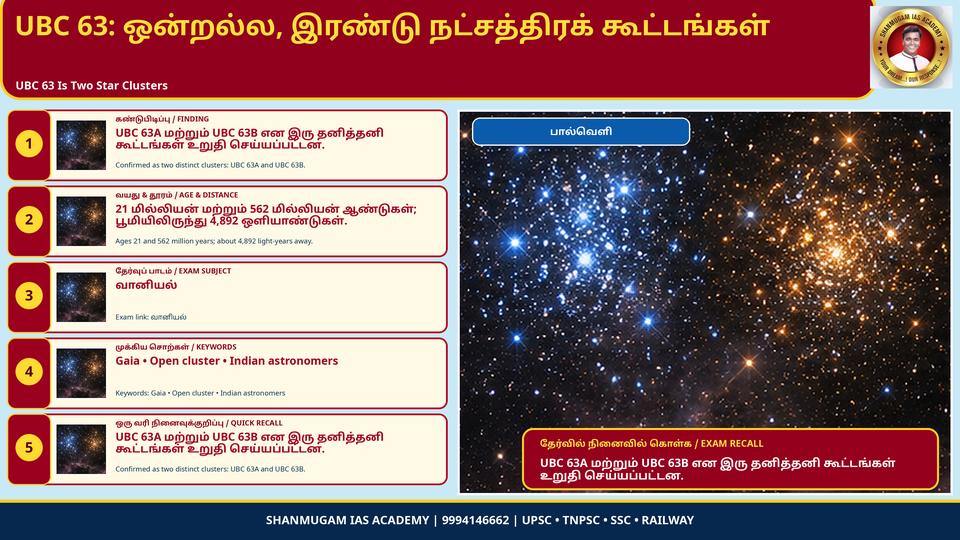
Star cluster 'UBC 63' is actually two separate clusters – Gauhati University study using Gaia data
5 November 2026 · English Science & Technology
⬇ Download this article as free PDF
Topics: Science · 5 November 2026 Current Affairs (UPSC / TNPSC / SSC / RRB)
News
A study led by the Department of Physics, Gauhati University (Assam), has found that 'UBC 63', long treated as a single open star cluster, is really two separate clusters of very different ages – UBC 63A (about 21 million years, 98 member stars) and UBC 63B (about 562 million years, 148 stars). The team analysed ESA's Gaia DR3 data with a machine-learning method (Gaussian Mixture Model). About 6 million years ago the two passed within about 7 parsec (≈23 light-years) of each other; being gravitationally unbound, they are now drifting apart. They lie about 1,500 parsec (≈4,900 light-years) from Earth. The paper appeared in The Astronomical Journal (AJ, 2026); reported 5 Nov 2026.
Key facts
| Cluster | UBC 63 → UBC 63A + UBC 63B (open clusters) |
| Ages | 63A ≈ 21 Myr; 63B ≈ 562 Myr – not born together |
| Lead | Dept of Physics, Gauhati University (Assam); co-authors from IIA Bengaluru, Cotton and Assam Universities, Italy, China, Japan, Spain |
| Data | ESA Gaia DR3 + machine learning; also GALEX, TESS |
| Encounter | ≈6 Myr ago at ≈7 pc (≈23 ly); now ≈26 pc apart |
| Distance | ≈1,500 pc (≈4,900 light-years) |
| Journal | The Astronomical Journal (AJ), 2026; arXiv: 20 July 2026 |
Background
- Science: star clusters are of two kinds – (1) open clusters: in the Milky Way's disc, a few hundred to thousands of young stars born from one molecular cloud, loosely bound (e.g. Pleiades/Karthigai, Hyades); (2) globular clusters: hundreds of thousands of very old stars in a tight sphere, in the galactic halo (e.g. Omega Centauri).
- Stars of one cluster share nearly the same age, distance and motion. In UBC 63 the two groups differ in age by about 540 million years, so they cannot have formed together. Their relative speed (≈3.6 km/s) exceeds the escape velocity (≈0.51 km/s) – an 'unbound flyby'.
- Gaia: ESA's space observatory, launched 19 Dec 2013; from the Sun–Earth L2 point it measured positions, distances (parallax) and motions of over a billion stars to build a 3-D map of the Milky Way. Science observations ended in Jan 2025; it was switched off on 27 March 2025. 'UBC' (University of Barcelona Cluster) objects were found by a University of Barcelona team using machine learning on Gaia DR2.
- Units: 1 parsec ≈ 3.26 light-years; 1 light-year = distance light travels in a year (≈9.46 trillion km) – both are units of distance.
Tamil Nadu link: the Indian Institute of Astrophysics (IIA, Bengaluru), a co-author institution of this study, runs the Vainu Bappu Observatory (2.34 m telescope) at Kavalur in the Javadhu Hills, Tirupattur district, and the Kodaikanal Solar Observatory (1899). Also, the 'Karthigai' star group (Pleiades), linked with the Karthigai Deepam festival, is an open star cluster.
Source: NewsBytes (5 Nov 2026); arXiv:2607.18224 (Samrat Biswas et al., 20 July 2026); The Astronomical Journal (AAS, 2026; DOI 10.3847/1538-3881/ae8c38); ESA (Gaia)
Join our UPSC classroom or online batch: UPSC coaching in Coimbatore · Fees · Call 99941 46662.
Link to this page from your website / blog (HTML code)
BANK Achievers
-

P. VIVEK KUMAR
BANK BANK
Today Current Affairs in Tamil | 06 நவம்பர் 2026 | TNPSC Group 4 முக்கிய வினாக்கள்
TNPSC குரூப் 1, 2/2A, 4 – நேரடி வகுப்புகள் · கோவை & மதுரை
2006 முதல் சண்முகம் IAS அகாடமி · Classroom & online coaching in Coimbatore and Madurai
