

Asteroid '2026 QQ8' becomes Earth's temporary 'mini-moon' – to stay bound to Earth until December 2026
5 November 2026 · English Science & Technology
⬇ Download this article as free PDF
Topics: Space · 5 November 2026 Current Affairs (UPSC / TNPSC / SSC / RRB)
News
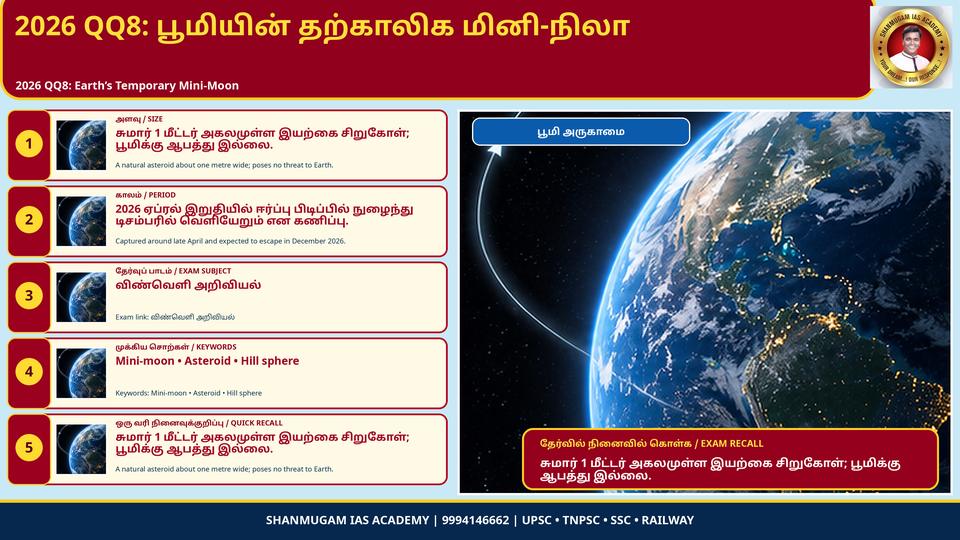
The roughly 1-metre asteroid '2026 QQ8' entered Earth's gravitational domain (the Hill sphere) in late April 2026 and became a temporary natural satellite of Earth – a 'mini-moon'. Hungarian astronomer Krisztián Sárneczky spotted it on 20 Aug 2026 at Piszkéstető Observatory in northern Hungary. It was first suspected to be old rocket debris; after follow-up with the University of Hawaii 2.2-m telescope and the Lowell Discovery Telescope, the Minor Planet Center (MPC) announced on 29 Oct 2026 that it is a natural asteroid 'temporarily bound to the Earth'. It will stay bound until December 2026, then escape and orbit the Sun in 2027.
Key facts
| Name / size | 2026 QQ8 – about 1 m; a natural asteroid |
| Discovery | 20 Aug 2026 – Krisztián Sárneczky, Piszkéstető Observatory, Hungary |
| Confirmation | 29 Oct 2026 – Minor Planet Center (MPC) announcement |
| Bound period | Late April 2026 to December 2026; returns to a solar orbit in 2027 |
| Closest distance | About 0.0038 AU (~570,000 km) – about 1.5 times the Moon's distance |
| Orbit | Circles the Sun in about 358 days; tilt about 0.5°; passed close in 1965 without capture; next in 2058 |
| Risk | None – so small it would burn up in the atmosphere |
Background
- Science: a 'mini-moon' is a small asteroid captured by Earth's gravity for a while before it escapes. The region where a planet's gravity dominates over the Sun's is its 'Hill sphere'. Asteroids that circle the Sun on Earth-like orbits are the ones that get captured. A 'quasi-moon' is different – it does not orbit Earth but stays near it while orbiting the Sun (e.g. 2025 PN7).
- Earlier mini-moons: 2020 CD3 (2020) and 2024 PT5. 2024 PT5 was found on 7 Aug 2024 by the NASA-funded ATLAS telescope at Sutherland, South Africa; about 10–11 m long; bound to Earth from 29 Sep to 25 Nov 2024. It belongs to the 'Arjuna asteroid belt' (asteroids on Earth-like orbits) and may be a fragment of the Moon. It returns near Earth in 2055.
- Bodies: the Minor Planet Center works under the authority of the International Astronomical Union (IAU) at the Smithsonian Astrophysical Observatory, Cambridge (Massachusetts), USA; it collects position measurements of asteroids and comets and assigns provisional designations (e.g. 2026 QQ8).
- Asteroid vs comet: asteroids are rocky/metallic – most lie in the main belt between Mars and Jupiter. Comets are made of frozen gases, ice and dust and grow a glowing tail near the Sun. A space rock that reaches the ground is a 'meteorite'.
Tamil Nadu link: Government Astronomer Norman Pogson discovered asteroids from the Madras Observatory between 1861 and 1885. 104 years later, R. Rajamohan's team found asteroid '4130 Ramanujan' (reported in 1989) with the 48-cm Schmidt telescope of the Vainu Bappu Observatory, Kavalur (Javadhu Hills, Tirupattur district) – the first asteroid discovered from an Indian observatory in the 20th century.
Source: EarthSky, 4 Nov 2026; WION, 5 Nov 2026; The Daily Galaxy, 5 Nov 2026; The Kashmir Monitor (2024 PT5); Swarajya (4130 Ramanujan, Pogson)
Join our UPSC classroom or online batch: UPSC coaching in Coimbatore · Fees · Call 99941 46662.
Link to this page from your website / blog (HTML code)
TNPSC Achievers
-

VENMATHI
TNPSC TNPSC
Today Current Affairs in Tamil | 06 நவம்பர் 2026 | TNPSC Group 4 முக்கிய வினாக்கள்
TNPSC குரூப் 1, 2/2A, 4 – நேரடி வகுப்புகள் · கோவை & மதுரை
2006 முதல் சண்முகம் IAS அகாடமி · Classroom & online coaching in Coimbatore and Madurai
