

Mayon volcano erupts in the Philippines – Alert Level 3; thousands evacuated
5 November 2026 · English International
⬇ Download this article as free PDF
Topics: International · 5 November 2026 Current Affairs (UPSC / TNPSC / SSC / RRB)
News
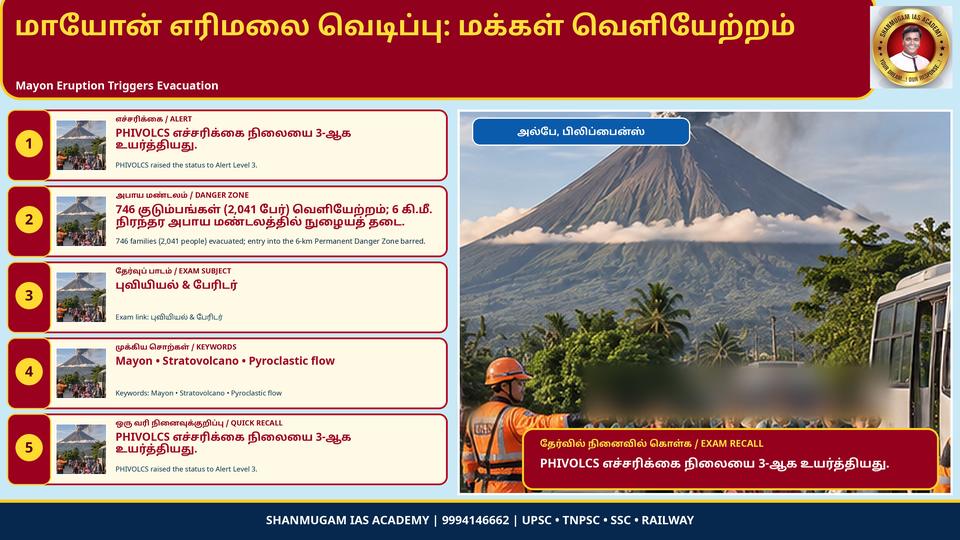
Mayon volcano in Albay province, the Philippines, had a 'moderately explosive' eruption lasting about 6 minutes at 11:53 a.m. local time on Friday, 30 Oct 2026; the ash plume rose about 3,000 m above the crater. The Philippine Institute of Volcanology and Seismology (PHIVOLCS) raised the alert from Level 2 to Level 3 the same day (the highest is 5). By that evening 746 families (2,041 people) had been evacuated from Tabaco City, Camalig and Ligao City; entry into the 6-km Permanent Danger Zone (PDZ) was barred.
Key facts
| Location | Albay province, Bicol region, Luzon island, Philippines |
| Eruption | 30 Oct 2026, 11:53 a.m.; about 6 minutes; plume 3,000 m |
| Alert | Level 2 → 3 (scale 0–5) – PHIVOLCS |
| Evacuation | 746 families / 2,041 people (evening of 30 Oct; Albay disaster office) |
| Danger zone | 6-km Permanent Danger Zone – entry barred |
| Earlier in 2026 | 6 Jan – Level 3 (lava-dome collapse); another eruption with evacuations in May |
Background
- Geography: Mayon is a 'stratovolcano' (composite volcano) famous for its almost perfect cone – built of alternating layers of lava and ash; its viscous magma makes it explosive. Japan's Fuji and Italy's Vesuvius are of the same type. By contrast, Hawaii's Mauna Loa is a 'shield volcano' – fluid basaltic lava and gentle slopes.
- Pacific Ring of Fire: a horseshoe-shaped belt around the Pacific Ocean with about 75% of the world's active volcanoes and about 90% of its earthquakes. Cause – oceanic plates sinking beneath other plates at convergent boundaries (subduction). The Philippines lies on its western rim.
- History: Mayon's 1814 eruption buried the Cagsawa church – its ruins are now a tourist site. Luzon's Mount Pinatubo produced one of the 20th century's largest eruptions in June 1991; sulphur dioxide spread in the stratosphere temporarily cooled global temperatures by about 0.5°C.
- Science: a 'lahar' is a mudflow of water, rock debris and ash rushing down a volcano's slopes (an Indonesian word); common on Mayon in the rainy season. A 'pyroclastic flow' is a fast-moving current of very hot gas, ash and rock. PHIVOLCS works under the Philippines' Department of Science and Technology (DOST).
Tamil Nadu link: there is no direct Tamil Nadu link; Tamil Nadu has no volcanoes. But subduction-zone disasters have hit the State – in the tsunami raised by the Sumatra–Andaman subduction earthquake of 26 Dec 2004, Nagapattinam was the worst-affected district on the Tamil Nadu coast.
Source: GMA News (30–31 Oct 2026); Daily Tribune (31 Oct 2026); Gulf News (2 May 2026); The Star / Xinhua (1 Nov 2026); Gulf News (6 Jan 2026); USGS (lahar, Pinatubo)
Join our UPSC classroom or online batch: UPSC coaching in Coimbatore · Fees · Call 99941 46662.
Link to this page from your website / blog (HTML code)
TNPSC Achievers
-

S. SYED ILLIYAS
TNPSC TNPSC
Today Current Affairs in Tamil | 06 நவம்பர் 2026 | TNPSC Group 4 முக்கிய வினாக்கள்
TNPSC குரூப் 1, 2/2A, 4 – நேரடி வகுப்புகள் · கோவை & மதுரை
2006 முதல் சண்முகம் IAS அகாடமி · Classroom & online coaching in Coimbatore and Madurai
