

Mains Analysis: Agnipath's "second tour of duty" – what the two-year extension for Agniveers changes, and what it still leaves open
6 November 2026 · English Defence
⬇ Download this analysis as free PDF
இந்தப் பகுப்பாய்வைத் தமிழில் படிக்க →
Topics: Defence · GS-III · UPSC Mains Analysis
UPSC Mains Analysis – current affairs of 6 November 2026 (Shanmugam IAS Academy)
Context
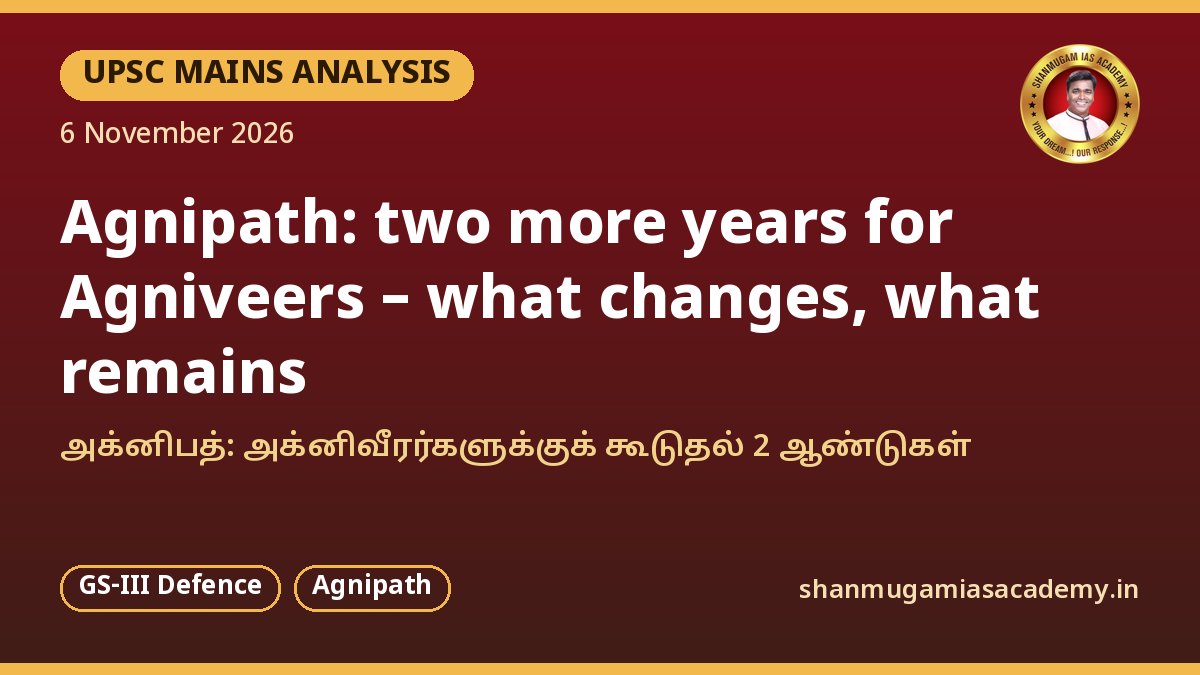
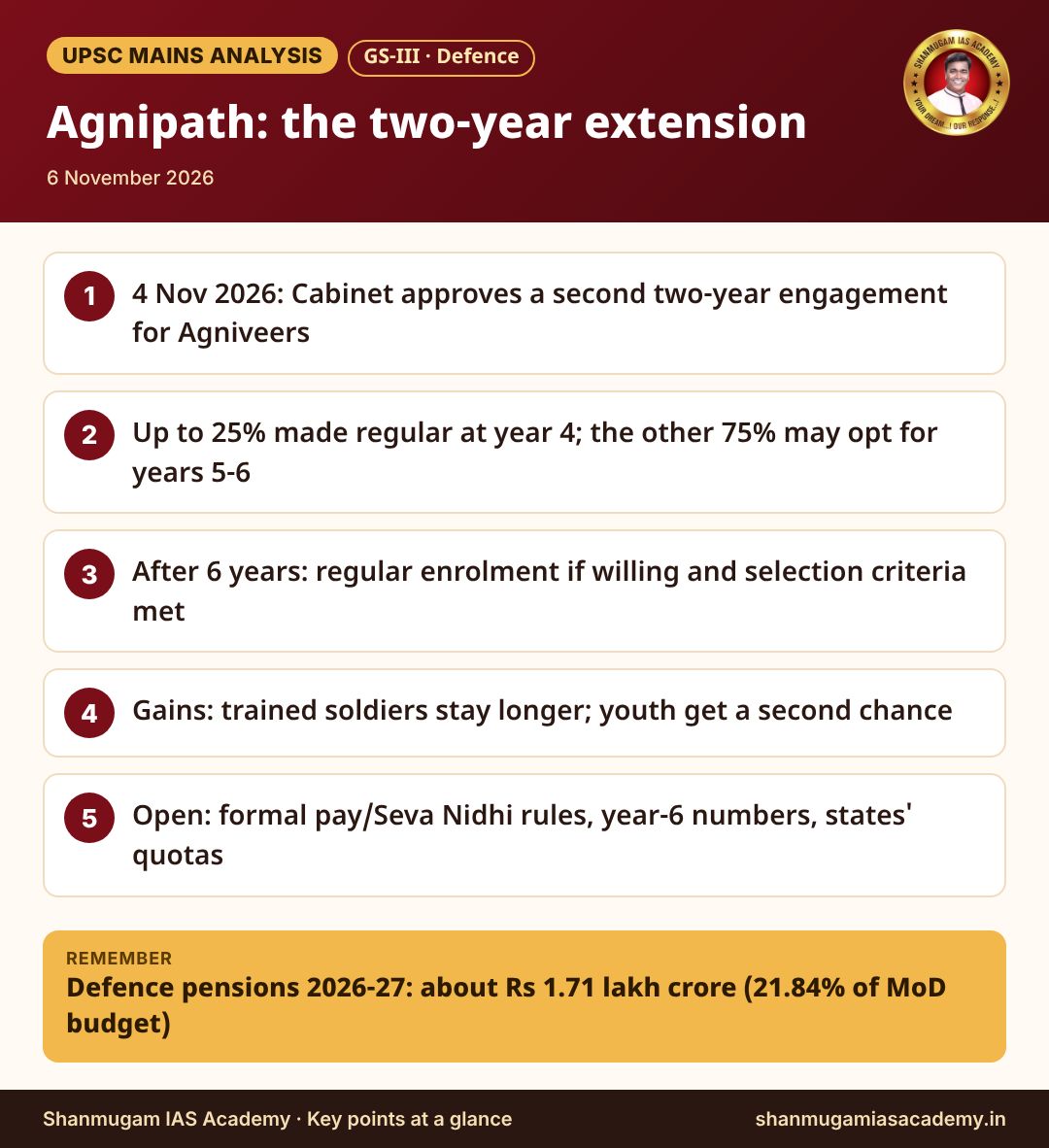
On 4 November 2026, the Union Cabinet approved a major change to the Agnipath scheme, launched on 14 June 2022. Under the original design, after four years up to 25% of each batch of Agniveers is taken into the regular forces on merit and the rest leave. Now the remaining 75% will be offered, if they are willing, a second engagement of two years, with higher pay, an enhanced Seva Nidhi package and seniority benefits. At the end of six years, all willing Agniveers who meet objective selection criteria will be offered enrolment as regular soldiers.
Chief of Defence Staff Gen N.S. Raja Subramani, who briefed the media, said the scheme "was not set in stone", will continue, and that the change followed a structured evaluation by the three services. Defence Minister Rajnath Singh called it a "Second Tour of Duty". The timing matters: the first batch – about 18,000 Agniveers, as reported – was due to complete four years by the end of 2026; the Navy's first batch completes its term this month and the Army and Air Force batches by the end of December. The question for a UPSC aspirant: does the extension fix Agnipath's weak points, or only postpone them?
Background: Agnipath in brief
| Feature | Original design (June 2022) |
|---|---|
| Entry | Age 17.5–21 (one-time upper limit of 23 in 2022); Army, Navy and Air Force, below officer rank |
| Tenure | Four years including training; Army basic and advanced training of about 24–31 weeks |
| Pay | Monthly package of Rs 30,000 in year one rising to Rs 40,000 in year four |
| Exit package | Seva Nidhi of about Rs 11.71 lakh, tax-free; no pension or gratuity for those who leave |
| Insurance | Non-contributory life cover of Rs 48 lakh during service |
| Retention | Up to 25% of each batch selected for regular service (15 more years) on merit and organisational need |
| First intake | 46,000 in 2022; Army training of the first batch began in January 2023 |
Core analysis: what the extension changes
| Question | Before (4-year model) | After the Cabinet decision |
|---|---|---|
| What happens to the 75%? | Leave after four years with Seva Nidhi | Option of two more years (years 5–6), if willing and recommended |
| Route to regular service | One chance – the 25% merit list at year four | A second chance at year six, subject to willingness and selection criteria |
| Pay and exit benefits | Fixed four-year package | Higher pay in years 5–6 (reported at Rs 43,500 a month in year five, more in year six) and an enhanced Seva Nidhi, with the government's share reported to rise to 70% from 50%; formal rules yet to be notified |
| Seniority | Year-four entrants become regulars | Those selected at year four rank senior to those absorbed after six years |
| For the forces | A trained soldier exits just as he becomes productive | Two more years of service from trained manpower |
The scheme's goals – and how the extension affects them
- Younger profile: the core aim in 2022 was a younger, fitter force. Keeping most of a batch for six years instead of four raises the average age a little, but every soldier still enters at 17.5–21, so the basic youth design survives.
- Pension bill: defence pensions are budgeted at about Rs 1.71 lakh crore in 2026-27 – 21.84% of the Ministry of Defence allocation of Rs 7.85 lakh crore, against 27.95% for capital outlay. The 2022 announcement presented Agnipath as a reform for a younger force, not as a pension-saving measure, but a shorter engagement without pension clearly lowers future liabilities. If many more Agniveers become regulars after six years, part of that saving will narrow – the size of the year-six intake is the key number to watch.
- Skills and experience: service chiefs and veterans had argued that technical roles need more than four years to master. The extension keeps trained soldiers in units for longer – a direct gain in operational value.
- Merit and competition: the 25% filter stays; the CDS explained that those not picked are "not bad", only lower in a relative ranking. The extension rewards them with time, income and a second chance.
Concerns that remain
- Training depth: basic training is shorter than in the pre-Agnipath system. Reports in 2024 said the Army had studied longer training and higher retention; the extension adds service time, not training time.
- Cohesion: analysts warned of "two classes of soldiers" with different terms in the same unit, and of strong competition for the 25% slots. A third category – six-year Agniveers – could add to this unless terms are clear and fair.
- Post-service future: those who still leave (unwilling, or not selected at six years) get no pension or gratuity. Exit at about 23–27 years of age with a Seva Nidhi is better than at 21–25, but it is not a career.
- States' quotas: the Centre raised the ex-Agniveer quota in BSF constable recruitment from 10% to 50% (notified December 2025); Uttar Pradesh gives 20% horizontal reservation in police recruitment (June 2025); Chhattisgarh, Uttarakhand, Odisha and others have quotas or preference. These were planned for a batch leaving at year four. As reported by PTI, the CDS indicated that such schemes may no longer be needed – but they remain the safety net for those who still exit. States need clarity on when, and how many.
- Open questions and politics: the formal rules on pay and Seva Nidhi (so far only figures reported from the briefing), whether the "4+2" model applies to future batches, and how many regular posts will be available at year six are not yet public. Opposition parties have long criticised the scheme over the fate of those who leave; the same question now applies to those not absorbed after six years.
Way forward
- Notify the rules quickly: pay, enhanced Seva Nidhi, seniority, and whether years 5–6 count for pension if absorbed – the first batch (Navy this month, Army and Air Force by December) must decide within weeks.
- Clear year-six numbers: announce each service's expected intake of regulars, so that the "pathway" is credible.
- Use the extra two years for skills: technical courses, recognised certificates and degree credits, and longer training where a trade needs it.
- Align Centre and States: keep CAPF and state police quotas in place for those who exit; one national placement portal for ex-Agniveers.
- Protect cohesion: the same ethos, equal operational roles and transparent assessment for all categories in a unit.
- Regular review: publish an annual Agnipath review to Parliament on age profile, retention, costs and post-service outcomes.
Mains practice question
Answer framework: Introduction – Agnipath (June 2022), 4-year tenure, 25% retention; Cabinet decision of 4 November 2026 · Body – (a) goals: younger profile, fitter force, pension liability (Rs 1.71 lakh crore, 2026-27); (b) what the extension corrects: loss of trained soldiers, single exit point, youth insecurity; (c) what remains: training depth, cohesion, no pension for those who exit, unclear year-six numbers, Centre–State quotas (BSF 50%, UP 20%); (d) effect on goals: slight rise in average age, smaller pension saving · Way forward – rules, numbers, skills, quotas, annual review · Conclusion – faculty-view line.
Prelims pointers
- Agnipath scheme announced on 14 June 2022; entry age 17.5–21; four-year tenure; recruits are called Agniveers.
- Seva Nidhi: about Rs 11.71 lakh, tax-free, at the end of four years; life cover of Rs 48 lakh.
- Delhi High Court upheld the scheme on 27 February 2023, saying it was introduced in the national interest.
- November 2026: 75% of Agniveers can opt for a second engagement of two years; regular enrolment offered after six years, subject to criteria.
- Ex-Agniveer quota in BSF constable recruitment: 50% (raised from 10%, notified December 2025).
- Defence budget 2026-27: Rs 7.85 lakh crore; defence pensions about Rs 1.71 lakh crore.
The concept to carry into the exam hall is "graduated retention" – keeping soldiers in stages (four years, then six, then a full career), with a fresh selection at each stage, instead of one fixed exit point. It lets a force stay young at entry while holding on to experience where it matters. The 4 November decision moves Agnipath from a "short service with one gate" to graduated retention. The next debate will be about where the gates are and how wide they open.
- A shift to note: the argument is no longer "Agnipath: yes or no" but "how much retention, at what cost". Write: "Military manpower reform is now about balancing youth, experience and fiscal space, not choosing between them."
- What to watch next: (1) the rules on pay, Seva Nidhi and pension status for years 5–6, (2) whether the 4+2 model is applied to future batches, (3) the number of Agniveers absorbed at year six in each service, (4) whether states keep or revise their ex-Agniveer quotas.
- Ready-made conclusion line: "Agnipath's promise was a younger army; graduated retention can make it a younger and wiser one."
Sources: Union Cabinet decision of 4 November 2026 as reported by ANI, PTI (ThePrint, Telangana Today), ETV Bharat, Outlook, Asianet News and The Daily Pioneer; BharatShakti, Millennium Post and Outlook (5 November 2026) on the reported pay and Seva Nidhi figures; CDS Gen N.S. Raja Subramani's media briefing (ANI); PIB New India Samachar (July 2022) and Scroll/Tribune on the original scheme; ThePrint and Tribune on Agniveer training; PIB Ministry of Defence budget note and Business Today on the 2026-27 defence budget; All India Radio News and Business Standard on the BSF quota; All India Radio News and Tribune on the UP quota; Scroll on state measures; Delhi Policy Group and India.com/Financial Express on concerns; LiveLaw and Business Today on the Delhi High Court verdict. Original analysis by Shanmugam IAS Academy.
Link to this page from your website / blog (HTML code)
TNPSC Achievers
-

E. SHANMUGA PRIYA
TNPSC TNPSC
Today Current Affairs in Tamil | 06 நவம்பர் 2026 | TNPSC Group 4 முக்கிய வினாக்கள்
TNPSC குரூப் 1, 2/2A, 4 – நேரடி வகுப்புகள் · கோவை & மதுரை
2006 முதல் சண்முகம் IAS அகாடமி · Classroom & online coaching in Coimbatore and Madurai
