

Mains Analysis: Sewer and septic-tank deaths – why India's ban on hazardous cleaning has not stopped sanitation workers from dying, and what "zero human entry" would need
6 November 2026 · English
⬇ Download this analysis as free PDF
இந்தப் பகுப்பாய்வைத் தமிழில் படிக்க →
Topics: Social Justice · GS-II · UPSC Mains Analysis
UPSC Mains Analysis – current affairs of 6 November 2026 (Shanmugam IAS Academy)
Context
On 26 October 2026, a worker fell into a pump-house well at a sewage treatment plant under trial run in Sola, Ahmedabad; three men who went in after him also collapsed, and two of the four died. The Ahmedabad Municipal Corporation served the contractor a notice for a Rs 50 lakh penalty, and on 5 November its standing committee announced, as reported by IANS, that the contractor would pay Rs 30 lakh to each family. Earlier in October, three workers died inside a newly built septic tank at Sendurai in Ariyalur district of Tamil Nadu (2 October), and two contract workers died in a stormwater sump at Kodungaiyur, Chennai (12 October), where the cause is still under inquiry.
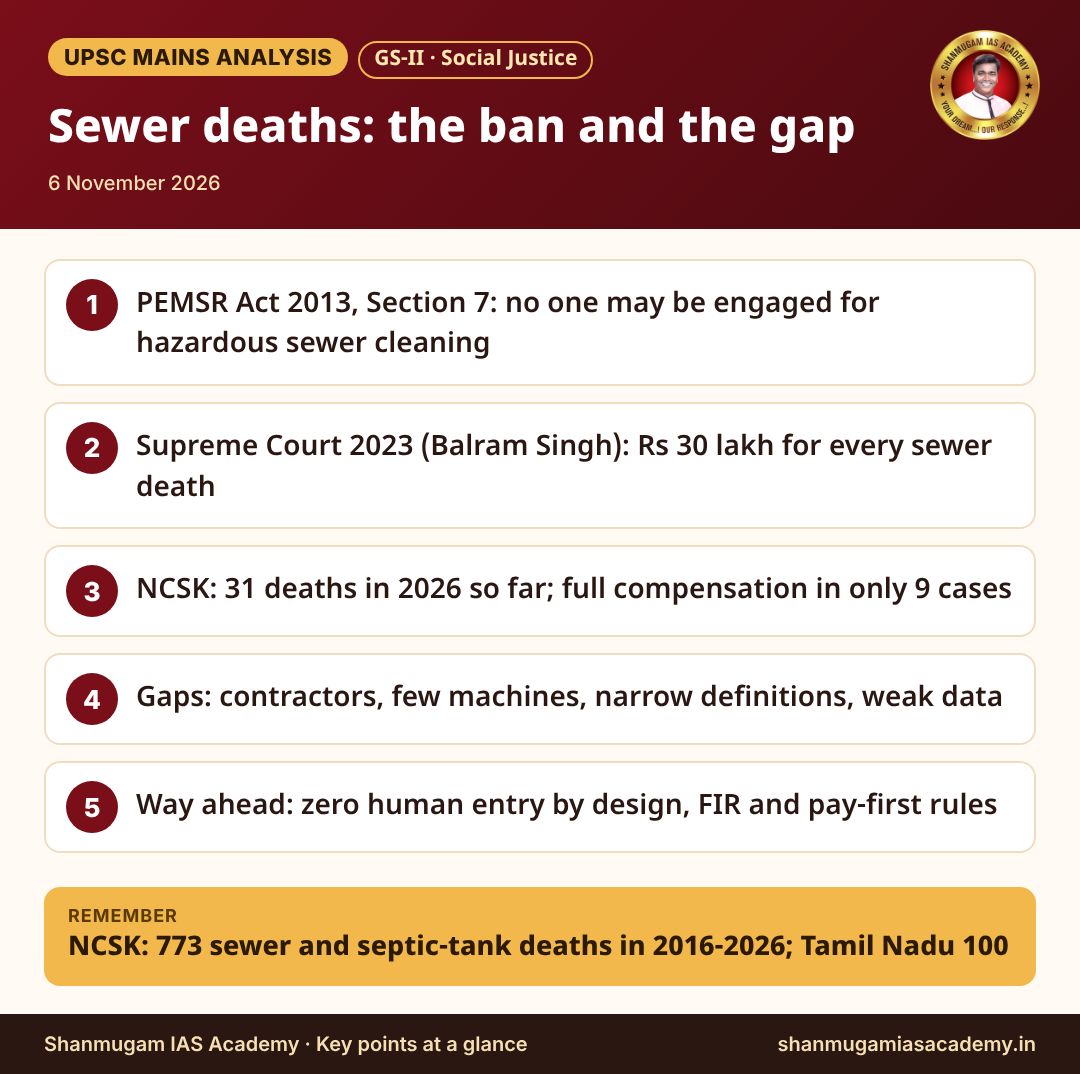
On 20–21 October, data of the National Commission for Safai Karamcharis (NCSK) showed 31 deaths while cleaning sewers and septic tanks in 2026 so far, with full compensation paid in only nine cases, and 773 deaths in 2016–2026. Tamil Nadu and Maharashtra recorded the highest number – 100 each. In July 2026 the Supreme Court had already asked the Chief Secretaries of several States, Tamil Nadu among them, to show cause why contempt proceedings should not begin. The question for an aspirant: why does a practice banned by law since 2013 still kill people?
Background: the law and the judgments
| Milestone | What it did |
|---|---|
| 1993 Act | Employment of Manual Scavengers and Construction of Dry Latrines (Prohibition) Act – targeted dry latrines; sewers left out |
| NCSK | Set up on 12 August 1994 under the NCSK Act, 1993; the Act lapsed on 29 February 2004, and the Commission now works as a non-statutory body; tenure extended up to 31 March 2028 |
| PEMSR Act, 2013 | Assent 18 September 2013. Section 7 bars any person, local authority or agency from engaging anyone for hazardous cleaning of a sewer or septic tank; Section 9 – up to 2 years or Rs 2 lakh fine (first offence), up to 5 years or Rs 5 lakh (repeat); Section 22 – offences cognizable and non-bailable; Section 33 – every local authority must use appropriate technology; Section 31 – NCSK monitors the Act |
| Safai Karamchari Andolan (27 March 2014) | Supreme Court: Rs 10 lakh for every sewer death since 1993; entry into sewers without safety gear to be made a crime even in emergencies |
| Balram Singh (20 October 2023) | Justices S. Ravindra Bhat and Aravind Kumar: Rs 30 lakh for a death, at least Rs 20 lakh for permanent disability, at least Rs 10 lakh for other disability; 14 directions – phased eradication, model contracts, cancellation of contracts and monetary liability after deaths, a national survey, a portal and dashboard |
| Later orders | 29 January 2025 – manual scavenging and manual sewer cleaning barred in Delhi, Mumbai, Kolkata, Chennai, Bengaluru and Hyderabad; January 2026 – Rs 30 lakh applies also to older deaths where compensation is still unpaid; 27 July 2026 – contempt show-cause notices to Chief Secretaries |
Core analysis: where the system breaks
| Link in the chain | What the rules say | What happens on the ground |
|---|---|---|
| Definition | Hazardous cleaning = manual cleaning without the employer meeting safety obligations | Deaths during repair, construction or rescue in tanks, sumps and STP wells are often recorded as "accidents"; in Ariyalur the Collector said the deaths were not manual scavenging but poor ventilation |
| Employer | Local authorities and agencies are liable | Work is outsourced to contractors and sub-contractors; liability is diluted |
| Machines | Section 33: local authorities must use technology | Small towns, housing societies and factories lack jetting and suction machines, gas detectors and trained crews |
| Data | NCSK monitors; Court ordered a portal and dashboard | NCSK has no statutory mandate to keep a full database; counts differ by source (773 since 2016 by NCSK; 622 since 2017 in a Lok Sabha reply) |
| Justice | Cognizable, non-bailable offence; Rs 30 lakh compensation | Since 2017, 52 families got no compensation and 25 only part, as told to the Lok Sabha in March 2026 |
Why it matters
- Constitutional morality: the work is tied to caste. The deaths test Article 17 (abolition of untouchability), Article 21 (life with dignity) and Article 23 (no forced labour). A worker who goes down a manhole for a day's wage has little real choice.
- Tamil Nadu's record: of 1,248 deaths since 1993 reported to the Rajya Sabha in November 2024, Tamil Nadu accounted for 253 – the highest, about one in five. In NCSK's 2016–2026 data it is joint-highest with Maharashtra (100 each). A State known for its social-justice tradition cannot treat this as a minor issue.
- Urban growth: as cities add sewer lines, STPs and septic tanks under SBM-U 2.0 (launched 1 October 2021, outlay Rs 1,41,600 crore), the number of confined spaces grows. Without safe operation rules, new infrastructure brings new risk.
- State capacity: the deaths are a failure of contracts, inspection and local finance, not of one careless worker.
What the State has done
- NAMASTE (National Action for Mechanised Sanitation Ecosystem, July 2023; MoSJE with MoHUA; NSKFDC implements): outlay Rs 349.70 crore till 2025-26, all 4,800+ urban local bodies; goal of zero fatalities. It profiles sewer and septic-tank workers, gives PPE and training, Ayushman Bharat PM-JAY cover, capital subsidy for sanitation machines, and Emergency Response Sanitation Units. Over 89,000 workers had been validated by April 2026; waste pickers were added in 2024.
- Safaimitra Suraksha Challenge (MoHUA, 19 November 2020): 243 cities pledged to mechanise all sewer and septic-tank cleaning.
- Tamil Nadu: in March 2024, loan orders were given to 213 sanitation workers to buy sewer-maintenance machines under the Annal Ambedkar Business Champions Scheme – a move from wage worker to machine-owning entrepreneur.
Challenges
- Denial in data: the Union government has told Parliament that recent district surveys found no manual scavengers, while deaths continue. A problem that is "officially absent" gets no budget.
- Contractor chain: victims are often contract or daily-wage workers hired through layers of contractors. The 2023 judgment had to order cancellation of contracts and monetary liability because accountability kept stopping at the lowest level.
- Machines do not fit every space: narrow lanes, old sewers and blocked chambers make machines hard to use, so crews still go in.
- Rescue deaths: in Ariyalur, Kodungaiyur and Ahmedabad, at least one of the dead had gone in to save a co-worker who had collapsed. Without gas detectors, harnesses and breathing sets, rescue turns into multiple deaths.
- Private premises: septic tanks in homes, hotels, hospitals and factories are cleaned by informal crews outside municipal control.
Way forward
- Make "zero human entry" the design rule: new sewers, STPs and sumps must be designed for machine access; entry only as a last resort under a written permit, with gas testing, ventilation, harness and a standby rescuer.
- Widen the definition in practice: treat every death in a sewer, septic tank, sump or STP well as a case under the 2013 Act until proved otherwise; FIR within 24 hours against the principal employer and contractor.
- Pay first, recover later: the local body pays Rs 30 lakh within a fixed time and recovers it from the contractor.
- Money and machines for small towns: pool machines through ERSUs at district level; tie SBM-U funds to safe-operation audits.
- One public dashboard: a statutory duty to record every death, FIR, compensation and rehabilitation step, as the Court ordered in 2023.
- Rehabilitation with dignity: scholarships and jobs for families; credit, contracts and training so that workers own sanitation enterprises, as in the Tamil Nadu loan model.
Mains practice question
Answer framework: Introduction – recent deaths (Ahmedabad, Ariyalur, Oct 2026); NCSK: 31 deaths in 2026, 773 since 2016 · Body – (a) the legal framework: PEMSR Act 2013 (Sections 7, 9, 22, 33), Safai Karamchari Andolan 2014, Balram Singh 2023 (Rs 30 lakh, 14 directions); (b) implementation gaps: definition, contractors, machines, data, compensation (52 families unpaid since 2017); (c) where law itself is weak: NCSK non-statutory, no full database duty; (d) schemes: NAMASTE, Safaimitra Suraksha Challenge, TN loan model · Way forward – zero human entry, FIR and compensation rules, ERSUs, dashboard, rehabilitation · Conclusion – faculty-view line.
Prelims pointers
- PEMSR Act, 2013 (Act No. 25 of 2013): Section 7 bans hazardous cleaning of sewers and septic tanks; Section 22 – offences cognizable and non-bailable.
- NCSK: constituted 12 August 1994; non-statutory since the NCSK Act lapsed on 29 February 2004; tenure extended up to 31 March 2028.
- Balram Singh v. Union of India (20 October 2023): Rs 30 lakh compensation for a sewer death.
- NAMASTE: launched July 2023 by MoSJE and MoHUA; implemented by NSKFDC; aim – zero fatalities in sanitation work.
- Safaimitra Suraksha Challenge: launched by MoHUA on World Toilet Day, 19 November 2020, in 243 cities.
- SBM-U 2.0: launched 1 October 2021; outlay Rs 1,41,600 crore for 2021-22 to 2025-26.
The concept to carry into the exam hall is "zero human entry" – a sanitation system planned, built and run so that no person has to enter a sewer, septic tank or sump; machines do the work, and entry, if ever needed, is a rare, permitted and fully protected act. The 2013 Act and the courts mostly act after a death – punishment and compensation. Zero human entry shifts the focus to design, before the death. It also ends the caste link, because the job itself disappears.
- A shift to note: the debate is moving from "how much compensation" to "who is responsible for design and contracts". Write: "Ending sewer deaths is an engineering and procurement reform as much as a social-justice reform."
- What to watch next: (1) the Supreme Court's action on the contempt show-cause notices to Chief Secretaries, (2) whether NAMASTE is continued and widened beyond 2025-26, (3) whether the NCSK is given statutory status and a duty to keep a full database, (4) whether Tamil Nadu and other high-death States notify safe-entry rules for sumps and STPs.
- Ready-made conclusion line: "A nation that sends its citizens into its sewers has not finished its freedom struggle; zero human entry is how it can."
Sources: NCSK data as reported by Millennium Post and The Observer Post (20–21 October 2026); Lok Sabha reply of 17 March 2026 as reported by ThePrint and Newsgram; Rajya Sabha reply of 28 November 2024 as reported by PTI (The Week), ETV Bharat and DT Next; PEMSR Act, 2013 (Legislative Department text) and Government of Goa notice on Section 7; NCSK website; All India Radio News and Deccan Herald on NCSK extension; IDSN press note and Outlook on the 2014 judgment; DT Next/PTI, Outlook and The Wire on the 2023 judgment; LiveLaw, The Wire and Maktoob on the January 2025 order; LiveLaw and Jurisight on the January 2026 clarification; LiveLaw, Courtbook and Bar & Bench on the July 2026 order; PIB, MoSJE documents and All India Radio News (24 April 2026) on NAMASTE; Tribune and Newsbharati on the Safaimitra Suraksha Challenge; PIB and PM India on SBM-U 2.0; DT Next and inkl on the Tamil Nadu loan scheme; The News Minute, DT Next and ETV Bharat on Ariyalur; DT Next and The News Minute on Kodungaiyur; DeshGujarat and IANS on Ahmedabad. Original analysis by Shanmugam IAS Academy.
Link to this page from your website / blog (HTML code)
BANK Achievers
-

ABILAASH
BANK BANK
Today Current Affairs in Tamil | 06 நவம்பர் 2026 | TNPSC Group 4 முக்கிய வினாக்கள்
TNPSC குரூப் 1, 2/2A, 4 – நேரடி வகுப்புகள் · கோவை & மதுரை
2006 முதல் சண்முகம் IAS அகாடமி · Classroom & online coaching in Coimbatore and Madurai
