

Mains Analysis: VISTAR and the reform of India's statistical system – why credible, timely and local data is now core economic infrastructure
7 November 2026 · English Economy & Banking
⬇ Download this analysis as free PDF
இந்தப் பகுப்பாய்வைத் தமிழில் படிக்க →
Topics: Economy · GS-III · UPSC Mains Analysis
UPSC Mains Analysis – current affairs of 7 November 2026 (Shanmugam IAS Academy)
Context
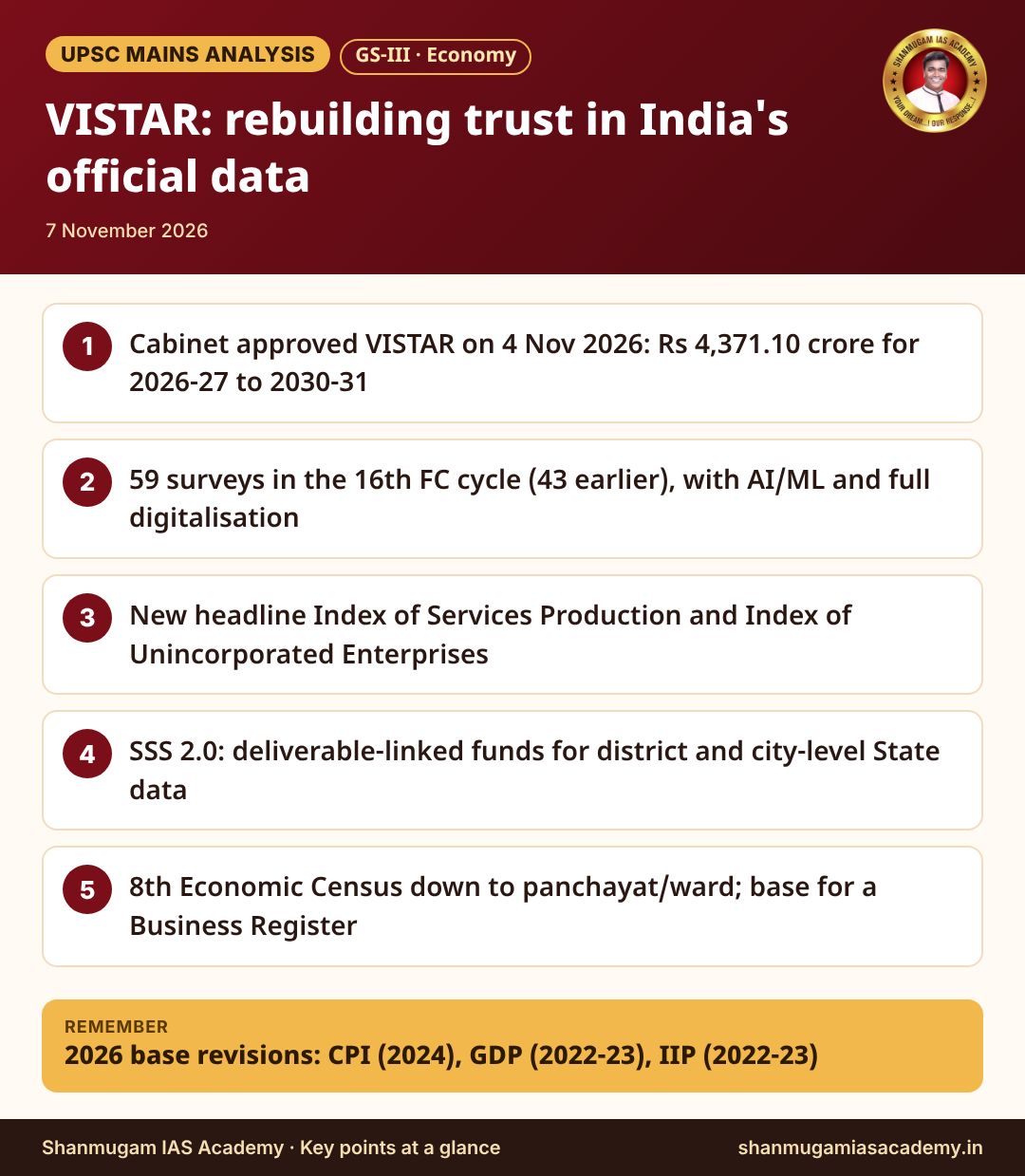
On 4 November 2026 the Union Cabinet chaired by Prime Minister Narendra Modi approved VISTAR – the Viksit Bharat Initiative for Statistical Transformation, Analytics & Research, a central sector scheme of the Ministry of Statistics and Programme Implementation (MoSPI) with an outlay of Rs 4,371.10 crore for 2026-27 to 2030-31, the period of the 16th Finance Commission. The government describes the aim as a "dynamic, real-time and future-ready" official statistical architecture in line with Viksit Bharat 2047. VISTAR comes after the Capacity Development umbrella scheme, which funded MoSPI's statistical work (with SSS and the Economic Census as sub-schemes); its continuation was approved in February 2022 up to 31 March 2026 with about Rs 3,179 crore. The scheme comes in the same year that India changed the base of all three of its headline indicators – CPI, GDP and IIP. The question for an economy that wants to be "developed" by 2047 is no longer only how fast it grows, but whether the numbers that measure that growth are trusted, timely and local enough to guide policy.
Background: how India's statistical system reached this point
- Constitution: "Census" is in the Union List (entry 69); "inquiries, surveys and statistics" for Union subjects are in the Union List (entry 94), and "inquiries and statistics" for State and Concurrent subjects are in the Concurrent List (entry 45). Statistics is therefore a shared responsibility of the Centre and the States.
- Institutions: the National Statistical Commission (NSC), a non-statutory body, came out of the Rangarajan Commission (2001). In May 2019 the Central Statistics Office (CSO) and the National Sample Survey Office (NSSO) were merged into the National Statistical Office (NSO). The Collection of Statistics Act, 2008 gives the legal power to collect data.
- Credibility episodes: in January 2019 two NSC members resigned over the delayed release of the PLFS 2017-18 jobs report; in November 2019 MoSPI decided not to release the Consumer Expenditure Survey 2017-18, citing data quality. Final all-India results of the 7th Economic Census (fieldwork from 2019) were not published – a delay a parliamentary panel flagged again in March 2025.
- External verdict: the IMF's 2025 Article IV review (November 2025) gave India's national accounts a "C" – the second-lowest grade – citing the old 2011-12 base year, use of wholesale prices as deflators and gaps between production and expenditure estimates. The overall data grade was "B".
- Recovery steps: monthly PLFS estimates from April 2025 (first bulletin 15 May 2025); a new CPI series (base 2024) from 12 February 2026; a new GDP series (base 2022-23) from 27 February 2026; a new IIP series (base 2022-23) from June 2026; and a trial Index of Services Production covering 19 sub-sectors from 14 July 2026.
What VISTAR contains
| Component | Main features | Why it matters |
|---|---|---|
| 1. Comprehensive statistical operations and strengthening of the ecosystem | 59 surveys in the 16th Finance Commission cycle (43 major surveys earlier); end-to-end digitalisation with AI/ML in processing, validation and analysis; a headline Index of Services Production and an Index of Unincorporated Sector Enterprises; data harmonisation (cataloguing, machine readability, interoperability, privacy by design); alternative data such as mobile phone, scanner and e-commerce data; internships and research proposals | Services are over half of gross value added, but India had no headline monthly services output index (only a trial sub-sectoral index from July 2026); the informal sector is the biggest blind spot of national accounts |
| 2. Support for Statistical Strengthening (SSS 2.0) | Funds to States/UTs through a redesigned, deliverable-linked framework; MoSPI technical support for district-level and million-plus city estimates in PLFS, HCES and ASUSE; help with State and District GDP and State IIP | Most schemes are delivered by States and districts, but most reliable data stop at the national or State level |
| 3. 8th Economic Census | With States/UTs; counts all non-farm establishments and workers down to gram panchayat and ward level; baseline for a National Statistical Business Register (SBR) | A sampling frame for enterprise surveys and a better estimate of the unorganised sector's share in GDP |
Why credible statistics matter for the economy
- Macro policy: the RBI's inflation target is set on CPI; fiscal targets are ratios to GDP. A wrong base or weight changes interest rates and deficit numbers.
- Targeting welfare: poverty lines, food-security coverage and scheme allocations rest on consumption and employment surveys.
- Fiscal federalism: Finance Commissions use State GSDP and population data; district GDP can guide local planning and the Aspirational Districts approach.
- Investor and market confidence: rating agencies, the IMF and bond investors price the risk of unreliable data.
- Democratic accountability: citizens and Parliament can judge policy only with numbers that are released on time and produced at arm's length.
Challenges
- Trust and independence: the NSC is still not a statutory body; past episodes of withheld reports affect public trust more than any single method change.
- Weak State capacity: many State statistical departments are short of staff and skills; earlier support did not ensure district-level data that could be used.
- Informal sector: a large share of output and jobs is outside registers; without a current Economic Census, survey frames become outdated.
- Population frame: the last completed Census was in 2011, so many surveys still project old population totals until Census 2027 data arrive.
- New data, new risks: mobile, scanner and e-commerce data bring privacy concerns under the Digital Personal Data Protection Act, 2023, and may miss offline and rural households.
- Comparability: frequent base changes break long time series; users need back series and clear documentation.
Way forward
- Give the NSC statutory status with control over the release calendar, so that no report can be held back without public reasons.
- Make SSS 2.0 truly outcome-based: release funds against usable district data, trained staff and published State GDP, not only spending.
- Complete the 8th Economic Census on time with State ownership of fieldwork, and keep the Business Register updated through GST, EPFO and company records.
- Publish back series for every new base, along with metadata and unit-level data, as the e-Sankhyiki portal and the Advance Release Calendar already begin to do.
- Use AI and big data to complement, not replace, surveys – with privacy by design and open methods that outsiders can test.
Mains practice question
Answer framework: Introduction – VISTAR (November 2026, Rs 4,371.10 crore, 2026-31) and the 2026 base revisions · Body – (a) why data credibility matters (CPI targeting, welfare targeting, Finance Commission, investors); (b) challenges: independence, State capacity, informal sector, old population frame, privacy; (c) what VISTAR addresses – 59 surveys, AI/ML, services index, SSS 2.0, 8th Economic Census · Way forward – statutory NSC, outcome-linked SSS, back series, open methods · Conclusion – faculty-view line below.
Prelims pointers
- VISTAR: Viksit Bharat Initiative for Statistical Transformation, Analytics & Research; central sector scheme of MoSPI; Rs 4,371.10 crore; 2026-27 to 2030-31; three components – statistical operations, SSS (2.0), Economic Census.
- New base years: CPI – 2024; GDP – 2022-23 (earlier 2011-12); IIP – 2022-23.
- NSO formed in 2019 by merging CSO and NSSO; NSC is non-statutory; Collection of Statistics Act, 2008.
- Constitution: Census – Union List entry 69; statistics – Union List entry 94 and Concurrent List entry 45.
- UN Fundamental Principles of Official Statistics: adopted by the UN Statistical Commission in 1994, endorsed by the UN General Assembly in 2014.
Read VISTAR through the idea of "statistical federalism": since statistics is in the Concurrent List and most schemes are delivered by States and districts, a modern data system must be built jointly – the Centre setting standards and funding, the States producing reliable local numbers and using them. SSS 2.0, district GDP and an Economic Census run with the States are the first real steps in that direction. The next big test is trust: a numbers system is only as strong as the belief that its releases will not be delayed or withheld.
- A shift to note: the debate has moved from "Is GDP over- or under-estimated?" to "Are our data timely, granular and independent?" Expect questions on data governance, informal-sector measurement and evidence-based policy.
- What to watch next: (1) launch of the headline Index of Services Production, (2) the start and timeline of the 8th Economic Census, (3) whether the IMF upgrades India's national accounts grade after the new series, (4) Census 2027 (reference date 1 March 2027) and its use as a fresh frame for all surveys.
- Ready-made conclusion line: "A Viksit Bharat needs not just faster growth but numbers that every citizen, State and investor can trust."
Sources: PIB and PMO India/Cabinet – approval of VISTAR (4 November 2026); MoSPI – new CPI, GDP and IIP series (2026), PLFS monthly bulletin (April 2025), trial Index of Services Production (14 July 2026); PIB – Capacity Development scheme extension (February 2022); IMF – 2025 Article IV report on India; Constitution of India, Seventh Schedule; Business Standard, Scroll and other news reports for the latest facts. Original analysis by Shanmugam IAS Academy.
Link to this page from your website / blog (HTML code)
SI/POLICE Achievers
-

VIVEK
SI/POLICE SI/POLICE
வாஞ்சிநாதன் | Vanchinathan | Maniyachi Incident 1911 | TNPSC Group 1, 2, 2A, 4 | NITHISH KUMAR
TNPSC குரூப் 1, 2/2A, 4 – நேரடி வகுப்புகள் · கோவை & மதுரை
2006 முதல் சண்முகம் IAS அகாடமி · Classroom & online coaching in Coimbatore and Madurai
