

Mains Analysis: Stubble burning – why fines, FIRs and red entries have not changed farmer behaviour, and what would make not burning the easier choice
7 November 2026 · English Environment & Ecology
⬇ Download this analysis as free PDF
இந்தப் பகுப்பாய்வைத் தமிழில் படிக்க →
Topics: Environment · GS-III · UPSC Mains Analysis
UPSC Mains Analysis – current affairs of 7 November 2026 (Shanmugam IAS Academy)
Context
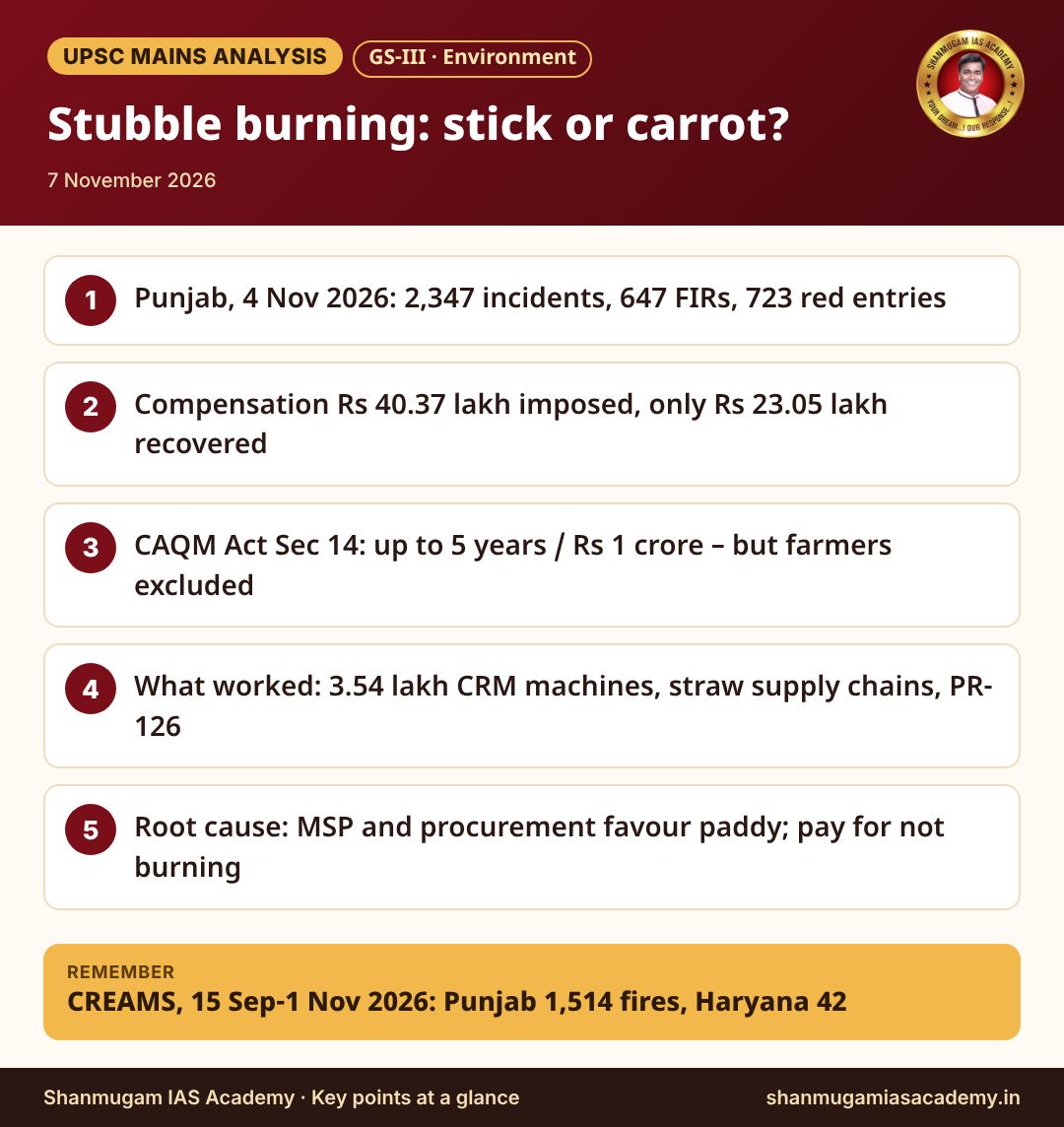
By 4 November 2026, the Punjab Pollution Control Board (PPCB) had logged 2,347 stubble-burning incidents this season. Against these, the State had registered 647 FIRs, made 723 "red entries" in land records and imposed environmental compensation of Rs 40.37 lakh – of which only Rs 23.05 lakh had been recovered. About 85 per cent of Punjab's 32.87 lakh hectares of paddy had been harvested by then, so the peak burning weeks were still running.
Satellite data tell a second story. The CREAMS laboratory of ICAR-IARI and the Union Environment Ministry both put fire events between 15 September and 1 November 2026 at 1,514 in Punjab and 42 in Haryana, and the Ministry's data show both States below the same window of 2025. The Ministry told the Lok Sabha in March 2026 that the 2025 season saw a fall of more than 90 per cent in the two States compared with 2022. Fires have fallen – but not mainly because of punishment. The question for an aspirant: what changes a farmer's choice, the fear of a fine or a cheaper way to clear the field?
Background: the legal and scheme framework
| Instrument | What it does |
|---|---|
| CAQM Act, 2021 | Sets up the Commission for Air Quality Management in NCR and Adjoining Areas, which issues binding directions to States, including on farm fires |
| Section 14(1) | Breach of the Act, rules or Commission directions – imprisonment up to 5 years or fine up to Rs 1 crore, or both. A proviso keeps farmers out of this section for stubble burning |
| Environmental compensation | Collected from farmers instead of criminal penalty; rates doubled on 6 November 2024: Rs 5,000 (under 2 acres), Rs 10,000 (2–5 acres), Rs 30,000 (above 5 acres) per incident |
| State measures (Punjab) | FIRs under Section 223 of the Bharatiya Nyaya Sanhita (disobeying an order of a public servant); "red entries" in land records that can bar sale or mortgage of land and farm loans |
| CRM scheme (since 2018-19) | In-situ machines – Super SMS on combines, Happy Seeder, mulchers, zero-till drills; subsidy 50% to individual farmers, 80% of project cost for custom hiring centres (CHCs) |
| Ex-situ guidelines (July 2023) | Paddy-straw supply-chain projects: 65% of project cost from Centre and State, 25% from the industry that uses the straw, 10% from farmers or aggregators |
Core analysis: why punishment has not changed behaviour
| Factor | How it weakens deterrence |
|---|---|
| Small, uncertain cost | A compensation of Rs 5,000–30,000 per incident, with only a little over half of the amount imposed actually recovered, is weighed against the time and money of clearing straw before wheat sowing |
| The real culprit is time | Wheat must be sown soon after the paddy harvest. Machines, labour and fuel are all needed in the same few weeks, so the match is the fastest tool |
| Detection gaps | On 12 November 2025 the amicus, citing a NASA scientist, told the Supreme Court that farmers may be timing fires to avoid satellite passes – enforcement pushes fires out of sight, not out of fields |
| Political cost | Mass prosecution of farmers is resisted by States; in September 2025 Punjab argued in court that arresting small farmers would hurt their families |
| Wrong target | Section 14 excludes farmers, so the Supreme Court has pushed its use against officials who fail to enforce; the cause sits in the cropping system, not in individual intent |
The core point is economic. Punishment works when the expected penalty exceeds the gain from breaking the rule. Here the gain – a field cleared in hours, wheat sown on time – is large and certain; the penalty is small, delayed and uncertain. Raising fines only shifts this balance a little, and raises the political cost faster than compliance.
What has actually worked
- Machines at scale: under the CRM scheme the Centre gave Rs 4,266.47 crore from 2018-19 to Punjab, Haryana, Uttar Pradesh, Madhya Pradesh and ICAR, and more than 3.54 lakh machines and 43,500 CHCs are in place. For 2026-27 it allotted Rs 544.15 crore, with targets of 46,000 more machines, 910 CHCs and 141 supply-chain projects; about 2.76 crore tonnes of paddy straw were expected from the 2026 harvest.
- Ex-situ demand: straw has value only if someone buys it. The 2023 guidelines pay for balers, rakers, loaders and other supply-chain machinery so that power, heat, compressed biogas and bio-ethanol plants get steady supply.
- Bio-decomposer: the Pusa decomposer of ICAR-IARI, a consortium of micro-organisms, is sprayed on straw, which breaks down in about 20–25 days – useful, but often too slow when the sowing window is short.
- Short-duration varieties: PAU's PR-126 matures about 93 days after transplanting, three to four weeks earlier than long-duration types such as Pusa-44 (about 160 days in all). A longer gap before wheat means less pressure to burn.
The deeper problem: price signals favour paddy
For 2026-27 the MSP for common paddy rose by Rs 72 to Rs 2,441 a quintal, while maize rose by only Rs 10 to Rs 2,410. In Punjab and Haryana paddy is bought by government agencies in bulk; procurement of maize, pulses and oilseeds is limited and uncertain by comparison. A farmer who shifts out of paddy gives up both price and certainty. As long as paddy is the safest crop, the straw – and the temptation to burn it – will return every October.
Court directions
- 16 October 2024 (Justice A.S. Oka's Bench): called State responses "absolute defiance" of CAQM directions, criticised "nominal fines" and directed the CAQM to act under Section 14 against State officers.
- 17 September 2025 (CJI B.R. Gavai's Bench): asked the Centre to consider penal provisions for farmers, saying jail for a few could send a message, while also noting that straw can be used as biofuel.
- 12 November 2025: Punjab and Haryana told to report the steps taken to curb stubble burning.
The courts have pressed hard, and rightly so: clean air is part of the right to life. But orders that ask for more punishment, without fixing the price and time constraints, treat the symptom.
Way forward
- Pay for not burning: a per-acre payment for verified residue management, linked to satellite and field checks, so that compliance earns money instead of only avoiding a fine.
- Crop-neutral support: extend assured procurement or price-deficiency payments to maize, pulses and oilseeds in Punjab and Haryana, so that leaving paddy does not mean leaving certainty.
- Fix the calendar: spread short-duration varieties and direct seeded rice; give machine-hiring priority to the latest-harvested fields.
- Build the straw market: long-term purchase contracts from power, CBG and pellet plants; aggregation through FPOs and panchayats.
- Targeted, credible enforcement: keep penalties for repeat and large burners, recover them fully, and hold officials to account under Section 14 – a smaller, surer stick.
- Better data: geostationary and multi-pass satellite monitoring to end "timing" of fires, with one public dashboard of fires, inspections and payments.
Mains practice question
Answer framework: Introduction – Punjab 4 November 2026: 2,347 incidents, 647 FIRs, 723 red entries; CREAMS: 1,514 (Punjab) and 42 (Haryana) fires, 15 Sept–1 Nov · Body – (a) framework: CAQM Act Section 14 and the farmer proviso, environmental compensation slabs, BNS Section 223, red entries; (b) why deterrence fails: low and uncertain penalty, short sowing window, detection gaps, political cost; (c) what worked: CRM machines and CHCs, ex-situ supply chains, bio-decomposer, PR-126; (d) the root cause: MSP and procurement favour paddy · Way forward – pay for not burning, crop-neutral support, straw market, credible enforcement, data · Conclusion – faculty-view line.
Prelims pointers
- CAQM Act, 2021: Section 14(1) – up to 5 years or up to Rs 1 crore fine, or both; farmers excluded for stubble burning.
- Environmental compensation for stubble burning (amended 6 November 2024): Rs 5,000 / Rs 10,000 / Rs 30,000 by landholding.
- CREAMS: Consortium for Research on Agroecosystem Monitoring and Modelling from Space, ICAR-IARI, New Delhi.
- CRM scheme: launched 2018-19; 50% subsidy to individuals, 80% for CHCs; Rs 544.15 crore for 2026-27.
- Pusa decomposer: ICAR-IARI microbial consortium; straw decomposes in about 20–25 days.
- PR-126: short-duration paddy of Punjab Agricultural University; about 93 days after transplanting.
- MSP 2026-27: common paddy Rs 2,441 per quintal; maize Rs 2,410.
The concept to carry into the exam hall is "incentive compatibility" – a policy is incentive compatible when the choice that is best for the individual is also the choice the rule wants. Stubble policy fails this test: for a farmer racing to sow wheat, burning is cheap, fast and rarely punished, while compliance costs time and money. Fines try to raise the cost of the wrong choice; incentive compatibility lowers the cost of the right one – through machines, buyers for straw, shorter-duration seed and crop-neutral price support.
- A shift to note: the debate is moving from "how to punish farmers" to "how to pay for clean air". Write: "Stubble burning is an agricultural-policy failure that shows up as an air-pollution problem."
- What to watch next: (1) the final 2026 season fire count from CREAMS once the Kharif harvest ends, (2) further Supreme Court hearings in M.C. Mehta on penal action and State reports, (3) whether the 141 supply-chain projects planned for 2026-27 create a steady market for straw, (4) whether MSP and procurement policy is used to support maize, pulses and oilseeds in Punjab and Haryana.
- Ready-made conclusion line: "Farmers will stop burning straw not when burning is punished, but when not burning pays."
Sources: Punjab Pollution Control Board data as reported by ANI and IANS (4–5 November 2026); ICAR-IARI CREAMS data as reported by PTI (The Tribune, 2 November 2026); Union Environment Ministry data as reported by ThePrint (3 November 2026); Lok Sabha reply of March 2026 as reported by IANS and Awaz The Voice; CAQM Act, 2021, Section 14 (India Kanoon); LiveLaw and Business Standard on the November 2024 amendment of the environmental compensation rules; Scroll and IANS on FIRs under BNS Section 223; Business Standard and The Morning Standard on red entries; PIB (11 September 2018) and the CRM scheme guidelines (agrimachinery.nic.in); IANS and Rural Voice on the 2026-27 CRM allocation (17 June 2026); Business Standard and Vikaspedia on the 2023 ex-situ guidelines; ANI and ThePrint on the Pusa decomposer; The Tribune and ThePrint on PR-126 and Pusa-44; PIB-based reports (narendramodi.in, Hindusthan Samachar) on MSP 2026-27; Business Standard, All India Radio News and The Tribune on the October 2024 hearing; LiveLaw and Deccan Herald on the September 2025 hearing; LiveLaw and The Tribune on the November 2025 hearing. Original analysis by Shanmugam IAS Academy.
Link to this page from your website / blog (HTML code)
BANK Achievers
-

S. SRIDHARAN
BANK BANK
வாஞ்சிநாதன் | Vanchinathan | Maniyachi Incident 1911 | TNPSC Group 1, 2, 2A, 4 | NITHISH KUMAR
TNPSC குரூப் 1, 2/2A, 4 – நேரடி வகுப்புகள் · கோவை & மதுரை
2006 முதல் சண்முகம் IAS அகாடமி · Classroom & online coaching in Coimbatore and Madurai
