

Mains Analysis: After Cyclones Arnab and Murasu – who pays to rebuild
9 November 2026 · English
⬇ Download this analysis as free PDF
இந்தப் பகுப்பாய்வைத் தமிழில் படிக்க →
Topics: Disaster Management · GS-III · UPSC Mains Analysis
UPSC Mains Analysis – current affairs of 9 November 2026 (Shanmugam IAS Academy)
Context
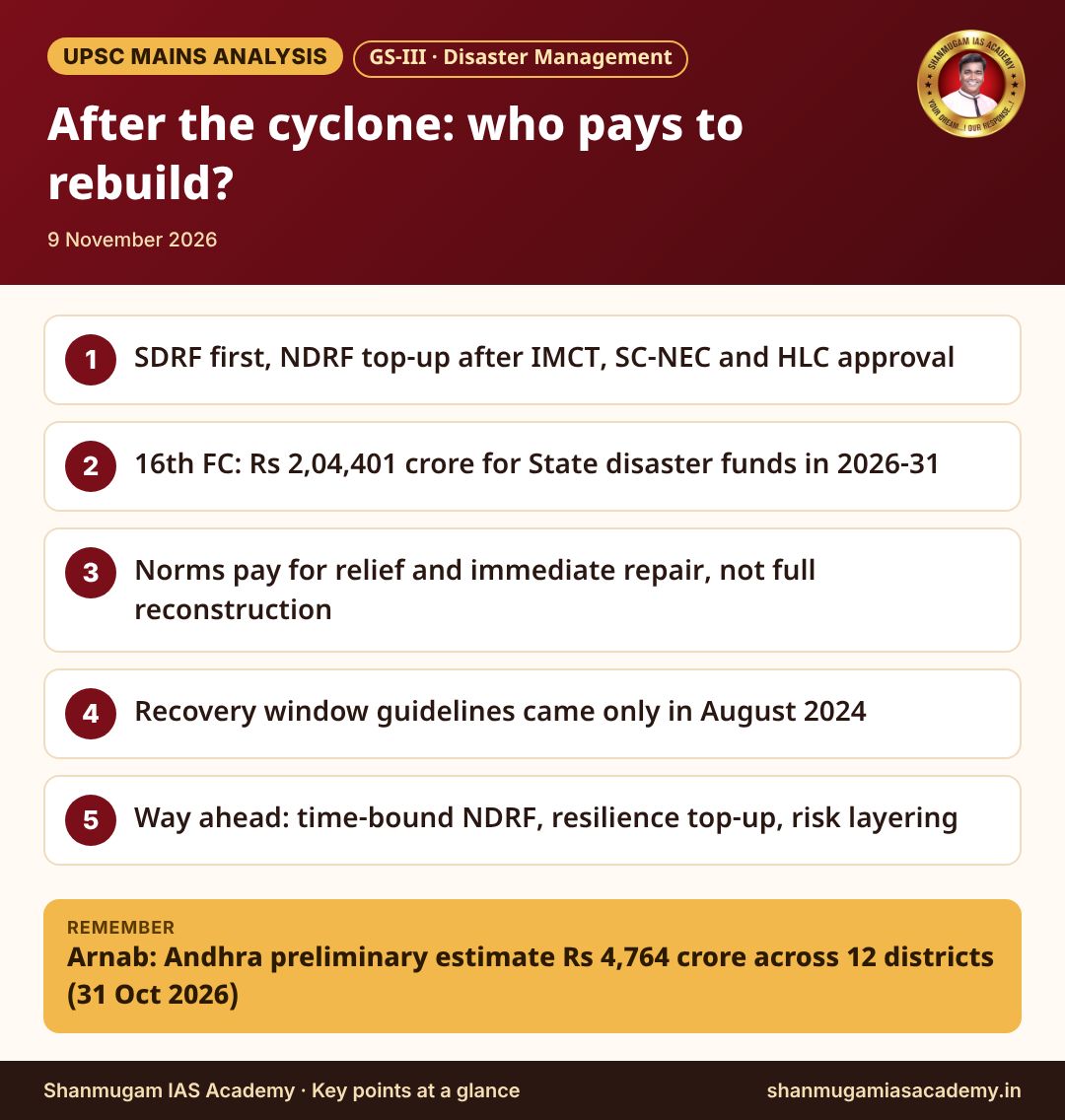
Within about a week, two cyclones from the Bay of Bengal struck the Andhra Pradesh coast. Cyclone Arnab, a very severe cyclonic storm, crossed the coast near Narsapur–Yanam early on 28 October 2026. Cyclone Murasu crossed the south Andhra coast near Ongole (Prakasam district) early on 3 November 2026 as a severe cyclonic storm, and brought heavy-rain alerts for parts of Tamil Nadu. Andhra Pradesh put its preliminary Arnab losses at about Rs 4,600 crore on 29–30 October and at Rs 4,764 crore across 12 districts on 31 October, when a seven-member Inter-Ministerial Central Team (IMCT), led by a Joint Secretary of the Union Home Ministry, began its tour. These are preliminary figures and may change. The State reported seven deaths from Arnab. After Murasu, the Union Home Minister assured central assistance.
Saving lives is no longer India's main cyclone problem. The harder question now is money: who pays to rebuild roads, power lines, houses, schools and embankments, how fast, and to what standard? This article looks at that question.
Background: how India finances disasters
| Layer | What it is |
|---|---|
| Law | Disaster Management Act, 2005: National Disaster Response Fund (Section 46), National Disaster Mitigation Fund (Section 47), State Disaster Response Fund and State Disaster Mitigation Fund (Section 48). |
| Size | Each Finance Commission recommends how much goes into these funds for five years and how it is shared among States. |
| SDRF | First line of money. Centre and State contribute; the State Executive Committee spends it on notified disasters, item by item, at rates fixed by the Union Home Ministry (MHA). |
| NDRF | Top-up for a disaster of "severe nature" when the SDRF is not enough. Release follows a central assessment and approval, after adjusting 50% of the State's SDRF balance. |
| SDMF / NDMF | Mitigation money – spent before the next disaster to reduce risk, not after it. |
Core analysis: the 15th and 16th Finance Commissions
| Item | 15th FC (2021-22 to 2025-26) | 16th FC (2026-27 to 2030-31) |
|---|---|---|
| State funds (SDRF + SDMF) | Rs 1,60,153 crore | Rs 2,04,401 crore, of which the Centre's share is about Rs 1,55,916 crore |
| National funds (NDRF + NDMF) | Rs 68,463 crore | Rs 79,406 crore |
| Response : mitigation | 80 : 20 | 80 : 20 retained |
| Windows inside the response fund (as shares of the whole fund) | Response and relief 40%, recovery and reconstruction 30%, preparedness and capacity building 10% | Preparedness and capacity building moved from the response funds to the mitigation funds |
| Recovery and reconstruction money | 30% of the totals: about Rs 48,046 crore (SDRF window) and Rs 20,539 crore (NDRF window) | – |
| Cost sharing (Centre : State) | 75 : 25; 90 : 10 for north-eastern and Himalayan States | 75 : 25; 90 : 10 for north-eastern and Himalayan States |
| How State funds are shared | Past expenditure, area and population, with a disaster risk index | Past expenditure plus a wider disaster risk index (hazard × exposure × vulnerability, ten hazards) |
The 15th FC made the big change: it moved India from disaster relief to disaster risk management. It put a fifth of the money into mitigation and set aside 30% for recovery and reconstruction. The 16th FC (report submitted on 17 November 2025, tabled on 1 February 2026) increases the money and keeps the 80:20 split. It widens the disaster risk index used to share the money to ten hazards, and moves preparedness and capacity building into the mitigation funds.
The norms problem: relief, not reconstruction
- Relief, not compensation: SDRF/NDRF help is meant as immediate relief, not as payment for the full loss. Any spending above the norms comes from the State's own budget.
- Small unit rates: under the MHA norms for 2022-23 to 2025-26, ex gratia is Rs 4 lakh per death and a fully damaged house gets Rs 1.2 lakh in the plains – less than the cost of building a cyclone-resistant house.
- Only "immediate" repairs: roads, power and water works are funded only for repair "of immediate nature", such as temporary road repair or restoring electricity supply. Long-term reconstruction is outside SDRF/NDRF norms.
- Why demands and releases differ: a State's memorandum counts the full cost of permanent restoration. The Centre counts only what the norms allow, minus half the SDRF balance. Part of the gap is delay, but part is built into the system.
The recovery and reconstruction (R&R) window was meant to fill this gap. But MHA issued its guidelines only on 14 August 2024, more than three years into the 15th FC period. Under these guidelines, the State prepares a Post-Disaster Needs Assessment (PDNA), and for severe disasters it sends the PDNA to MHA for NDRF help. The State also pays a graded share, up to 25% for large projects. Delays in guidelines slowed the use of the new windows.
The IMCT route and delays
| Step | What happens |
|---|---|
| 1. Memorandum | The State sends sector-wise damage details and asks for NDRF help. |
| 2. IMCT | MHA sends a central team of several ministries. In practice it is now formed soon after a severe disaster, often before the memorandum arrives (for Arnab, within three days of landfall). |
| 3. SC-NEC | A sub-committee of the National Executive Committee, chaired by the Union Home Secretary, studies the IMCT report and recommends an amount. |
| 4. HLC | A High Level Committee chaired by the Union Home Minister approves; the Finance Ministry releases. |
- Michaung and the south Tamil Nadu floods (December 2023): the State asked for about Rs 37,907 crore for the two disasters. With no NDRF decision months later, the State went to the Supreme Court in early April 2024. The Centre announced about Rs 276 crore at the end of April 2024. Karnataka also went to court over drought relief in the same months.
- Fengal (November–December 2024): Tamil Nadu asked for Rs 6,675 crore for temporary and permanent restoration. The Rs 944.80 crore approved by MHA was both instalments of the State's regular SDRF central share – not NDRF help. NDRF help was to follow the IMCT report.
- The federal point: Finance Commission transfers are formula-based and predictable. NDRF top-ups depend on central committees, with no fixed time limit. So States see delay as unfair, and they turn to the courts instead of working it out with the Centre.
Why it matters – "build back better"
- Repeated hits: Arnab and Murasu struck the same coast within a week. If roads, lines and houses are rebuilt to the old design, the next cyclone damages them again, and the public money is wasted.
- Sendai Priority 4: the Sendai Framework (2015–2030) asks countries to "Build Back Better" in recovery, rehabilitation and reconstruction. Relief-rate norms cannot pay for stronger standards.
- State finances: large losses push States to borrow or delay capital works, so a cyclone becomes a fiscal shock as well.
- Trust in federalism: clear and timely support is part of cooperative federalism. Long delays push disputes into the courts.
Challenges
- Late guidelines and slow use of the mitigation and reconstruction windows.
- Capacity: many SDMAs and districts lack trained teams to prepare a good PDNA and detailed project reports.
- Discretion and opacity: no public timeline from memorandum to IMCT report to HLC decision.
- Uninsured losses: crops, boats, small shops and houses are mostly uninsured, so public funds carry most of the loss.
- Equity: the risk-index formula may still under-reward States with high exposure but low past spending.
Way forward
- Time-bound NDRF: notify fixed timelines for the IMCT report, SC-NEC and HLC, and publish a dashboard of every memorandum and its status.
- Raise unit rates in the 2026–31 norms and add a "resilience top-up" so that rebuilt houses, poles and culverts meet cyclone-safe standards.
- Make the R&R window work: standard PDNA templates, PDNA cells in SDMAs, pre-approved resilient designs, and staged releases linked to progress.
- Risk layering: SDRF for frequent small events, NDRF for big ones, and insurance – including parametric cover – or catastrophe bonds for rare extreme events.
- Spend mitigation money before the storm: underground cabling in coastal towns, cyclone-resistant housing, mangrove shelterbelts and drainage, funded from SDMF/NDMF.
- Tamil Nadu angle: after Michaung and Fengal, the State can build a ready pipeline of resilient-reconstruction projects. Then its PDNA and NDRF request can go to MHA as soon as a disaster is notified.
Mains practice question
Answer framework: Introduction – Arnab (28 October 2026) and Murasu (3 November 2026); Andhra estimate Rs 4,764 crore; IMCT visit · Body – (a) architecture: DM Act Sections 46–48, 15th/16th FC funds, 80:20, R&R window; (b) gaps: relief-rate norms, immediate-repair rule, 50% SDRF adjustment, late R&R guidelines, discretionary NDRF timelines, TN examples (Michaung Rs 37,907 crore sought vs about Rs 276 crore; Fengal) · Way forward – timelines, resilience top-up, PDNA capacity, risk layering, mitigation first · Conclusion – faculty-view line.
Prelims pointers
- DM Act, 2005: NDRF – Section 46; NDMF – Section 47; SDRF and SDMF – Section 48.
- SDRF replaced the Calamity Relief Fund from 2010-11; NDRF replaced the National Calamity Contingency Fund.
- 16th Finance Commission (Chairman: Arvind Panagariya): award period 2026-27 to 2030-31; report tabled on 1 February 2026.
- MHA guidelines on the Recovery and Reconstruction funding window under NDRF and SDRF: 14 August 2024.
- SC-NEC is chaired by the Union Home Secretary; the HLC for NDRF approvals is chaired by the Union Home Minister.
- Sendai Framework Priority 4: enhancing preparedness for effective response and to "Build Back Better" in recovery.
The concept to use in the exam is "risk layering". Match each size of disaster loss to the right source of money: the State budget and SDRF for frequent, small losses; NDRF and central support for large ones; and insurance, parametric cover or catastrophe bonds for rare, extreme events. India now has the first two layers but almost no third layer. That is why every big cyclone becomes a Centre–State quarrel over money. Risk layering makes the debate about planned financing, not about blame.
- What to watch next: (1) the IMCT report and the HLC decision on NDRF help to Andhra Pradesh for Arnab and Murasu; (2) MHA's items and norms for 2026–31, and whether the recovery and reconstruction window continues in the same form; (3) memoranda, if any, from Tamil Nadu after this north-east monsoon season; (4) any State or national move towards parametric disaster insurance.
- Use it in: GS-III disaster management, GS-II fiscal federalism and Finance Commission answers, and Essay topics on resilience.
- Ready-made conclusion line: "India has learnt to fund relief; through risk layering and timely, norm-based reconstruction money, it must now learn to fund resilience."
Sources: IMD national bulletins (Murasu, 1–3 November 2026); All India Radio News, ThePrint/PTI, The News Minute, The Week/PTI and Daily Pioneer on Arnab losses and the central team; Al Jazeera, National Herald and The South First on Murasu; PRS Legislative Research, Down To Earth, RGICS and The Policy Edge on the 16th Finance Commission; MHA guidelines on the Recovery and Reconstruction funding window (14 August 2024, via HPSDMA); The Sentinel on 15th FC windows; MHA items and norms of SDRF/NDRF assistance (via Assam, Tripura, Goa and HP State portals); Arthapedia (Indian Economic Service) and Factly on NDRF procedure; The South First, DT Next and Deccan Chronicle on Michaung; DT Next, News Arena and All India Radio News on Fengal. Original analysis by Shanmugam IAS Academy.
Link to this page from your website / blog (HTML code)
BANK Achievers
-

NANDA KUMAR
BANK BANK
Indian Polity in Tamil | 100 அரசியலமைப்பு வினா விடை | TNPSC Group 4 Preparation 2026
TNPSC குரூப் 1, 2/2A, 4 – நேரடி வகுப்புகள் · கோவை & மதுரை
2006 முதல் சண்முகம் IAS அகாடமி · Classroom & online coaching in Coimbatore and Madurai
