

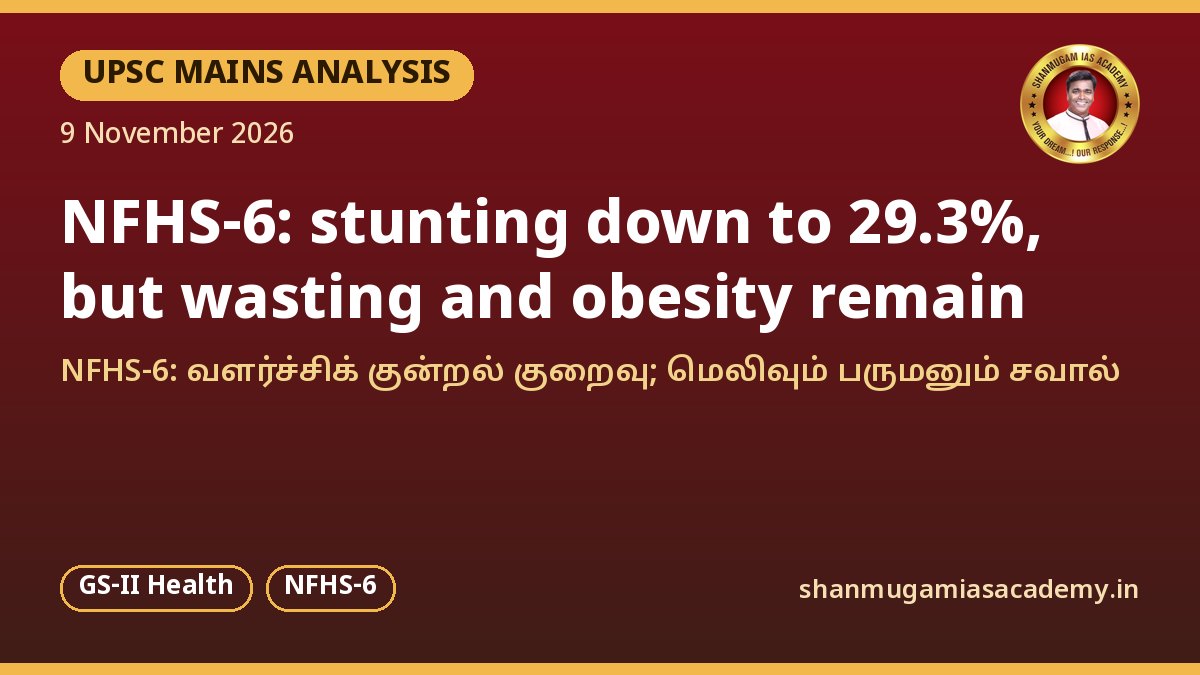
Mains Analysis: NFHS-6 – stunting falls to 29.3%, fertility at 2.0
9 November 2026 · English Health
⬇ Download this analysis as free PDF
இந்தப் பகுப்பாய்வைத் தமிழில் படிக்க →
Topics: Health · GS-II · UPSC Mains Analysis
UPSC Mains Analysis – current affairs of 9 November 2026 (Shanmugam IAS Academy)
Context
On 29 May 2026, the Union Ministry of Health and Family Welfare (MoHFW) released the India and State/UT fact sheets of the sixth National Family Health Survey (NFHS-6), 2023–24. The International Institute for Population Sciences (IIPS), Mumbai, is the nodal agency. The survey covered 6,79,238 households in 715 districts. It is India's main source of district-level data on nutrition, fertility, maternal and child care, and women's empowerment, and the comparison point is NFHS-5 (2019–21).
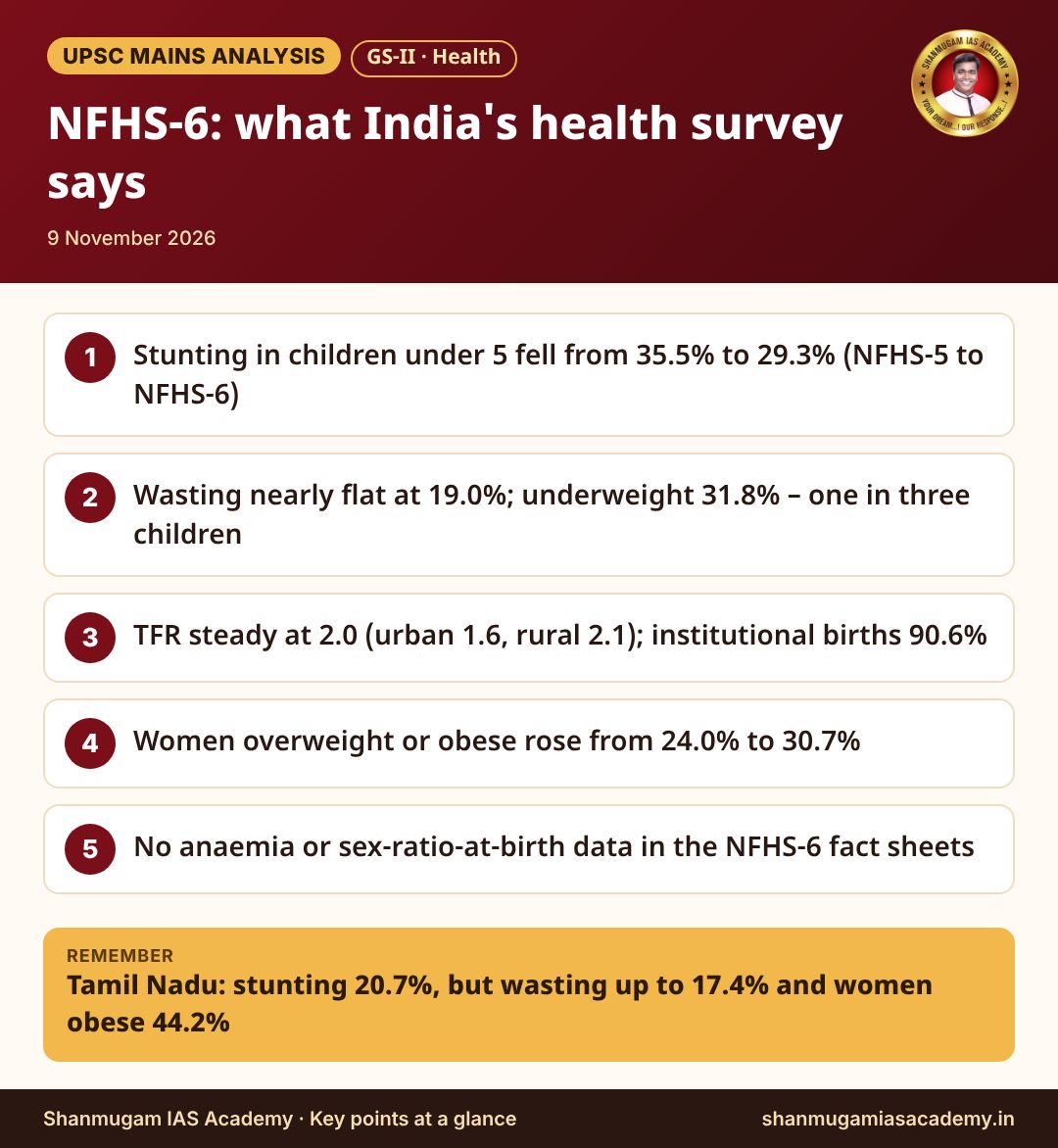
The headline is mixed. Child stunting fell from 35.5% to 29.3%, the total fertility rate (TFR) stayed at 2.0, and 90.6% of births now take place in health facilities. But wasting and underweight barely moved, adult overweight and high blood sugar rose sharply, and the fact sheets carry 101 key indicators against 131 in NFHS-5 – anaemia and sex ratio at birth are not among them. For an aspirant the question is: what does India's latest health survey say, what does it not say, and what should policy do next?
Background: what NFHS is
- A large, nationally representative household survey run by MoHFW through IIPS; NFHS-5 covered 2019–21 and NFHS-6 covers 2023–24.
- It measures children's height and weight (for stunting, wasting and underweight), and adults' weight, blood sugar and blood pressure, besides asking about births, contraception, antenatal care, vaccination and women's autonomy.
- The fact sheets give provisional results; a detailed National Report normally follows.
Core analysis: the national picture (NFHS-5 → NFHS-6)
| Indicator | NFHS-5 (2019–21) | NFHS-6 (2023–24) | Reading |
|---|---|---|---|
| Children under 5 stunted (height-for-age) | 35.5% | 29.3% | Fastest gain – chronic undernutrition is falling |
| Children under 5 wasted (weight-for-height) | 19.3% | 19.0% | Almost no change – acute undernutrition persists |
| Children under 5 severely wasted | 7.7% | 5.2% | Real fall in the most dangerous form |
| Children under 5 underweight | 32.1% | 31.8% | Nearly flat; one in three children |
| Exclusive breastfeeding (under 6 months) | 63.7% | 55.8% | A worrying decline |
| Total fertility rate | 2.0 | 2.0 (urban 1.6, rural 2.1) | Below replacement level (2.1) nationally |
| Institutional births | 88.6% | 90.6% | Near-universal access in many States |
| Births by caesarean section | 21.5% | 27.2% | Rising; far more common in private facilities |
| Mothers who took IFA for 180+ days in pregnancy | 26.0% | 37.8% | Better, but still a minority |
| Women overweight or obese (BMI 25+) | 24.0% | 30.7% | The other face of malnutrition |
| Women with high blood sugar or on medicine | 13.5% | 17.8% | Rising NCD burden |
| Women 20–24 married before 18 | 23.3% | 20.1% | Slow fall; one in five |
| Anaemia (children 6–59 months / women 15–49 / pregnant women) | 67.1% / 57.0% / 52.2% | Not measured | Haemoglobin test dropped |
| Sex ratio at birth (girls per 1,000 boys) | 929 | Not in fact sheet | Left to other data systems |
Why it matters
- Stunting vs wasting: stunting reflects long-term deprivation – poor maternal nutrition, infections, sanitation – and its fall suggests that broad gains in income, toilets, schooling and maternal care are working. Wasting reflects recent, acute shortfalls and illness; its stagnation at 19% means India still needs a strong system to find and treat thin children quickly.
- Fertility: a national TFR of 2.0 confirms that the population-control frame is outdated. The policy questions are now quality of family-planning choice, the urban–rural gap (1.6 vs 2.1) and, in southern States, an ageing population.
- Women's health: more women give birth in facilities and take IFA tablets, and more use a bank account (78.6% → 89.0%) or the internet (33.3% → 64.3%). Yet one in five young women was married as a child, and nearly one in three women is overweight or obese.
- Data as public good: without anaemia and sex-ratio-at-birth figures, the survey cannot show whether Anaemia Mukt Bharat or the campaign against sex-selective practices worked between the two rounds.
Tamil Nadu vs India
| Indicator | Tamil Nadu NFHS-5 | Tamil Nadu NFHS-6 | India NFHS-6 |
|---|---|---|---|
| Stunting | 25.0% | 20.7% | 29.3% |
| Wasting | 14.6% | 17.4% (rise) | 19.0% |
| Underweight | 22.0% | 23.2% (rise) | 31.8% |
| Total fertility rate | 1.8 | 1.7 | 2.0 |
| Institutional births | 99.6% | 99.7% | 90.6% |
| ANC check-up in first trimester | 77.4% | 71.2% (fall) | 76.2% |
| Women overweight or obese | about 40% | 44.2% | 30.7% |
| Births by caesarean section | 44.9% | 46.9% | 27.2% |
| Sex ratio at birth | 878 | not in fact sheet | not in fact sheet |
Tamil Nadu is ahead on stunting, fertility and facility births, but three warning signs stand out: wasting and underweight have risen, first-trimester antenatal check-ups have fallen, and 44.2% of women are overweight or obese, with 25.2% of women and 26.7% of men having high blood sugar. NFHS-5 had also shown a low sex ratio at birth of 878 for the State; NFHS-6 gives no update, so the State must rely on its own birth-registration data. Low fertility has entered the State's political debate too: on 1 June 2026, VCK MP D. Ravikumar wrote to the State Health Minister seeking steps to address the decline.
What the State has done
- POSHAN Abhiyaan: launched by the Prime Minister on 8 March 2018 at Jhunjhunu, Rajasthan; aims to reduce stunting, underweight and anaemia among young children, women and adolescent girls through convergence of ministries and community events.
- Mission Saksham Anganwadi and Poshan 2.0: formed under Budget 2021–22 by merging Anganwadi Services, POSHAN Abhiyaan and the Scheme for Adolescent Girls; covers supplementary nutrition, early childhood care and education, and upgrading Anganwadi centres (Saksham Anganwadis). The Poshan Tracker app records growth monitoring of children in real time.
- Anaemia Mukt Bharat (2018): a "6×6×6" strategy – six target groups, six interventions, six institutional mechanisms – with IFA supplementation, deworming, testing and treatment, and fortified foods in government programmes.
- Why anaemia is missing: haemoglobin testing was dropped from NFHS-6 over doubts about finger-prick (capillary) samples. MoHFW will use the ICMR Diet and Biomarkers Survey, which uses venous blood. In a Rajya Sabha reply reported on 4 August 2026, the Minister of State said the indicators were finalised by a Technical Advisory Committee (with MoSPI, NITI Aayog and the Registrar General) for data harmonisation.
Challenges
- Wasting gap: programmes built around food rations reach children, but finding and treating acutely thin children needs regular weighing, referral and follow-up – the weakest link in many Anganwadis.
- Feeding practices: exclusive breastfeeding fell to 55.8%; working mothers, early formula use and weak counselling all matter.
- Nutrition transition: undernutrition among children now sits beside overweight and diabetes among adults, especially in richer States. Schemes designed only for calories can worsen diets high in sugar, salt and fat.
- Quality of maternal care: high caesarean rates, especially in private hospitals, and falling early ANC in Tamil Nadu show that access alone is not quality.
- Broken time series: dropping anaemia, sex ratio at birth and other indicators makes NFHS-5 to NFHS-6 comparison impossible on issues where the country most needs evidence.
Way forward
- Make wasting the next target: community-based management of acute malnutrition in every Anganwadi, with Poshan Tracker data used for monthly follow-up, not just reporting.
- Protect the first 1,000 days: early pregnancy registration, IFA for 180 days, breastfeeding counselling and support for working mothers (creches, maternity benefits).
- Diet quality, not only calories: millets, eggs, pulses and vegetables in supplementary nutrition and PM POSHAN; front-of-pack labelling and limits on marketing of unhealthy foods to children.
- Audit caesarean births: publish facility-wise rates and review clinical need, starting with private hospitals.
- Restore data continuity: release the NFHS-6 National Report and the ICMR anaemia estimates with a clear note on comparability; track sex ratio at birth through the Civil Registration System and SRS in every district.
- State-specific plans: Tamil Nadu needs a wasting-and-obesity plan, while high-burden States still need a stunting plan.
Mains practice question
Answer framework: Introduction – NFHS-6 (2023–24, released 29 May 2026): stunting 35.5% → 29.3% · Body – (a) why stunting fell (income, sanitation, maternal care, schooling); (b) why wasting (19.0%) and underweight (31.8%) stalled; (c) the other side – women overweight 30.7%, high blood sugar 17.8%; Tamil Nadu example (stunting 20.7% but wasting 17.4%, women overweight 44.2%); (d) schemes – POSHAN Abhiyaan, Saksham Anganwadi and Poshan 2.0, Anaemia Mukt Bharat; (e) data gap on anaemia · Way forward – wasting care, first 1,000 days, diet quality, data continuity · Conclusion – faculty-view line.
Prelims pointers
- NFHS-6 (2023–24): fact sheets released by MoHFW on 29 May 2026; nodal agency IIPS, Mumbai; 6,79,238 households, 715 districts.
- Stunting = low height-for-age (chronic); wasting = low weight-for-height (acute); underweight = low weight-for-age (composite).
- NFHS-6 India: TFR 2.0 (urban 1.6, rural 2.1); institutional births 90.6%; stunting 29.3%; wasting 19.0%; underweight 31.8%.
- NFHS-5 India (latest NFHS anaemia figures): children 6–59 months 67.1%, women 15–49 57.0%, pregnant women 52.2%; sex ratio at birth 929.
- POSHAN Abhiyaan launched on 8 March 2018 at Jhunjhunu, Rajasthan; Anaemia Mukt Bharat launched in 2018 with a 6×6×6 strategy.
- ICMR Diet and Biomarkers Survey (DABS-I) – the source MoHFW will use for anaemia estimates (venous blood).
The concept to carry into the exam hall is "nutrition transition" – the shift that comes with rising incomes and urban living, from diets and diseases of scarcity (stunting, underweight) to diets and diseases of excess (obesity, diabetes). NFHS-6 shows India in the middle of this shift: stunting is falling while adult overweight rises, and Tamil Nadu shows where the rest of India is heading. The policy lesson is that nutrition schemes must now fight both hunger and unhealthy diets, and measure both.
- A shift to note: the debate is moving from "how much food reaches the child" to "what quality of diet and care the family gets". Write: "India's nutrition challenge has moved from calories to quality."
- What to watch next: (1) the NFHS-6 National Report and whether it restores dropped indicators, (2) the ICMR Diet and Biomarkers Survey anaemia estimates, (3) whether Tamil Nadu responds to the rise in wasting through its Anganwadi network, (4) how targets under Saksham Anganwadi and Poshan 2.0 are reset for the period after 2025–26.
- Ready-made conclusion line: "India has begun to win the battle against stunting; to win the war on malnutrition it must manage the nutrition transition – and keep measuring what it wants to fix."
Sources: NFHS-6 India and State/UT Fact Sheets, 2023–24 (IIPS for MoHFW, May 2026); NFHS-5 Tamil Nadu Fact Sheet; MoHFW statement on NFHS-6 as reported by PTI (ThePrint), Medical Dialogues and Nagaland Tribune (29 May 2026); Outlook, Etemaad and Madhyamam on national figures; DT Next, Madhyamam/IANS, Medbound Times, The South First and SBI Research (17 June 2026) on Tamil Nadu; The News Minute, OpenCity and India Today NE on missing indicators; ThePrint/PTI and Business Standard on the Rajya Sabha reply (4 August 2026); The South First on the ICMR survey; PIB (17 December 2021) and Morung Express/PTI on NFHS-5 sex ratio; PIB (4 February 2022) and MoHFW on Anaemia Mukt Bharat; PIB (7 March 2025, 8 July 2026) and Haryana WCD Department on POSHAN; DT Next and The South First on the VCK letter. Original analysis by Shanmugam IAS Academy.
Link to this page from your website / blog (HTML code)
BANK Achievers
-

SANISHA
BANK BANK
Indian Polity in Tamil | 100 அரசியலமைப்பு வினா விடை | TNPSC Group 4 Preparation 2026
TNPSC குரூப் 1, 2/2A, 4 – நேரடி வகுப்புகள் · கோவை & மதுரை
2006 முதல் சண்முகம் IAS அகாடமி · Classroom & online coaching in Coimbatore and Madurai
