

Mains Analysis: Cracker ban – clean air needs enforcement, not orders
10 November 2026 · English Environment & Ecology
⬇ Download this analysis as free PDF
இந்தப் பகுப்பாய்வைத் தமிழில் படிக்க →
Topics: Environment – Air Pollution · GS-III · UPSC Mains Analysis
Key takeaways
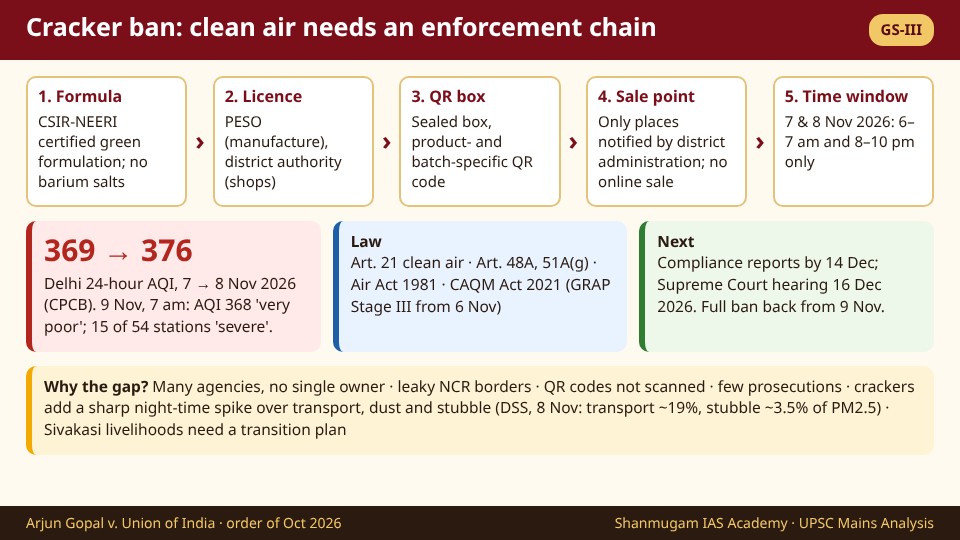
- The Supreme Court allowed only certified green crackers in Delhi-NCR for Diwali 2026 – 6–7 am and 8–10 pm on 7 and 8 November; the year-round ban returned on 9 November.
- Delhi's 24-hour AQI still rose from 369 to 376 (CPCB), showing an enforcement gap, not a gap in law.
- For UPSC: Article 21 (clean air), Article 19(6) limits on trade, CAQM and GRAP, PESO licensing and Sivakasi livelihoods – GS-III with a GS-II link.
Why in news
In an order of late October 2026 in Arjun Gopal v. Union of India, a Supreme Court bench of Justices M.M. Sundresh and Prasanna B. Varale relaxed the year-round firecracker ban in Delhi-NCR only for Diwali: certified green crackers could be burst from 6 am to 7 am and 8 pm to 10 pm on 7 and 8 November 2026. Boxes had to be sealed and QR-coded, sale was allowed only at places notified by the district administration, online sale was barred, and the full ban returned on 9 November.
Even so, Central Pollution Control Board (CPCB) data showed Delhi's 24-hour average AQI rising to 376 on 8 November from 369 the day before. At 7 am on 9 November the city AQI was 368 ('very poor'), with 15 of 54 reporting stations in the 'severe' band. Residents of several areas reported crackers being burst beyond the permitted hours, and conventional crackers were reported too. GRAP Stage III had already been in force across NCR since 6 November. The Court has asked the States, CPCB and pollution control boards to file compliance reports by 14 December; the matter is listed on 16 December 2026.
Constitutional and legal framework
| Provision / body | What it does |
|---|---|
| Article 21 | Right to life includes the right to a pollution-free environment (Subhash Kumar v. State of Bihar, 1991). |
| Article 48A and Article 51A(g) | State shall protect the environment (DPSP, added by the 42nd Amendment, 1976); citizens have a duty to protect it. |
| Air (Prevention and Control of Pollution) Act, 1981; Environment (Protection) Act, 1986 | Legal basis for CPCB/SPCB monitoring and for emission and noise standards. |
| Explosives Act, 1884 and Explosives Rules, 2008 | Licensing of fireworks – PESO (Petroleum and Explosives Safety Organisation) for manufacture and larger storage; district authorities for retail shops. |
| CAQM Act, 2021 | Commission for Air Quality Management in NCR and Adjoining Areas; runs the Graded Response Action Plan (GRAP). |
| Arjun Gopal (2018 onwards) | Supreme Court allowed only improved/green crackers, banned barium-based crackers and set time windows; the line of orders continues every year. |
Why orders are not enough – the enforcement gap
- Too many hands, no single owner: police, district magistrates, pollution control boards and PESO each hold one link of the chain. When everyone is responsible, no one is answerable on Diwali night.
- Leaky borders: NCR spans Delhi, Haryana, Uttar Pradesh and Rajasthan. Crackers bought outside the notified points or outside NCR cross easily; checks on vehicles are hard to sustain.
- Verification on paper: a QR code protects only if someone scans it. Fake "green" labels and conventional stock sold under counters defeat certification.
- Weak deterrence: prosecutions are few and slow; most action is seizure after the event. A ban that is seen to be breached without cost loses legitimacy.
- Social licence: the issue is often framed as tradition versus regulation, which makes police reluctant to act in residential areas.
- Crackers are one source, not the only one: the Decision Support System (DSS) estimated transport at about 19% and stubble burning at about 3.5% of Delhi's PM2.5 on 8 November. Crackers add a short, intense spike on top of an already high base, on nights when cold, still air traps pollutants – that is why the timing matters.
- Livelihoods: Sivakasi in Virudhunagar district, Tamil Nadu, is India's main fireworks cluster. Sudden or uneven bans hit workers and small units first; the shift to green formulations needs testing capacity and credit.
Faculty view
Treat the cracker ban as public-health regulation of a supply chain, not as a one-night policing exercise. The real control points are upstream – the NEERI-approved formulation, the PESO licence and the QR-coded box – long before a cracker reaches a terrace. The right to trade under Article 19(1)(g) is subject to reasonable restrictions (Article 19(6)), and courts have balanced it, and the manner of celebration, against the right to health and clean air under Article 21 – provided the limits are proportionate. In your answer, show both sides: clean air as a right of the many, and livelihoods of Sivakasi workers as a legitimate concern that calls for transition support, not exemption.
Way forward
- One nodal officer per district, with a public daily dashboard of sales points, seizures and prosecutions during the festival window.
- Uniform pre-festival raids and transit checks across all NCR States, coordinated by CAQM, so that one State's laxity does not undo another's effort.
- Mandatory QR scanning at the point of sale and random laboratory testing of market samples by NEERI and pollution control boards.
- Community fireworks displays at designated open grounds instead of street-level bursting.
- Sustained behaviour change through schools and public figures, as the Court has asked.
- A transition package for Sivakasi: research support for low-emission chemistry, testing labs near the cluster, skilling and MSME credit.
- Year-round action on transport, dust, industry and stubble, so that festival rules are not seen as token measures.
Glossary – Green crackers
Firecrackers made to a formulation certified by CSIR-NEERI that leaves out or cuts harmful chemicals such as barium salts. NEERI says they emit about 30% less particulate matter than conventional crackers – less harmful, not harmless. Each certified box carries a product- and batch-specific QR code.
Asked before in UPSC
1. "Does the right to clean environment entail legal regulations on burning crackers during Diwali? Discuss in the light of Article 21 of the Indian Constitution and Judgement(s) of the Apex Court in this regard." – GS-II, 2015 (12½ marks)
2. "Mumbai, Delhi and Kolkata are the three mega cities of the country but the air pollution is much more serious problem in Delhi as compared to the other two. Why is this so?" – GS-I, 2015 (12½ marks)
Mains practice question
Court-ordered restrictions on firecrackers are repeatedly breached in Delhi-NCR. Examine the institutional reasons for weak enforcement and suggest a framework that balances the right to clean air with the livelihoods of fireworks workers. (15 marks, 250 words)
FAQ
Are green crackers allowed every day in Delhi-NCR?
No. The ban in Delhi-NCR is year-round. For Diwali 2026 the Supreme Court allowed only certified green crackers, only from 6 am to 7 am and 8 pm to 10 pm on 7 and 8 November; the full ban returned on 9 November.
Which constitutional provision supports the cracker ban?
Article 21. The Supreme Court has read the right to life to include the right to a pollution-free environment; Article 48A and Article 51A(g) support it.
Who licenses the manufacture and sale of crackers?
Under the Explosives Act, 1884 and the Explosives Rules, 2008, PESO (Petroleum and Explosives Safety Organisation) licenses manufacture and larger storage; licences for shops selling fireworks are issued by district authorities. CSIR-NEERI certifies green-cracker formulations.
Sources: Supreme Court of India order in Arjun Gopal v. Union of India (October 2026); CPCB AQI data; CAQM GRAP orders; CSIR-NEERI; reporting by Business Standard and Down To Earth (8–9 November 2026). Topic from the editorial page of The Hindu, 10 November 2026; analysis is our own.
Related on our site: UPSC Mains Analysis – all articles · UPSC glossary · UPSC Mains answer-writing practice · Free PDF downloads
Link to this page from your website / blog (HTML code)
BANK Achievers
-
N. NARMADHA
BANK BANK
Indian Polity in Tamil | 100 அரசியலமைப்பு வினா விடை | TNPSC Group 4 Preparation 2026
TNPSC குரூப் 1, 2/2A, 4 – நேரடி வகுப்புகள் · கோவை & மதுரை
2006 முதல் சண்முகம் IAS அகாடமி · Classroom & online coaching in Coimbatore and Madurai
