

Mains Analysis: Article 22 – the 24-hour clock starts at detention
10 November 2026 · English Polity & Governance
⬇ Download this analysis as free PDF
இந்தப் பகுப்பாய்வைத் தமிழில் படிக்க →
Topics: Polity – Fundamental Rights and Criminal Justice · GS-II · UPSC Mains Analysis
Key takeaways
- Sujit Das v. Union of India (5 November 2026): the 24-hour limit in Article 22(2) starts when liberty is curtailed, not when a formal arrest is recorded.
- Only the journey time to the Magistrate can be excluded; Magistrates must record the actual time of detention.
- For UPSC: Article 22, Article 21 due process, BNSS sections 35, 36, 58 and 187, D.K. Basu and police reform – GS-II.
Why in news
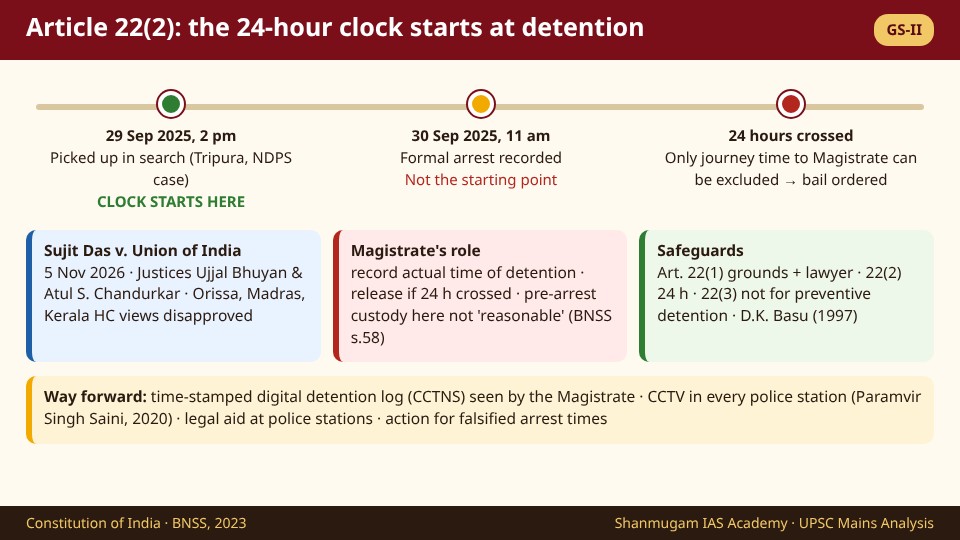
On 5 November 2026, in Sujit Das v. Union of India, a Supreme Court bench of Justices Ujjal Bhuyan and Atul S. Chandurkar held that the 24-hour limit in Article 22(2) begins the moment a person's liberty is curtailed – when he is detained or intercepted – and not when a formal arrest is recorded later. In a Tripura drug case (NDPS Act), the appellants had been picked up at 2 pm on 29 September 2025 during a search and shown as arrested only at about 11 am the next day. Because the constitutional deadline had been breached, the Court set aside the Tripura High Court's refusal of bail and directed that they be produced before the Special Court within seven days and released on bail. The allegations themselves remain to be tried.
The Court disapproved rulings of the Orissa, Madras and Kerala High Courts that had excluded pre-arrest detention from the 24 hours. The only time that can be excluded is the journey to the Magistrate, which the Constitution itself allows. It also told Magistrates to record the actual date and time of detention when a person is produced, to release the person if 24 hours have been crossed. It also held that the custody before the formal arrest in this case was not a 'reasonable period' under Section 58 of BNSS. The special bail bar in Section 37 of the NDPS Act could not stand in the way once Article 21 was violated.
The constitutional and legal framework
| Provision | Safeguard |
|---|---|
| Article 22(1) | Arrested person must be told the grounds of arrest as soon as may be, and has the right to consult and be defended by a lawyer of choice. |
| Article 22(2) | Production before the nearest Magistrate within 24 hours, excluding journey time; no detention beyond that without the Magistrate's authority. |
| Article 22(3) | Clauses (1) and (2) do not apply to enemy aliens or to persons held under preventive detention laws. |
| Article 21 | Life and personal liberty only by a procedure that is fair, just and reasonable (Maneka Gandhi, 1978). |
| BNSS, 2023 | Section 35 (arrest without warrant), Section 36 (procedure of arrest, arrest memo), Section 58 (no detention beyond 24 hours), Section 187 (remand). |
| Key judgments | Joginder Kumar (1994) – arrest must be justified, not routine; D.K. Basu (1997) – arrest memo, informing a relative, medical examination; Arnesh Kumar (2014) – no automatic arrest for offences punishable up to 7 years; Paramvir Singh Saini (2020) – CCTV in all police stations. |
Why this ruling matters
- Closes the "picked up for questioning" loophole: hours spent in a vehicle, a camp or a police station before the paperwork is written are now counted. These unrecorded hours are when custodial violence is most likely.
- Constitution over special statutes: strict bail laws such as the NDPS Act cannot be used to excuse a breach of Article 22(2).
- Settles conflicting High Court views: one national standard instead of different rules in different States.
- Makes the Magistrate an active check: remand is no longer a formality; the Magistrate must examine the time-line.
- A lesson from Tamil Nadu: the deaths of P. Jayaraj and his son J. Bennix after police custody in Sathankulam (Thoothukudi district) in June 2020 showed what can happen when custody escapes early judicial scrutiny.
Concerns and challenges
- Interceptions in remote areas, at borders or at sea make 24-hour production hard; the journey-time exclusion must be applied honestly, not stretched.
- Police may simply record a later "interception" time. Without independent, time-stamped records, the ruling can be evaded on paper.
- Release of accused in serious cases on a constitutional breach can be portrayed as a "technicality", creating pressure on courts.
- Magistrates in busy courts may not have the time or the records to test each claim.
Faculty view
Article 22(2) is a guarantee against the State, not a courtesy granted by the police. The Court has done its part by fixing the starting point; enforcement now depends on records that the police cannot alter afterwards. In answers, link the ruling to three ideas: procedural due process under Article 21, judicial supervision of investigation, and police reform. Avoid presenting it as "pro-accused" – a clean investigation that respects the clock also produces evidence that survives trial.
Way forward
- A digital, time-stamped detention log, linked to CCTNS, that the Magistrate can see at the time of production.
- Full compliance with the CCTV directions of Paramvir Singh Saini, including interrogation rooms, with footage preserved.
- Legal aid lawyers available at police stations, and immediate intimation of detention to a family member.
- Departmental and criminal accountability for falsifying arrest times.
- Training of police and Magistrates on BNSS Sections 35, 36, 58 and 187, and on this judgment.
- Stronger oversight through State Human Rights Commissions and Police Complaints Authorities (Prakash Singh, 2006).
Glossary – Remand
A Magistrate's order under Section 187 of the Bharatiya Nagarik Suraksha Sanhita (BNSS), 2023 (earlier Section 167 CrPC) allowing an accused to be kept in police custody or judicial custody beyond the first 24 hours. Police custody can total up to 15 days, which BNSS lets the police use in parts during the early stage of the investigation (the first 40 or 60 days). Without a remand order, no one can be held beyond 24 hours.
Asked before in UPSC
We have not found a GS paper question on exactly this point (when the Article 22(2) clock starts). Fundamental Rights and criminal justice are regular GS-II areas, so practise the question below and keep this judgment ready as a recent example.
Mains practice question
"The guarantee in Article 22(2) would be meaningless if the 24-hour clock could be paused by delaying the formal arrest." In the light of a recent Supreme Court judgment, discuss the safeguards against arbitrary detention in India and the reforms needed to make them effective. (15 marks, 250 words)
FAQ
When does the 24-hour period under Article 22(2) start?
From the moment the person's liberty is curtailed – detention or interception – and not from the time the police record a formal arrest (Sujit Das v. Union of India, 5 November 2026).
What time can be excluded from the 24 hours?
Only the time needed for the journey from the place of arrest to the Magistrate's court, as Article 22(2) itself says.
Does the 24-hour rule apply to preventive detention?
No. Article 22(3) excludes enemy aliens and persons held under preventive detention laws; preventive detention has its own safeguards in Article 22(4) to 22(7).
Sources: Supreme Court of India, Sujit Das v. Union of India (5 November 2026), as reported by legal news services; Constitution of India; Bharatiya Nagarik Suraksha Sanhita, 2023. Topic from the editorial page of The Indian Express, 10 November 2026; analysis is our own.
Related on our site: UPSC Mains Analysis – all articles · UPSC glossary · UPSC Mains answer-writing practice · Free PDF downloads
Link to this page from your website / blog (HTML code)
TNPSC Achievers
-

CHINNADURAI
TNPSC TNPSC
Indian Polity in Tamil | 100 அரசியலமைப்பு வினா விடை | TNPSC Group 4 Preparation 2026
TNPSC குரூப் 1, 2/2A, 4 – நேரடி வகுப்புகள் · கோவை & மதுரை
2006 முதல் சண்முகம் IAS அகாடமி · Classroom & online coaching in Coimbatore and Madurai
