

Mains Analysis: Gokul Dairy row – who should run a cooperative?
12 November 2026 · English Polity & Governance
⬇ Download this analysis as free PDF
Topics: Governance – Co-operative Societies and State Laws · GS-II · UPSC Mains Analysis
Key takeaways
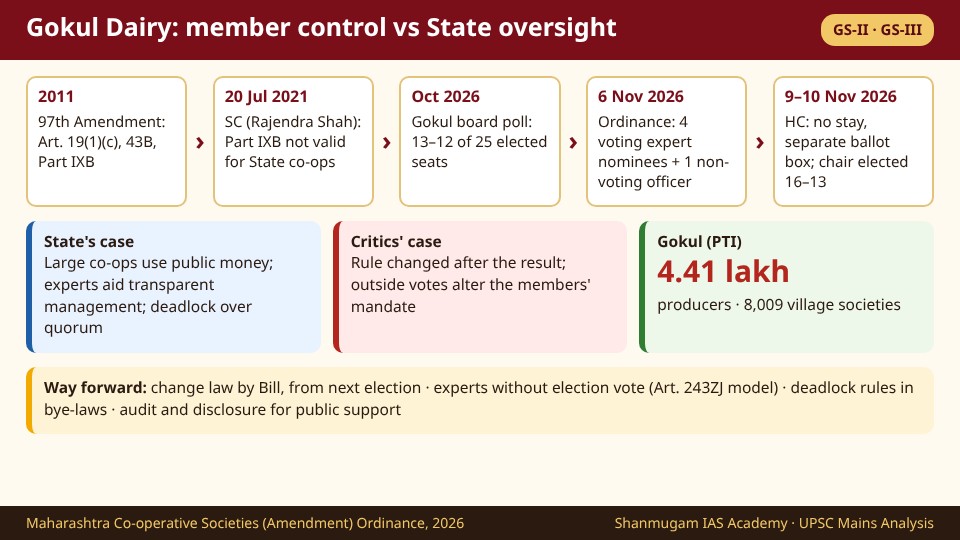
- A Maharashtra ordinance of 6 November 2026 lets the State nominate four voting experts (and one non-voting officer) to large, State-assisted federal co-operatives; at Gokul, where the board had split 13–12, the Mahayuti-backed candidate then won the chair 16–13.
- The Bombay High Court refused a stay but kept the nominees' votes in a separate ballot box, subject to its final decision (next hearing 25 November).
- For UPSC: Entry 32 State List, 97th Amendment (Art. 19(1)(c), 43B, Part IXB), Art. 243ZJ and 243ZL, Rajendra Shah (2021), Article 213 ordinances – member democracy versus accountability for public money.

Why in news
The Kolhapur Zilla Sahakari Dudh Utpadak Sangh – better known by its brand Gokul – is one of Maharashtra's largest milk co-operatives. Set up in 1963, it reported a turnover of Rs 3,966.28 crore in 2024-25 and serves about 4.41 lakh milk producers through 8,009 village-level societies (PTI). In its board election in October 2026, the panel led by Congress MLC Satej Patil won 13 of the 25 elected seats and the panel backed by the ruling Mahayuti alliance won 12.
On 6 November 2026, Governor Jishnu Dev Varma promulgated the Maharashtra Co-operative Societies (Amendment) Ordinance, 2026 under Article 213(1), amending Section 73AAA of the Maharashtra Co-operative Societies Act, 1960. For federal co-operatives with an annual turnover above Rs 500 crore that receive State assistance, the State may now nominate five members to the managing committee: four non-official experts with voting rights and one officer (not below Assistant Registrar) without a vote. Nominees cannot become chairperson or vice-chairperson; District Central Co-operative Banks are excluded.
On 9 November, the Bombay High Court refused to stay the ordinance but directed that the four nominees' votes in the chairperson election be kept in a separate ballot box, that the process be video-recorded, and that the result remain subject to its final decision (next hearing: 25 November). On 10 November, the Mahayuti-backed Rajesh Patil was elected chairperson by 16 votes to 13. Chief Minister Devendra Fadnavis said no side had a majority after the 13–12 result and that, without a quorum, a chairperson could not be elected; the Opposition said the change overturns the members' mandate after the result.
Background: how the Constitution treats co-operatives
| Provision | What it says |
|---|---|
| Entry 32, State List | "Co-operative societies" are a State subject. Societies whose objects extend beyond one State fall under the Union (Entry 44, Union List) – hence the Multi-State Co-operative Societies Act, 2002. |
| 97th Constitutional Amendment, 2011 | Added "co-operative societies" to Article 19(1)(c), inserted Article 43B (State to promote voluntary formation, autonomous functioning, democratic control and professional management of co-operatives) and Part IXB (Articles 243ZH–243ZT). |
| Article 243ZJ | Board of not more than 21 directors; up to two co-opted experts in addition, who cannot vote in any election of the society or become office-bearers; five-year term. |
| Article 243ZL | A board may be superseded or kept under suspension for at most six months – but not at all where there is no government shareholding, loan, financial assistance or guarantee. |
| Union of India v. Rajendra N. Shah (20 July 2021) | By 2:1, the Supreme Court struck down Part IXB as far as it applies to co-operatives within a State, because the amendment curtailed a State subject without ratification by half the States under Article 368(2). Part IXB survives for multi-State co-operatives. |
| Union-level changes | A separate Ministry of Cooperation (July 2021); the Multi-State Co-operative Societies (Amendment) Act, 2023, which set up a Co-operative Election Authority for multi-State societies. |
Analysis: two legitimate claims in conflict
- Member control: a co-operative belongs to its members. "Democratic member control" and "autonomy and independence" are core principles in the International Co-operative Alliance's Statement on the Co-operative Identity (1995). Giving outsiders a vote that can change a board majority weakens that principle.
- Accountability for public support: the State's case is also real. Large federations use public money – share capital, loans, guarantees, land. The Constitution itself links State control to State money: Article 243ZL bars supersession where there is no government stake. Expert oversight of public funds is a fair aim.
- Means and timing: the problem is less the idea than the method. Voting experts were added after a close election and applied to a sitting board; a 13–12 deadlock is a quorum problem that bye-laws or a fresh election can solve. Rules that change after a result invite the charge of political engineering, whatever the intent.
- The ordinance route: Article 213 is for urgent situations when the legislature is not in session; an ordinance must be laid before the House and lapses six weeks after it reassembles. In Krishna Kumar Singh v. State of Bihar (2017), a seven-judge bench held that ordinances are open to judicial review and re-promulgation can be a fraud on the Constitution.
- Economic stakes (GS-III): district milk unions such as Gokul are the middle tier of the Anand pattern (village society – district union – State federation) that made India the world's largest milk producer. Politicised boards can hurt procurement prices, payments and investment in chilling and processing.
- Federal angle: after Rajendra Shah, State co-operatives are governed almost wholly by State laws, so Part IXB's safeguards (such as the bar on co-opted members voting in elections) are no longer binding on them. Good practice now depends on each State.
Faculty view
Do not frame this as a party contest. The examiner wants the principle: how can the State protect public money in large co-operatives without taking away the members' right to elect and control their board? Balance the two values – member democracy (Article 43B, the co-operative principles) and accountability (State assistance, audit, Article 243ZL). Then show that the process matters: changes made by law after debate, applied prospectively, with non-voting experts or clear deadlock rules, carry far more legitimacy than changes made by ordinance during a dispute.
Way forward
- Make structural changes to co-operative law through a Bill debated in the legislature, and apply them from the next board election, not to a sitting board.
- Use expert members as advisers or co-opted directors without a vote in elections – the model Article 243ZJ adopted – and strengthen professional management through a qualified chief executive.
- Write deadlock and quorum rules (casting vote, fresh election within a fixed time) into model bye-laws, so that a split board does not need outside votes.
- Tie public support to transparency: independent audit, disclosure of milk prices paid, accounts and related-party deals, and an independent State co-operative election authority.
- States should voluntarily adopt the good-governance parts of Part IXB in their own laws, since after 2021 they are not binding on State co-operatives.
Glossary – Co-opted director
An expert taken on to the board of a co-operative society without being elected by the members. Article 243ZJ(3), inserted by the 97th Constitutional Amendment (2011), provides for co-opting up to two members with experience in banking, management, finance or a related field, in addition to the maximum of 21 directors; such co-opted members cannot vote in any election of the society or become its office-bearers. Since the Supreme Court's 2021 ruling, this rule binds multi-State co-operative societies; for co-operatives within a State, the State's own law decides.
Asked before in UPSC
We did not find a direct UPSC Mains GS question on co-operative autonomy or the 97th Amendment in recent papers, so none is quoted here. The topic fits the GS-II syllabus lines on the "functions and responsibilities of the Union and the States" and "government policies and interventions", and GS-III lines on agricultural marketing and animal rearing. Prepare it with Article 43B, Part IXB and the 2021 Rajendra Shah ruling.
Mains practice question
"Co-operatives must be member-controlled, yet many large co-operatives depend on State support." In the light of the 97th Constitutional Amendment and the Supreme Court's 2021 ruling, discuss how the State can ensure accountability without undermining co-operative democracy. (15 marks, 250 words)
FAQ
What does the Maharashtra ordinance of November 2026 do?
It amends Section 73AAA of the Maharashtra Co-operative Societies Act, 1960 so that, in federal co-operatives with turnover above Rs 500 crore that receive State assistance, the State can nominate four experts with voting rights and one officer without a vote; nominees cannot become chairperson or vice-chairperson.
What did the Bombay High Court order on 9 November 2026?
It refused to stay the ordinance but ordered that the nominees' votes in the chairperson election be kept in a separate ballot box and video-recorded, with the result subject to its final decision; the case is next listed on 25 November.
Does Part IXB of the Constitution apply to Gokul?
Not directly. In Union of India v. Rajendra N. Shah (2021) the Supreme Court held Part IXB inoperative for co-operatives within a State; it applies to multi-State co-operatives. Gokul is governed by the Maharashtra Co-operative Societies Act, 1960.
Sources: Constitution of India, Articles 19(1)(c), 43B, 213, 243ZJ, 243ZL and Seventh Schedule; Supreme Court – Union of India v. Rajendra N. Shah (20 July 2021) and Krishna Kumar Singh v. State of Bihar (2017); PTI reports of 6 and 9 November 2026 on the ordinance and the High Court order; Free Press Journal, 11 November 2026 (chairperson election). Topic from the editorial page of The Hindu, 12 November 2026; analysis is our own.
Related on our site: UPSC Mains Analysis – all articles · UPSC glossary · UPSC Mains answer-writing practice · Free PDF downloads
Link to this page from your website / blog (HTML code)
BANK Achievers
-

P. VIVEK KUMAR
BANK BANK
நடப்பு நிகழ்வுகள் 12 - 11- 2026 | Today Current Affairs in Tamil | TNPSC Group 4 வினா விடை
TNPSC குரூப் 1, 2/2A, 4 – நேரடி வகுப்புகள் · கோவை & மதுரை
2006 முதல் சண்முகம் IAS அகாடமி · Classroom & online coaching in Coimbatore and Madurai
