

Mains Analysis: Should the voter list decide who gets welfare?
12 November 2026 · English Polity & Governance
⬇ Download this analysis as free PDF
Topics: Governance – Welfare Delivery and Electoral Rolls · GS-II · UPSC Mains Analysis
Key takeaways
- A Union Minister's remarks, reported in early November 2026, about using EPIC (voter ID) numbers to verify Panchayati Raj beneficiaries revived the debate on tying welfare to electoral rolls under revision.
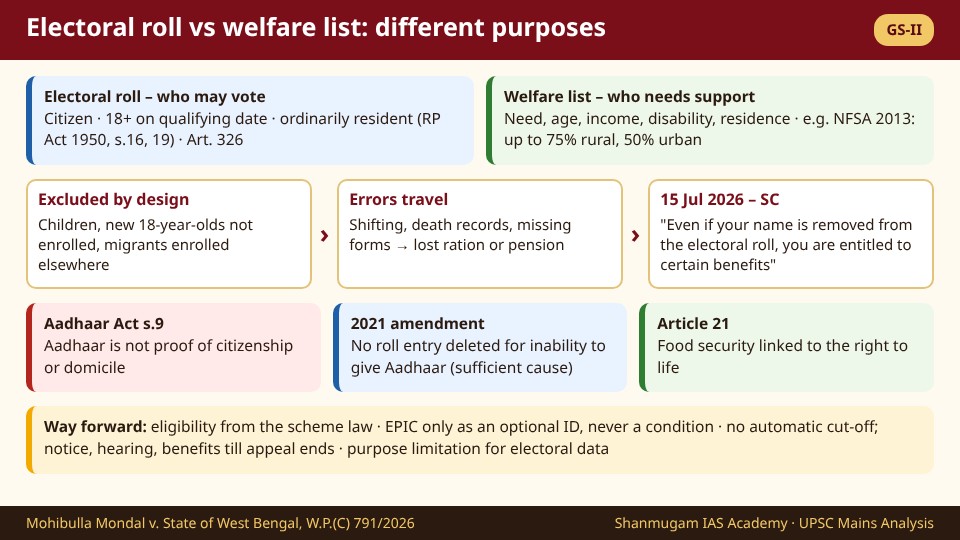
- The roll lists citizens who may vote; welfare laws such as NFSA 2013 decide entitlement by need. On 15 July 2026 the Supreme Court observed that a person removed from the roll is still entitled to certain benefits.
- For UPSC: Articles 14, 21, 324, 326; RP Act 1950; Election Laws (Amendment) Act 2021; Aadhaar Act Sections 7 and 9; Puttaswamy and purpose limitation – GS-II welfare delivery.

Why in news
In early November 2026, reported remarks by Union Panchayati Raj Minister Rajiv Ranjan (Lalan) Singh at a national workshop of his Ministry – that Aadhaar would no longer be the basis for payments to beneficiaries and that biometric verification with the EPIC (voter ID) number would be used to verify beneficiaries of Panchayati Raj schemes – drew sharp criticism from the Opposition, which said welfare was being tied to electoral rolls that are under revision. On 6 November, the Minister replied that biometric verification and the EPIC number had been added along with Aadhaar, and that, for a Panchayat training scheme, identity is verified using both the EPIC number and Aadhaar biometric authentication, and that the aim is to make benefits reach genuine beneficiaries (ANI/IANS).
The debate is not new. On 4 June 2026, West Bengal's Food and Supplies Department ordered that ration cards of persons removed from the roll during the Special Intensive Revision (SIR) be marked inactive; it later said those appealing would keep getting benefits until their appeals were heard. On 15 July 2026, a Supreme Court bench of Chief Justice Surya Kant and Justices Joymalya Bagchi and V. Mohana, hearing an affected person, observed: "Even if your name is removed from the electoral roll, you are entitled to certain benefits," and sent him to the Calcutta High Court, asking the appellate tribunal to decide his appeal preferably within two months. The Hindu's editorial of 12 November argues that the roll cannot be used to decide welfare beneficiaries.
Background: two different registers, two different purposes
| Law / provision | What it decides |
|---|---|
| Article 326; 61st Amendment (1988) | Elections on the basis of adult suffrage; voting age 18. The roll is a list of citizens who may vote in a constituency. |
| Representation of the People Act, 1950 | Section 16: disqualifications (not a citizen, declared of unsound mind by a court, disqualified for corrupt practices); Section 19: 18 years on the qualifying date and ordinarily resident; Section 21: preparation and revision of rolls, including special revision. |
| Election Laws (Amendment) Act, 2021 | EROs may ask for Aadhaar to authenticate entries, but no application may be denied and no entry deleted for inability to furnish Aadhaar for a sufficient cause. |
| National Food Security Act, 2013 | Covers up to 75% of the rural and 50% of the urban population; States identify eligible households on need. Ration card issued in the name of the eldest woman (18+) of the household. |
| Aadhaar Act, 2016 | Section 7 allows Aadhaar authentication for subsidies and benefits paid from the Consolidated Fund of India (upheld in Puttaswamy, 2018); Section 9 says Aadhaar is not proof of citizenship or domicile. |
Analysis: why the voter list is a poor welfare filter
- Different questions: the roll answers "who is a citizen ordinarily resident here and 18 or above?"; welfare asks "who is poor, old, disabled, a child, a worker in need?" Many entitled people – children, those who recently turned 18 and are not yet enrolled, migrants enrolled elsewhere – are not on the local roll by design.
- Errors travel: names leave a roll because of shifting, death records, missing forms or disputes on documents. If welfare follows the roll, every such error becomes a lost meal or pension – a right-to-life issue under Article 21, which courts have linked to food security.
- Due process gap: deletion from the roll is followed by appeals that take time. Automatic stoppage of rations while an appeal is pending punishes people before any final finding.
- Effect on the franchise: if losing one's name also means losing benefits, roll revision becomes high-stakes and contentious, and trust in a neutral electoral exercise suffers. The Election Commission's role under Article 324 is elections, not welfare targeting.
- Purpose and privacy: data collected to run elections should not be repurposed without a law and a proportionality test (Puttaswamy, 2017).
- The genuine concern: weeding out ghost and duplicate beneficiaries is a legitimate aim. But tools built for it already exist – Aadhaar-based e-KYC with exceptions, direct benefit transfer, field verification, social audit – and they test eligibility, not voter status.
Faculty view
Answer this as a governance-design question, not a political one. Accept that identity verification is needed to stop leakage, then argue that eligibility must come from the welfare law itself (need, age, income, residence), while the electoral roll serves the franchise. Use one line each from Article 21 (right to food), Article 14 (non-arbitrariness), Article 326 (purpose of the roll) and Puttaswamy (purpose limitation). End with safeguards: no automatic cut-off, notice and hearing, and a quick grievance channel.
Way forward
- Keep welfare eligibility in the scheme law and guidelines; use the EPIC, if at all, only as one optional identity document among many, never as a condition.
- No automatic stoppage of benefits on deletion from the roll; prior notice, a hearing and continuation of benefits until appeals are decided.
- Clear, published rules from the Union and States on which identity documents are accepted for each scheme, with exceptions for people who cannot authenticate.
- Use portability (One Nation One Ration Card), field verification and social audit to remove ineligible names without excluding migrants and the poor.
- A data-sharing protocol under the data-protection law, so that electoral data is not used for other purposes without legal authority.
Glossary – Purpose limitation
A data-protection principle: personal data collected for one stated purpose should be used only for that purpose or a compatible one, unless the law or fresh consent allows more. It flows from the right to privacy recognised in K.S. Puttaswamy v. Union of India (2017), which requires any intrusion to have a legal basis, a legitimate aim and proportionality, and is reflected in the Digital Personal Data Protection Act, 2023, which ties processing to a specified, lawful purpose. An electoral roll is compiled to decide who may vote, not who needs welfare.
Asked before in UPSC
A direct question on using the electoral roll for welfare has not appeared in UPSC Mains. The closest earlier question on the electoral framework:
1. "Discuss the procedures to decide the disputes arising out of the election of a Member of the Parliament or State Legislature under The Representation of the People Act, 1951. What are the grounds on which the election of any returned candidate may be declared void? What remedy is available to the aggrieved party against the decision? Refer to the case laws." – GS-II, 2022 (15 marks)
Use today's topic for questions on welfare delivery, exclusion errors and the role of the Election Commission.
Mains practice question
"Identity verification can reduce leakages in welfare, but the electoral roll is not a measure of entitlement." Critically examine the use of voter registration as a condition for welfare benefits. (15 marks, 250 words)
FAQ
Is there any law that links welfare benefits to the electoral roll?
No central welfare law makes inclusion in the electoral roll a condition of eligibility. Entitlements under laws such as the National Food Security Act, 2013 depend on need-based criteria set by the law and the States.
What did the Supreme Court say on 15 July 2026?
Hearing a person excluded from the West Bengal roll, a bench led by Chief Justice Surya Kant observed that even if a name is removed from the electoral roll, the person is entitled to certain benefits, and sent him to the Calcutta High Court for relief.
Is Aadhaar compulsory for getting on the electoral roll?
No. The Election Laws (Amendment) Act, 2021 lets EROs ask for Aadhaar for authentication, but no application can be denied and no entry deleted for inability to furnish Aadhaar for a sufficient cause.
Sources: Constitution of India, Articles 14, 21, 324 and 326; Representation of the People Act, 1950; Election Laws (Amendment) Act, 2021; National Food Security Act, 2013; Aadhaar Act, 2016; Supreme Court – K.S. Puttaswamy v. Union of India (2017, 2018) and Mohibulla Mondal v. State of West Bengal, W.P.(C) No. 791/2026 (15 July 2026, as reported by LiveLaw); ANI and IANS reports of 6–8 November 2026. Topic from the editorial page of The Hindu, 12 November 2026; analysis is our own.
Related on our site: UPSC Mains Analysis – all articles · UPSC glossary · UPSC Mains answer-writing practice · Free PDF downloads
Link to this page from your website / blog (HTML code)
BANK Achievers
-

RAMYA
BANK BANK
நடப்பு நிகழ்வுகள் 12 - 11- 2026 | Today Current Affairs in Tamil | TNPSC Group 4 வினா விடை
TNPSC குரூப் 1, 2/2A, 4 – நேரடி வகுப்புகள் · கோவை & மதுரை
2006 முதல் சண்முகம் IAS அகாடமி · Classroom & online coaching in Coimbatore and Madurai
