

Mains Analysis: Hasina's return plan and the reset with Dhaka
13 November 2026 · English International
⬇ Download this analysis as free PDF
இந்தப் பகுப்பாய்வைத் தமிழில் படிக்க →
Topics: International Relations – India and its Neighbourhood · GS-II · UPSC Mains Analysis
Key takeaways
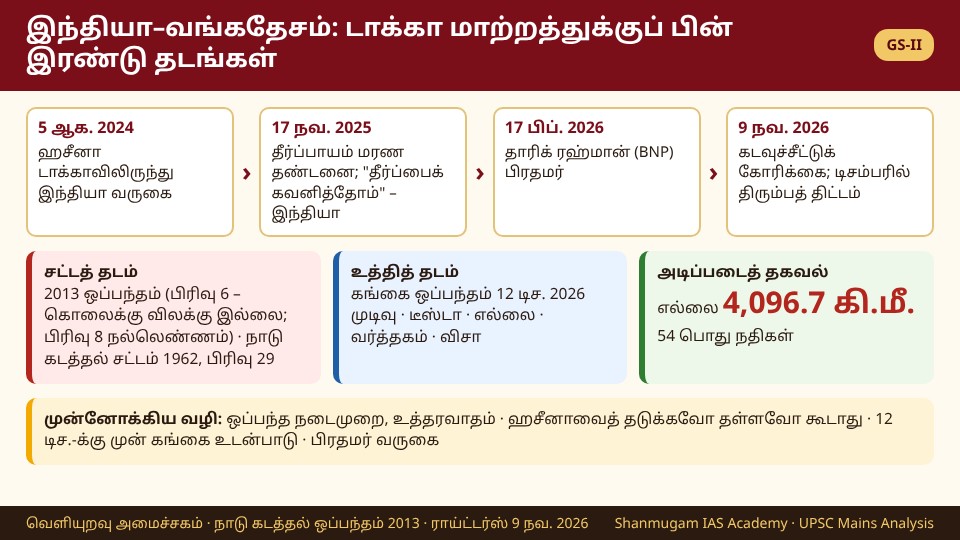
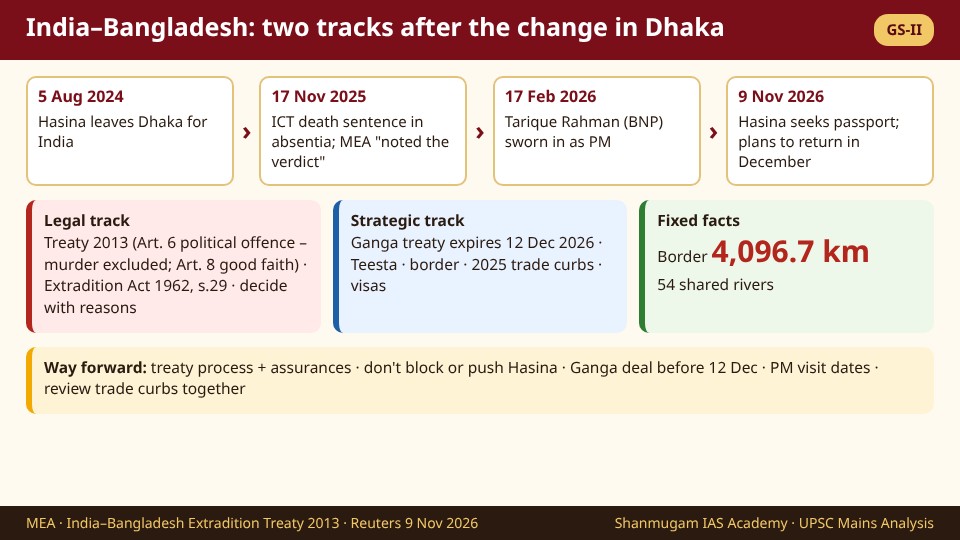
- Sheikh Hasina, in India since 5 August 2024 and sentenced to death in absentia by Bangladesh's International Crimes Tribunal on 17 November 2025, has sought a new passport and says she will return in December 2026; Dhaka wants her extradited.
- Bangladesh's BNP government (PM Tarique Rahman since 17 February 2026) and India must also settle the Ganga Water Treaty, which expires on 12 December 2026.
- For UPSC: Extradition Treaty 2013 (Art. 6, 8), Extradition Act 1962 s.29, Land Boundary Agreement 2015, 54 shared rivers, 4,096.7 km border – keep the legal and strategic tracks separate.
Why in news
Former Bangladesh Prime Minister Sheikh Hasina, who has lived in India since she left Dhaka on 5 August 2024, has asked Bangladesh, through her lawyers, for a new passport and national identity card. She has said she intends to return in December 2026 and surrender before a court (Reuters, 9 November 2026). Bangladesh's Home Minister Salahuddin Ahmed said the foreign and law ministries are examining whether there is a legal basis for the request. On 5 November, State Minister for Foreign Affairs Humaiun Kobir said Dhaka wants her handed over under the extradition treaty, which he described as "active".
On 17 November 2025, Bangladesh's International Crimes Tribunal sentenced Hasina to death in absentia for crimes against humanity over the crackdown on the 2024 student-led protests; the UN human rights office estimated that up to 1,400 people may have been killed between 1 July and 15 August 2024. India's Ministry of External Affairs (MEA) said that day that India had "noted the verdict" and, "as a close neighbour", remained committed to "the best interests of the people of Bangladesh, including in peace, democracy, inclusion and stability". In the February 2026 election, from which the Awami League was barred, the Bangladesh Nationalist Party (BNP)-led alliance won a two-thirds majority, and Tarique Rahman was sworn in as Prime Minister on 17 February 2026.
The question now sits next to a deadline: the Ganga Water Treaty, signed on 12 December 1996 for 30 years, expires on 12 December 2026. The MEA has said water talks are going on through the Joint Rivers Commission and a "structured bilateral mechanism".
Background: the relationship in one table
| Area | Key facts |
|---|---|
| Border | At 4,096.7 km, India's longest land border, shared by West Bengal, Assam, Meghalaya, Tripura and Mizoram (Ministry of Home Affairs). |
| Land Boundary Agreement | The 1974 agreement and its 2011 protocol were implemented by the Constitution (100th Amendment) Act, 2015: 111 Indian enclaves went to Bangladesh and 51 Bangladeshi enclaves to India. |
| Rivers | 54 rivers are shared; the Joint Rivers Commission was set up in 1972. The Ganga Water Treaty (1996) shares the lean-season flow at Farakka (1 January–31 May); the Teesta agreement remains unsigned. |
| Extradition | Treaty signed in 2013; amended in 2016 so that an arrest warrant from a competent court can support a request. Article 6: political offence exception (with exclusions); Article 8: refusal if the accusation is not made in good faith in the interests of justice. |
| Trade frictions (2025) | India withdrew the transshipment facility for Bangladeshi exports through its ports (April 2025) and, on 17 May 2025, restricted ready-made garment imports from Bangladesh to the Kolkata and Nhava Sheva sea ports and barred some other goods at land ports in the North-East and West Bengal. |
| Political shift | Hasina's Awami League governed from 2009 to 2024; an interim government led by Muhammad Yunus followed; the BNP government took office in February 2026. |
Analysis: separate the legal question from the strategic one
- The law gives the Union government discretion. India's Extradition Act, 1962 (Section 29) lets the Union government stay proceedings or refuse surrender if a request is not made in good faith or in the interests of justice, or for political reasons. The treaty's Article 8 says the same in bilateral terms. A death sentence passed in absentia, in a politically charged atmosphere, gives India legitimate grounds to ask about fair-trial guarantees.
- But the political offence shield is narrow. Article 6(2) of the treaty excludes murder and related offences from the "political" category. India cannot simply call the case political; it has to rest any refusal on fair-trial and good-faith grounds, and say so through the treaty process.
- Hasina's own plan changes the frame. If she chooses to return and face the courts, the extradition decision may never arise. India's concern then is her safety and a fair process, which it can raise diplomatically, without either blocking her or pushing her out.
- The cost of a one-party policy. Under Hasina, India gained a great deal: action against north-eastern insurgent groups, transit and connectivity, power trade and the land boundary settlement. But the close identification with one party left India with little goodwill when the government changed. "Neighbourhood First" has to mean ties with the people and all major parties.
- A crowded agenda that cannot wait. The Ganga treaty deadline, the unsigned Teesta deal, border deaths and illegal crossings, trade curbs on both sides, visas and the safety of minorities all need a working relationship with the elected government. China's and Pakistan's growing engagement with Dhaka makes delay costly.
- Tamil Nadu angle: Bangladesh is the second-largest garment-exporting country after China (WTO) and a direct competitor of Tiruppur's knitwear exporters, so trade decisions on garments matter to Tamil Nadu. Hospitals in Chennai and Vellore have long treated many Bangladeshi patients, so medical visas are a people-to-people link worth protecting. And for students who know the Cauvery dispute, the Ganga treaty (with a joint monitoring site at Farakka) is a useful example of a sharing formula that is reviewed jointly.
Faculty view
Do not answer this as "protect Hasina" versus "please Dhaka". The examiner wants two tracks. On the legal track, India should handle the request through the treaty and the Extradition Act, judge it on fair-trial and good-faith grounds, and give reasons. On the strategic track, India should work fully with the elected BNP government on water, trade, border and connectivity, because a neighbour of 17 crore people on a 4,096.7 km border cannot be managed through one leader. Use the Ganga treaty deadline (12 December 2026) as the concrete test of the reset.
Way forward
- Reply to the extradition request through the formal treaty channel, with reasons; if needed, seek assurances on a fair retrial and on the death penalty, as is common practice in extradition cases.
- Neither obstruct nor hasten Hasina's own decision to return; raise her safety and due process with Dhaka diplomatically.
- Agree on the Ganga Water Treaty before 12 December 2026 – or a short interim extension if talks need more time – and add joint studies on changing flows; restart talks on the Teesta.
- Fix early dates for Prime Minister Tarique Rahman's visit (MEA says he has been invited) and hold a full Joint Consultative Commission meeting.
- Review the 2025 trade restrictions on both sides as a package; restore normal visa services, especially medical visas.
- Keep a non-lethal approach on the border and joint patrolling under the Coordinated Border Management Plan, so that border incidents do not drive public opinion.
Glossary – Political offence exception
A standard clause in extradition treaties that lets a country refuse to surrender a person if the offence is of a "political character". Article 6 of the India–Bangladesh Extradition Treaty (2013) contains it, but also lists offences that can never be treated as political – among them murder, culpable homicide, kidnapping, hostage-taking and incitement to murder. Separately, Article 8 allows refusal when an accusation is not made in good faith in the interests of justice. In India, the final decision rests with the Union government under the Extradition Act, 1962.
Asked before in UPSC
1. "The protests in Shahbag Square in Dhaka in Bangladesh reveal a fundamental split in society between the nationalists and Islamic forces. What is its significance for India?" – GS-II, 2013 (200 words)
2. "Analyze internal security threats and transborder crimes along Myanmar, Bangladesh and Pakistan borders including Line of Control (LoC). Also discuss the role played by various security forces in this regard." – GS-III, 2020 (250 words)
UPSC has asked how Bangladesh's internal politics affect India – the same skill today's topic tests.
Mains practice question
"India's relationship with Bangladesh cannot rest on one political party." Examine this statement in the light of the extradition request for Sheikh Hasina and the expiry of the Ganga Water Treaty in 2026. (15 marks, 250 words)
FAQ
Is India bound to extradite Sheikh Hasina?
Not automatically. The 2013 treaty and India's Extradition Act, 1962 allow refusal if a request is not made in good faith in the interests of justice; the political offence exception, however, does not cover murder and related offences. The final decision is the Union government's.
When does the Ganga Water Treaty expire?
It was signed on 12 December 1996 for 30 years and expires on 12 December 2026. It shares the Ganga's lean-season flow at Farakka between 1 January and 31 May.
Who heads Bangladesh's government now?
Tarique Rahman of the Bangladesh Nationalist Party, sworn in as Prime Minister on 17 February 2026 after the BNP-led alliance won a two-thirds majority; the Awami League was barred from that election.
Sources: MEA statement of 17 November 2025 and MEA briefings (October–November 2026); India–Bangladesh Extradition Treaty (2013, amended 2016); Extradition Act, 1962; Ministry of Home Affairs (border length); Constitution (100th Amendment) Act, 2015; Reuters/Al Jazeera, 9 November 2026; DGFT notification of 17 May 2025. Topic from the editorial page of The Hindu, 13 November 2026; analysis is our own.
Related on our site: UPSC Mains Analysis – all articles · UPSC glossary · UPSC Mains answer-writing practice · Free PDF downloads
Link to this page from your website / blog (HTML code)
TNPSC Achievers
-
MALARVIZHI
TNPSC TNPSC
TNPSC Group 4 PYQ Discussion 🔥 இது நம்ம குரூப் 4! | Speed Revision | Shanmugam IAS Academy
TNPSC குரூப் 1, 2/2A, 4 – நேரடி வகுப்புகள் · கோவை & மதுரை
2006 முதல் சண்முகம் IAS அகாடமி · Classroom & online coaching in Coimbatore and Madurai
