

Mains Analysis: River sand mining – a three-year phase-out plan
13 November 2026 · English Environment & Ecology
⬇ Download this analysis as free PDF
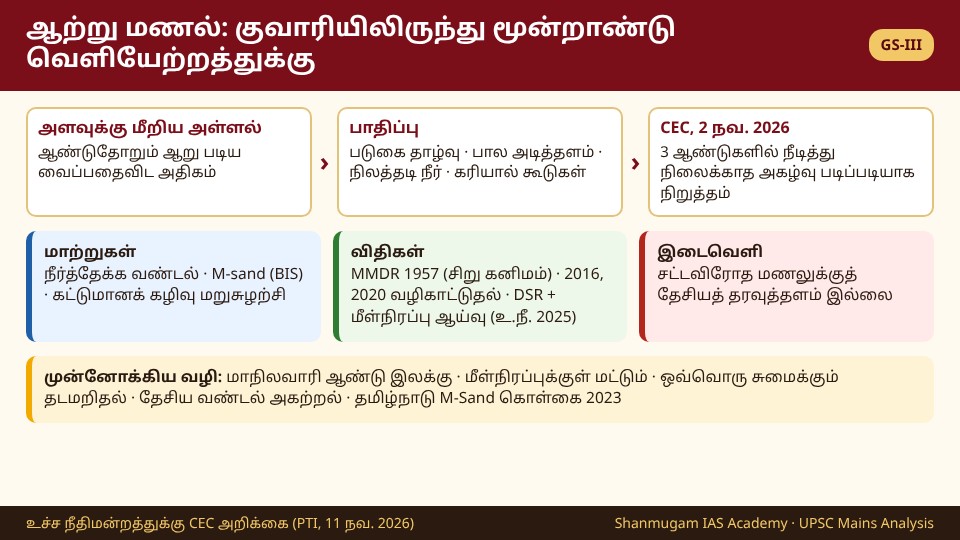
இந்தப் பகுப்பாய்வைத் தமிழில் படிக்க →
Topics: Environment – Conservation, Environmental Degradation and EIA · GS-III · UPSC Mains Analysis
Key takeaways
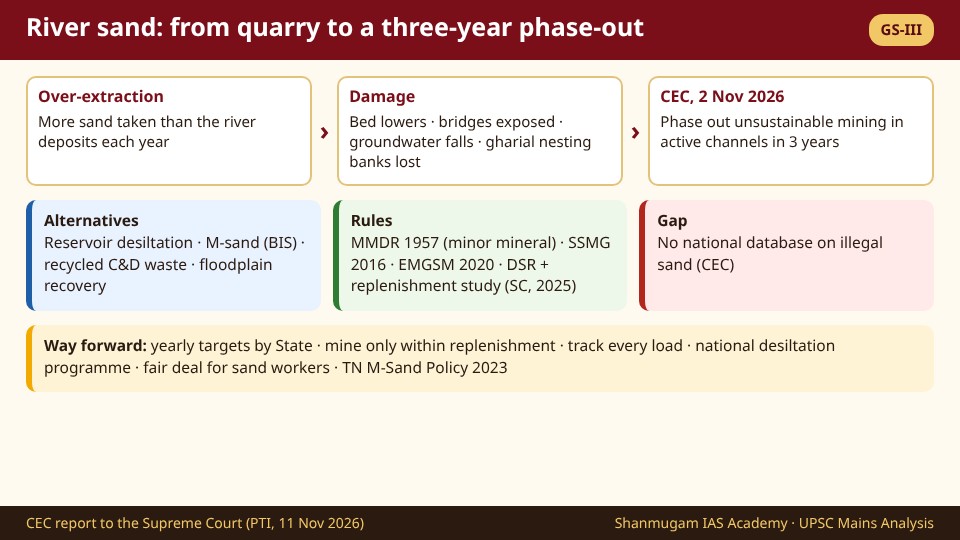
- The Supreme Court's Central Empowered Committee (report of 2 November 2026, Chambal sand-mining case) wants unsustainable sand extraction from active river channels phased out over three years.
- Alternatives: reservoir desiltation (national programme with the Ministry of Jal Shakti), M-sand and recycled C&D waste; the CEC also found no national database on illegal sand.
- For UPSC: MMDR Act 1957 (minor mineral), Deepak Kumar (2012), SSMG 2016, EMGSM 2020, Raja Muzaffar Bhat (2025) on replenishment studies; PYQs: GS-III 2019 (coastal sand mining) and GS-III 2025 (mining as an environmental hazard).
Why in news
The Supreme Court's Central Empowered Committee (CEC) has recommended a time-bound roadmap to "progressively phase out unsustainable sand extraction from active river channels" over three years. Its report, submitted on 2 November 2026 in a suo motu case on illegal sand mining in the National Chambal Sanctuary, asks that the shift go hand in hand with alternatives – sediment from dams and reservoirs, manufactured sand (M-sand) and recycled construction and demolition (C&D) waste – so that legitimate construction needs are still met (PTI, 11 November 2026).
The CEC listed the damage: riverbed degradation, weaker bridges and embankments, groundwater depletion and loss of aquifers, destruction of aquatic and riverside habitats, and changes in river shape and flow. It also noted that India has no consolidated, reliable national database on the volume or value of illegally mined river sand. The CEC was first set up in 2002 on the Supreme Court's order and has been a statutory body since 2023.
Background: how sand mining is regulated
| Rule / ruling | What it says |
|---|---|
| MMDR Act, 1957 | Ordinary sand is a "minor mineral" (Section 3(e)); States make the rules for leases and royalty (Section 15) and have powers to curb illegal mining (Section 23C). |
| Deepak Kumar v. State of Haryana (2012) | The Supreme Court required environmental clearance even for small mining leases of minor minerals, noting that extraction from or near a streambed directly affects the river's physical habitat. |
| Sustainable Sand Mining Management Guidelines, 2016 | Issued by the Environment Ministry: District Survey Reports (DSRs), scientific identification of mineable stretches and limits linked to annual replenishment. |
| Enforcement and Monitoring Guidelines for Sand Mining, 2020 | Replenishment studies, monitoring of mining sites and tracking of sand from mine to buyer. |
| UT of J&K v. Raja Muzaffar Bhat (22 August 2025) | The Supreme Court upheld the NGT: a DSR without a proper replenishment study is untenable, and clearances based on it cannot stand. |
| National Chambal Sanctuary | A river sanctuary on the Chambal shared by Madhya Pradesh, Rajasthan and Uttar Pradesh; a key habitat of the critically endangered gharial, the Ganges river dolphin and freshwater turtles; mining destroys the sandbanks where gharials and turtles nest. |
Analysis: why rivers became quarries
- Demand is real. Sand is, after water, among the most used natural resources, because concrete, plaster and roads need it. Housing and infrastructure growth keep demand rising, so a ban without supply alternatives only pushes mining underground.
- Rivers do not refill on demand. A river deposits only a limited amount of sediment each year. Taking more than that lowers the bed, cuts the river off from its floodplain and wells, exposes bridge foundations and destroys breeding grounds. This is why the courts insist on replenishment data.
- The governance gap. DSRs are often copied or out of date, replenishment studies are missing, and the gap between low royalty and high market price creates rent for illegal mining – which explains the violence often linked to "sand mafias". The CEC's finding that there is no national database shows how weak monitoring is.
- Alternatives exist but need a push. M-sand made from crushed rock can meet the Bureau of Indian Standards specification for concrete aggregate; reservoir sediment can be removed while restoring storage capacity; C&D waste can be processed into aggregates. Each needs quality control, assured buyers and an initial price advantage over river sand.
- People and federalism. Sand is a State subject in practice, and royalty is a revenue source for States and local bodies. Traditional manual sand collectors and boatmen need a fair transition. A three-year roadmap is realistic only if the Centre, the States and the Ministry of Jal Shakti work together, as the CEC proposes through a national desiltation programme.
- Tamil Nadu angle: Tamil Nadu released a new M-Sand Policy on 9 March 2023 to promote BIS-quality manufactured sand from quarry and crusher waste as an alternative to river sand. Its rivers – the Cauvery and Kollidam, Palar, Thamirabarani and Vaigai – face steady extraction pressure. The State's many dams and tanks are also candidates for scientific desiltation, which would add both sand supply and water storage.
Faculty view
Write this as a demand–supply–governance answer, not a lecture against mining. (1) Demand: sand is essential, so the goal is to change where it comes from. (2) Supply: replenishment-based limits in rivers, plus M-sand, reservoir sediment and C&D waste. (3) Governance: honest DSRs, digital tracking from pit to site, a national database and enforcement. Quote the CEC's three-year roadmap and the 2025 Raja Muzaffar Bhat ruling as your two current anchors, and add the Tamil Nadu M-Sand Policy as a State example.
Way forward
- Adopt the three-year roadmap with yearly targets for reducing extraction from active channels, published State by State.
- Allow mining only in scientifically identified stretches, within the measured replenishment rate; update DSRs with independent field data.
- Track every load digitally – e-transit passes, GPS on vehicles, weighbridges and end-use records – and build the national database the CEC found missing.
- Launch the proposed National Programme for scientific desiltation of dams and reservoirs, with the Ministry of Jal Shakti and dam-owning agencies.
- Promote BIS-certified M-sand and recycled C&D aggregates through public procurement and incentives, so that alternatives become cheaper and trusted.
- Protect river communities: a fair transition for manual sand workers, and protection for whistle-blowers and officials who act against illegal mining.
Glossary – Replenishment study
A study that measures how much sand and sediment a river naturally deposits each year in a given stretch, so that extraction can be kept within that natural rate. The Sustainable Sand Mining Management Guidelines, 2016 and the Enforcement and Monitoring Guidelines for Sand Mining, 2020 make it part of the District Survey Report, which is the basis for environmental clearance. In Union Territory of J&K v. Raja Muzaffar Bhat (22 August 2025), the Supreme Court held that a District Survey Report without a proper replenishment study is untenable.
Asked before in UPSC
1. "Coastal sand mining, whether legal or illegal, poses one of the biggest threats to our environment. Analyze the impact of sand mining along the Indian coasts, citing specific examples." – GS-III, 2019 (150 words)
2. "Mineral resources are fundamental to the country's economy and these are exploited by mining. Why is mining considered an environmental hazard? Explain the remedial measures required to reduce the environmental hazard due to mining." – GS-III, 2025 (250 words)
Coastal sand mining was asked in 2019 and the environmental hazards of mining in 2025 – prepare river and coastal sand together.
Mains practice question
"Rivers are being treated as quarries." Discuss the environmental costs of river sand mining in India and evaluate the alternatives proposed to reduce dependence on active river channels. (15 marks, 250 words)
FAQ
What did the Central Empowered Committee recommend in November 2026?
A time-bound roadmap to progressively phase out unsustainable sand extraction from active river channels over three years, together with alternatives – reservoir sediment, M-sand and recycled C&D waste – and a national programme for scientific desiltation of dams and reservoirs.
Is sand a major or minor mineral?
Ordinary sand is a minor mineral under Section 3(e) of the MMDR Act, 1957, so States frame the rules for its mining, though environmental clearance is still required.
Why is a replenishment study important?
It tells how much sand a river naturally deposits each year, so mining can be kept within that limit. The Supreme Court held in 2025 that a District Survey Report without it is untenable.
Sources: PTI report on the CEC report to the Supreme Court (11 November 2026); MMDR Act, 1957; Supreme Court – Deepak Kumar v. State of Haryana (2012) and UT of J&K v. Raja Muzaffar Bhat (22 August 2025); MoEFCC Sustainable Sand Mining Management Guidelines, 2016 and Enforcement and Monitoring Guidelines for Sand Mining, 2020; Government of Tamil Nadu press release on the M-Sand Policy (9 March 2023). Topic from the editorial page of The Indian Express, 13 November 2026; analysis is our own.
Related on our site: UPSC Mains Analysis – all articles · UPSC glossary · UPSC Mains answer-writing practice · Free PDF downloads
Link to this page from your website / blog (HTML code)
BANK Achievers
-

MAGESH
BANK BANK
TNPSC Group 4 PYQ Discussion 🔥 இது நம்ம குரூப் 4! | Speed Revision | Shanmugam IAS Academy
TNPSC குரூப் 1, 2/2A, 4 – நேரடி வகுப்புகள் · கோவை & மதுரை
2006 முதல் சண்முகம் IAS அகாடமி · Classroom & online coaching in Coimbatore and Madurai
