

SC: two-child norm case sent to larger bench; sales tax ruling
13 November 2026 · English Polity & Governance
⬇ Download this article as free PDF
Topics: Polity & Judiciary · UPSC Prelims · TNPSC · SSC · Current Affairs
Current affairs of 13 November 2026 (Shanmugam IAS Academy) – explained for UPSC, TNPSC and other competitive exams
News
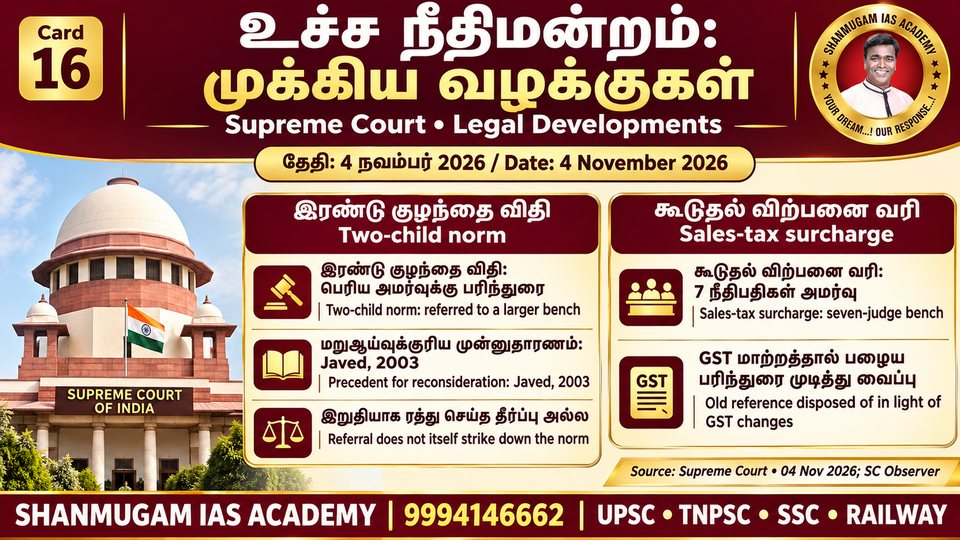
On 4 November 2026 the Supreme Court delivered two important rulings. (1) Two-child norm: a bench of Justices P.S. Narasimha and Alok Aradhe said laws barring people with more than two children from contesting panchayat polls 'have lost their relevance', and referred Javed v. State of Haryana (2003), which upheld the bar, to a larger bench for reconsideration. The case was filed by former sarpanch Mangala Bhimrao Ingle, disqualified under the Maharashtra Village Panchayats Act, 1959; the Court noted India's total fertility rate has fallen from 3 in 2003 to 1.9, below the replacement level of 2.1. (2) Additional sales tax: a seven-judge Constitution Bench headed by Chief Justice Surya Kant upheld State legislatures' power to impose an additional tax or surcharge calculated on sales tax. The 1999 reference in Arjun Flour Mills v. State of Odisha, on Section 5A of the Orissa Sales Tax Act, 1947, was disposed of as academic after GST (2017). The Bench held that S. Kodar v. State of Kerala (1974) – treating such a levy as sales tax under Entry 54 of the State List, not income tax – remains good law.
Key facts for the exam
| Point | Details |
|---|---|
| Date | 4 November 2026 (both cases) |
| Case 1 | Mangala Bhimrao Ingle v. Addl. Commissioner, Amravati |
| Bench 1 | Justices P.S. Narasimha, Alok Aradhe (2 judges) |
| Outcome 1 | Javed v. Haryana (2003) referred to larger bench |
| Fertility rate | 3 (2003) → 1.9; replacement level 2.1 |
| Case 2 | Arjun Flour Mills v. State of Odisha (1999 reference) |
| Bench 2 | 7 judges led by CJI Surya Kant |
| Outcome 2 | Additional sales tax within State power (Entry 54, List II); S. Kodar (1974) holds |
Background
- Panchayat framework: the 73rd Amendment (1992) added Part IX. Under Article 243F, a law made by the State Legislature may prescribe disqualifications for panchayat membership – the basis for conditions such as the two-child norm. In Javed (2003) a three-judge bench upheld the bar in the Haryana Panchayati Raj Act, 1994.
- Court's view: the bench said the bar excludes citizens from political representation for reasons unrelated to their ability to hold office and burdens reproductive autonomy under Article 21. As a two-judge bench cannot overrule a three-judge ruling, it referred the matter to a larger bench. According to the amicus report, 7 States have repealed the norm, 9 retain it in some form (for elections or public jobs) – including Assam, Goa, Gujarat, Maharashtra, Odisha and Uttarakhand – and 15 never had such a policy.
- Taxing power: Article 246 and the Seventh Schedule divide taxing powers. After GST came through the 101st Amendment (2016), Entry 54 of the State List was narrowed to sales tax on petroleum crude, high-speed diesel, petrol, natural gas, aviation turbine fuel and alcoholic liquor for human consumption. Questions of constitutional interpretation must be heard by a bench of at least five judges (Article 145(3)).
- Earlier rulings: Hoechst Pharmaceuticals v. State of Bihar held a surcharge on sales tax keeps the character of sales tax. India Cement v. State of Tamil Nadu (1989, seven judges) struck down a cess on mining royalty; its view that royalty is a tax was overruled in 2024 by a nine-judge bench (8:1) in Mineral Area Development Authority v. SAIL. The present bench said the conflict between the two lines was 'more apparent than real'.
What is this news about?
On 4 November 2026 the Supreme Court delivered two important rulings. (1) Two-child norm: a bench of Justices P.S. Narasimha and Alok Aradhe said laws barring people with more than two children from contesting panchayat polls 'have lost their relevance', and referred Javed v. State of Haryana (2003), which upheld the bar, to a larger bench for reconsideration.
What are the key facts to remember for the exam?
Date: 4 November 2026 (both cases); Case 1: Mangala Bhimrao Ingle v. Addl. Commissioner, Amravati; Bench 1: Justices P.S. Narasimha, Alok Aradhe (2 judges); Outcome 1: Javed v. Haryana (2003) referred to larger bench.
What is the background to this news?
Panchayat framework: the 73rd Amendment (1992) added Part IX. Under Article 243F, a law made by the State Legislature may prescribe disqualifications for panchayat membership – the basis for conditions such as the two-child norm.
Practise more: Weekly current affairs · Daily subject quiz · Knowledge nugget
Sources: Supreme Court of India – sci.gov.in (Mangala Bhimrao Ingle v. Addl. Commissioner, Amravati, 2026 INSC 1193, 4 Nov 2026); ThePrint (6 Nov 2026); Bar & Bench (4 Nov 2026, additional sales tax); SC Observer; Constitution of India – legislative.gov.in. Compiled by Shanmugam IAS Academy.
Link to this page from your website / blog (HTML code)
BANK Achievers
-

REVATHI
BANKING BANKING
Indian Polity in Tamil | 100 அரசியலமைப்பு வினா விடை | TNPSC Group 4 Preparation 2026
TNPSC குரூப் 1, 2/2A, 4 – நேரடி வகுப்புகள் · கோவை & மதுரை
2006 முதல் சண்முகம் IAS அகாடமி · Classroom & online coaching in Coimbatore and Madurai
