

Rechargeable zinc–air battery with vitamin B12 catalyst
13 November 2026 · English Science & Technology
⬇ Download this article as free PDF
Topics: Science & Technology · UPSC Prelims · TNPSC · SSC · Current Affairs
Current affairs of 13 November 2026 (Shanmugam IAS Academy) – explained for UPSC, TNPSC and other competitive exams
News
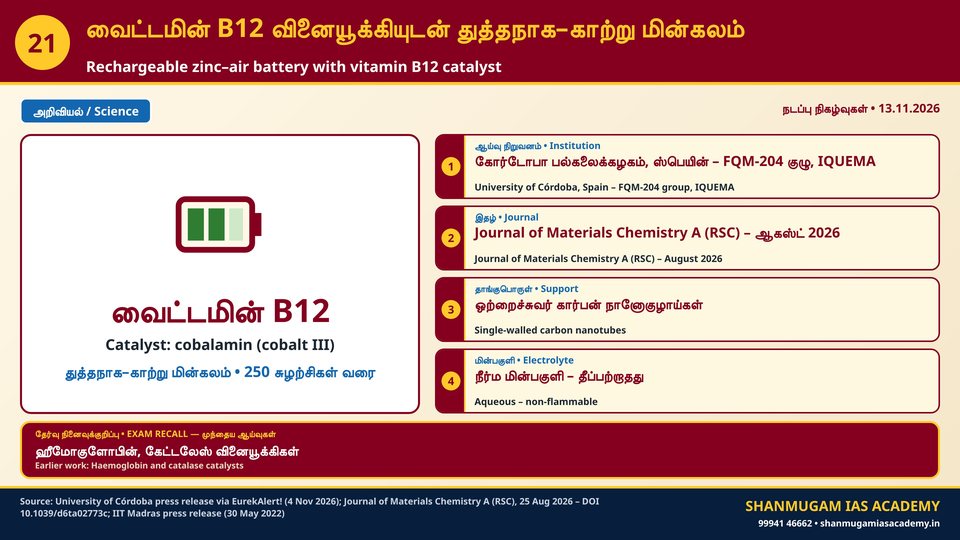
A physical chemistry research group (FQM-204, IQUEMA institute) at the University of Córdoba, Spain, has developed a rechargeable zinc–air battery that uses vitamin B12 (cobalamin) as its catalyst. The results were published in the 'Journal of Materials Chemistry A' (Royal Society of Chemistry) in August 2026; the university issued a press release on 4 November 2026. Because B12 dissolves easily in water, the team anchored it to single-walled carbon nanotubes to form the air electrode (cathode). The cobalt(III) ion at the core of B12 helps reduce oxygen to water during discharge and release oxygen during charging. The researchers reported that the prototype ran for up to 250 charge–discharge cycles; Manuel Cano Luna is one of the study's authors. With a non-flammable aqueous electrolyte and abundant, recyclable zinc, they say it could be a cheaper, safer alternative to lithium-ion batteries and help store renewable electricity. The group had earlier used haemoglobin and catalase (iron-based biomolecules) as catalysts; B12 is its third biomolecule.
Key facts for the exam
| Point | Details |
|---|---|
| Institution | University of Córdoba, Spain – FQM-204 group, IQUEMA |
| Journal | Journal of Materials Chemistry A (RSC) – August 2026 |
| Battery type | Rechargeable zinc–air battery |
| Catalyst | Vitamin B12 (cobalamin) – cobalt(III) at its core |
| Support | Single-walled carbon nanotubes |
| Cycle life | Up to 250 charge–discharge cycles |
| Electrolyte | Aqueous – non-flammable |
| Earlier work | Haemoglobin and catalase catalysts |
| Tamil Nadu | IIT Madras – zinc–air battery research (2022) |
Background
- Battery basics: a battery converts chemical energy into electrical energy. During discharge, oxidation occurs at the anode and reduction at the cathode. Rechargeable cells are 'secondary cells' (e.g. lead-acid, lithium-ion); single-use ones are 'primary cells' (e.g. dry cell). Alessandro Volta built the first battery in 1800.
- Zinc–air battery: zinc is oxidised at the anode, while oxygen from the air is used at the cathode. As oxygen is not stored inside, the battery is light with high energy density. Button cells used in hearing aids are of this type (primary). The main challenge is a cheap, efficient catalyst that also releases oxygen on charging; costly metals such as platinum are usually needed.
- Catalyst: a substance that speeds up a reaction by lowering the activation energy while itself remaining unchanged. Enzymes are biological catalysts. This study is an example of a bio-inspired approach that uses natural biomolecules in place of costly metal catalysts.
- Vitamin B12: the only vitamin containing cobalt – hence 'cobalamin'. It is water-soluble, made in nature only by bacteria, and found mainly in animal foods such as meat, fish, eggs and milk. Its absorption needs 'intrinsic factor' secreted by the stomach; deficiency causes pernicious anaemia and nerve damage.
- Economic context: India relies heavily on imports of battery raw materials such as lithium, cobalt and nickel. Zinc is available in India (major mines in Rajasthan), so IIT Madras researchers noted in 2022 that zinc-based batteries could cut import dependence.
What is this news about?
A physical chemistry research group (FQM-204, IQUEMA institute) at the University of Córdoba, Spain, has developed a rechargeable zinc–air battery that uses vitamin B12 (cobalamin) as its catalyst.
What are the key facts to remember for the exam?
Institution: University of Córdoba, Spain – FQM-204 group, IQUEMA; Journal: Journal of Materials Chemistry A (RSC) – August 2026; Battery type: Rechargeable zinc–air battery; Catalyst: Vitamin B12 (cobalamin) – cobalt(III) at its core.
What is the background to this news?
Battery basics: a battery converts chemical energy into electrical energy. During discharge, oxidation occurs at the anode and reduction at the cathode.
Practise more: Weekly current affairs · Daily subject quiz · Knowledge nugget
Sources: University of Córdoba press release via EurekAlert! (4 Nov 2026); Journal of Materials Chemistry A (RSC), 25 Aug 2026 – DOI 10.1039/d6ta02773c; IIT Madras press release (30 May 2022). Compiled by Shanmugam IAS Academy.
Link to this page from your website / blog (HTML code)
BANK Achievers
-

S. DEEPTHI PREMNATH
BANK BANK
Indian Polity in Tamil | 100 அரசியலமைப்பு வினா விடை | TNPSC Group 4 Preparation 2026
TNPSC குரூப் 1, 2/2A, 4 – நேரடி வகுப்புகள் · கோவை & மதுரை
2006 முதல் சண்முகம் IAS அகாடமி · Classroom & online coaching in Coimbatore and Madurai
