

Mains Analysis: Battery recycling – India needs a full ecosystem
14 November 2026 · English Environment & Ecology
⬇ Download this analysis as free PDF
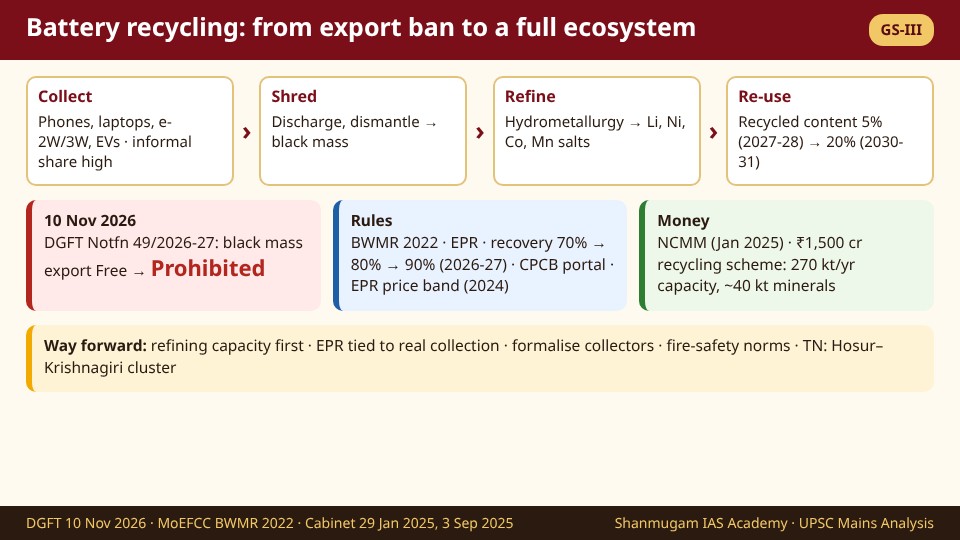
Topics: Environment – Pollution, Waste Management and Circular Economy · GS-III · UPSC Mains Analysis
Key takeaways
- On 10 November 2026 India prohibited the export of lithium-ion battery black mass (DGFT Notification 49/2026-27, ITC (HS) 8549 14 00) so that lithium, nickel and cobalt are recovered at home.
- Rules and money exist – Battery Waste Management Rules 2022 (EPR; 90% material recovery from 2026-27; recycled content 5% to 20% from 2027-28 to 2030-31), NCMM (2025) and a ₹1,500-crore recycling scheme – but collection, refining capacity and enforcement lag.
- For UPSC: write it as a value chain (collect → shred → refine → re-use); PYQ: GS-III 2018 (solid and toxic waste); TN: EV Policy 2023, Hosur–Krishnagiri cluster.

Why in news
On 10 November 2026, the Directorate General of Foreign Trade (DGFT) issued Notification No. 49/2026-27 under Sections 3 and 5 of the Foreign Trade (Development and Regulation) Act, 1992. It changed the export policy for "unsorted" battery waste that does not contain lead, cadmium or mercury – described as lithium-ion battery black mass (ITC (HS) 8549 14 00) – from "Free" to "Prohibited", with immediate effect and until further orders. The aim is to keep this mineral-rich material in India so that lithium, nickel and cobalt are recovered at home.
The ban comes a week after the Union Cabinet (4 November 2026) approved a ₹2,814-crore capex support scheme for lithium and nickel processing. Together they raise the question this analysis takes up: an export ban can secure the feedstock, but India still needs a whole ecosystem – collection, safe transport, enough chemical-recovery capacity, clean standards and buyers for recycled material – for recycling to work.
Background: the rules and schemes in one table
| Measure | Key facts |
|---|---|
| Battery Waste Management Rules, 2022 (MoEFCC) | Notified on 22 August 2022, replacing the Batteries (Management and Handling) Rules, 2001. Cover all batteries – portable, electric vehicle (EV), automotive and industrial. Producers (including importers) carry extended producer responsibility (EPR): collection and recycling or refurbishment; landfilling and incineration are banned. |
| Recovery and recycled-content targets | Minimum material recovery for EV and portable batteries rises from 70% (2024-25) to 80% (2025-26) and 90% (from 2026-27). New batteries must use a minimum share of domestically recycled material, starting at 5% in 2027-28 and reaching 20% by 2030-31. |
| Enforcement | Registration of producers, recyclers and refurbishers on a centralised online portal run by the Central Pollution Control Board (CPCB); trade in EPR certificates; environmental compensation on the polluter-pays principle for missed targets. |
| Amendments | 2023; 2024 (notified 14 March 2024) – CPCB fixes the highest and lowest price of EPR certificates, at 100% and 30% of the environmental compensation; 2025 (effective 24 February 2025) – EPR registration number may be shown through a barcode or QR code. |
| National Critical Mineral Mission | Approved by the Cabinet on 29 January 2025: ₹16,300 crore of expenditure plus an expected ₹18,000 crore by PSUs and others over seven years; includes recycling, processing parks and a national stockpile. |
| Recycling incentive scheme | Approved on 3 September 2025: ₹1,500 crore for FY 2025-26 to 2030-31, for recycling e-waste, lithium-ion battery scrap and other scrap; 20% capex subsidy plus an opex incentive; aims at 270 kilotonnes a year of recycling capacity, about 40 kilotonnes of critical minerals, about ₹8,000 crore of investment and close to 70,000 jobs. |
Analysis: why rules alone have not built an industry
- Value sits in the chemical stage. Recycling has two steps: mechanical (discharging, dismantling, shredding into black mass) and chemical (hydrometallurgy, which leaches and refines the metals into battery-grade salts). Shredding is cheap; refining is capital-heavy. When black mass is exported, India keeps the low-value step and gives away the minerals. The DGFT ban corrects this – but only if domestic refining capacity grows fast enough to absorb the black mass.
- Collection is the weak link. Most spent lithium-ion batteries today come from phones, laptops, power banks and electric two- and three-wheelers. Many pass through informal dismantlers and scrap dealers who often offer better prices than formal recyclers, open packs unsafely and send cells to unregistered units. EPR targets are met on paper when certificates are traded without enough physical collection.
- Volumes are still small and uneven. India's EV boom is recent, so large end-of-life volumes from EVs and grid storage will arrive only towards the end of this decade. Until then, recyclers depend on factory scrap and small consumer batteries, which makes plants hard to finance without assured feedstock.
- Safety and environment. Damaged lithium-ion cells can catch fire during storage and transport; poor chemical processing creates acidic effluents and fluoride emissions. Standards for transport, storage and plant emissions must keep pace with the industry.
- Strategic link. Lithium, cobalt and nickel are among the 30 critical minerals listed by the Ministry of Mines (2023), and India imports almost all of them. Recycling is "urban mining" – a domestic source that also reduces mining impacts abroad. The recycled-content targets from 2027-28 create a guaranteed market for recovered material.
- Tamil Nadu angle: Tamil Nadu's Electric Vehicles Policy 2023 (February 2023) aims at ₹50,000 crore of investment and 1.5 lakh jobs, offers a special capital-subsidy option for advanced chemistry cell (ACC) manufacturing, and names six pilot EV cities – Chennai, Coimbatore, Tiruchirappalli, Madurai, Salem and Tirunelveli. The Hosur–Krishnagiri belt is a major hub for electric two-wheelers, and the State's Battery Energy Storage Systems Policy 2026 will add grid batteries. This makes Tamil Nadu a natural site for a recycling cluster close to manufacturers – with the Tamil Nadu Pollution Control Board licensing and monitoring plants.
Analysis table: mechanical vs chemical recycling
| Stage | What happens | India's position |
|---|---|---|
| Collection and transport | Spent batteries gathered from users, dealers and fleets; safe packing of damaged cells | Weak; large informal share; EPR collection often on paper |
| Mechanical processing | Discharging, dismantling, shredding, sieving into black mass | Many small units; low entry cost |
| Chemical recovery (hydrometallurgy) | Leaching and refining into battery-grade lithium, nickel, cobalt and manganese salts | Limited capacity – the stage the export ban and the ₹1,500-crore scheme aim to build |
| Re-use in new cells | Recycled salts go back into cathodes | Depends on domestic cell and cathode plants and on the recycled-content targets from 2027-28 |
Faculty view
Write this as a value-chain answer: collection → mechanical → chemical → re-use. Show that India has the rules (BWMR 2022 with EPR, recovery and recycled-content targets), the money (NCMM, the ₹1,500-crore recycling scheme) and now the trade measure (the black-mass export ban of 10 November 2026) – but the missing pieces are physical collection, refining capacity and enforcement. End with a balanced line: an export ban works only as a bridge while domestic refining grows; if capacity lags, stockpiled black mass becomes a fire and pollution risk.
Way forward
- Build chemical-recovery capacity fast through the ₹1,500-crore scheme and NCMM processing parks, so that black mass kept at home is actually refined.
- Tie EPR certificates to verified physical collection, with digital tracking of each battery from sale to recycler (a "battery passport" approach).
- Bring informal collectors into the formal chain through registered collection centres, buy-back schemes at dealers and safety training.
- Notify clear standards for safe storage and transport of damaged lithium-ion cells and for emissions and effluents from recycling plants.
- Use public procurement and the recycled-content targets to create assured demand for recovered lithium, nickel and cobalt.
- Review the export ban periodically against domestic capacity, and promote design for recycling and second-life use of EV batteries in storage.
Glossary – Black mass
The dark powder obtained when spent lithium-ion batteries (and factory scrap) are discharged, shredded and sieved. It holds the valuable cathode and anode material – lithium, nickel, cobalt, manganese and graphite – and is the main feedstock for the chemical (hydrometallurgical) stage of recycling, where these metals are separated and refined. Whoever processes the black mass captures most of the value of recycling. On 10 November 2026, DGFT Notification No. 49/2026-27 moved the export of lithium-ion battery black mass (ITC (HS) 8549 14 00) from "Free" to "Prohibited".
Asked before in UPSC
1. "What are the impediments in disposing of the huge quantities of discarded solid wastes which are continuously being generated? How do we remove safely the toxic wastes that have been accumulating in our habitable environment?" – GS-III, 2018 (150 words)
We found no Mains question so far on battery recycling itself. With the 2022 rules, the 2025 recycling scheme and the 2026 export ban, expect waste management to be asked through this new angle – prepare EPR and critical minerals together.
Mains practice question
"Banning the export of black mass secures the feedstock, but India still lacks a battery-recycling ecosystem." Examine the statement and suggest measures to make lithium-ion battery recycling a pillar of India's critical mineral security. (15 marks, 250 words)
FAQ
What did India ban on 10 November 2026?
The export of lithium-ion battery black mass – unsorted battery waste not containing lead, cadmium or mercury, under ITC (HS) 8549 14 00 – through DGFT Notification No. 49/2026-27. Its export policy changed from "Free" to "Prohibited" with immediate effect.
What does EPR mean under the Battery Waste Management Rules, 2022?
Producers, including importers, must ensure that the batteries they sell are collected and recycled or refurbished, meet set targets, and register on the CPCB portal; failure attracts environmental compensation.
How much recovery do the rules require from EV batteries?
Minimum material recovery of 70% in 2024-25, 80% in 2025-26 and 90% from 2026-27 onwards.
Sources: DGFT Notification No. 49/2026-27 (10 November 2026) and PTI report (11 November 2026); PIB/MoEFCC release on the Battery Waste Management Rules, 2022 (25 August 2022) and the 2024 and 2025 amendments; Cabinet decisions on the National Critical Mineral Mission (29 January 2025), the critical mineral recycling incentive scheme (3 September 2025) and the capex support scheme for lithium and nickel processing (4 November 2026); Tamil Nadu Electric Vehicles Policy 2023. Topic from the editorial page of The Hindu, 14 November 2026; analysis is our own.
Related on our site: UPSC Mains Analysis – all articles · UPSC glossary · UPSC Mains answer-writing practice · Free PDF downloads
Link to this page from your website / blog (HTML code)
SI/POLICE Achievers
-

MURUGAN
SI / POLICE SI / POLICE
Indian Polity in Tamil | 100 அரசியலமைப்பு வினா விடை | TNPSC Group 4 Preparation 2026
TNPSC குரூப் 1, 2/2A, 4 – நேரடி வகுப்புகள் · கோவை & மதுரை
2006 முதல் சண்முகம் IAS அகாடமி · Classroom & online coaching in Coimbatore and Madurai
