

Mains Analysis: Inflation above 6% – rate hike or supply fix?
14 November 2026 · English Economy & Banking
⬇ Download this analysis as free PDF
Topics: Indian Economy – Inflation, Monetary Policy and Growth · GS-III · UPSC Mains Analysis
Key takeaways
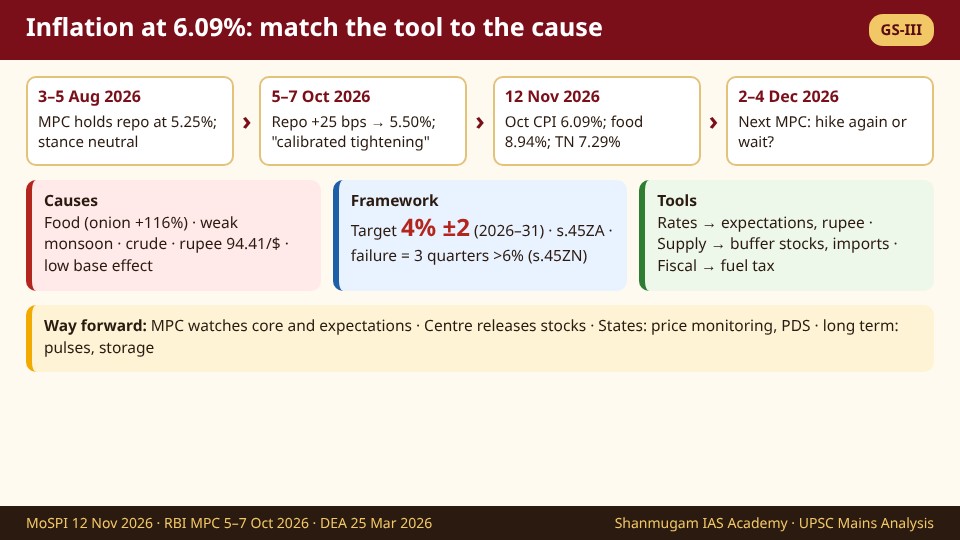
- CPI inflation rose to 6.09% in October 2026 (food 8.94%), above the 6% upper tolerance for the first time in two years; Tamil Nadu led large States at 7.29%.
- The MPC raised the repo rate to 5.50% on 7 October 2026 ("calibrated tightening"); its next meeting is on 2–4 December 2026. The drivers – food after a weak monsoon, crude oil, a weaker rupee and a low base – are mostly on the supply side.
- For UPSC: RBI Act ss. 45ZA (4% ±2, notified for 2026–31), 45ZB (MPC), 45ZN (failure = three quarters outside the band); match tools to causes; PYQ: GS-III 2024 (food inflation and monetary policy).

Why in news
Data released by the National Statistics Office (NSO), Ministry of Statistics and Programme Implementation, on 12 November 2026 show all-India CPI inflation at 6.09% in October 2026 (5.54% in September) – above the RBI's upper tolerance limit of 6% for the first time in two years. Food inflation rose to 8.94%; rural inflation was 6.63% and urban 5.41%. Onion (about +116% over a year), garlic (+61%) and ginger (+48%) led the rise. Retail inflation was unusually low a year earlier, so a low base (statistical base effect) also lifts this year's rate.
The RBI had already acted: its Monetary Policy Committee (MPC), meeting on 5–7 October 2026, raised the repo rate by 25 basis points to 5.50% by a 6–0 vote and changed its stance from neutral to "calibrated tightening" (two members preferred to keep it neutral). The debate now is whether the MPC should raise rates again at its next meeting on 2–4 December 2026, or whether inflation driven by food, oil and the rupee needs a different mix of tools.
Background: the inflation-targeting framework
| Element | Key facts |
|---|---|
| Target (Section 45ZA, RBI Act, 1934) | Set by the Central Government in consultation with the RBI once every five years. Notified on 25 March 2026 for 1 April 2026 to 31 March 2031: 4% CPI inflation, with 6% upper and 2% lower tolerance. |
| Monetary Policy Committee (Section 45ZB) | Six members – the Governor (chair, with a casting vote), a Deputy Governor, one RBI officer and three external members appointed by the Centre; decides the repo rate. |
| Failure (Section 45ZN) | If average inflation stays above 6% or below 2% for three consecutive quarters, the RBI must report to the Centre the reasons, the remedial action and the time needed to return to target. |
| October 2026 decision | Repo 5.50%; Standing Deposit Facility 5.25%; Marginal Standing Facility and Bank Rate 5.75%. Projections for 2026-27: CPI 5.2% (Q3 6.0%, Q4 5.7%), core 4.4%, real GDP growth 7.1%. |
| External pressures | MPC minutes cite rising crude oil prices linked to the West Asia conflict, exchange-rate depreciation, a deficient south-west monsoon and El Niño. The rupee settled at 94.41 a dollar on 5 November 2026 (PTI), against 88.63 on 12 November 2025 – a dollar now costs about 6.5% more in rupees. |
Analysis: what kind of inflation is this?
- Mainly supply-side, but spreading. The surge is led by food (vegetables, sugar) after a weak monsoon, and by energy costs. Interest rates do little to grow onions. But the MPC noted that food inflation has become broader, and the October projection of 4.4% core inflation is above target – so the risk is that high food and fuel prices feed into household expectations, wages and other prices.
- Imported inflation through oil and the rupee. A weaker rupee raises the rupee cost of crude oil, edible oil, fertilisers and electronics. Brent eased to about $96 a barrel in early November 2026 from above $105 (PTI), but the rupee's fall offsets part of that relief. Here a rate hike works mainly through the exchange rate and capital flows, not through demand.
- The case for another hike. With the repo at 5.50% and inflation at 6.09%, the real policy rate is negative. Inflation-targeting credibility rests on acting before expectations slip; the RBI itself projects Q3 inflation at 6.0%. A further 25-basis-point move would signal resolve and support the rupee.
- The case for patience. Monetary policy works with a lag of several quarters; a part of the jump is a base effect; and growth faces external headwinds. Over-tightening against a supply shock can hurt borrowers and MSMEs without lowering food prices. The law also gives room: one month above 6% is not a "failure" – that needs three consecutive quarterly averages above 6%.
- The fiscal side matters. Supply measures – releasing buffer stocks of pulses and onion, easier imports of edible oil and pulses, curbs on hoarding, and lower fuel taxes where fiscal space allows – act faster on food and fuel. Coordination between the Finance Ministry and the RBI decides how much of the burden monetary policy must carry.
- Tamil Nadu angle: Among States with a population above 50 lakh, Tamil Nadu recorded the highest inflation in October 2026 at 7.29%, and Puducherry was the highest of all States/UTs at 7.96% (MoSPI). The three highest large States – Tamil Nadu, Telangana (7.26%) and Andhra Pradesh (7.25%) – are all in the south, so the food shock hit the region hardest. Tamil Nadu's universal public distribution system cushions poor households on rice, but fresh vegetables and spices fall outside it – which is why market intervention and price monitoring by the State matter.
Analysis table: matching the tool to the cause
| Cause | Best tool | Who acts |
|---|---|---|
| Vegetable and pulse price spikes (weak monsoon) | Buffer-stock release, imports, storage and cold chains, curbs on hoarding | Centre and States |
| Costlier crude oil and a weaker rupee | Fuel-tax adjustment; forex intervention; rate action to support the rupee | Finance Ministry and RBI |
| Spread into core prices and expectations | Repo rate hike, liquidity management, clear forward guidance | MPC / RBI |
| Hardship for poor households | Targeted transfers, food through PDS | Centre and States |
Faculty view
Avoid a one-line answer such as "RBI should hike rates". Begin with the numbers (6.09% in October 2026; food 8.94%; repo 5.50%), classify the causes (supply shock + imported inflation + base effect), then judge the tools: monetary policy for expectations and the rupee, supply and fiscal measures for food and fuel. Quote Sections 45ZA and 45ZN to show you know the framework, and end with coordination between the Centre, the States and the RBI. A State example (Tamil Nadu at 7.29%) adds depth.
Way forward
- MPC: decide on 2–4 December 2026 on the basis of core inflation and expectations, not one month's headline number; keep forward guidance clear.
- Centre: release buffer stocks of onion and pulses in time, ease imports of edible oil and pulses, and act against hoarding.
- Fuel: use tax room to smooth retail fuel prices if crude stays high, without hurting the fiscal deficit target.
- States: strengthen price monitoring, cooperative and farm-fresh outlets, and cold storage for perishables; protect the poor through PDS.
- Long term: raise pulses and oilseed output, build crop-specific storage, improve monsoon-risk planning and diversify energy imports.
Glossary – Imported inflation
A rise in domestic prices that comes from abroad – through costlier imports such as crude oil, edible oil, fertilisers and electronics, or through a weaker rupee, which makes every dollar-priced import dearer. It is a cost-push pressure: a rate hike cannot lower world oil prices, but it can support the rupee and stop higher costs from spreading into wages and other prices (second-round effects). In its October 2026 meeting, the RBI's Monetary Policy Committee cited rising crude oil prices linked to the West Asia conflict and exchange-rate depreciation among the risks to inflation.
Asked before in UPSC
1. "What are the causes of persistent high food inflation in India? Comment on the effectiveness of the monetary policy of the RBI to control this type of inflation." – GS-III, 2024 (150 words)
The 2024 question asked exactly today's dilemma – can interest rates control food-led inflation? Use the October 2026 data and the December 2026 MPC choice as fresh examples.
Mains practice question
"When inflation is driven by food, oil and the exchange rate, monetary policy alone cannot bring it down." Examine this statement in the light of India's inflation in October 2026 and the flexible inflation-targeting framework. (15 marks, 250 words)
FAQ
What was India's CPI inflation in October 2026?
6.09%, up from 5.54% in September, according to the NSO data released on 12 November 2026; food inflation was 8.94%.
When is the RBI said to have failed its inflation target?
Under Section 45ZN of the RBI Act, 1934, when average inflation stays above the upper tolerance (6%) or below the lower tolerance (2%) for three consecutive quarters. The RBI must then explain the reasons and the remedial action to the Centre.
What did the MPC decide in October 2026?
It raised the repo rate by 25 basis points to 5.50% by a 6–0 vote and moved to a "calibrated tightening" stance; its next meeting is on 2–4 December 2026.
Sources: MoSPI/NSO CPI press release for October 2026 (12 November 2026); RBI – MPC resolution and minutes of the meeting of 5–7 October 2026 (minutes released 21 October 2026) and the MPC calendar for 2026-27; Department of Economic Affairs notification on the inflation target (25 March 2026); RBI Act, 1934 (Sections 45ZA, 45ZB, 45ZN); PTI market reports (5 November 2026). Topic from the editorial page of The Hindu, 14 November 2026; analysis is our own.
Related on our site: UPSC Mains Analysis – all articles · UPSC glossary · UPSC Mains answer-writing practice · Free PDF downloads
Link to this page from your website / blog (HTML code)
TNPSC Achievers
-

M. KAVIYA
TNPSC TNPSC
Indian Polity in Tamil | 100 அரசியலமைப்பு வினா விடை | TNPSC Group 4 Preparation 2026
TNPSC குரூப் 1, 2/2A, 4 – நேரடி வகுப்புகள் · கோவை & மதுரை
2006 முதல் சண்முகம் IAS அகாடமி · Classroom & online coaching in Coimbatore and Madurai
