

Villupuram: 2,300-year-old burial urns found in Thenpennai river bed
15 November 2026 · English History, Art & Culture
⬇ Download this article as free PDF
Topics: History & Archaeology · UPSC Prelims · TNPSC · SSC · Current Affairs
Current affairs of 15 November 2026 (Shanmugam IAS Academy) – explained for UPSC, TNPSC and other competitive exams
News
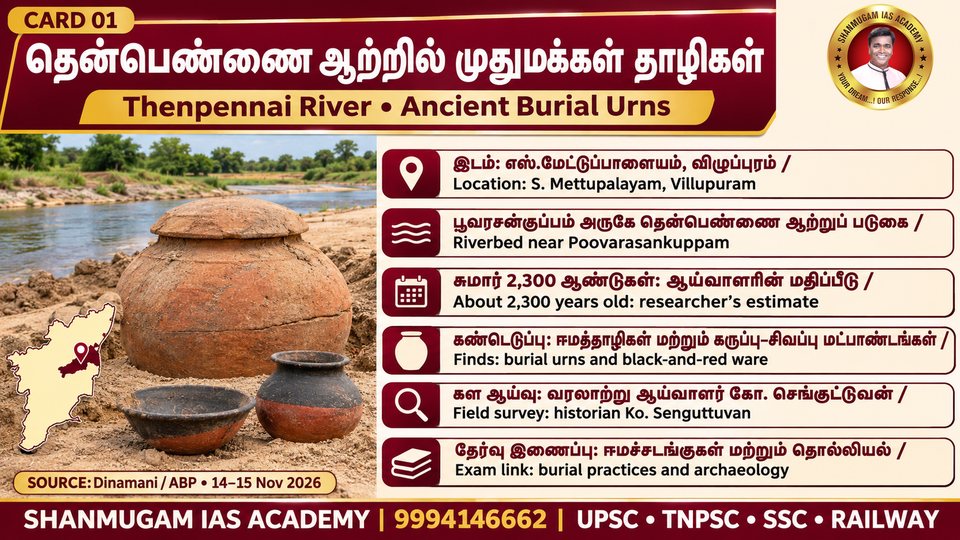
Media reported on 14 November 2026 that burial urns had been found in the Thenpennai river bed at S. Mettupalayam near Poovarasankuppam, close to Villupuram. Acting on information from local resident K. Prakash, Villupuram history researcher Ko. Senguttuvan carried out a field survey. The urns held bones; a small, finely made pot with a lid and a very thin rim, black inside and black-and-red outside, was also found. He said they are evidence of the funerary practice of burying the dead in urns and estimated them to be about 2,300 years old (no scientific dating has been done yet). Potsherds bearing symbols were found in the same area in 2019. He has asked the Villupuram District Collector and the State Archaeology Department to carry out excavation and a surface survey and to declare the site protected.
Key facts for the exam
| Point | Details |
|---|---|
| Place | S. Mettupalayam, near Poovarasankuppam, Villupuram district |
| River | Thenpennai (South Pennar / Ponnaiyar) |
| Field survey | Researcher Ko. Senguttuvan; tip-off – K. Prakash |
| Finds | Urns with bones, black-and-red ware, small lidded pot |
| Age | About 2,300 years (researcher's estimate) |
| Earlier find | 2019 – potsherds with symbols |
| Demand | Excavation; declaration as protected site |
| Dept letter | July 2020 – survey ordered; no action yet (reported) |
Background
- Archaeology: placing the dead, or their bones, in large earthen urns and burying them is 'urn burial'. In south India it is linked to the Megalithic culture, which largely coincides with the Iron Age. Dolmens, cists, cairn circles and menhirs are types of megalithic monuments. Black-and-red ware is a hallmark of this culture – firing the pot upside down turns the inside black and the outside red.
- Tamil Nadu evidence: Adichanallur on the Thamirabarani is the State's best-known urn-burial site; Andrew Jagor dug there in 1876 and Alexander Rea in 1899–1905. Sivakalai (Thoothukudi), Kodumanal (Erode) and Konthagai (Keeladi cluster, Sivaganga) are other key sites. The Manimekalai lists several modes of disposal – cremation, exposure, pit burial, burial in a vault and covering in an urn; in Purananuru 228 the poet Aiyur Mudavanar addresses the potter making a king's burial urn as 'kalam sei kove'.
- Geography: the Thenpennai (Ponnaiyar) rises on Nandi Hills (Nandidurg) in Karnataka's Chikkaballapur district. It flows through Krishnagiri, Dharmapuri, Tiruvannamalai, Kallakurichi, Villupuram and Cuddalore districts and enters the Bay of Bengal at Cuddalore. The Krishnagiri (KRP) and Sathanur dams stand across it; Tirukoilur is a historic town on its bank. It runs about 80 km in Karnataka and 320 km in Tamil Nadu (Britannica).
- Law: Article 49 of the Constitution (a Directive Principle) makes it the State's duty to protect monuments of national importance. At the Union level the Archaeological Survey of India protects sites under the Ancient Monuments and Archaeological Sites and Remains (AMASR) Act, 1958; at the State level the Tamil Nadu Archaeology Department declares protected sites under the Tamil Nadu Ancient and Historical Monuments and Archaeological Sites and Remains Act, 1966.
What is this news about?
Media reported on 14 November 2026 that burial urns had been found in the Thenpennai river bed at S. Mettupalayam near Poovarasankuppam, close to Villupuram. Acting on information from local resident K. Prakash, Villupuram history researcher Ko. Senguttuvan carried out a field survey.
What are the key facts to remember for the exam?
Place: S. Mettupalayam, near Poovarasankuppam, Villupuram district; River: Thenpennai (South Pennar / Ponnaiyar); Field survey: Researcher Ko. Senguttuvan; tip-off – K. Prakash; Finds: Urns with bones, black-and-red ware, small lidded pot.
What is the background to this news?
Archaeology: placing the dead, or their bones, in large earthen urns and burying them is 'urn burial'. In south India it is linked to the Megalithic culture, which largely coincides with the Iron Age. Dolmens, cists, cairn circles and menhirs are types of megalithic monuments.
Practise more: Weekly current affairs · Daily subject quiz · Knowledge nugget
Sources: ETV Bharat Tamil Nadu (14 Nov 2026); Dinamalar (14 Nov 2026); Tamil Nadu State Department of Archaeology (tnarch.gov.in); DT Next (Gingee grooves, 2021). Compiled by Shanmugam IAS Academy.
Link to this page from your website / blog (HTML code)
BANK Achievers
-

M. NANDHINI
BANK BANK
நடப்பு நிகழ்வுகள் 17 நவம்பர் 2026 | Today Current Affairs in Tamil | TNPSC Group 4 வினா விடை
TNPSC குரூப் 1, 2/2A, 4 – நேரடி வகுப்புகள் · கோவை & மதுரை
2006 முதல் சண்முகம் IAS அகாடமி · Classroom & online coaching in Coimbatore and Madurai
