

Rare water rail sighted at Navi Mumbai's TS Chanakya wetland
15 November 2026 · English Environment & Ecology
⬇ Download this article as free PDF
Topics: Environment · UPSC Prelims · TNPSC · SSC · Current Affairs
Current affairs of 15 November 2026 (Shanmugam IAS Academy) – explained for UPSC, TNPSC and other competitive exams
News
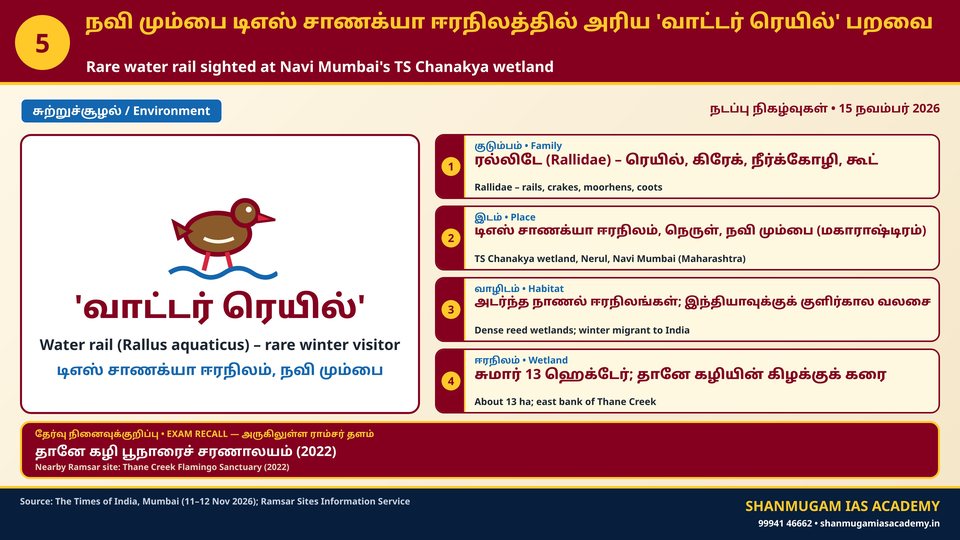
Bird photographer Yash Shetty spotted a rare Water Rail (Rallus aquaticus) at the TS Chanakya wetland in Nerul, Navi Mumbai, on 11 November 2026, The Times of India reported. It appeared unexpectedly while photographers were shooting Baillon's crakes feeding there. The species was last recorded in the Mumbai region in 2018, so this is reported to be the first record in about eight years. Shy and secretive, the bird lives in dense, reed-filled wetlands across Europe, Asia and North Africa; it is a winter migrant to India. The wetland – about 13 hectares of tidal wetland on the east bank of Thane Creek, next to the maritime training institute 'Training Ship Chanakya' – is a key roost of lesser flamingos. The report says the sighting underlines the need to protect Navi Mumbai's wetlands.
Key facts for the exam
| Point | Details |
|---|---|
| Bird | Water rail – Rallus aquaticus |
| Family | Rallidae – rails, crakes, moorhens, coots |
| Place | TS Chanakya wetland, Nerul, Navi Mumbai (Maharashtra) |
| Date | 11 November 2026 (reported) |
| Previous record | Mumbai region, 2018 |
| Habitat | Dense reed wetlands; winter migrant to India |
| Wetland | About 13 ha; east bank of Thane Creek |
| Nearby Ramsar site | Thane Creek Flamingo Sanctuary (2022) |
| Legal cover | Wetlands Rules, 2017 – Environment (Protection) Act, 1986 |
Background
- Ornithology: rails belong to the family Rallidae, which also includes crakes, moorhens, coots and the purple swamphen. Their laterally flattened bodies and long toes help them slip through dense reeds. The water rail has a red bill and a grey-brown body; because of its wide range, the IUCN lists it as 'Least Concern'.
- Ramsar Convention: signed in 1971 at Ramsar, Iran, to conserve wetlands of international importance; India joined in 1982. Ramsar sites whose ecological character is under threat are placed on the 'Montreux Record'; in India, Keoladeo (Rajasthan) and Loktak (Manipur) are on it. 2 February is World Wetlands Day.
- Law: in India, wetlands are regulated by the Wetlands (Conservation and Management) Rules, 2017, framed under the Environment (Protection) Act, 1986; every State must set up a State Wetlands Authority. Coastal wetlands are also protected under the Coastal Regulation Zone (CRZ) notification; Being an intertidal wetland, the TS Chanakya wetland falls in CRZ-I, according to environmentalists.
- Geography: Thane Creek is the estuarine inlet separating Salsette Island (Mumbai) from the mainland (Navi Mumbai); its mangroves and mudflats draw thousands of flamingos. The 'Thane Creek Flamingo Sanctuary' was declared a Ramsar site in August 2022. The flamingos mostly arrive from Kutch, Gujarat, around November.
What is this news about?
Bird photographer Yash Shetty spotted a rare Water Rail (Rallus aquaticus) at the TS Chanakya wetland in Nerul, Navi Mumbai, on 11 November 2026, The Times of India reported. It appeared unexpectedly while photographers were shooting Baillon's crakes feeding there.
What are the key facts to remember for the exam?
Bird: Water rail – Rallus aquaticus; Family: Rallidae – rails, crakes, moorhens, coots; Place: TS Chanakya wetland, Nerul, Navi Mumbai (Maharashtra); Date: 11 November 2026 (reported).
What is the background to this news?
Ornithology: rails belong to the family Rallidae, which also includes crakes, moorhens, coots and the purple swamphen. Their laterally flattened bodies and long toes help them slip through dense reeds.
Practise more: Weekly current affairs · Daily subject quiz · Knowledge nugget
Sources: The Times of India, Mumbai (11–12 Nov 2026); Ramsar Sites Information Service (rsis.ramsar.org); MoEFCC – Wetlands (Conservation and Management) Rules, 2017. Compiled by Shanmugam IAS Academy.
Link to this page from your website / blog (HTML code)
BANK Achievers
-

R. RAMYA
BANK BANK
நடப்பு நிகழ்வுகள் 17 நவம்பர் 2026 | Today Current Affairs in Tamil | TNPSC Group 4 வினா விடை
TNPSC குரூப் 1, 2/2A, 4 – நேரடி வகுப்புகள் · கோவை & மதுரை
2006 முதல் சண்முகம் IAS அகாடமி · Classroom & online coaching in Coimbatore and Madurai
