

Mains Analysis: Census 2027 goes digital – data, privacy and trust
19 November 2026 · English Polity & Governance
⬇ Download this analysis as free PDF
Topics: Governance – Transparency, e-Governance, Statistical System; Society – Population · GS-II · GS-I · UPSC Mains Analysis
Key takeaways
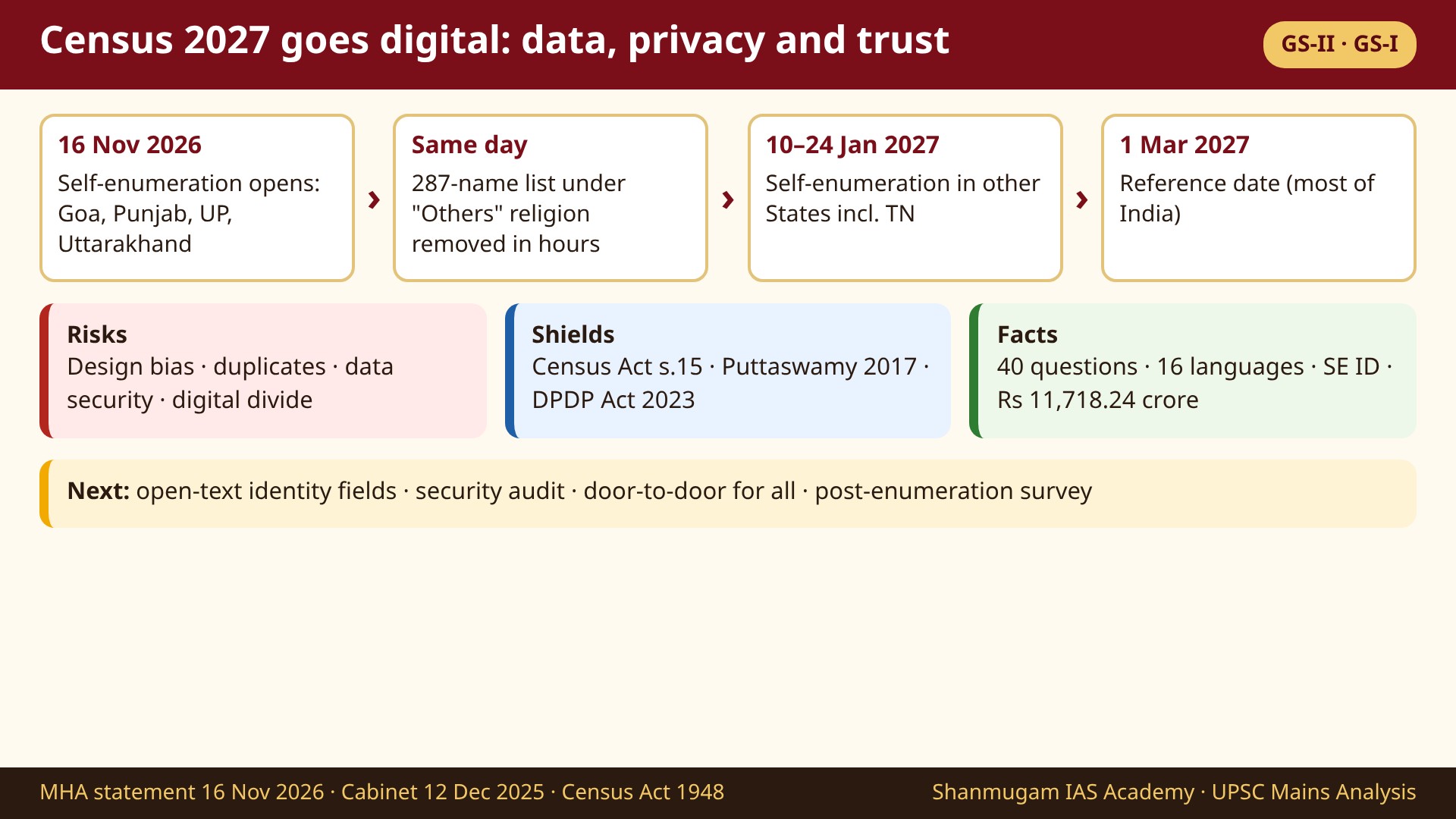
- Census 2027 self-enumeration opened on 16 November 2026 (se.census.gov.in) for Goa, Punjab, Uttar Pradesh and non-snow-bound Uttarakhand – 40 questions, 16 languages, a Self-Enumeration ID, and the enumerator still visits every home; the rest of India follows on 10–24 January 2027.
- On the first day a 287-name list appeared under the "Others" religion option and was removed within hours; the Census office said "Others" stays a free-text field – a reminder that portal design can shape the count.
- A digital census must pass four tests – data quality, security, legal protection (Census Act section 15, Puttaswamy 2017, DPDP Act 2023) and public trust; it feeds delimitation after 2026, a key concern for Tamil Nadu.

Why in news
On 16 November 2026 the self-enumeration facility for Phase II (Population Enumeration) of Census 2027 opened on se.census.gov.in for Goa, Punjab, Uttar Pradesh and the non-snow-bound areas of Uttarakhand (Ministry of Home Affairs statement). The same day, the "Others" option of the religion question on the portal showed a list of 287 names – from ISKCON and Sarna to sects and saints – that had never appeared in census records as religions. After The Hindu sought the Home Ministry's response, the list was removed within hours. India's first digital census has thus raised a governance question larger than one bug: how should a digital census protect data quality, privacy and public trust?
How self-enumeration works
- Residents log in with a mobile number (preferably the one registered in Phase I), answer the 40 notified questions on household and individual particulars in any of 16 Indian languages, and get a Self-Enumeration ID (SE ID).
- The SE ID is shown to the enumerator, who still visits every household; families that do not self-enumerate are counted door to door.
- Four States: online till 30 November 2026; house-to-house enumeration 1 December 2026 – 4 January 2027; revision 5–9 January; reference date 00:00 hours, 5 January 2027. These States go to Assembly polls early in 2027.
- Rest of India (including Tamil Nadu): self-enumeration 10–24 January 2027; enumeration 25 January – 28 February 2027; revision 1–5 March; reference date 00:00 hours, 1 March 2027. Manipur's process is on hold.
- Phase I (Houselisting and Housing Census) is complete in 35 States and UTs, except Manipur.
The religion drop-down episode
- The religion question keeps six named religions (Hindu, Muslim, Christian, Sikh, Buddhist, Jain) and "Others". A menu under "Others" was a first.
- The office of the Registrar General and Census Commissioner said "Others" remains open and the respondent "is free to write any other religion as in previous censuses", and that it was incorrect to say the listed terms were shown as religions. An official said the names had been compiled as predictive text to help enumerators spell entries, and that officials were examining how the list became selectable.
- Why it matters: groups such as Sarna followers seek a separate religion code (the Jharkhand Assembly passed a resolution in November 2020). A pre-filled list can nudge answers, merge sects with religions and change the final count – the classic "design effect" in surveys.
Background and verified data
| Item | Fact |
|---|---|
| Legal basis | Census Act, 1948 and Census Rules, 1990; Census is in the Union List (Entry 69, Seventh Schedule) |
| Census 2027 | 16th Census of India and 8th since Independence; the 2021 round was postponed because of COVID-19 |
| Cost (Union Cabinet, 12 December 2025) | Rs 11,718.24 crore; about 30 lakh field functionaries |
| Digital features | Enumerators use mobile devices and custom software; online self-enumeration; "Census as a Service" – machine-readable data for ministries |
| Census 2011 – "Other religions and persuasions" | About 79 lakh people (0.66%); "religion not stated" about 29 lakh (0.24%) |
| Uses of the count | Delimitation of Lok Sabha/Assembly seats after the first census after 2026 (Articles 82, 170 as amended in 2001); trigger for women's reservation (106th Amendment, 2023); SC/ST seat reservation; Finance Commission and scheme targeting |
Analysis: four tests for a digital census
| Test | Risk | What good practice looks like |
|---|---|---|
| Data quality | Drop-downs and auto-fill can steer answers; self-reports may be incomplete; duplicate entries (online + door-to-door) | Open-text fields for identity questions; SE ID matching; a strong post-enumeration survey to measure coverage error |
| Privacy and security | A single national database of every resident is a high-value target; mobile-number login links identity data | Encryption, minimum data, audit logs, independent security audits, breach notification |
| Legal protection | The DPDP Act, 2023 lets the government exempt processing for statistical purposes (section 17(2)(b)) and exempt its agencies on grounds such as security | Section 15 of the Census Act (records confidential, not evidence) is the core shield – it must apply fully to digital records and never be diluted by data sharing |
| Trust and inclusion | Digital divide (elderly, rural, women without phones); fear of misuse in a politically charged year | Door-to-door visit for all; clear public communication; quick, transparent correction of errors – as with the drop-down |
The drop-down episode was fixed in hours, but it shows why a census must be designed like a public institution, not just an app: every design choice – which options appear first, what is pre-filled, what is mandatory – can change the numbers that later decide seats, funds and policy. Under K.S. Puttaswamy v. Union of India (2017) privacy is a fundamental right under Article 21; any data collection must meet the tests of legality, legitimate aim and proportionality.
Tamil Nadu angle
- Tamil Nadu falls in the second group: self-enumeration 10–24 January 2027 and door-to-door count from 25 January 2027.
- Census 2027 data will be the base for the delimitation that follows the first census after 2026 – a major concern for States such as Tamil Nadu that controlled population growth. An accurate and trusted count is therefore a federal issue, not only a technical one.
- With a high mobile and internet reach, Tamil Nadu can show high self-enumeration – if the portal is easy in Tamil and the doorstep visit remains for those who need it.
Faculty view
Do not turn this into a caste-census or religion-politics answer. The examiner is testing e-governance: digital tools improve speed and cost, but statistics are only as good as public trust. Structure the answer as: what changed (self-enumeration, devices, Census as a Service) → what can go wrong (design bias, privacy, digital divide) → legal shield (Census Act section 15, Puttaswamy, DPDP Act) → way forward. Use the drop-down episode as a one-line example, not the whole answer.
Way forward
- Design rules: publish the questionnaire, screen designs and code lists in advance; keep identity questions (religion, language, tribe) as open text with neutral help.
- Security: independent audit (for example by CERT-In empanelled auditors), data stored in India, role-based access and logs.
- Law: state clearly that census data will not be shared for any individual-level purpose; extend section 15 protection expressly to digital records.
- Coverage: retain door-to-door visits, assisted self-enumeration at common service centres, and a strong post-enumeration survey with published results.
- Trust: an independent technical advisory group and quick public explanations when errors happen.
Glossary – Statistical confidentiality
The rule that information a person gives for official statistics is used only to produce statistics and is never used to take action against, or decide anything about, that individual. India's Census Act, 1948 builds it in: under section 15 no one has a right to inspect census records, and census entries are not admissible as evidence in any civil proceeding, or in any criminal proceeding other than a prosecution under the Act itself. The UN Fundamental Principles of Official Statistics (Principle 6) say the same. Statistical confidentiality is the basis of public trust: people answer honestly only when they are sure their answers will not be used against them.
Asked before in UPSC
We did not find a verified UPSC GS Mains question directly on a digital census or self-enumeration. The closest verified question is from Prelims:
"Right to Privacy is protected as an intrinsic part of Right to Life and Personal Liberty. Which of the following in the Constitution of India correctly and appropriately imply the above statement?" – Prelims 2018 (answer: Article 21 and the freedoms guaranteed in Part III).
For Mains, prepare this topic under GS-II (e-governance, transparency, government policies) and GS-I (population).
Mains practice question
"A digital census can be faster and cheaper, but its value depends on public trust." Discuss the data-quality and privacy challenges of self-enumeration in Census 2027 and suggest safeguards. (15 marks, 250 words)
FAQ
When did Census 2027 self-enumeration start?
On 16 November 2026 for Goa, Punjab, Uttar Pradesh and non-snow-bound Uttarakhand (till 30 November). Other States and UTs: 10–24 January 2027.
How does self-enumeration work?
Log in at se.census.gov.in with a mobile number, answer 40 questions in one of 16 languages, and show the Self-Enumeration ID to the enumerator who visits.
What was the religion drop-down issue?
On the first day, the "Others" religion option showed a list of 287 names. It was removed within hours; the Census office said "Others" remains a free-text field.
Is census data confidential?
Yes. Under section 15 of the Census Act, 1948, census records cannot be inspected and are not admissible as evidence, except in prosecutions under the Act.
What is the reference date of Census 2027?
00:00 hours on 1 March 2027 for most of India; 5 January 2027 for the four early States; snow-bound areas were counted in September 2026.
Sources: Ministry of Home Affairs statement on Phase II self-enumeration (16 November 2026, via PTI/ANI); The Hindu report on the religion list as carried by other outlets (17 November 2026); PIB/PMO – Cabinet approval of the Census of India 2027 scheme (12 December 2025); Census Act, 1948; Digital Personal Data Protection Act, 2023; K.S. Puttaswamy v. Union of India (2017); Constitution of India, Articles 82 and 170; Census of India 2011 (religion tables). Analysis is our own.
Related on our site: UPSC Mains Analysis – all articles · UPSC glossary · UPSC Mains answer-writing practice · Free PDF downloads
Add us as a preferred source on Google
Link to this page from your website / blog (HTML code)
TNPSC Achievers
-

SATHISH
TNPSC TNPSC
Indian Polity in Tamil | 100 அரசியலமைப்பு வினா விடை | TNPSC Group 4 Preparation 2026
TNPSC குரூப் 1, 2/2A, 4 – நேரடி வகுப்புகள் · கோவை & மதுரை
2006 முதல் சண்முகம் IAS அகாடமி · Classroom & online coaching in Coimbatore and Madurai
