

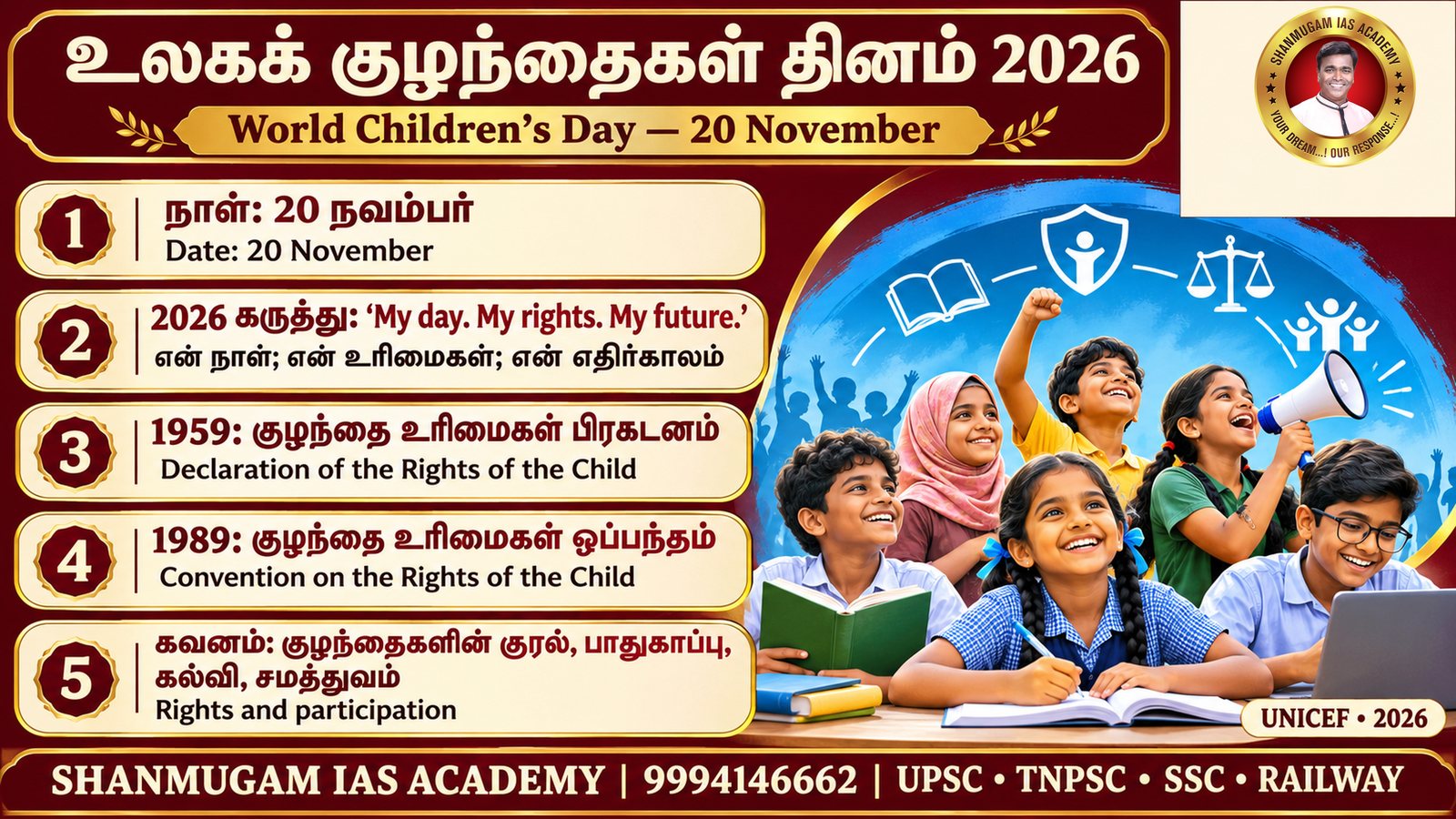
World Children's Day 2026: 'My day, my rights, my future'
20 November 2026 · English Important Days
⬇ Download this article as free PDF
Topics: Important Days · UPSC Prelims · TNPSC · SSC · Current Affairs
Current affairs of 20 November 2026 (Shanmugam IAS Academy) – explained for UPSC, TNPSC and other competitive exams
News
The UN's Universal (World) Children's Day is observed every year on 20 November; it is different from India's Children's Day (14 November). It marks the dates on which the UN General Assembly adopted the Declaration of the Rights of the Child (1959) and the Convention on the Rights of the Child (UNCRC, 1989). UNICEF's 2026 theme is 'Children are speaking up: My day, my rights, my future'; under it, children share their ideas about their lives, rights and futures. UNICEF has urged leaders and businesses to 'choose a future for children'. Children's views on privacy, safety and inclusion in artificial intelligence (AI) are being gathered for a 'Children's Manifesto on Child Rights and AI'. 'Kids' takeovers' of roles in media, politics and sport, and 'Go Blue' events lighting landmarks in blue, are held. About 190 countries take part each year (UNICEF).
Key facts for the exam
| Point | Details |
|---|---|
| Date | 20 November – UN World Children's Day (India's Children's Day – 14 Nov) |
| 2026 theme | 'My day, my rights, my future' |
| Banner | 'Children are speaking up'; 'Choose a future for children' |
| 1924 | Geneva Declaration – League of Nations; drafted by Eglantyne Jebb |
| 1959 / 1989 | Declaration / Convention on the Rights of the Child – 20 Nov |
| Optional Protocols | 2000 – children in armed conflict, sale of children; 2011 – complaints procedure |
| Non-ratifier | USA – the only UN member not to ratify the UNCRC |
| UNICEF | Created by the UN General Assembly in 1946 |
| 2026 activities | AI Children's Manifesto; kids' takeovers; Go Blue; ~190 countries |
Background
- History of child rights: In 1924 the League of Nations adopted the Geneva Declaration of the Rights of the Child, drafted by Eglantyne Jebb, founder of Save the Children. In 1946 the UN General Assembly created UNICEF. The 1959 Declaration of the Rights of the Child covered rights to education, play, a supportive environment and health care; the legally binding UNCRC followed in 1989.
- UNCRC: Defining every person below 18 as a 'child', it is the most widely ratified human rights treaty in history. Two Optional Protocols in 2000 cover children in armed conflict and the sale and sexual exploitation of children; a 2011 protocol created a 'communications procedure' for complaints to the Committee on the Rights of the Child. It has 196 States parties; the USA, which signed it, is the only UN member that has not ratified it.
- Indian Constitution: Article 15(3) allows special laws for women and children. Article 39(f), a Directive Principle (reworded by the 42nd Amendment, 1976), directs the State to give children opportunities to develop in a healthy manner in freedom and dignity, and to protect childhood and youth against exploitation and moral and material abandonment. Article 45 covers early childhood care and education below age six.
What is this news about?
The UN's Universal (World) Children's Day is observed every year on 20 November; it is different from India's Children's Day (14 November). It marks the dates on which the UN General Assembly adopted the Declaration of the Rights of the Child (1959) and the Convention on the Rights of the Child (UNCRC, 1989).
What are the key facts to remember for the exam?
Date: 20 November – UN World Children's Day (India's Children's Day – 14 Nov); 2026 theme: 'My day, my rights, my future'; Banner: 'Children are speaking up'; 'Choose a future for children'; 1924: Geneva Declaration – League of Nations; drafted by Eglantyne Jebb.
What is the background to this news?
History of child rights: In 1924 the League of Nations adopted the Geneva Declaration of the Rights of the Child, drafted by Eglantyne Jebb, founder of Save the Children.
Practise more: Weekly current affairs · Daily subject quiz · Knowledge nugget
Sources: UNICEF; DT Next. Compiled by Shanmugam IAS Academy.
Prepared by the Shanmugam IAS Academy faculty team, Coimbatore (since 2006) · independently checked against primary sources · Our editorial policy
Add us as a preferred source on Google
Link to this page from your website / blog (HTML code)
TNPSC Achievers
-
E. SHANMUGA PRIYA
TNPSC TNPSC
Indian Polity in Tamil | 100 அரசியலமைப்பு வினா விடை | TNPSC Group 4 Preparation 2026
📚 TNPSC குரூப் 4 / 2 / 2A – பொதுத்தமிழ், பொது அறிவு நூல்கள்
PDF நூல்கள் · ₹149 முதல் · ஒவ்வொன்றுக்கும் 50 பக்க இலவச மாதிரி · UPI-இல் பணம் செலுத்தியதும் உடனே பதிவிறக்கம்
 பொதுத் தமிழ் — முழுமையான கையேடு (TNPSC குரூப் 2 · 2A · 4)
₹199
 TNPSC முழுமையான பாடநூல்கள் – முழுத் தொகுப்பு (9 நூல்கள்)
₹1599
 பொதுத் தமிழ் — முந்தைய ஆண்டு வினா – விடை – விளக்கம் (புதிய பாடத்திட்டம்)
₹199
 TNPSC திறனறிவும் மனக்கணக்கு நுண்ணறிவும் (Aptitude & Mental Ability) – முழுமையான பாடநூல்
₹199
TNPSC குரூப் 1, 2/2A, 4 – நேரடி வகுப்புகள் · கோவை & மதுரை
2006 முதல் சண்முகம் IAS அகாடமி · Classroom & online coaching in Coimbatore and Madurai
