

Mains Analysis: COP31 – from lofty climate pledges to delivery
15 November 2026 · English Environment & Ecology
⬇ Download this analysis as free PDF
Topics: Environment – Climate Change, Paris Agreement and International Negotiations · GS-III · UPSC Mains Analysis
Key takeaways
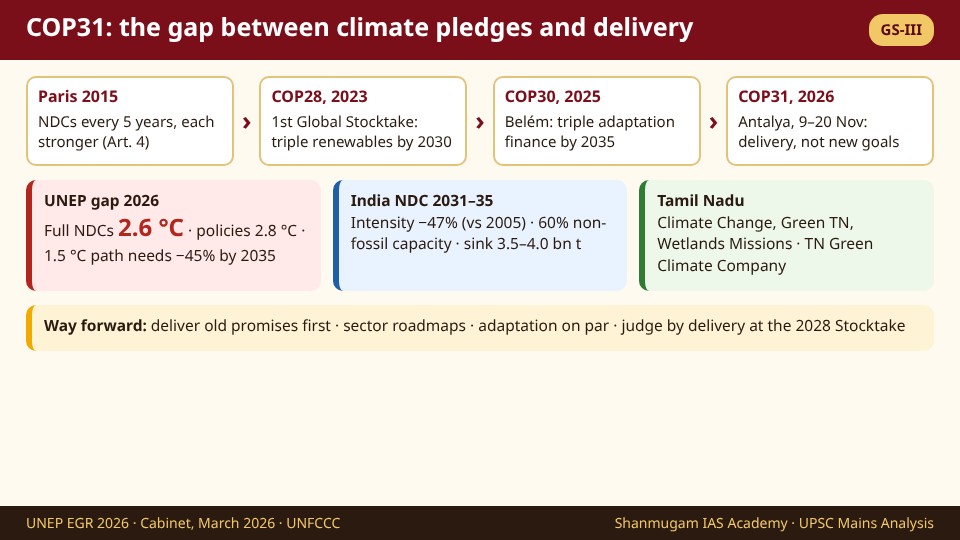
- COP31 (Antalya, Türkiye, 9–20 November 2026) is framed as an "implementation COP" – the real test is delivering past promises; it adopted a standalone Climate Finance Work Programme but dropped a separate item on tripling adaptation finance.
- The implementation gap is large: UNEP's Emissions Gap Report 2026 projects about 2.6 °C of warming even with full NDCs and 2.8 °C under current policies; the 1.5 °C path needs a 45% cut by 2035 from 2025 levels.
- India's NDC for 2031–35 (Cabinet, March 2026): emissions intensity −47% from 2005, 60% non-fossil capacity and a 3.5–4.0 billion tonne carbon sink by 2035. PYQ: GS-III 2021 (COP26 outcomes); TN: Climate Change, Green TN and Wetlands Missions.

Why in news
The 31st UN climate conference (COP31) is meeting at Antalya, Türkiye, from 9 to 20 November 2026. Türkiye holds the presidency, while Australia leads the negotiations. On the opening day the conference adopted its agenda with a standalone Climate Finance Work Programme; proposals for separate agenda items on tripling adaptation finance and on climate-related trade measures were dropped. The incoming Presidencies have framed Antalya as an "implementation COP" – the focus is on turning what has already been promised into practical outcomes.
That is the editorial's point: the world does not lack goals, it lacks delivery. The UNEP Emissions Gap Report 2026 (21 October 2026) found that even if every country fully implements its NDC, warming would reach about 2.6 °C by 2100 – and about 2.8 °C under current policies. This analysis looks at the implementation gap – the distance between targets on paper and action on the ground – rather than the finance gap alone.
Background: pledges and reality in one table
| Item | Key facts |
|---|---|
| Paris Agreement (2015) | Aim: hold warming "well below 2 °C" and pursue 1.5 °C (Article 2). Countries set their own NDCs, renewed every five years and each more ambitious than the last (Article 4). A Global Stocktake every five years (Article 14); an Enhanced Transparency Framework for reporting (Article 13). |
| First Global Stocktake (COP28, Dubai, 2023) | Called for tripling renewable energy capacity and doubling the rate of energy-efficiency improvement by 2030, and for "transitioning away from fossil fuels in energy systems". The next stocktake concludes in 2028. |
| COP30, Belém (2025) | "Global Mutirão" decision; call for efforts to at least triple adaptation finance by 2035; 59 Belém Adaptation Indicators under the Global Goal on Adaptation; a two-year work programme on climate finance including Article 9.1; a voluntary Global Implementation Accelerator and the "Belém Mission to 1.5"; work on a just transition mechanism. |
| Emissions Gap Report 2026 (UNEP) | Full NDCs → about 2.6 °C; current policies → about 2.8 °C; NDCs plus net-zero pledges → about 2.1 °C. For the lowest-overshoot 1.5 °C path, emissions must fall 18% by 2030 and 45% by 2035 from 2025 levels; current pledges deliver only 5–8% and 11–15%. The chance of 1.5 °C with no or limited overshoot "has now been lost". |
| India's NDC for 2031–35 (Cabinet, March 2026) | Cut the emissions intensity of GDP by 47% by 2035 from the 2005 level; 60% of installed electric power capacity from non-fossil sources by 2035; an additional carbon sink of 3.5–4.0 billion tonnes CO₂e through forest and tree cover by 2035. Record cited: emissions intensity down 36% (2005–2020); non-fossil capacity 52.57% (February 2026); carbon sink of about 2.29 billion tonnes by 2021. |
Analysis: why lofty goals are not turning into lower emissions
- Targets are national, delivery is local. The Paris design trusts each country to set and meet its own target; there is no penalty for missing it (the Article 15 committee is facilitative and non-punitive). Ambition therefore depends on domestic politics, budgets and institutions – and these change faster than five-year cycles.
- The arithmetic does not add up. UNEP's numbers show that even full NDCs close only a small part of the gap: a 2035 shortfall of about 16 GtCO₂e against the 1.5 °C path, and about 22 GtCO₂e under current policies. UNEP adds that every five years of emissions at current levels pushes peak warming up by about 0.1 °C.
- Old promises are still unpaid. The $100-billion-a-year goal (2009) was met only in 2022; the Glasgow pledge (2021) to double adaptation finance from 2019 levels by 2025 is off track. Developing countries are being asked to raise ambition while support lags – the trust deficit the editorial warns about.
- Adaptation is the forgotten half. Even at 1.5–2 °C, heatwaves, floods and sea-level rise will intensify. Adaptation has indicators (Belém) but not yet assured money; dropping the separate agenda item on tripling adaptation finance at Antalya shows how hard it remains.
- India: strong on targets met, harder road ahead. India met its 2015 NDC goals (33–35% intensity cut; 40% non-fossil capacity) years early and has set higher 2035 goals. The next phase is tougher: firm round-the-clock clean power, storage, grid and transmission, industrial decarbonisation (steel, cement), and a fair transition for coal-dependent districts – while per-capita emissions remain well below the world average. India also opposes unilateral trade measures (such as carbon border taxes) that shift the burden on to developing countries.
- Tamil Nadu angle: Tamil Nadu runs three State missions – the Tamil Nadu Climate Change Mission, the Green Tamil Nadu Mission (aiming to raise forest and tree cover to 33% of the State's area) and the Tamil Nadu Wetlands Mission – through the Tamil Nadu Green Climate Company (2022). With a long, cyclone-prone coast and large wind and solar capacity, the State shows that delivery happens at the sub-national level: heat action, mangrove restoration, coastal protection and grid-scale storage.
Analysis table: where the implementation gap lies
| Gap | What it means | What could close it |
|---|---|---|
| Ambition gap | Sum of NDCs is far from the 1.5 °C / 2 °C path (2.6 °C even with full NDCs) | Second Global Stocktake (2028) feeding stronger NDCs for 2036–40 |
| Implementation gap | Current policies (2.8 °C) fall short even of NDCs | Laws, budgets and sector plans that turn NDCs into action; transparent reporting |
| Finance gap | Promised support arrives late, mostly as loans | Climate Finance Work Programme; grant-based adaptation money |
| Adaptation gap | Indicators agreed, money not | Tripling adaptation finance by 2035; national and State adaptation plans |
| Trust gap | Old promises unpaid; unilateral trade measures | Deliver past pledges first; respect CBDR-RC and equity |
Faculty view
Do not write this as another "climate finance" answer – that angle was covered in our UPSC answer-writing practice of 14 November. Frame it as pledge versus delivery: the Paris ratchet raises targets, but emissions follow only when States legislate, budget and report. Use three numbers – 2.6 °C (full NDCs), 2.8 °C (current policies), 45% cut needed by 2035 – and three India facts – 47%, 60%, 3.5–4.0 billion tonnes. End with a balanced line: India should keep its record of over-delivering at home while insisting that developed countries deliver the promises they made first.
Way forward
- Make COP31 an "implementation COP": time-bound plans for tripling renewables and doubling efficiency, with progress reported under the transparency framework.
- Deliver old promises before new ones – grant-based adaptation finance and a working Climate Finance Work Programme to rebuild trust.
- For India: back the 2035 NDC with sector roadmaps (power storage, green hydrogen, steel and cement), the Carbon Credit Trading Scheme and a just-transition plan for coal regions.
- Give States money and data: State Action Plans on Climate Change, climate budget tagging and district heat and flood plans.
- Put adaptation on par with mitigation – early warning for all, heat action plans, mangrove and wetland restoration.
- Use the second Global Stocktake (2028) to judge countries by delivery, not by announcements, while keeping equity and CBDR-RC at the centre.
Glossary – Ratchet mechanism
The design of the Paris Agreement (2015) that is meant to raise climate ambition over time. Each country sets its own target – a Nationally Determined Contribution (NDC) – and must submit a new one every five years (Article 4.9); each new NDC should be a progression beyond the last and reflect its "highest possible ambition" (Article 4.3). A Global Stocktake every five years (Article 14) assesses collective progress and informs the next round, and the Enhanced Transparency Framework (Article 13) makes countries report what they have actually done. The ratchet tightens targets on paper; whether emissions fall depends on delivery at home. India's NDC for 2031–35, approved by the Union Cabinet in March 2026, is India's contribution to the third round ("NDC 3.0") of this cycle.
Asked before in UPSC
1. "Describe the major outcomes of the 26th session of the Conference of the Parties (COP) to the United Nations Framework Convention on Climate Change (UNFCCC). What are the commitments made by India in this conference?" – GS-III, 2021 (250 words)
2. "'Climate Change' is a global problem. How India will be affected by climate change? How Himalayan and coastal states of India will be affected by climate change?" – GS-III, 2017 (15 marks, 250 words)
UPSC asks COP outcomes and India's commitments directly. With a new NDC (2031–35) and COP31 under way, expect a question on whether pledges are being delivered – keep the NDC numbers and the UNEP gap figures ready.
Mains practice question
"The world does not lack climate goals; it lacks delivery." In the light of COP31 and India's Nationally Determined Contribution for 2031–35, examine the gap between climate pledges and implementation, and suggest how it can be closed. (15 marks, 250 words)
FAQ
What are India's climate targets for 2035?
Under its NDC for 2031–35, approved by the Union Cabinet in March 2026: a 47% cut in the emissions intensity of GDP from the 2005 level, 60% of installed power capacity from non-fossil sources, and an additional carbon sink of 3.5–4.0 billion tonnes CO₂e through forest and tree cover – all by 2035.
How much warming do current pledges imply?
According to UNEP's Emissions Gap Report 2026, about 2.6 °C by 2100 if all NDCs are fully implemented and about 2.8 °C under current policies.
Where and when is COP31 being held?
At Antalya, Türkiye, from 9 to 20 November 2026; Türkiye holds the presidency and Australia leads the negotiations.
Sources: Cabinet release on India's Nationally Determined Contribution 2031–2035 (pmindia.gov.in, March 2026); UNEP Emissions Gap Report 2026 (21 October 2026) and its coverage; Paris Agreement text (UNFCCC); COP28 Global Stocktake decision (2023); Down To Earth reports on COP30 outcomes (5 August 2026) and the COP31 agenda (10 November 2026); Tamil Nadu Green Climate Company. Topic from an editorial in The Hindu; analysis is our own.
Related on our site: UPSC Mains Analysis – all articles · UPSC glossary · UPSC Mains answer-writing practice · Free PDF downloads
Link to this page from your website / blog (HTML code)
TNPSC Achievers
-

CHINNADURAI
TNPSC TNPSC
நடப்பு நிகழ்வுகள் 16 நவம்பர் 2026 | Today Current Affairs in Tamil | TNPSC Group 4 வினா விடை
TNPSC குரூப் 1, 2/2A, 4 – நேரடி வகுப்புகள் · கோவை & மதுரை
2006 முதல் சண்முகம் IAS அகாடமி · Classroom & online coaching in Coimbatore and Madurai
