

Mains Analysis: AI and creative work – copyright, credit and ethics
15 November 2026 · English Science & Technology
⬇ Download this analysis as free PDF
Topics: Science and Technology – Artificial Intelligence and Intellectual Property Rights · GS-III · GS-IV · UPSC Mains Analysis
Key takeaways
- The 2026 Booker Prize (M. John Harrison, The End of Everything) set off a debate on visions of the future; The Hindu's editorial ties it to anxiety about AI's place in society and creative work.
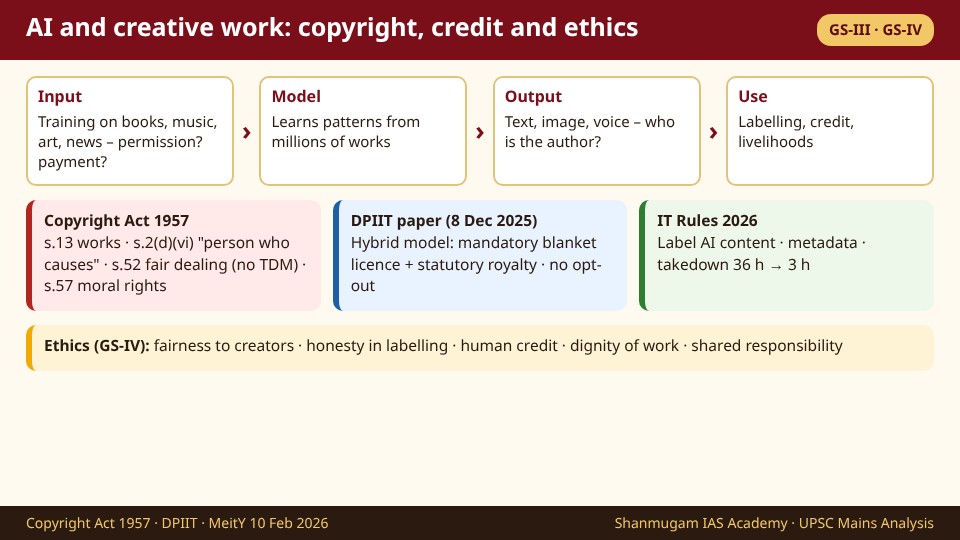
- Two legal questions: training on copyrighted works (India has no text-and-data-mining exception; DPIIT's 8 December 2025 paper proposes a mandatory blanket licence with statutory royalty, no opt-out) and authorship of AI output (Copyright Act s.2(d)(vi); human authorship required abroad – Thaler v. Perlmutter, 2025).
- For UPSC: GS-III (S&T, IPR) plus GS-IV values – fairness, honesty, credit, dignity of work; IT Rules 2026 require labelling of AI content. PYQ: GS-III 2023 (AI in healthcare); no AI-copyright question yet.

Why in news
This year's Booker Prize went to M. John Harrison's The End of Everything (announced in November 2026), a satirical science-fiction novel set in a post-apocalyptic future; the judges were chaired by the historian Mary Beard. The Hindu's editorial on the prize links such visions of the future to a wider anxiety of our time – the place of artificial intelligence in society, and in creative work in particular.
The anxiety has a legal and economic core. Generative AI systems are trained on millions of books, songs, images and news reports, and they can now produce text, music and art in seconds. Two questions follow: may AI firms use copyrighted works for training without permission or payment? and who, if anyone, owns what an AI produces? India is debating both – a DPIIT committee has proposed a licensing model, and the Delhi High Court is hearing ANI Media v. OpenAI, the first case of its kind in India.
Background: the law and the policy in one table
| Item | Key facts |
|---|---|
| Copyright Act, 1957 – what is protected | Section 13: copyright subsists in original literary, dramatic, musical and artistic works, cinematograph films and sound recordings. The Supreme Court (Eastern Book Company v. D.B. Modak, 2008) requires skill, judgment and a "modicum of creativity". |
| Who is the author | Section 2(d)(vi): for a computer-generated literary, dramatic, musical or artistic work, the author is "the person who causes the work to be created". The law assumes a human (or legal person) behind the work. |
| Use of works without permission | Section 52 fair dealing – private or personal use including research, criticism or review, reporting current events. There is no express exception for text and data mining or AI training. |
| Moral rights | Section 57: the author's right to claim authorship (attribution) and to object to distortion or mutilation that harms honour or reputation – central when AI imitates an artist's style or voice. |
| DPIIT committee (28 April 2025) and Working Paper Part 1 (8 December 2025) | Eight-member committee chaired by DPIIT Additional Secretary Himani Pande. Proposed a "hybrid model": a mandatory blanket licence for AI developers to train on lawfully accessed works, with a statutory right to remuneration for rights holders, collected by a proposed non-profit body ("Copyright Royalties Collective for AI Training", CRCAT). Rights holders cannot opt out. Comments were invited (deadline later extended to 6 February 2026); a second part on the authorship of AI-generated output was to follow. |
| IT Amendment Rules, 2026 (MeitY) | Notified 10 February 2026, in force 20 February 2026: AI-generated ("synthetically generated") content must be clearly labelled and, where feasible, carry permanent metadata; takedown time on lawful orders cut from 36 hours to 3 hours. |
Analysis: the main issues
- Training: consent and compensation. AI firms argue that models learn patterns, not copies, and that licensing every work is impossible. Creators argue that their work is being used to build products that compete with them. India's working paper takes a middle path – access for innovation, payment for creators – but critics ask how royalties will be valued and distributed fairly, and whether small Indian developers can bear the cost.
- Output: is there an author? Courts abroad insist on human authorship – in the United States, Thaler v. Perlmutter (D.C. Circuit, March 2025) refused copyright to an image listed as made by an AI system alone, and the US Copyright Office (January 2025) said prompts alone are not enough. Section 2(d)(vi) gives India a possible answer ("the person who causes the work to be created"), but it was written in 1994 for simple computer programs, not for systems that make creative choices themselves.
- Livelihoods. Translators, illustrators, voice artists, dubbing artists, session musicians and journalists face the most direct competition. The 2023 Hollywood writers' agreement (Writers Guild of America) set an early model: AI cannot be credited as a writer, and AI-generated material cannot be treated as source material that lowers a writer's credit or pay.
- Truth and trust. Deepfakes, cloned voices and AI-written fake news blur what is real. India's 2026 labelling rules address deception, but labels do not settle ownership or payment.
- Global patchwork. The EU AI Act requires providers of general-purpose AI models to have a copyright policy and publish a summary of their training content (obligations from 2 August 2025); the EU and Japan allow text and data mining under conditions; the US relies on case-by-case "fair use" litigation. Without some common rules, AI firms will train where the law is loosest.
- Tamil Nadu angle: Tamil Nadu has a long tradition of treating literature as a public good while paying the creator – Subramania Bharati's works were nationalised in 1949, and the State continues to buy the rights of Tamil scholars' works from their heirs and release them to the public. That principle – wide access, fair payment – is close to the "licence with remuneration" idea now proposed for AI. Tamil, with its vast classical and modern literature, also needs good-quality, lawfully licensed datasets so that AI tools serve Tamil speakers well.
Analysis table: the ethical questions (GS-IV)
| Value | Question raised by AI | Ethical response |
|---|---|---|
| Fairness and justice | Is it fair to profit from creators' work without consent or payment? | Consent where possible, fair remuneration always |
| Honesty and transparency | Should audiences know when a work is AI-made? | Clear labelling; disclosure of AI use by authors and publishers |
| Integrity and credit | Who deserves credit – the prompt-writer, the developer, the authors in the training data? | Credit human creative contribution; never pass off AI output as one's own |
| Dignity of work | Will AI replace or assist creative workers? | Use AI as a tool; reskilling and social protection for affected workers |
| Responsibility | Who is accountable for harmful or infringing output? | Shared duties of developers, platforms and users, backed by law |
Faculty view
Start with the hook – a Booker year that made the future and technology a public talking point – and move quickly to the two legal questions: input (training on copyrighted works) and output (authorship of AI-made works). Quote Sections 13, 2(d)(vi), 52 and 57 of the Copyright Act, then the DPIIT hybrid model and one foreign case. In GS-IV answers, use the values table – fairness, honesty, credit, dignity of work. A balanced conclusion: India should neither block AI nor let it free-ride – licensing with fair payment, labelling and human credit can protect both innovation and creators.
Way forward
- Finalise the DPIIT framework after consultation, with transparent rate-setting and distribution of royalties, and a lighter burden for start-ups and research.
- Amend the Copyright Act to clarify (a) whether and how AI training is permitted and (b) the authorship of AI-assisted works, keeping meaningful human contribution as the test.
- Require AI developers to disclose training-data summaries, as the EU does, so that creators can claim their share.
- Strengthen moral rights and personality rights against unauthorised cloning of voices, faces and styles.
- Support creative workers – reskilling, collective bargaining models and social security for gig creators.
- Build licensed, high-quality datasets in Indian languages (including Tamil) through public libraries, archives and publishers.
Glossary – Text and data mining (TDM) exception
A legal exception in copyright law that allows computers to copy and analyse large volumes of text, images or data to find patterns – the process used to train AI models – without separate permission from each rights holder. The EU allows it for research and, for other uses, unless the rights holder has opted out (DSM Directive, 2019); Japan's Article 30-4 permits use of works for data analysis. India's Copyright Act, 1957 has no express TDM exception – fair dealing under Section 52 covers purposes such as private use, research, criticism and review. A DPIIT committee's working paper (8 December 2025) rejected an opt-out model and proposed instead a mandatory blanket licence for AI training with statutory payment to creators.
Asked before in UPSC
1. "Introduce the concept of Artificial Intelligence (AI). How does AI help clinical diagnosis? Do you perceive any threat to privacy of the individual in the use of AI in healthcare?" – GS-III, 2023 (150 words)
We found no Mains question so far on AI and copyright as such. With the DPIIT working paper, the 2026 IT Rules on AI content and pending court cases, expect AI to be asked beyond its uses – through IPR, regulation and ethics. Prepare the Copyright Act sections and the GS-IV values together.
Mains practice question
"Generative AI is built on human creativity but threatens to replace it." Examine the challenges that generative AI poses to India's copyright regime and to creative livelihoods, and suggest a balanced framework. (15 marks, 250 words)
FAQ
Can an AI-generated work get copyright in India?
The Copyright Act does not expressly answer this. Section 2(d)(vi) makes "the person who causes the work to be created" the author of a computer-generated work, so the question is whether a human's contribution is enough. Courts in the US have refused copyright to works with no human author.
What did the DPIIT working paper propose?
A hybrid model (8 December 2025): AI developers get a mandatory blanket licence to train on lawfully accessed works, and rights holders get a statutory right to remuneration through a central collecting body; rights holders cannot opt out.
Who won the Booker Prize 2026?
M. John Harrison, for The End of Everything, a satirical science-fiction novel; the judging panel was chaired by Mary Beard.
Sources: Copyright Act, 1957 (India Code); DPIIT working paper on generative AI and copyright (8 December 2025) as reported by Bar & Bench (11 December 2025), and the consultation extension (January 2026); MeitY – Information Technology (Intermediary Guidelines and Digital Media Ethics Code) Amendment Rules, 2026 (10 February 2026); US Court of Appeals (D.C. Circuit), Thaler v. Perlmutter (2025); EU AI Act; Booker Prize 2026 announcement (NPR report, 9 November 2026). Topic from an editorial in The Hindu; analysis is our own.
Related on our site: UPSC Mains Analysis – all articles · UPSC glossary · UPSC Mains answer-writing practice · Free PDF downloads
Link to this page from your website / blog (HTML code)
BANK Achievers
-

S. DEEPTHI PREMNATH
BANK BANK
நடப்பு நிகழ்வுகள் 16 நவம்பர் 2026 | Today Current Affairs in Tamil | TNPSC Group 4 வினா விடை
TNPSC குரூப் 1, 2/2A, 4 – நேரடி வகுப்புகள் · கோவை & மதுரை
2006 முதல் சண்முகம் IAS அகாடமி · Classroom & online coaching in Coimbatore and Madurai
