

Mains Analysis: PLI at six – what worked, what lags, what next
16 November 2026 · English
⬇ Download this analysis as free PDF
Topics: Indian Economy – Industrial Policy, Manufacturing and Atmanirbhar Bharat · GS-III · UPSC Mains Analysis
Key takeaways
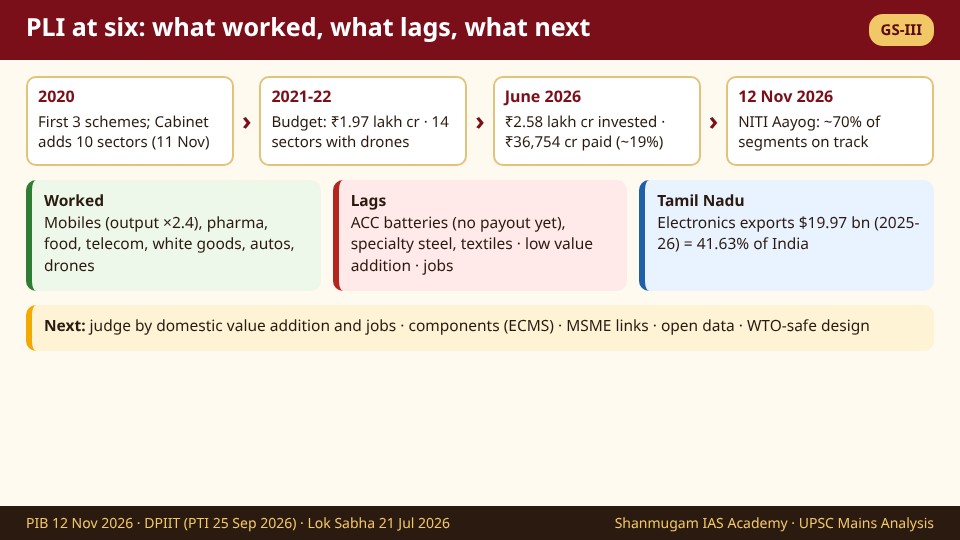
- Six years on, NITI Aayog's assessment (released 12 November 2026) finds nearly 70% of PLI's targeted segments on track across 14 sectors; DPIIT data to 30 June 2026 show ₹2.58 lakh crore invested, ₹23.79 lakh crore of production, ₹15.53 lakh crore of exports and over 14.57 lakh jobs.
- The lags: only ₹36,754 crore (about 19% of the ₹1.91 lakh crore outlay) paid, half of it to electronics; ACC batteries have had no payout; domestic value addition, MSME links and jobs trail output and exports.
- Next phase: judge support by value addition and jobs, build components (ECMS), keep WTO-safe design. TN: electronics exports $19.97 bn in 2025-26 (41.63% of India). PYQ: GS-III 2017 (labour-intensive exports).

Why in news
Six years after the first schemes were notified in 2020, the Production Linked Incentive (PLI) programme is being judged on results. On 12 November 2026 NITI Aayog released the report "Impact Assessment of PLI Schemes", prepared with IIM Ahmedabad as knowledge partner. It assessed all 14 notified sectors on investment, additional production, exports and jobs, and found that nearly 70% of targeted segments are on track. An editorial in The Indian Express (16 November 2026) welcomed the gains but asked the government to "mind the lags". Our news post of 13 November carried the report's headline numbers; this analysis looks at the design questions a Mains answer needs – value addition, jobs, uneven sectors, WTO-compatibility and what should come after PLI.
Background: what PLI is and how it is built
- Idea: pay firms a percentage of their incremental sales of goods made in India over a base year, for a fixed number of years. The subsidy is paid only after production happens – "pay for performance", unlike up-front tax holidays.
- Evolution: the first three schemes (mobile phones and specified electronic components, bulk drugs, medical devices) came in 2020; the Union Cabinet approved ten more sectors on 11 November 2020; the Union Budget 2021-22 announced an outlay of about ₹1.97 lakh crore over five years; with drones (2021) the family reached 14 sectors. The current approved outlay is ₹1.91 lakh crore (DPIIT).
- Sectors: large-scale electronics (mobiles), IT hardware, bulk drugs, medical devices, pharmaceuticals, telecom and networking, food products, white goods (ACs, LED lights), high-efficiency solar PV modules, automobiles and auto components, advanced chemistry cell (ACC) batteries, textiles (man-made fibre and technical textiles), specialty steel and drones.
- Why it was needed: manufacturing's share of GDP had stayed in the mid-teens for decades; India imported most electronics and many key drug ingredients; the 2020 supply shock showed the risk of depending on one country for inputs.
Verified data: where PLI stands (latest official figures)
| Indicator | Figure | Source and date |
|---|---|---|
| Actual investment | ₹2.58 lakh crore | DPIIT data up to 30 June 2026 (PTI, 25 September 2026) |
| Production / sales | ₹23.79 lakh crore | Same |
| Exports | ₹15.53 lakh crore | Same |
| Employment (direct + indirect) | over 14.57 lakh | Same |
| Incentives disbursed (cumulative) | ₹36,754 crore – about 19% of the ₹1.91 lakh crore outlay (₹10,114 crore in 2024-25; ₹15,519 crore in 2025-26) | Same |
| Sectors on track | nearly 70% of targeted segments | NITI Aayog report, PIB, 12 November 2026 |
| Mobile phones | Production about 2.4 times since PLI; about 99.2% of phones sold in India made in India; phone imports down about 77% | Lok Sabha reply, 21 July 2026 (IANS) |
Sector scorecard: winners and laggards
| Group | Sectors | Evidence (DPIIT, to 30 June 2026, unless stated) |
|---|---|---|
| Notable progress (NITI Aayog, Nov 2026) | Pharmaceuticals, mobile manufacturing (LSEM), food processing, telecom, white goods, automobiles, drones (an "early implementation success") | Large-scale electronics alone has received ₹19,091 crore – about half of all incentives paid; pharma ₹6,662 crore; investment in pharma ₹46,744 crore and autos ₹45,477 crore |
| Big capacity addition | High-efficiency solar PV modules | Largest investment of any sector: ₹73,437 crore |
| Slower movers | ACC batteries, specialty steel, textiles | ACC batteries: investment about ₹5,180 crore (to 31 May 2026, Lok Sabha reply of 21 July 2026) but no incentive paid yet; specialty steel ₹236 crore and textiles ₹386 crore paid |
The pattern is clear: PLI works where a global anchor firm can plug India into an existing supply chain (phones, pharma); it lags where India must build deep technology from scratch (cell chemistry, special steel grades) or where the product is fragmented and price-sensitive (textiles).
Analysis: the five lags the editorial points to
- 1. Assembly versus value addition. Output and exports have soared, but much of the value in electronics is still imported (chips, displays, camera modules). NITI Aayog itself calls for deepening domestic value addition and strengthening supply chains. Big exports with thin domestic value can leave the import bill high.
- 2. Concentration. About half of all incentives have gone to one sector (large-scale electronics) and, within it, to a handful of large firms. That shows the scheme works best for big, export-ready players – but it raises questions of fiscal concentration and of MSME inclusion – the report recommends wider MSME participation.
- 3. Jobs. Over 14.57 lakh direct and indirect jobs is significant, but small against the need to absorb millions of new workers each year. Capital-intensive sectors (solar modules, steel, cells) add investment faster than jobs; labour-intensive ones (textiles) have lagged.
- 4. Slow disbursal and data. Only about a fifth of the outlay has been paid in six years – partly because firms missed thresholds, partly because of slow claims processing. The report recommends harmonised data systems; public, firm-level outcome data remain limited.
- 5. Frontier sectors. ACC batteries – vital for EVs and grid storage – have drawn investment but no incentive payout, showing that deep-tech manufacturing needs technology tie-ups, skilled people, mineral supply and patient capital, not just a sales-linked subsidy.
Static syllabus link: PLI and the WTO
GS-III asks about industrial policy and the effects of liberalisation. Under the WTO Agreement on Subsidies and Countervailing Measures (SCM), subsidies contingent on export performance are prohibited. In 2019 a WTO panel (dispute DS541, brought by the United States) ruled against India's export schemes such as the Merchandise Exports from India Scheme (MEIS); India appealed. PLI links the incentive to incremental sales – domestic and export – rather than to exports alone, a design meant to keep it clear of the export-subsidy ban. Its sunset clauses (fixed tenure per scheme) also fit the idea of temporary, time-bound support for "infant" capability.
Tamil Nadu angle
Tamil Nadu is the clearest beneficiary of the electronics push. According to the Union Commerce Minister's reply in the Lok Sabha (21 July 2026), the State's electronics exports rose from $14.65 billion (2024-25) to $19.97 billion (2025-26) – 41.63% of India's electronics exports. Its total merchandise exports in 2025-26 were about $59 billion, third among States. District export data for 2025-26 (DT Next, 8 July 2026) place Kancheepuram district (home to the Sriperumbudur–Oragadam electronics and automobile cluster) second among all districts at $26.4 billion. Hosur (Krishnagiri district) is a growing electronics and EV hub. The next step for the State is components, skilling and supplier MSMEs, so that more value – not just more assembly – stays in Tamil Nadu.
Analysis table: what to fix in the next phase
| Lag | Why it matters | Fix |
|---|---|---|
| Low value addition | Imports of parts offset export gains | Component schemes (e.g. ECMS, 2025), DVA milestones built into incentives |
| Few big beneficiaries | Fiscal concentration; weak MSME links | Supplier-development credit, cluster infrastructure, lower thresholds for MSMEs |
| Jobs below potential | Capital-intensive sectors lead | Labour-intensive focus (textiles, leather, food, toys); employment-linked support |
| Slow payouts, thin data | Uncertainty for firms; weak evaluation | Time-bound claims, public sector-wise dashboards, independent evaluation |
| Deep-tech gaps | ACC, specialty steel slow | Technology partnerships, critical-mineral supply, R&D and skilled workforce |
Faculty view
Do not write "PLI has succeeded" or "PLI has failed" – both are wrong. Write "PLI has worked where India could join an existing value chain and lagged where it had to build one". Use three numbers (₹2.58 lakh crore investment, ₹36,754 crore paid – about 19% of the outlay, nearly 70% of segments on track), one winner (mobiles) and one laggard (ACC batteries – no payout yet). Add the WTO point and a Tamil Nadu example. The best conclusion is about the next policy: move the test from output to domestic value addition and jobs.
Way forward
- Shift the yardstick from sales to domestic value addition and jobs – link the later years of support to DVA and employment milestones.
- Build the component layer: the Electronics Component Manufacturing Scheme (approved March 2025, outlay ₹22,919 crore) and the India Semiconductor Mission should be read as PLI's next stage.
- Use the National Manufacturing Mission (Union Budget 2025-26) for the basics PLI cannot buy – power, logistics, land, skills, testing labs and faster approvals.
- Bring in MSMEs: supplier-development programmes, credit guarantees and cluster common facilities around anchor firms.
- Fix process: time-bound claims, public sector-wise outcome data and independent evaluation before any extension.
- Respect fiscal and WTO limits: keep schemes time-bound, end support where firms are competitive and avoid export-contingent design.
Glossary – Domestic value addition (DVA)
The part of a product's value that is created inside the country – roughly, the value of the finished product minus the value of imported parts, materials and services used to make it, often shown as a percentage of the product's value. A phone "made in India" from imported chips, displays and camera modules may have low DVA even if final assembly is local; DVA rises when components, sub-assemblies and design move into the country. It is the better test of an industrial policy than output or exports alone, because large exports with low DVA can leave the trade balance and the job count little changed. NITI Aayog's PLI assessment (November 2026) calls for deepening domestic value addition and strengthening supply chains.
Asked before in UPSC
1. "Account for the failure of manufacturing sector in achieving the goal of labour-intensive exports. Suggest measures for more labour-intensive rather than capital-intensive exports." – GS-III, 2017 (10 marks, 150 words)
2. "Success of 'Make in India' programme depends on the success of 'Skill India' programme and radical labour reforms." Discuss with logical arguments. – GS-III, 2015 (12.5 marks, 200 words)
UPSC has not yet asked a question by name on PLI, but it repeatedly asks why manufacturing has not created enough jobs. The PLI record – investment and exports up, jobs and value addition lagging – is ready material for that question.
Mains practice question
"Production Linked Incentive schemes have boosted output and exports, but the real test is domestic value addition and employment." Critically examine the performance of the PLI programme and suggest how India's next industrial policy should be designed. (15 marks, 250 words)
FAQ
How many sectors are covered by PLI and what is the outlay?
14 sectors. The Union Budget 2021-22 announced about ₹1.97 lakh crore; the current approved outlay is ₹1.91 lakh crore (DPIIT).
How much incentive has actually been paid?
₹36,754 crore up to 30 June 2026 (DPIIT) – about 19% of the approved outlay; about half of it to large-scale electronics.
What did the NITI Aayog report of November 2026 conclude?
About 70% of targeted segments are broadly on track; pharma, mobiles, food processing, telecom, white goods, autos and drones showed notable progress; it calls for deeper domestic value addition, wider MSME participation and harmonised data. On DPIIT data, ACC batteries, specialty steel and textiles are the slower movers.
Is PLI consistent with WTO rules?
It is designed to be: the incentive is linked to incremental sales (domestic and export), not to export performance alone, which the SCM Agreement prohibits.
Sources: PIB – NITI Aayog releases "Impact Assessment of PLI Schemes" (12 November 2026); DPIIT data on PLI up to 30 June 2026 as reported by PTI (25 September 2026); Lok Sabha written replies of 21 July 2026 (PTI, IANS; DT Next, 22 July 2026); DT Next on State exports (8 July 2026); Union Budget 2021-22 and 2025-26; Cabinet decision on ECMS (March 2025); WTO dispute DS541. Topic from an editorial in The Indian Express; analysis is our own.
Related on our site: UPSC Mains Analysis – all articles · UPSC glossary · UPSC Mains answer-writing practice · Free PDF downloads
Link to this page from your website / blog (HTML code)
TNPSC Achievers
-

P. SUBASH CHANDRA BOSH
TNPSC TNPSC
நடப்பு நிகழ்வுகள் 17 நவம்பர் 2026 | Today Current Affairs in Tamil | TNPSC Group 4 வினா விடை
TNPSC குரூப் 1, 2/2A, 4 – நேரடி வகுப்புகள் · கோவை & மதுரை
2006 முதல் சண்முகம் IAS அகாடமி · Classroom & online coaching in Coimbatore and Madurai
