

Mains Analysis: US–Iran 'no war, no deal' and India's stakes
16 November 2026 · English International
⬇ Download this analysis as free PDF
Topics: International Relations – India and West Asia, Effect of Policies of Developed Countries on India's Interests, Diaspora · GS-II · UPSC Mains Analysis
Key takeaways
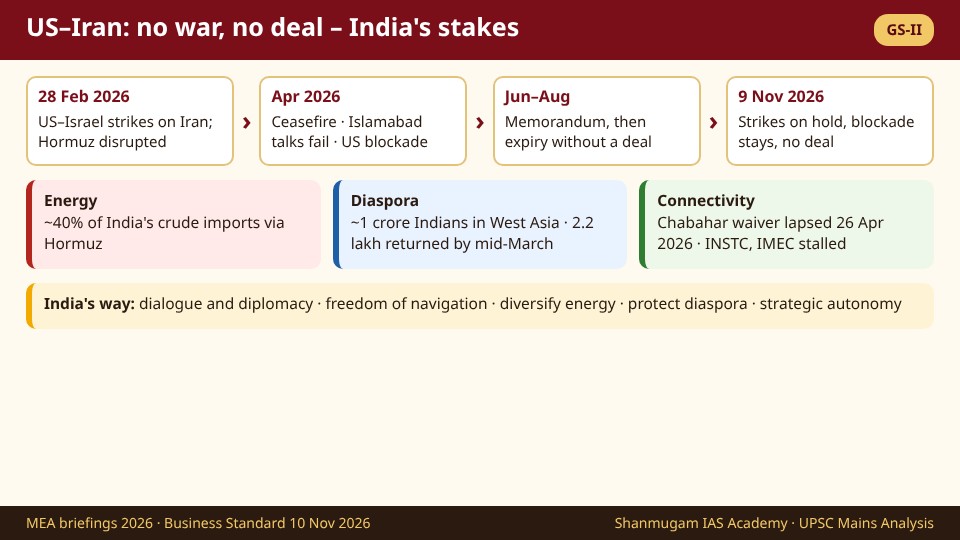
- On 8–9 November 2026 President Trump said renewed strikes on Iran were "highly unlikely" to be necessary and put new strikes on hold, but kept the naval blockade of Iran's ports and reached no deal – a stalemate The Hindu calls "a step back".
- India's stakes: about 40% of its crude imports pass through Hormuz; nearly one crore Indians live in West Asia; the Chabahar sanctions waiver lapsed on 26 April 2026; oil prices and remittances hit the economy.
- India's course: dialogue and diplomacy, freedom of navigation, energy diversification, diaspora protection and strategic autonomy. PYQ: GS-II 2018 (US–Iran nuclear pact and India's interest); GS-II 2017 (energy security and West Asia).

Why in news
An editorial in The Hindu (16 November 2026) calls US President Donald Trump's latest Iran stance "a step back": no return to full-scale war, but no deal either. On 8 November 2026 he told CNN that renewed strikes were "highly unlikely" to be necessary as long as talks made progress; on 9 November, after meeting Qatar's Prime Minister Sheikh Mohammed bin Abdulrahman Al-Thani at the White House, he said the war was "militarily, effectively over" and that he would hold off new strikes for the time being – while keeping the US naval blockade of Iran's ports. US Secretary of State Marco Rubio called Tehran's conditions "really not realistic". Brent crude settled nearly 6% lower that day, at about $92.6 a barrel. For India – energy importer, home of the largest diaspora in the Gulf and investor in Chabahar – a frozen conflict is less dangerous than war, but costly.
Background: the 2026 war in one table
| Date (2026) | Event |
|---|---|
| 28 February | US and Israel launch strikes on Iran ("Operation Epic Fury"); Supreme Leader Ali Khamenei killed; Iran retaliates against Israel and US bases in the Gulf |
| From 1 March | Shipping through the Strait of Hormuz disrupted; oil prices surge |
| 7–8 April | Two-week ceasefire announced |
| 11–13 April | Talks in Islamabad (Pakistan as mediator) end without agreement on 12 April; the US begins a naval blockade of Iranian ports on 13 April |
| June | A US–Iran memorandum (announced 14 June) to end hostilities and reopen Hormuz; ceasefire extended by 60 days for talks |
| 13 July | After attacks on ships in Hormuz blamed on Iran (7 July), the US reinstates the naval blockade |
| August | The memorandum expires without a deal |
| 3 November | US midterm elections; the President's party loses control of both Houses of Congress; the President and Vice-President cite public opposition to the war and its effect on energy prices |
| 7–9 November | US Central Command sets up "Task Force Iron Gate" against Iranian smuggling routes; "effectively over" remark; strikes on hold, blockade stays |
Iran's reported terms: an end to the US blockade, relief from some sanctions and a halt to bombing, in return for lifting its own restrictions on Hormuz, with nuclear talks to follow. President Trump says it depends on whether Iran will "sign a very strong agreement", with its nuclear programme at the centre. The gap explains the stalemate.
India's stakes: verified data
| Stake | What we know | Source and date |
|---|---|---|
| Energy | About 40% of India's crude imports pass through the Strait of Hormuz; crude import bill $137 billion in 2024-25 | Government briefing reported by The Tribune, 4 March 2026 |
| Shipping | No blanket transit deal with Iran – "every ship movement is an individual happening"; 22 Indian-flagged vessels with 611 Indian seafarers were west of Hormuz in mid-March | EAM S. Jaishankar (16 March 2026); Ministry of Ports, Shipping and Waterways (16 March 2026) |
| Diaspora | Lives and jobs of nearly one crore Indians in West Asia at stake; about 2.2 lakh returned from the Gulf by 16 March; about 550 crossed from Iran into Armenia and about 90 into Azerbaijan | MEA, 3 and 16 March 2026 |
| Remittances | India received a record $135.46 billion in 2024-25 – the Gulf is a major source | RBI balance-of-payments data |
| Chabahar | 10-year agreement for the Shahid Beheshti terminal signed in May 2024; US revoked the 2018 exemption from 29 September 2025, then gave a conditional waiver to 26 April 2026, which expired; MEA: issue "under discussion with both Iran and the United States", the conflict "a complicating factor" | MEA briefing, 27 April 2026 |
| Diplomacy | PM Modi spoke to Iranian President Masoud Pezeshkian on 12 March – the first leader-level contact since the war began; EAM spoke to FM Abbas Araghchi four times by mid-March | Reports of 16 March 2026 |
Static syllabus link
- Effect of policies of developed countries on India's interests (GS-II): US secondary sanctions and the blockade decide whether India can use Chabahar or buy Iranian oil – India bears costs of a conflict it is not party to.
- Connectivity: Chabahar is India's route to Afghanistan and Central Asia bypassing Pakistan, and a planned node of the International North–South Transport Corridor (INSTC; India, Iran, Russia agreement of 2000). The India–Middle East–Europe Economic Corridor (IMEC), announced at the G20 summit in New Delhi in September 2023, runs through the Gulf, Jordan and Israel – the war has put its timelines in doubt.
- Indian Ocean security: the Indian Navy's Operation Sankalp (since June 2019) protects Indian-flagged shipping in the Gulf region; chokepoint security is part of India's SAGAR/MAHASAGAR vision.
Analysis: why "no war, no deal" still hurts India
- Uncertainty is a cost. A blockade without a settlement keeps freight, insurance and oil prices higher than in peace. Every $10 rise in crude widens India's import bill and current account deficit and feeds inflation.
- Two friends, one quarrel. The US is India's key technology and defence partner; the Gulf states supply most of its energy and host its workers; Iran is part of its extended neighbourhood and the gateway to Chabahar. India cannot afford to pick a side – the classic case for strategic autonomy and multi-alignment.
- Connectivity on hold. With the Chabahar waiver lapsed and Iran under blockade, India's western connectivity strategy – Chabahar, INSTC and IMEC – is stalled at the same time.
- Diaspora risk. Strikes on Gulf states during the war put Indian workers in harm's way (two Indians were killed in a drone attack in Sohar, Oman, on 13 March). Evacuation at this scale tests consular capacity, airlines and the Indian Community Welfare Fund.
- The diplomatic opening. Mediation now runs mainly through Qatar and Pakistan. India has channels to all sides but no mediating role; its interest lies in reopening Hormuz under international law (freedom of navigation, UNCLOS) rather than in who "wins".
Tamil Nadu angle
Tamil Nadu sends a large number of workers to the Gulf, and many households in the State depend on their remittances; every evacuation and job loss in the region is felt in Tamil villages. The State also depends on imported energy – the Chennai Petroleum (CPCL) refinery at Manali runs on imported crude and the Ennore LNG terminal on imported gas – so prolonged disruption at Hormuz raises costs for its industry and transport. The State's department for the welfare of Non-Resident Tamils is the first point of help for families; coordination with the MEA during crises is essential.
Faculty view
Write this as a stakes answer, not a story of the war. Open with the stalemate in one line (9 November: strikes on hold, blockade on, no deal). Then give India's four stakes with one fact each: energy (about 40% of crude via Hormuz), diaspora (nearly one crore in West Asia), connectivity (Chabahar waiver lapsed on 26 April 2026), economy (oil prices, remittances). Close with India's posture – dialogue and diplomacy, freedom of navigation, strategic autonomy – and two practical steps: diversify energy and protect the diaspora. Stay neutral; do not judge any side.
Way forward for India
- Energy hedging: keep diversifying crude sources (Americas, Africa, Russia under existing contracts), expand strategic petroleum reserves (Phase II at Chandikhol and Padur) and long-term LNG contracts from outside the Gulf.
- Diaspora protection: standing evacuation plans for each Gulf country, use of eMigrate data, the Indian Community Welfare Fund and State NRI cells.
- Chabahar: seek a renewed carve-out on humanitarian and Afghanistan-connectivity grounds; keep INSTC alive through other routes until then.
- Maritime security: continue naval escort of Indian-flagged ships and work with partners on freedom of navigation through Hormuz and the Red Sea.
- Diplomacy: support mediation by regional states and the UN, keep leader-level contact with Tehran, Washington and Gulf capitals, and push for a settlement that reopens the strait.
Glossary – Maritime chokepoint
A narrow sea passage through which a large share of world shipping must pass, so that closing or threatening it can disrupt trade and energy supply far away. The Strait of Hormuz – between Iran and Oman's Musandam peninsula, linking the Persian Gulf to the Gulf of Oman and the Arabian Sea – is the most important for oil: roughly a fifth of the world's oil consumption normally passes through it. Others that matter to India are Bab-el-Mandeb (Red Sea), the Suez Canal and the Strait of Malacca. Because a chokepoint cannot be bypassed easily, countries reduce their exposure through diversified suppliers, strategic reserves, pipelines and naval presence.
Asked before in UPSC
1. "In what ways would the ongoing U.S-Iran Nuclear Pact Controversy affect the national interest of India? How should India respond to this situation?" – GS-II, 2018 (15 marks, 250 words)
2. "The question of India's Energy Security constitutes the most important part of India's economic progress. Analyze India's energy policy cooperation with West Asian countries." – GS-II, 2017 (15 marks, 250 words)
The 2018 question is almost the same frame as today's situation – US policy towards Iran and its effect on India. Update it with 2026 facts: Hormuz, the blockade, the lapsed Chabahar waiver and the diaspora.
Mains practice question
"A conflict that is neither war nor peace in the Persian Gulf can hurt India almost as much as open war." In the light of the 2026 US–Iran confrontation, examine India's stakes and suggest a strategy to protect them. (15 marks, 250 words)
FAQ
What is meant by Trump's "no war, no deal" approach?
On 8–9 November 2026 he said renewed strikes were "highly unlikely" to be necessary and held off new strikes, but kept the naval blockade of Iran's ports and did not agree to Iran's terms – a stalemate rather than a settlement.
Why does the Strait of Hormuz matter to India?
About 40% of India's crude imports pass through it (government briefing, March 2026), along with much of its LPG and LNG; disruption raises prices and freight costs.
What is the status of the Chabahar sanctions waiver?
The conditional US waiver expired on 26 April 2026; the MEA said the issue was under discussion with both Iran and the US.
How many Indians live in West Asia?
Nearly one crore, according to the MEA (March 2026).
Sources: Business Standard timeline of the conflict (10 November 2026); Khaleej Times (10 November 2026), Colorado Politics (9 November 2026) and AP (CNN interview, 8 November 2026) on President Trump's remarks; Reuters (9 November 2026) on oil prices; Gulf News (28 August 2026); The Tribune (4 March 2026, MEA briefing); Open (16 March 2026, MEA briefing); The Wire (16 March 2026, EAM interview); DT Next (27 April 2026, MEA on Chabahar); RBI data. Topic from an editorial in The Hindu; analysis is our own.
Related on our site: UPSC Mains Analysis – all articles · UPSC glossary · UPSC Mains answer-writing practice · Free PDF downloads
Link to this page from your website / blog (HTML code)
BANK Achievers
-

S. DEEPTHI PREMNATH
BANK BANK
நடப்பு நிகழ்வுகள் 17 நவம்பர் 2026 | Today Current Affairs in Tamil | TNPSC Group 4 வினா விடை
TNPSC குரூப் 1, 2/2A, 4 – நேரடி வகுப்புகள் · கோவை & மதுரை
2006 முதல் சண்முகம் IAS அகாடமி · Classroom & online coaching in Coimbatore and Madurai
