

WHO issues its first-ever guidelines on type 1 diabetes in adults
16 November 2026 · English Health
⬇ Download this article as free PDF
Topics: Health · UPSC Prelims · TNPSC · SSC · Current Affairs
Current affairs of 16 November 2026 (Shanmugam IAS Academy) – explained for UPSC, TNPSC and other competitive exams
News
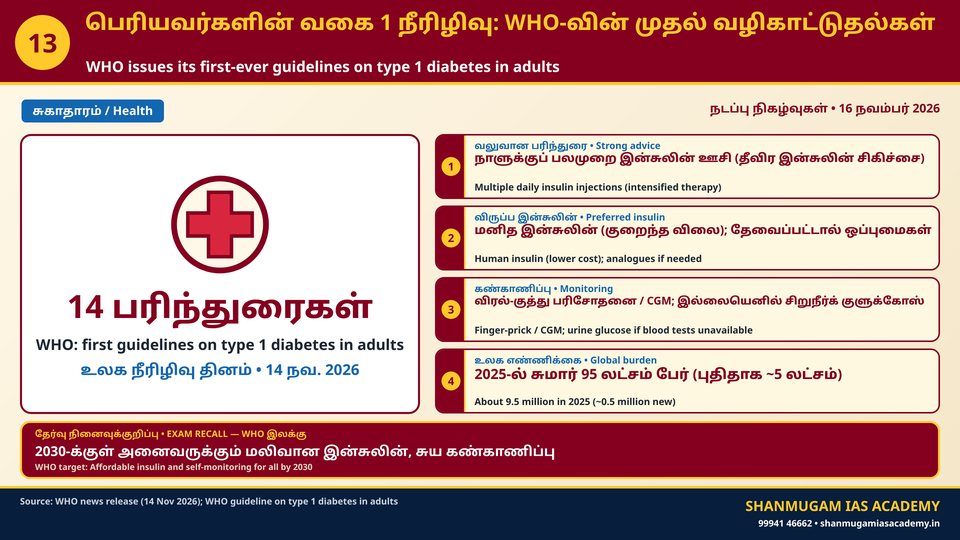
On World Diabetes Day, 14 November 2026, the World Health Organization (WHO) released its first-ever guidelines on diagnosing and managing type 1 diabetes in adults. They contain 14 recommendations – one strong and 13 conditional – and apply also to low-resource, emergency and humanitarian settings. The strong recommendation is for intensified insulin therapy: multiple daily injections with doses adjusted to blood-glucose levels. Human insulin is preferred because it costs less, with insulin analogues as options where needed; insulin pens may be considered over syringes (conditional). At home, patients may use finger-prick tests or continuous glucose monitors (CGMs); where blood testing is unavailable, urine glucose testing may be considered. When the diagnosis is uncertain, islet-cell autoantibody and C-peptide tests are advised; adults wrongly labelled as type 2 face delayed treatment and a higher risk of diabetic ketoacidosis (DKA). About 9.5 million people lived with type 1 diabetes worldwide in 2025, and about 5 lakh were newly diagnosed that year. WHO's target is that by 2030 everyone with type 1 diabetes has affordable insulin and glucose self-monitoring.
Key facts for the exam
| Point | Details |
|---|---|
| Released | 14 Nov 2026 – World Diabetes Day |
| Significance | WHO's first guidelines on type 1 diabetes in adults |
| Recommendations | 14 – 1 strong, 13 conditional |
| Strong advice | Multiple daily insulin injections (intensified therapy) |
| Preferred insulin | Human insulin (lower cost); analogues if needed |
| Monitoring | Finger-prick / CGM; urine glucose if blood tests unavailable |
| Doubtful diagnosis | Islet-cell autoantibodies, C-peptide |
| Global burden | About 9.5 million in 2025 (~0.5 million new) |
| WHO target | Affordable insulin and self-monitoring for all by 2030 |
Background
- Science: In type 1 diabetes the immune system destroys the insulin-making cells of the pancreas, so insulin production almost stops and lifelong insulin injections are needed. In type 2, insulin is made but the body does not respond to it properly (insulin resistance). Insulin is a protein (peptide) hormone of 51 amino acids; taken by mouth it would be broken down by digestive enzymes, so it is injected.
- C-peptide & DKA: The pancreas splits 'proinsulin' and releases insulin and C-peptide in equal amounts, so C-peptide levels reveal the body's own insulin output. Without insulin the body burns fat for energy; ketones made in the liver acidify the blood – diabetic ketoacidosis (DKA), a life-threatening state. For most adults the new guidelines set an HbA1c target of 7% (53 mmol/mol) or below.
- Biotechnology: Insulin was once extracted from cattle and pig pancreases. Human insulin made by recombinant DNA technology was approved in the US in 1982 – the first medicine produced by that technology. Low-cost human insulin is on WHO's Essential Medicines List.
- WHO: Set up on 7 April 1948, headquartered in Geneva. The Global Diabetes Compact was launched in 2021. About 830 million people had diabetes in 2022, over 40% of them unaware of it (WHO). In November 2025 WHO also issued its first guidelines on diabetes in pregnancy.
What is this news about?
On World Diabetes Day, 14 November 2026, the World Health Organization (WHO) released its first-ever guidelines on diagnosing and managing type 1 diabetes in adults. They contain 14 recommendations – one strong and 13 conditional – and apply also to low-resource, emergency and humanitarian settings.
What are the key facts to remember for the exam?
Released: 14 Nov 2026 – World Diabetes Day; Significance: WHO's first guidelines on type 1 diabetes in adults; Recommendations: 14 – 1 strong, 13 conditional; Strong advice: Multiple daily insulin injections (intensified therapy).
What is the background to this news?
Science: In type 1 diabetes the immune system destroys the insulin-making cells of the pancreas, so insulin production almost stops and lifelong insulin injections are needed.
Practise more: Weekly current affairs · Daily subject quiz · Knowledge nugget
Sources: WHO news release, 14 Nov 2026 (who.int/news/item/14-11-2026-who-issues-first-guidelines-on-type-1-diabetes-for-adults); WHO guideline (who.int/publications/i/item/9789240126244); WHO – World Diabetes Day 2026; The South First (15 Nov 2026); Stanley Medical College (stanleymedicalcollege.ac.in/page/diabetology); IIM Bangalore Tejas (TNMSC). Compiled by Shanmugam IAS Academy.
Prepared by the Shanmugam IAS Academy faculty team, Coimbatore (since 2006) · independently checked against primary sources · Our editorial policy
Add us as a preferred source on Google
Link to this page from your website / blog (HTML code)
BANK Achievers
-

RAJ
BANK BANK
நடப்பு நிகழ்வுகள் 18 நவம்பர் 2026 | Today Current Affairs in Tamil | TNPSC Group 4 வினா விடை
TNPSC குரூப் 1, 2/2A, 4 – நேரடி வகுப்புகள் · கோவை & மதுரை
2006 முதல் சண்முகம் IAS அகாடமி · Classroom & online coaching in Coimbatore and Madurai
