

NASA's Voyager 1 to reach one light-day from Earth on 18 Nov
16 November 2026 · English Science & TechnologyImportant Days
⬇ Download this article as free PDF
Topics: Space Science · UPSC Prelims · TNPSC · SSC · Current Affairs
Current affairs of 16 November 2026 (Shanmugam IAS Academy) – explained for UPSC, TNPSC and other competitive exams
News
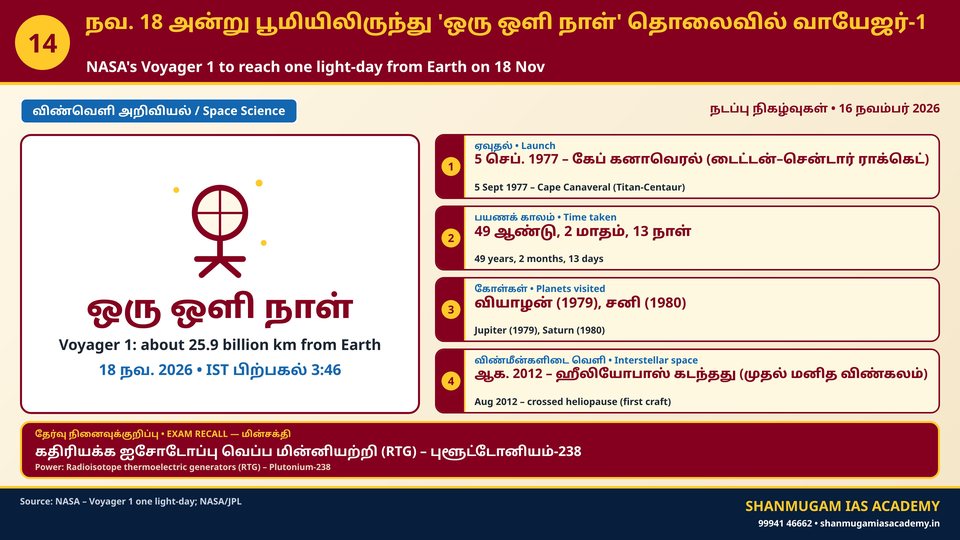
NASA has calculated that Voyager 1, launched in 1977, will reach one light-day from Earth at 10:16:07 UTC (3:46 p.m. IST) on 18 November 2026. A light-day is the distance light travels in 24 hours – about 25.9 billion km, or roughly 173 astronomical units. That means a command sent from Earth will take a day to reach the craft and its reply another day to come back. Voyager 1 has taken 49 years, 2 months and 13 days to get this far; it is the most distant human-made object. It flew past Jupiter in 1979 and Saturn in 1980, and in August 2012 it crossed the heliopause – the edge of the solar wind's bubble – becoming the first spacecraft to enter interstellar space. Most of its instruments have been switched off to save power; the Low-Energy Charged Particle instrument was turned off in April 2026. Its twin, Voyager 2, is expected to reach one light-day in November 2035; NASA has announced a 'Shine Bright' event on 17 November to mark the milestone.
Key facts for the exam
| Point | Details |
|---|---|
| Milestone | 18 Nov 2026, 10:16:07 UTC (3:46 p.m. IST) – one light-day |
| One light-day | About 25.9 billion km ≈ 173 AU |
| Launch | 5 Sept 1977 – Cape Canaveral (Titan-Centaur) |
| Time taken | 49 years, 2 months, 13 days |
| Planets visited | Jupiter (1979), Saturn (1980) |
| Interstellar space | Aug 2012 – crossed heliopause (first craft) |
| Power | Radioisotope thermoelectric generators (RTG) – Plutonium-238 |
| Golden Record | Earth's sounds, images, music – committee led by Carl Sagan |
| Voyager 2 | Expected to reach one light-day in Nov 2035 |
Background
- Units of distance: Light travels about 3 lakh km per second. One astronomical unit (AU) = mean Earth–Sun distance ≈ 150 million km; sunlight takes about 8 min 20 s to reach Earth. One light-year ≈ 9.46 trillion km – a unit of distance, not time. A parsec ≈ 3.26 light-years. A light-day is just 1/365 of a light-year; the nearest star, Proxima Centauri, is 4.24 light-years away.
- Voyager mission: Voyager 2 (20 Aug) and Voyager 1 (5 Sept) were launched in 1977, using a planetary alignment that occurs once in 176 years for a 'Grand Tour'. Voyager 2 is the only craft to have flown past all four giant planets (Jupiter, Saturn, Uranus, Neptune). Voyager 1 studied Saturn's moon Titan closely; its 1990 'Pale Blue Dot' image of Earth is famous.
- Heliosphere: The solar wind – a stream of charged particles from the Sun – blows a bubble (the heliosphere) around the solar system; the heliopause is where it meets the interstellar medium. The Oort Cloud, at the edge of the Sun's gravitational reach, lies much farther; Voyager will need thousands of years to cross it.
- Technology: Solar panels are useless so far from the Sun, so Voyager runs on RTGs that turn heat from decaying plutonium-238 into electricity; power drops by about 4 watts a year. Contact is through NASA's Deep Space Network – Goldstone (USA), Madrid (Spain) and Canberra (Australia). The Golden Record carries the Hindustani song 'Jaat Kahan Ho' (Raga Bhairavi) by Kesarbai Kerkar.
What is this news about?
NASA has calculated that Voyager 1, launched in 1977, will reach one light-day from Earth at 10:16:07 UTC (3:46 p.m. IST) on 18 November 2026. A light-day is the distance light travels in 24 hours – about 25.9 billion km, or roughly 173 astronomical units.
What are the key facts to remember for the exam?
Milestone: 18 Nov 2026, 10:16:07 UTC (3:46 p.m. IST) – one light-day; One light-day: About 25.9 billion km ≈ 173 AU; Launch: 5 Sept 1977 – Cape Canaveral (Titan-Centaur); Time taken: 49 years, 2 months, 13 days.
What is the background to this news?
Units of distance: Light travels about 3 lakh km per second. One astronomical unit (AU) = mean Earth–Sun distance ≈ 150 million km; sunlight takes about 8 min 20 s to reach Earth.
Practise more: Weekly current affairs · Daily subject quiz · Knowledge nugget
Sources: NASA – science.nasa.gov/mission/voyager/voyager-1/voyager-1-what-is-a-light-day/; NASA news release 'NASA invites media, public to join Voyager 1 one light-day activities' (nasa.gov); NASA JPL Golden Record; ISRO (Aditya-L1 page); The Hindu / Deccan Herald (Nigar Shaji). Compiled by Shanmugam IAS Academy.
Prepared by the Shanmugam IAS Academy faculty team, Coimbatore (since 2006) · independently checked against primary sources · Our editorial policy
Add us as a preferred source on Google
Link to this page from your website / blog (HTML code)
TET Achievers
-

SUMITHRA
TNTET TNTET
நடப்பு நிகழ்வுகள் 18 நவம்பர் 2026 | Today Current Affairs in Tamil | TNPSC Group 4 வினா விடை
TNPSC குரூப் 1, 2/2A, 4 – நேரடி வகுப்புகள் · கோவை & மதுரை
2006 முதல் சண்முகம் IAS அகாடமி · Classroom & online coaching in Coimbatore and Madurai
