

Mains Analysis: Outlook outage – risks of centralised digital systems
17 November 2026 · English Science & Technology
⬇ Download this analysis as free PDF
Topics: Internal Security – Cyber Security; Science and Technology – IT and Digital Infrastructure · GS-III · UPSC Mains Analysis
Key takeaways
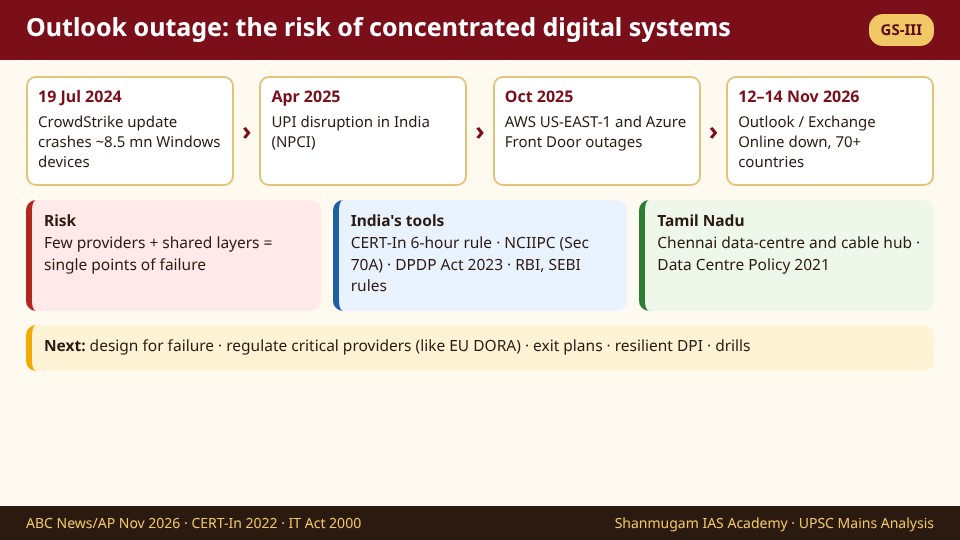
- On 12–13 November 2026 Microsoft Outlook / Exchange Online mail went down for users in more than 70 countries; Microsoft said it was not a cyberattack but an issue introduced during an earlier network capacity upgrade.
- It fits a pattern – CrowdStrike (July 2024, about 8.5 million Windows devices), AWS and Azure (October 2025), UPI in India (April 2025): when many depend on a few providers, the provider becomes a single point of failure.
- India's tools: CERT-In 6-hour reporting (2022), NCIIPC for critical infrastructure, DPDP Act 2023, RBI and SEBI resilience rules. Way forward: design for failure, regulate critical providers (like EU DORA), exit plans, resilient DPI. PYQ: GS-III 2015 (cloud hosting).

Why in news
From the evening of 12 November 2026 (from about 16:15 GMT, around 9:45 pm in India) users across the world could not open their Microsoft Outlook / Exchange Online mailboxes; Teams and Copilot were partly affected. Downdetector logged problem reports from more than 70 countries, and Japan, Singapore and Australia said some government operations were hit (ABC News/AP, 13–14 November 2026). Microsoft said there was "no indication this is the result of malicious or cyber activity" and that the incident "was introduced by an issue during an earlier network capacity upgrade"; on 13 November it reported "encouraging recovery progress", and just after midnight (US time) on 14 November it said it had "restored service to the remaining impacted customers and regions" (ABC News/AP). An editorial in The Hindu (17 November 2026) used the outage to ask a bigger question – what happens when so much of the world's communication runs on a few centralised systems?
Background: how we came to depend on a few providers
- Cloud and SaaS: governments, banks, hospitals and firms have moved email, files, meetings and applications to a small number of large cloud and software-as-a-service providers. This brings scale, security teams and lower cost – but also concentration.
- Shared layers: even "different" services often share the same underlying layers – a cloud region, a content-delivery network, a DNS service, an identity system or a security agent. A fault in one shared layer can take down thousands of unrelated services together.
- Not a cyberattack, still a security issue: most big outages are caused by a faulty update or configuration change, not hackers. But availability is one of the three pillars of information security (confidentiality, integrity, availability), so an outage is a security failure.
Verified precedents: a pattern, not an accident
| Date | Incident | Cause (as stated) | Lesson |
|---|---|---|---|
| 19 July 2024 | CrowdStrike update crashes Windows computers worldwide (Microsoft estimated about 8.5 million devices) | Faulty content update to a security agent | One vendor's update hit airlines, banks and hospitals at once; Indian airports moved to manual check-in; CERT-In issued an advisory |
| 12 April 2025 | UPI disruption in India | NPCI cited intermittent technical issues | Digital public infrastructure is also a concentration point |
| 20 October 2025 | Amazon Web Services outage centred on its US-EAST-1 region | DNS resolution problem in a core database service | One cloud region can take down apps across the world |
| 29 October 2025 | Microsoft Azure Front Door outage | An inadvertent configuration change | Configuration, not capacity, is the frequent trigger |
| 12–14 November 2026 | Microsoft Outlook / Exchange Online outage, reports from 70+ countries | Issue introduced during an earlier network capacity upgrade; not cyber (Microsoft) | Communication itself – including government email – can stop |
Analysis: why concentration is dangerous
- Correlated failure: when everyone uses the same provider, failures happen at the same time everywhere – the backup plan of one bank cannot rely on another bank that has the same dependency.
- Sovereignty and control: when government email or records sit with a foreign provider, recovery time, data access and even priority in a crisis are decided outside the country's control.
- Market power: high switching costs and "lock-in" weaken the customer's ability to demand resilience, transparency and compensation.
- Speed of change: providers push frequent updates to millions of systems; without staged roll-outs and quick rollback, a small error spreads globally in minutes.
- But centralisation also protects: large providers usually have better security, patching and monitoring than a small office server. The answer is not "leave the cloud" but resilient design – no single dependency for critical functions.
India's framework: what exists
| Measure | What it does |
|---|---|
| IT Act, 2000 – Section 70 and 70A | Notifies "protected systems" / critical information infrastructure (CII); NCIIPC is the national nodal agency for CII protection |
| IT Act – Section 70B; CERT-In Directions of 28 April 2022 | CERT-In is the national agency for incident response; cyber incidents must be reported within 6 hours; ICT system logs kept for 180 days |
| Digital Personal Data Protection Act, 2023 and DPDP Rules (notified November 2025) | Data fiduciaries must protect personal data and report personal data breaches to the Data Protection Board and affected persons |
| RBI Master Direction on Outsourcing of IT Services (2023) | Banks remain responsible for outsourced IT; need business continuity and exit plans and must watch concentration risk |
| SEBI Cybersecurity and Cyber Resilience Framework (August 2024) | Resilience, recovery and drills for market entities |
| MeghRaj (GI Cloud) and MeitY empanelment of cloud providers | Government cloud adoption with security and audit conditions |
Global comparison: the European Union's Digital Operational Resilience Act (DORA), applicable from 17 January 2025, brings critical ICT third-party providers to the financial sector under direct oversight – a model of regulating the provider, not only the user.
Tamil Nadu angle
- A digital hub: Chennai is one of India's largest data-centre markets and a landing point for submarine internet cables; the State released a Data Centre Policy in 2021 to attract more capacity. Concentration of capacity also means the State must plan for power, cooling water, cyclone and flood risk to these facilities.
- E-governance: State services (e-Sevai centres, departmental portals, school and health systems) depend on data centres and cloud services; business-continuity plans and offline fall-backs matter as much as new apps.
- Industry: Tamil Nadu's IT and GCC (global capability centre) sector and its factories run on the same global cloud platforms – an outage abroad is a production loss here.
Faculty view
Avoid the easy line "cloud is unsafe". Examiners want balance: "Centralised platforms give scale and security, but they create single points of failure; resilience must be designed and regulated." Use the 2024–2026 chain of incidents (CrowdStrike, AWS, Azure, Outlook) as evidence, add India's DPI angle (UPI 2025) to show it is not only a foreign-provider issue, cite CERT-In's 6-hour rule and the DPDP Act, and give one global model (EU DORA). The best conclusion: treat digital resilience as critical infrastructure, like power and water.
Way forward
- Design for failure: multi-region and, for critical services, multi-provider set-ups; tested offline fall-backs (for example, alternate email/messaging for government in a crisis).
- Regulate critical providers: identify cloud and software providers that are systemically important for India, and require incident reporting, staged updates, root-cause reports and resilience testing – similar to EU DORA.
- Procurement rules: exit plans, data portability, open standards and service-level penalties in every government and regulated-sector contract.
- National capacity: strengthen CERT-In and NCIIPC, sector CERTs and regular national cyber-resilience drills; encourage domestic data-centre and cloud capacity.
- Build DPI with redundancy: UPI, Aadhaar and other DPI need active-active data centres, load management and public post-incident reports.
- People and skills: train officials in continuity planning; publish outage data so users and regulators can judge providers.
Glossary – Single point of failure
A part of a system whose failure stops the whole system, because nothing else can take over its job. A single power line to a hospital, one cloud region hosting all of a bank's apps, or one software update pushed to millions of computers at once are examples. Engineers remove single points of failure through redundancy (a second copy that can take over), diversity (a different supplier or technology, so one bug cannot hit both) and isolation (so a failure in one part cannot spread). At the level of an economy, when many institutions depend on the same few providers, the provider itself becomes a single point of failure – the lesson of the CrowdStrike crash of July 2024 and of the Microsoft Outlook outage of November 2026.
Asked before in UPSC
1. "Discuss the advantages and security implications of cloud hosting of servers vis-a-vis in-house machine-based hosting for government businesses." – GS-III, 2015 (12.5 marks, 200 words)
2. "Considering the threats cyberspace poses for the country, India needs a 'Digital Armed Force' to prevent crimes. Critically evaluate the National Cyber Security Policy, 2013 outlining the challenges perceived in its effective implementation." – GS-III, 2015 (12.5 marks, 200 words)
The 2015 cloud-hosting question is directly relevant: today's outage gives fresh examples for its "security implications" part.
Mains practice question
"Recent global outages show that the concentration of digital services in a few providers has become a systemic risk." Discuss with examples, and suggest how India can make its government and financial digital infrastructure more resilient. (15 marks, 250 words)
FAQ
What happened in the Microsoft Outlook outage of November 2026?
From 12 November 2026 users in more than 70 countries could not access Outlook / Exchange Online mail; Teams and Copilot were partly affected. Microsoft said it was not a cyberattack and that the issue was introduced during an earlier network capacity upgrade; services recovered gradually from 13 November and were fully restored on 14 November.
What is concentration risk in digital systems?
The risk that arises when many users depend on the same few providers or shared layers (cloud region, DNS, security agent), so that one fault causes failures everywhere at the same time.
What was the CrowdStrike outage?
On 19 July 2024 a faulty update to CrowdStrike's security software crashed about 8.5 million Windows devices worldwide (Microsoft's estimate), disrupting airlines, banks and hospitals.
Which Indian rules deal with cyber incidents?
CERT-In Directions of 28 April 2022 (report incidents within 6 hours), Sections 70, 70A and 70B of the IT Act (CII, NCIIPC, CERT-In), the DPDP Act 2023 for personal data breaches, and sector rules of RBI and SEBI.
Should India avoid cloud services?
No. Large providers often offer better security; the aim is resilient design – no single dependency for critical services, tested fall-backs and regulation of systemically important providers.
Sources: ABC News/AP (13–14 November 2026); NPR (12 November 2026); CNN (12–13 November 2026); Microsoft statements as reported; CERT-In Directions under Section 70B(6) of the IT Act (28 April 2022); Information Technology Act, 2000; Digital Personal Data Protection Act, 2023; RBI Master Direction on Outsourcing of Information Technology Services (2023); SEBI CSCRF (2024); EU Regulation 2022/2554 (DORA); Microsoft and AWS post-incident statements (2024–2025); NPCI statement (April 2025). Topic from an editorial in The Hindu; analysis is our own.
Related on our site: UPSC Mains Analysis – all articles · UPSC glossary · UPSC Mains answer-writing practice · Free PDF downloads
Add us as a preferred source on Google
Link to this page from your website / blog (HTML code)
BANK Achievers
-

DHAVASANKARI
BANKING BANKING
நடப்பு நிகழ்வுகள் 18 நவம்பர் 2026 | Today Current Affairs in Tamil | TNPSC Group 4 வினா விடை
TNPSC குரூப் 1, 2/2A, 4 – நேரடி வகுப்புகள் · கோவை & மதுரை
2006 முதல் சண்முகம் IAS அகாடமி · Classroom & online coaching in Coimbatore and Madurai
