

Mains Analysis: Counting women's work – unpaid care and jobs
17 November 2026 · English
⬇ Download this analysis as free PDF
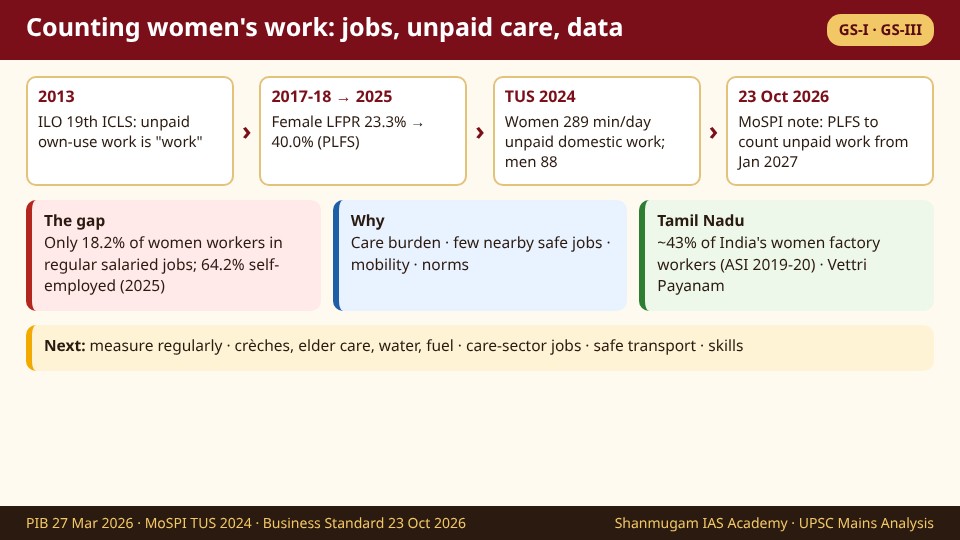
Topics: Indian Society – Role of Women; Indian Economy – Employment · GS-I · GS-III · UPSC Mains Analysis
Key takeaways
- Women's measured work is rising – female LFPR (15+, usual status) went from 23.3% in 2017-18 to 41.7% in 2023-24 and was 40.0% in calendar 2025 (PLFS, new design) – but only 18.2% of women workers have regular salaried jobs and 64.2% are self-employed.
- Unpaid care is the hidden half: in the Time Use Survey 2024, 81.5% of women (6+) did unpaid domestic work for 289 minutes a day, against 27.1% of men for 88 minutes.
- MoSPI's concept note of 23 October 2026 proposes that the PLFS count unpaid domestic and care work, volunteer and trainee work from January 2027. Way forward: regular measurement, care infrastructure, nearby safe jobs. PYQ: GS-III 2023 (care economy).

Why in news
An article in The Indian Express (17 November 2026) has reopened an old question: are we measuring women's work correctly? The trigger is a change in India's main job survey. On 23 October 2026 the Ministry of Statistics and Programme Implementation (MoSPI) released a concept note proposing that the Periodic Labour Force Survey (PLFS), from January 2027, add questions on unpaid household services, caregiving, volunteer work, unpaid trainee work and production of goods for own use – activities that until now were captured only by the occasional Time Use Survey (Business Standard, 23 October 2026). The same note proposes a separate sampling stratum for households with platform (gig) workers. For a Mains answer this is a chance to connect three things: the numbers on women's employment, the invisible unpaid work behind them, and what policy should do.
Background: what "work" means in statistics
- Old view: official surveys counted mainly work done for pay or profit (and work on the family farm or business). Cooking, cleaning and caring at home were outside "work" – so a woman who worked 10 hours a day at home could be recorded as "not in the labour force".
- New international standard: the ILO's 19th International Conference of Labour Statisticians (2013) defined work broadly and split it into five forms – own-use production work (goods and services for the household), employment (work for pay or profit), unpaid trainee work, volunteer work and other work. "Employment" became the narrower idea of work for pay or profit.
- Global goal: SDG target 5.4 asks countries to recognise and value unpaid care and domestic work; indicator 5.4.1 is the share of time spent on it – which needs a time-use survey.
- India's tools: the PLFS (since 2017; quarterly urban, annual all-India; monthly estimates after the January 2025 redesign) measures jobs; the Time Use Survey (TUS) – 2019 and 2024 – measures how people spend each minute of a day, including unpaid work.
Verified data: women's work in numbers
| Indicator | Figure | Source |
|---|---|---|
| Female LFPR, age 15+, usual status | 23.3% (2017-18) → 41.7% (2023-24) | PLFS annual reports (July–June years) |
| Female LFPR, age 15+, calendar 2025 | 40.0% (male 79.1%); rural women 45.9% | PLFS Annual Report 2025, PIB, 27 March 2026 (new design – not strictly comparable with earlier years) |
| Urban female unemployment rate, 2025 | 6.4% (6.7% in 2024) | Same |
| Women workers by status, 2025 | Self-employed 64.2%; regular wage/salaried 18.2% (16.6% in 2024) | Same |
| Taking part in employment-related activities (age 15–59) on a day | Women 21.8% → 25%; men 70.9% → 75% (2019 → 2024) | Time Use Survey 2024, MoSPI, 25 February 2025 |
| Unpaid domestic services (age 6+) | Women: 81.5% take part, 289 min/day; men: 27.1%, 88 min/day (time per participant) | Same |
| Unpaid caregiving (age 15–59) | Women 41% take part, about 140 min/day; men 21.4%, about 74 min/day | Same |
| TUS 2024 sample | 1,39,487 households; 4,54,192 persons aged 6+ | Same |
Read together, the numbers say: more women are now counted as working, but most of the rise is in self-employment (including unpaid help in family farms and enterprises), only about one in five women workers has a regular salaried job, and women still carry the bulk of unpaid care. The headline FLFPR alone hides all three facts.
What the PLFS change will fix – and what it will not
| Issue | Today | After the proposed change (from January 2027) |
|---|---|---|
| Unpaid domestic and care work | Seen only in TUS (2019, 2024) – years apart | Questions in the regular PLFS (age 15+, first visit) – annual estimates proposed |
| Volunteer and unpaid trainee work | Largely invisible | Separately recorded |
| Platform / gig work | Experimental questions since January 2026; too few gig households sampled | Separate sampling stratum for gig households |
| Limits that remain | – | Recall-based questions are less precise than a time diary; value of unpaid work still not in GDP; State-level detail depends on sample size |
Analysis: why women are not in formal jobs
- Time poverty: with 4–5 hours a day of unpaid domestic work, a full-time job far from home is often impossible. Care, not lack of willingness, is the main constraint.
- The U-shape: economists (including Nobel laureate Claudia Goldin) describe a U-shaped link between development and women's work – participation falls as families move out of farm work and incomes rise, and rises again only when education and suitable white-collar and service jobs grow. India is still climbing the second arm of the U.
- Too few suitable jobs: regular, safe, nearby jobs with fixed hours – in manufacturing, services and the care sector – are scarce; women crowd into agriculture and home-based self-employment.
- Safety and mobility: distance, cost of travel and safety in public spaces shape whether a woman can take a job.
- Social norms and life events: marriage, childbirth and migration after marriage push many women out of the workforce, and few return.
- Measurement itself: when unpaid work is not counted, policy also does not see it – for example the need for crèches, elder care and water and fuel at home, which free women's time.
Static syllabus link
- GS-I (Society): role of women, women's organisations, effects of globalisation on women, social empowerment.
- GS-III (Economy): employment, inclusive growth, the "care economy" versus the "monetised economy" (asked in 2023).
- Constitution: Article 39(a) and (d) (adequate livelihood; equal pay for equal work), Article 42 (just and humane conditions of work and maternity relief).
- Labour codes (in force from 21 November 2025): the Code on Social Security keeps 26 weeks of paid maternity leave and crèche facility for establishments with 50 or more employees; the OSH Code allows women to work in all establishments, including at night, with their consent and safety safeguards.
Tamil Nadu angle
- Women in factories: an analysis of Annual Survey of Industries 2019-20 data (reported February 2023) found that about 6.8 lakh of India's roughly 16 lakh women factory workers – about 43% – were in Tamil Nadu, and women were about 40% of the State's factory workforce. Garments in Tiruppur, electronics and footwear around Chennai and Hosur, and textile mills in western Tamil Nadu are examples.
- Mobility: the free bus travel scheme for women – renamed Vettri Payanam from 2 October 2026 – lowers the cost of reaching work, one of the barriers listed above.
- Lesson: where regular jobs, hostels and transport exist close to where women live, women take them. The Tamil Nadu experience supports the "demand and enabling conditions" explanation over the "women do not want to work" explanation.
Faculty view
Do not write that India's FLFPR "has doubled, so the problem is solved", and do not write that "women are not working". Both are wrong. Write: "Women have always worked; statistics are now catching up, and the economy must now offer them paid, regular, safe work." Use three numbers – FLFPR 40.0% (2025), regular salaried only 18.2% of women workers, and 289 minutes a day of unpaid domestic work – cite ILO 2013 and SDG 5.4 for the concept, and the October 2026 PLFS concept note for the policy. End with care infrastructure as economic infrastructure.
Way forward
- Measure well: run the TUS at a fixed interval, publish the new PLFS unpaid-work estimates by State and social group, and build a satellite account that values unpaid work without mixing it into GDP.
- Recognise, reduce, redistribute unpaid care (the widely used "3R" approach; the ILO's 2018 care-work report adds reward and representation – "5R"): public crèches and anganwadi-cum-crèches, elder care, piped water and clean cooking fuel at home, and shared parental leave norms.
- Create the jobs: labour-intensive manufacturing and services, the care sector itself (nursing, early-childhood care, elder care) as a job creator, and formalisation of home-based work.
- Make work reachable and safe: safe transport, working-women hostels near industrial clusters, and enforcement of the labour codes' safeguards.
- Skills and assets: skilling linked to real vacancies, credit for women-led enterprises and Self Help Groups, and digital skills.
Glossary – Unpaid care work
All the work done to look after a household and its members without any payment – cooking, cleaning, fetching water and fuel, and caring for children, the sick and the elderly. It is "work" because it uses time and effort and has economic value (if it were bought from the market it would have a price), but it is not counted in GDP because no money changes hands. The ILO's 19th International Conference of Labour Statisticians (2013) treats it as "own-use provision of services", one of the recognised forms of work, and SDG target 5.4 asks countries to "recognise and value" it. In India it falls mostly on women: in the Time Use Survey 2024, women aged 6 and above who did unpaid domestic work spent 289 minutes a day on it, against 88 minutes for men.
Asked before in UPSC
1. "Distinguish between 'care economy' and 'monetized economy'. How can care economy be brought into monetized economy through women empowerment?" – GS-III, 2023 (15 marks, 250 words)
2. "Discuss the positive and negative effects of globalization on women in India." – GS-I, 2015 (12.5 marks, 200 words)
The 2023 question is almost the same theme as today's news: the PLFS change is a step towards "recognising" the care economy in data.
Mains practice question
"India's female labour force participation has risen sharply, yet the quality of women's work and the burden of unpaid care remain unresolved." Examine the statement in the light of recent PLFS and Time Use Survey data, and suggest measures. (15 marks, 250 words)
FAQ
What is India's female labour force participation rate now?
40.0% for women aged 15 and above in calendar 2025 (usual status), as per the PLFS Annual Report 2025 released on 27 March 2026. In 2017-18 it was 23.3%.
What did MoSPI propose in October 2026?
A concept note of 23 October 2026 proposes that the PLFS, from January 2027, ask about unpaid household services, caregiving, volunteer work, unpaid trainee work and production of goods for own use, and add a separate sampling stratum for platform (gig) worker households.
How much unpaid domestic work do women do?
In the Time Use Survey 2024, 81.5% of women aged 6+ did unpaid domestic work, spending 289 minutes a day on it; for men the figures were 27.1% and 88 minutes.
Is unpaid care work included in GDP?
No. It is "work" in the ILO 2013 definition, but it is outside GDP. Countries value it through time-use surveys and separate (satellite) accounts.
Why is this important for UPSC?
It links GS-I (role of women), GS-III (employment, inclusive growth) and the 2023 GS-III question on the care economy.
Sources: PIB – PLFS Annual Report 2025 (27 March 2026); PLFS annual reports 2017-18 and 2023-24; MoSPI – Time Use Survey 2024 press release (25 February 2025) as reported by PTI, Business Standard and Business Today; Business Standard on the MoSPI concept note (23 October 2026); ILO, Resolution concerning statistics of work (19th ICLS, 2013); UN SDG target 5.4; Labour codes notification (21 November 2025); ThePrint (7 February 2023) on ASI 2019-20 data. Topic from an article in The Indian Express; analysis is our own.
Related on our site: UPSC Mains Analysis – all articles · UPSC glossary · UPSC Mains answer-writing practice · Free PDF downloads
Add us as a preferred source on Google
Link to this page from your website / blog (HTML code)
TNPSC Achievers
-

PM. JAYALAKSHMI
TNPSC TNPSC
நடப்பு நிகழ்வுகள் 18 நவம்பர் 2026 | Today Current Affairs in Tamil | TNPSC Group 4 வினா விடை
TNPSC குரூப் 1, 2/2A, 4 – நேரடி வகுப்புகள் · கோவை & மதுரை
2006 முதல் சண்முகம் IAS அகாடமி · Classroom & online coaching in Coimbatore and Madurai
