

Mains Analysis: Death penalty vote at the UN and fallible justice
18 November 2026 · English Polity & Governance
⬇ Download this analysis as free PDF
Topics: Polity – Judiciary, Criminal Justice, Pardoning Powers; Ethics – Justice and Punishment · GS-II · GS-IV · UPSC Mains Analysis
Key takeaways
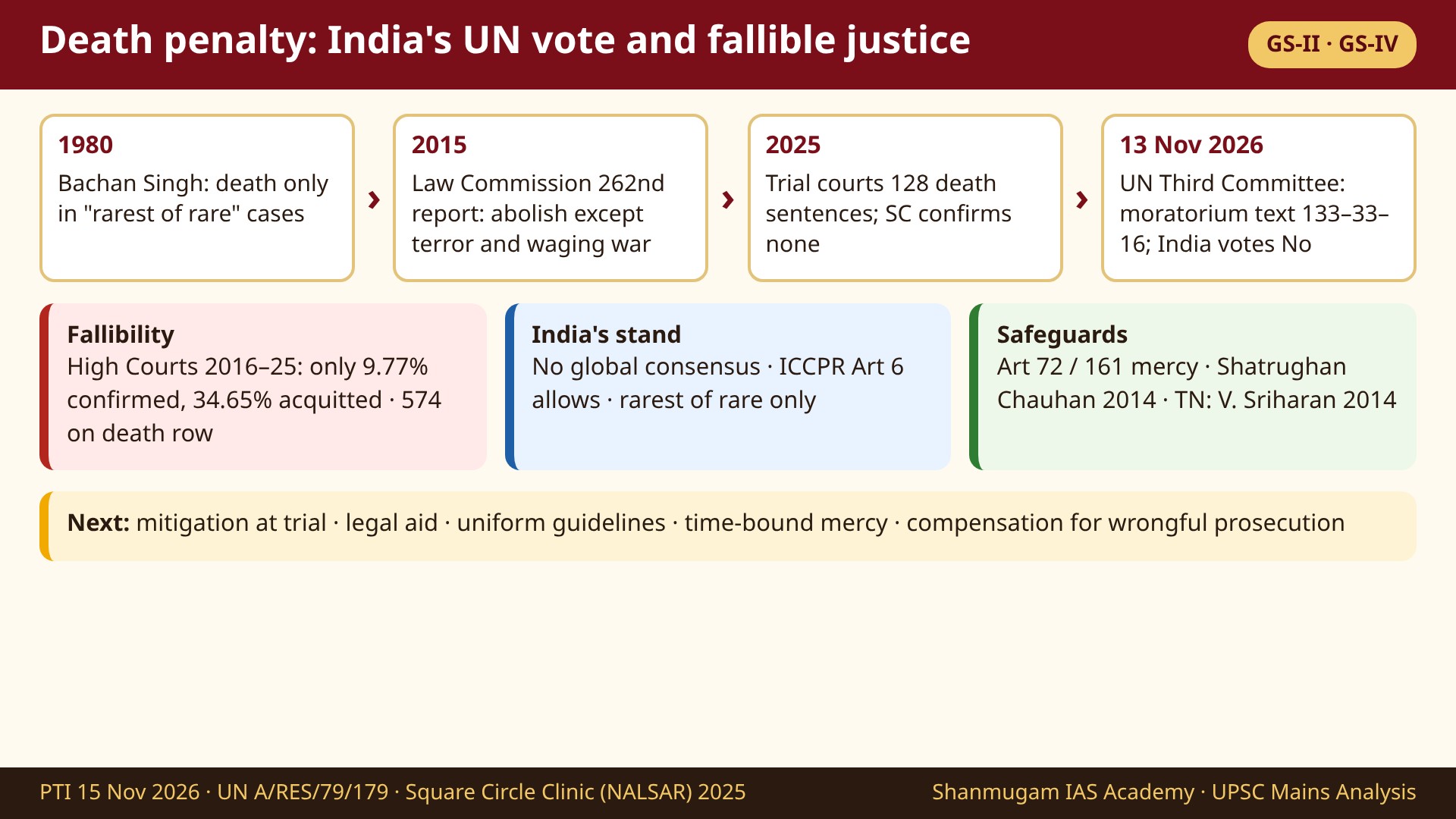
- On 13 November 2026 the UN General Assembly's Third Committee approved a draft calling for a moratorium on executions by 133–33–16; India voted against, saying there is no international consensus, ICCPR Article 6 allows the death penalty with restrictions, and India uses it only in the "rarest of rare" cases (Bachan Singh, 1980).
- The case for caution is data on error: from 2016 to 2025 High Courts confirmed only 9.77% of the death sentences they decided and acquitted 34.65%; the Supreme Court confirmed none in 2025, while trial courts gave 128 and 574 people were on death row (Square Circle Clinic, NALSAR).
- Way forward: mitigation at the trial stage, legal aid, uniform sentencing guidelines, time-bound mercy decisions under Articles 72/161, and a debate on the Law Commission's 262nd report (2015: abolish except for terrorism and waging war). PYQ: Prelims 2025 (pardoning power).

Why in news
On 13 November 2026 the UN General Assembly's Third Committee (social, humanitarian and cultural questions) approved a draft resolution titled "Moratorium on the use of the death penalty", presented by Mexico, by a recorded vote of 133 in favour, 33 against and 16 abstentions. India voted against, along with countries such as the United States, China, Japan, Pakistan, Saudi Arabia, Iran and Egypt (PTI, 15 November 2026). The draft calls on all States to establish a moratorium on executions "with a view to abolishing the death penalty", while reaffirming the right of every country to develop its own legal system. An editorial in The Hindu (18 November 2026) asked whether India's stand fits the evidence on how often its own courts get capital cases wrong. This article builds the Mains answer from primary sources.
What the UN text says and what India said
- The text: notes concern at a significant surge in reported executions in 2025; asks States not to impose the death penalty on persons below 18 (or whose age is uncertain), to restrict it for pregnant women, persons with mental or intellectual disabilities and older persons, and to reduce the number of capital offences, including by removing the mandatory death penalty. It is not binding.
- India's explanation of vote (First Secretary Bhavika Mangalanandan, as reported by news agencies on 14 November 2026): "There is no international consensus against capital punishment, and Article 6 of the ICCPR permits its use with restrictions"; in India "the death penalty is a statutory provision exercised exclusively in the rarest of rare cases". India's long-standing position is that each State has the sovereign right to decide its own criminal laws.
- History of the vote: the first such resolution was adopted in 2007; the tenth, A/RES/79/179 of 17 December 2024, passed 130–32–22, with India voting No (UN Digital Library). The committee approval of 2026 now goes to the General Assembly plenary, usually in December.
Background: India's law on the death penalty
| Milestone | What it decided |
|---|---|
| Law Commission, 35th Report (1967) | Recommended that the death penalty be retained |
| CrPC 1973, Section 354(3) | Life imprisonment became the normal sentence for murder; death needs "special reasons" in writing (the rule continues in the BNSS, 2023) |
| Bachan Singh v. State of Punjab (1980) | Upheld the death penalty for murder but only in the "rarest of rare cases when the alternative option is unquestionably foreclosed" |
| Machhi Singh (1983); Mithu v. State of Punjab (1983) | Machhi Singh listed categories of "rarest of rare"; Mithu struck down the mandatory death sentence of Section 303 IPC |
| Kehar Singh (1989); Epuru Sudhakar (2006) | Mercy power under Articles 72/161 is subject to limited judicial review (e.g. mala fide, irrelevant grounds) |
| Shatrughan Chauhan v. Union of India (2014) | Unexplained, inordinate delay in deciding mercy petitions is a ground to commute death to life; solitary confinement before rejection is illegal |
| Law Commission, 262nd Report (31 August 2015) | Recommended abolition for all crimes except terrorism-related offences and waging war; found no evidence that the death penalty deters more than life imprisonment |
| Manoj v. State of Madhya Pradesh (2022) | Trial courts must gather mitigation material (psychological evaluation, social history, jail conduct) before sentencing; in September 2022 the question of uniform guidelines was referred to a Constitution Bench |
Verified data: how fallible is capital sentencing?
| Indicator | Figure |
|---|---|
| Death sentences given by trial (sessions) courts in 2025 | 128 |
| Prisoners on death row, end of 2025 | 574 (400 in 2016) |
| Supreme Court in 2025 | Confirmed no death sentence (third year in a row); acquitted 10 persons |
| High Courts, 2016–2025 (1,085 death sentences decided) | Confirmed only 106 (9.77%); acquitted 376 (34.65%); commuted 515 |
| Supreme Court, 2016–2025 | Confirmed 19; acquitted 38; commuted 71 |
| Last executions in India | 20 March 2020 (four convicts in the 2012 Delhi gang-rape and murder case) |
Source: The Death Penalty in India – Annual Statistics Report 2025, Square Circle Clinic, NALSAR University of Law (formerly Project 39A), as reported by ThePrint (8 February 2026) and Bar & Bench (6 February 2026).
The pattern is striking: trial courts keep giving about a hundred or more death sentences a year, but higher courts acquit far more often than they confirm. An acquittal means the person should never have been convicted at all – yet sat under a death sentence for years. In Ankush Maruti Shinde v. State of Maharashtra (2019) the Supreme Court acquitted six men who had been on death row and ordered compensation. This is the core of the "fallible justice" argument: an irreversible punishment is being given by a system whose error rate is high.
Arguments on both sides
| For retention | For abolition / moratorium |
|---|---|
| Retribution and public conscience in the most brutal crimes (terrorism, child rape-murder) | Irreversibility – a wrongful execution cannot be corrected; the error data above is high |
| Possible deterrence; a tool against terror and organised crime | Law Commission (2015) found no proof it deters more than life imprisonment |
| Sovereign choice; ICCPR Article 6 allows it for "the most serious crimes" | "Rarest of rare" is applied unevenly – outcome depends on the Bench (Santosh Bariyar, 2009) |
| Rarely carried out – only 8 executions since 2004 (Dhananjoy Chatterjee 2004, Kasab 2012, Afzal Guru 2013, Yakub Memon 2015, four in 2020) | Falls mostly on the poor, who lack good lawyers; long death-row wait is itself a punishment |
Ethics angle (GS-IV)
- Theories of punishment: retributive (just deserts), deterrent (prevent future crime) and reformative (change the offender). The death penalty rests on the first two and closes the door on the third.
- Kantian view: the dignity of the person; utilitarian view: only if it saves more lives – which the evidence does not show.
- Justice to victims: certainty and speed of punishment, victim compensation and support matter more than severity – a fair point both sides accept.
- Fallibility as an ethical problem: when an institution knows its error rate, choosing an irreversible penalty is a question of institutional humility and the State's duty of care.
Tamil Nadu angle
- In the Rajiv Gandhi assassination case the Supreme Court (V. Sriharan, 18 February 2014) commuted the death sentences of Murugan, Santhan and Perarivalan to life because of the long delay in deciding their mercy petitions – applying the Shatrughan Chauhan principle.
- On 30 August 2011 the Tamil Nadu Assembly passed a resolution urging the President to reconsider their mercy pleas; in May 2022 the Supreme Court ordered Perarivalan's release using Article 142, also discussing the Governor's delay on a recommendation under Article 161.
- The case shows the federal side of mercy powers: Article 161 (Governor, State laws) and Article 72 (President) operate side by side.
Faculty view
Do not write a one-sided "abolish now" or "hang them" answer. UPSC rewards balance: India retains the death penalty in law but uses it very rarely; the strongest argument for change is not sentiment but data on error – High Courts confirmed fewer than 10% of death sentences they heard in ten years and acquitted over a third. Quote Bachan Singh for the test, the Law Commission's 262nd report for the reform path, and Articles 72/161 for safeguards. A mature conclusion: keep the national debate open, fix the trial stage first (mitigation, legal aid, forensics), and consider the Law Commission's calibrated route.
Way forward
- Fix the trial stage: compulsory mitigation investigation (as in Manoj), quality legal aid from day one, and independent forensic labs.
- Uniform sentencing guidelines: early decision on the 2022 Constitution Bench reference.
- Time-bound, transparent mercy process: reasoned decisions under Articles 72/161 within fixed time.
- Compensation for wrongful prosecution: a statutory scheme, as the Law Commission's 277th report (2018) suggested.
- Data and review: annual official data on capital sentencing; a national debate on the 262nd report's calibrated abolition.
Glossary – "Rarest of rare" doctrine
The test the Supreme Court laid down in Bachan Singh v. State of Punjab (1980) for choosing between death and life imprisonment for murder. A five-judge Bench (4:1, Justice P.N. Bhagwati dissenting) upheld the death penalty but said it may be given only in the "rarest of rare cases when the alternative option is unquestionably foreclosed". Life imprisonment is the rule and death the exception; the court must weigh aggravating circumstances (about the crime) and mitigating circumstances (about the criminal – age, background, mental health, chance of reform) and record "special reasons". Later judgments (Santosh Bariyar, 2009) admitted that the test has been applied unevenly, and Manoj v. State of Madhya Pradesh (2022) required courts to collect mitigation material – psychological and social history – before sentencing.
Asked before in UPSC
In the UPSC GS Mains papers we checked, we did not find a question directly on the death penalty. The closest verified question is from Prelims:
"Consider the following statements with regard to pardoning power of the President of India: I. The exercise of this power by the President can be subjected to limited judicial review. II. The President can exercise this power without the advice of the Central Government." – Prelims 2025 (answer: I only).
For Mains, prepare this topic under GS-II (judiciary, criminal justice, executive powers) and GS-IV (justice, ethics of punishment).
Mains practice question
"The 'rarest of rare' doctrine was meant to make the death penalty an exception, yet data show high rates of reversal in appeal." In the light of India's vote at the UN in November 2026, examine whether India should move towards a moratorium. (15 marks, 250 words)
FAQ
How did India vote on the UN death penalty moratorium in November 2026?
India voted against the draft in the UN General Assembly's Third Committee on 13 November 2026. The draft was approved 133–33–16.
Why did India vote against?
India said there is no international consensus against capital punishment, ICCPR Article 6 allows it with restrictions, and in India it is used only in the "rarest of rare" cases.
What is the "rarest of rare" doctrine?
The test from Bachan Singh v. State of Punjab (1980): death may be given only when life imprisonment is "unquestionably foreclosed", after weighing aggravating and mitigating circumstances.
What did the Law Commission's 262nd report recommend?
In August 2015 it recommended abolishing the death penalty for all crimes except terrorism-related offences and waging war.
How many people are on death row in India?
574 at the end of 2025, as per the Square Circle Clinic (NALSAR) annual report; the last executions took place on 20 March 2020.
Sources: UN General Assembly Third Committee vote of 13 November 2026 (PTI, 15 November 2026; ANI, 14 November 2026); UN Digital Library – A/RES/79/179 (17 December 2024); UN press release GA/SHC/4431 (2024); Square Circle Clinic, NALSAR – Annual Statistics Report 2025 (ThePrint, 8 February 2026; Bar & Bench, 6 February 2026); Law Commission of India – Reports 35, 262 and 277; Supreme Court judgments cited; Constitution of India, Articles 21, 72, 161; ICCPR. Topic from an editorial in The Hindu; analysis is our own.
Related on our site: UPSC Mains Analysis – all articles · UPSC glossary · UPSC Mains answer-writing practice · Free PDF downloads
Add us as a preferred source on Google
Link to this page from your website / blog (HTML code)
BANK Achievers
-

PREETHA
BANK BANK
Indian Polity in Tamil | 100 அரசியலமைப்பு வினா விடை | TNPSC Group 4 Preparation 2026
TNPSC குரூப் 1, 2/2A, 4 – நேரடி வகுப்புகள் · கோவை & மதுரை
2006 முதல் சண்முகம் IAS அகாடமி · Classroom & online coaching in Coimbatore and Madurai
