

Mains Analysis: As US doors narrow, can India be a study hub?
18 November 2026 · English Government Schemes & Education
⬇ Download this analysis as free PDF
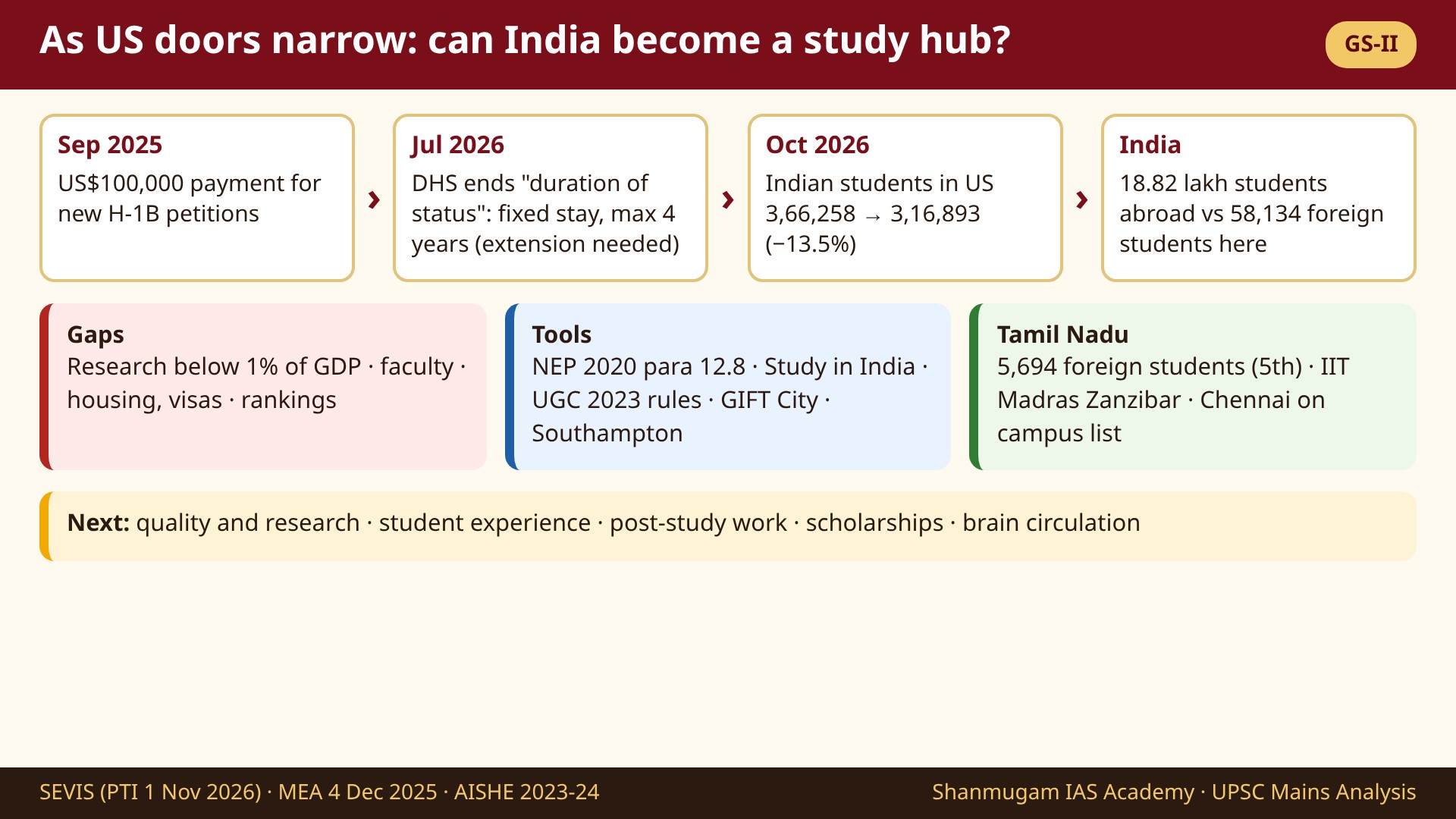
Topics: Social Justice – Education, Human Resources; International Relations – Diaspora and Soft Power · GS-II · UPSC Mains Analysis
Key takeaways
- Active Indian students in the US fell about 13.5% in a year – from 3,66,258 (October 2025) to 3,16,893 (October 2026, SEVIS) – after the US$100,000 H-1B payment (September 2025) and the end of "duration of status" for students (rule of July 2026).
- India is the world's biggest sender but a small host: about 18.82 lakh Indian students abroad (MEA, 2025) against 58,134 foreign students in India from 173 countries (AISHE 2023-24).
- Tools exist – NEP 2020 para 12.8, Study in India, UGC 2023 foreign-campus rules, GIFT City (Deakin, Wollongong), Southampton Gurugram, 13 LoIs – but India must fix research funding, faculty and student experience to turn brain drain into brain circulation.

Why in news
The number of Indian students in the United States is falling for the first time in years. Data from the US Student and Exchange Visitor Information System (SEVIS) show 3,16,893 active Indian students in October 2026, down about 13.5% from 3,66,258 a year earlier; Indian master's students fell by about 20% (PTI, 1 November 2026). Tighter US rules on student visas, post-study work and the H-1B route are behind the change. An editorial in The Indian Express (18 November 2026) argued that as the "American dream" clouds over, India should build universities that can hold its own students and attract others. This article checks the numbers and the policy tools.
What changed in the United States
| Date | Measure | Effect on Indian students |
|---|---|---|
| 19 September 2025 | Presidential proclamation: a US$100,000 payment for new H-1B petitions | The main job route after study became costlier for employers |
| 17 July 2026 (in force 15 September 2026) | DHS final rule ends "duration of status": fixed admission period of up to four years; F-1 grace period cut from 60 to 30 days | More paperwork (extension of stay), less certainty about finishing study and moving to work |
| 2025–26 | Stricter visa screening, including social-media vetting | Delays and refusals at the visa stage |
| Fall 2025 | New international enrolment in the US fell about 17% (Open Doors 2025 snapshot) | Early sign of the slowdown |
Verified data: outbound versus inbound
| Indicator | Figure | Source |
|---|---|---|
| Indian students abroad | 18.82 lakh (2025) | MEA, written reply in Rajya Sabha, 4 December 2025 |
| Indian students in the US, 2024-25 | 3,63,019 (+10%), the largest group – 30.8% of all international students | Open Doors 2025 (November 2025) |
| Active Indian students in the US, October 2026 | 3,16,893 (October 2025: 3,66,258); master's 2,92,929 → 2,34,034 | SEVIS data (PTI, 1 November 2026) |
| Foreign students in India, 2023-24 | 58,134 from 173 countries (48,898 in 2019-20); Nepal 24.1%; 73.6% in undergraduate courses | AISHE 2023-24, Ministry of Education |
| Top host States, 2023-24 | Karnataka 7,914; Punjab 7,902; Maharashtra 6,190; Uttar Pradesh 5,953; Tamil Nadu 5,694 | Same |
Put simply: for every foreign student studying in India there are roughly 30 Indian students abroad (the two figures are for different years, so read this as an order of magnitude). India is the world's largest sender of students but a small host.
India's policy tools so far
| Tool | What it does |
|---|---|
| NEP 2020, para 12.8 | India as a global study destination with "premium education at affordable costs"; International Students Office in every institution receiving foreign students; Indian universities to go abroad; top foreign universities to be facilitated in India |
| Study in India (Ministry of Education, from 2018) | Single portal for admission of foreign students; linked to dedicated e-Student visas |
| UGC (Setting up and Operation of Campuses of Foreign Higher Educational Institutions in India) Regulations, 2023 | Foreign universities in the top 500 of global rankings (overall or subject-wise), or of outstanding expertise, may open campuses; initial approval for 10 years; freedom on fees; repatriation of funds allowed; no online or distance mode |
| GIFT City (IFSCA route) | Deakin University (registered 9 January 2024) and University of Wollongong (8 November 2024) – the first foreign branch campuses |
| First UGC-route campus | University of Southampton, Gurugram – courses from August 2025; by December 2025, 13 Letters of Intent had been issued to institutions from Australia, Italy, the UK and the US, for cities including Bengaluru, Delhi NCR, Mumbai and Chennai (Ministry of Education reply in Parliament) |
| Indian campuses abroad | IIT Madras in Zanzibar (Tanzania) and IIT Delhi in Abu Dhabi |
Analysis: can India really become a destination?
- Opportunity: students who would have gone to the US may now choose cheaper, nearer or new options – foreign campuses in India, dual degrees, or strong Indian institutions. Every student who stays saves foreign exchange and may stay in the Indian job market.
- But the diversion is mostly to other countries: Germany, Ireland, the UAE and others are actively recruiting. India competes not only with the US but with every other host.
- Quality gap: few Indian universities rank high globally; research spending in India is below 1% of GDP; faculty shortages and regulatory overload limit autonomy.
- Experience gap: foreign students look for housing, safety, simple visas, English-medium teaching, recognition of degrees and post-study work. Much of India's intake still comes from neighbouring countries, the Gulf and Africa.
- Equity risk: high-fee foreign campuses may serve only the rich and pull faculty from public universities unless linked to public institutions.
- Brain drain to brain circulation: the larger aim is not to stop mobility but to make India a node – where talent comes, studies, researches and also returns.
Static syllabus link
- GS-II: issues relating to development and management of education and human resources; government policies; Indian diaspora; effect of policies of developed countries on India's interests.
- Constitution: education is in the Concurrent List (Entry 25, List III); coordination and standards in higher education are a Union subject (Entry 66, List I) – the basis of UGC's role.
- Soft power: foreign alumni of Indian universities become long-term friends of India – a foreign-policy asset.
Tamil Nadu angle
- Tamil Nadu hosted 5,694 foreign students in 2023-24 (AISHE) – fifth among States; Chennai, Vellore and Coimbatore have institutions with an international intake.
- IIT Madras runs India's first IIT campus abroad, in Zanzibar – an example of "going global" from Tamil Nadu.
- Chennai is among the cities named for new foreign university campuses under the UGC route.
- Many students from Tamil Nadu also go abroad; strong State universities, hostels and industry links can turn the State into a regional study hub.
Faculty view
Write this as a "challenge into opportunity" answer, but stay honest with numbers: India sends about 18.8 lakh students abroad and hosts about 58,000. Use the SEVIS fall of 13.5% as the trigger, NEP 2020 para 12.8 and the UGC 2023 regulations as the policy frame, and GIFT City / Southampton as examples. Then show the gaps – research funding, faculty, student experience – and end with a balanced line: India should aim at brain circulation, not just at stopping brain drain.
Way forward
- Quality first: more research funding through the Anusandhan National Research Foundation, faculty recruitment, real autonomy for good institutions.
- Student experience: quick e-Student visas, hostels, safety, international student offices, credit transfer and recognition of degrees.
- Smart use of foreign campuses: encourage research tie-ups with Indian public universities; protect affordability through scholarships.
- Post-study pathway: clear internship and work options for foreign graduates in India.
- Regional focus: scholarships for students from the neighbourhood, Africa and West Asia under development partnership.
- Measure outcomes: publish data on foreign students, their courses and placements every year.
Glossary – Internationalisation at home
Giving students an international experience without their leaving the country – through foreign faculty and students on campus, joint and dual degrees, global courses and research partnerships, foreign-language and area-studies programmes, and campuses of foreign universities in India. The National Education Policy 2020 (paragraph 12.8) uses the idea: India is to be promoted as a global study destination "providing premium education at affordable costs", high-performing Indian universities are to set up campuses abroad, and selected top foreign universities are to be facilitated to operate in India. The aim is twofold – fewer students forced to go abroad for quality (less outflow of money and talent), and more foreign students coming to India (soft power and revenue).
Asked before in UPSC
In the UPSC GS Mains papers we checked, we did not find a question directly on internationalisation of higher education or foreign university campuses. The topic falls under the GS-II syllabus line "issues relating to development and management of social sector/services relating to education, human resources" and "effect of policies and politics of developed and developing countries on India's interests, Indian diaspora". Treat it as a likely future question.
Mains practice question
"Tightening immigration rules in traditional study destinations offer India an opportunity to become a global education hub." Discuss the opportunities and constraints, with reference to NEP 2020 and the UGC regulations of 2023. (15 marks, 250 words)
FAQ
How many Indian students are studying abroad?
About 18.82 lakh in 2025, according to the Ministry of External Affairs (Rajya Sabha reply, 4 December 2025).
How much has the number of Indian students in the US fallen?
Active Indian students in SEVIS fell about 13.5% – from 3,66,258 (October 2025) to 3,16,893 (October 2026).
How many foreign students study in India?
58,134 students from 173 countries in 2023-24 (AISHE); Nepal is the largest source.
What do the UGC 2023 regulations allow?
Foreign universities ranked in the global top 500 (or of outstanding expertise) can set up campuses in India with UGC approval, set their own fees and repatriate funds, but cannot teach online.
What is "internationalisation at home"?
Giving students an international education in their own country – foreign faculty, students and campuses, joint degrees and global courses – an idea used in NEP 2020.
Sources: SEVIS data (PTI, 1 November 2026); Open Doors 2025 (ThePrint, November 2025); MEA reply in Rajya Sabha (4 December 2025); AISHE 2023-24, Ministry of Education (Business Today, 13 July 2026); US Presidential Proclamation of 19 September 2025; US DHS final rule of 17 July 2026; National Education Policy 2020; UGC Regulations 2023; IFSCA list of foreign universities; Ministry of Education reply in Parliament (December 2025). Topic from an editorial in The Indian Express; analysis is our own.
Related on our site: UPSC Mains Analysis – all articles · UPSC glossary · UPSC Mains answer-writing practice · Free PDF downloads
Add us as a preferred source on Google
Link to this page from your website / blog (HTML code)
BANK Achievers
-

PRINCY
BANK BANK
Indian Polity in Tamil | 100 அரசியலமைப்பு வினா விடை | TNPSC Group 4 Preparation 2026
TNPSC குரூப் 1, 2/2A, 4 – நேரடி வகுப்புகள் · கோவை & மதுரை
2006 முதல் சண்முகம் IAS அகாடமி · Classroom & online coaching in Coimbatore and Madurai
