

Mains Analysis: SCO Civilisational Dialogue – India's soft-power bet
20 November 2026 · English International
⬇ Download this analysis as free PDF
Topics: International Relations – Regional Groupings, Soft Power; Indian Culture and Heritage · GS-II · UPSC Mains Analysis
Key takeaways
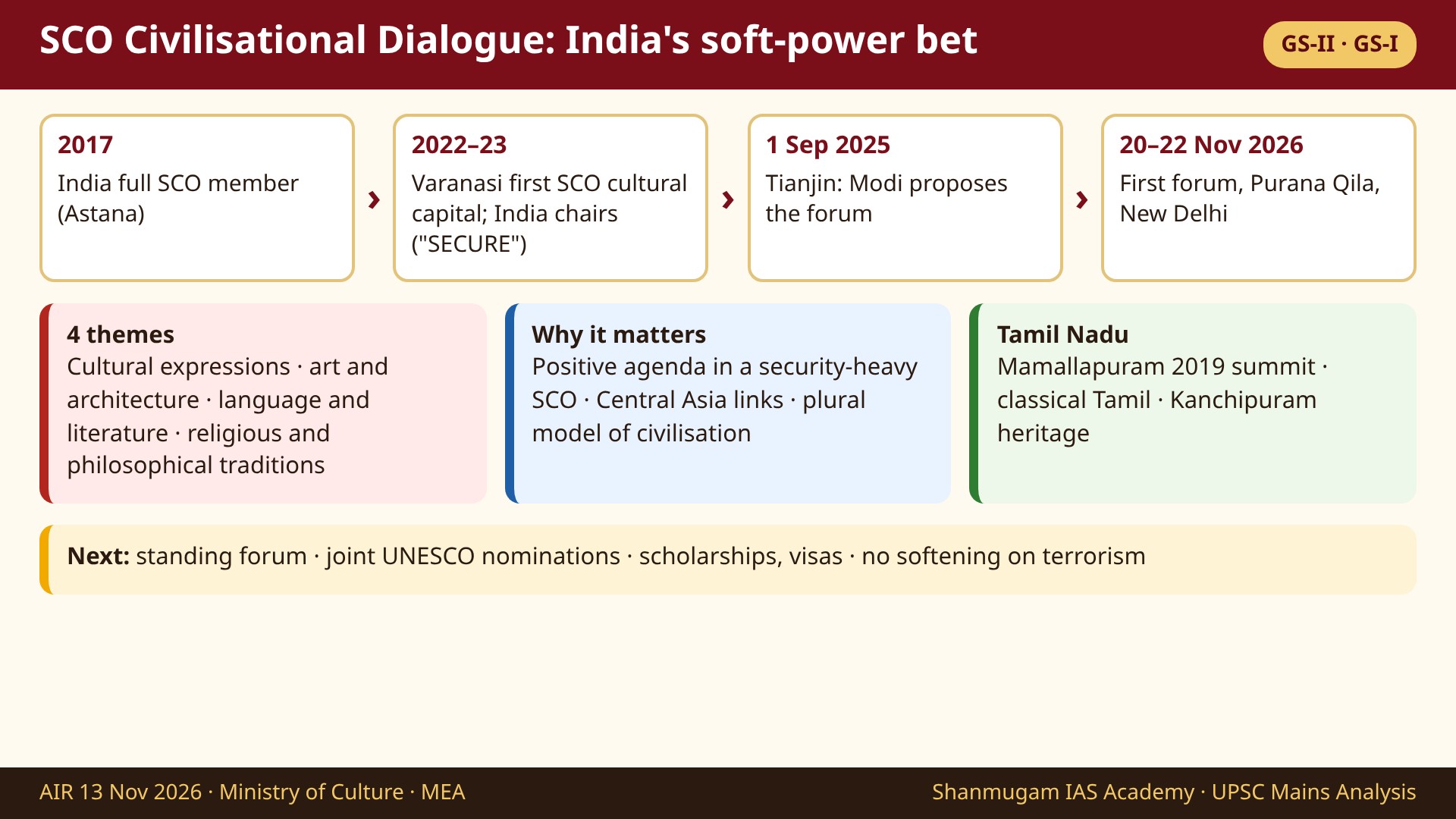
- India hosts the first SCO Civilisational Dialogue Forum at Purana Qila, New Delhi, on 20–22 November 2026 (Ministry of Culture with MEA); 15 countries confirmed, and the forum – proposed by PM Modi at the Tianjin SCO summit on 1 September 2025 – runs four themes from cultural expressions to religious and philosophical traditions.
- It gives India a positive, leadership agenda inside a security-heavy SCO and reconnects it with Central Asia, while China pushes its own Global Civilization Initiative – soft power works only with follow-up (visas, scholarships, joint UNESCO nominations).
- Way forward: make it a standing forum, deliver concrete heritage projects, keep culture and the firm line on terrorism on separate tracks. PYQ: Mains GS-II 2021 (SCO aims and objectives) and 2023 ("Virus of Conflict").

Why in news
India hosts the first SCO Civilisational Dialogue Forum at Purana Qila, New Delhi, from 20 to 22 November 2026. It is organised by the Ministry of Culture with the Ministry of External Affairs, and the Prime Minister is to inaugurate it. Union Culture and Tourism Minister Gajendra Singh Shekhawat said 15 countries had confirmed participation, including China, Kazakhstan, Uzbekistan, Iran, Belarus and Tajikistan (AIR, 13 November 2026). India invited all ten SCO members, including Pakistan; Radio Pakistan reported (14 November) that Dr Musadik Malik, Minister for Climate Change, would represent Pakistan. The forum is India's own idea: Prime Minister Modi proposed it at the SCO summit in Tianjin, China (1 September 2025), and Defence Minister Rajnath Singh announced the hosting at the SCO Council of Heads of Government in Dushanbe (20 October 2026).
What the forum covers
| Session theme | Examples named by the Culture Ministry |
|---|---|
| Civilisational and cultural expressions | Dress, food, traditional games, music |
| Art and architecture | Monuments, sculpture, frescoes, coins, building traditions |
| Language and literature | Scripts, manuscripts and centres of learning such as Nalanda, Takshashila and Vallabhi |
| Monastic, religious and philosophical traditions | Buddhism, Islam, Confucianism, Taoism, Zoroastrianism, Sikhism |
Alongside discussions there are exhibitions and cultural performances; the forum will also consider joint nominations to UNESCO's Intangible Cultural Heritage lists and the Memory of the World Register. The minister described it as "not an academic platform" and said: "Dialogue leads to recognition, and recognition leads to influence."
Background: India in the SCO
| Year | Milestone |
|---|---|
| 2001 | SCO founded in Shanghai (15 June) – China, Russia, Kazakhstan, Kyrgyzstan, Tajikistan, Uzbekistan |
| 2002 | SCO Charter signed in St Petersburg |
| 2005 | India becomes an observer |
| 2017 | India and Pakistan become full members (Astana summit) |
| 2022–23 | Varanasi named the first SCO Tourism and Cultural Capital; India chairs the SCO and hosts a (virtual) summit on 4 July 2023 under the theme "Towards a SECURE SCO"; Iran joins |
| 2024 | Belarus joins – SCO now has 10 members |
| 2025 | Tianjin summit: India's three pillars Security, Connectivity, Opportunity; the Tianjin Declaration condemns the Pahalgam terror attack; Modi proposes the Civilisational Dialogue Forum |
| 2026 | First forum, Purana Qila (20–22 November) |
Why Purana Qila? The fort is a 16th-century structure linked with Humayun's Dinpanah and Sher Shah Suri, and Archaeological Survey of India excavations there have found layers of settlement going back to the pre-Mauryan period – a fitting stage for a message of "living, continuous civilisation".
Analysis: why civilisational diplomacy, and why now?
| India's aim | How the forum helps | The limit |
|---|---|---|
| A positive agenda in a security-heavy SCO | India often finds itself the odd one out in SCO statements on terrorism and connectivity (it has not endorsed the Belt and Road Initiative). Culture gives it a field where it can lead | Culture cannot replace a firm line on cross-border terrorism – India must keep both tracks separate |
| Reconnect with Central Asia | Shared Buddhist, Sufi and Silk Road heritage; Nowruz is a joint UNESCO inscription that includes India and Central Asian states | No direct land access (Pakistan blocks transit); connectivity runs through Chabahar and the INSTC |
| A plural model of civilisation | India's message: many civilisations in dialogue, no single centre | China runs its own Global Civilization Initiative (2023); the SCO's cultural agenda could be shaped by Beijing's framing unless India keeps the lead |
| People-to-people channel with Pakistan and China | A low-risk platform where ministers can meet without a bilateral agenda | Goodwill events do not settle the border or terrorism issues |
The core point: soft power works slowly and only when it is credible. India's strengths – pluralism, Buddhist sites, yoga, Indian languages, films and a large diaspora – become influence only if they are backed by visas, scholarships, research money, and steady follow-up after the event.
Verified facts to quote
| Item | Fact |
|---|---|
| SCO members (10) | China, Russia, India, Pakistan, Kazakhstan, Kyrgyzstan, Tajikistan, Uzbekistan, Iran, Belarus |
| Forum dates and venue | 20–22 November 2026, Purana Qila, New Delhi |
| Countries confirmed (Culture Ministry, 13 Nov) | 15 |
| Proposed | Tianjin SCO summit, 1 September 2025 |
| SCO counter-terror body | Regional Anti-Terrorist Structure (RATS), Tashkent |
| International Day of Yoga | UN General Assembly resolution, December 2014 – a model of Indian soft power turned into global practice |
Static syllabus link
- GS-II: bilateral, regional and global groupings and agreements involving India; India and its neighbourhood (Central Asia, extended neighbourhood).
- GS-I: Indian culture – salient aspects of art forms, literature and architecture from ancient to modern times (Nalanda, Takshashila, Buddhist art, Indo-Islamic architecture).
- Essay / GS-IV: dialogue, tolerance and plural identity.
Tamil Nadu angle
- Mamallapuram, 2019: the second India–China informal summit (11–12 October 2019) was held among the Pallava monuments – a clear example of heritage used as a stage for diplomacy.
- Tamil as a classical language (declared 2004) and Sangam literature are assets India can put on the forum's "language and literature" track.
- Kanchipuram's Buddhist past and the tradition that links Bodhidharma to the Pallava region are part of India's heritage story in East Asia (a tradition, not settled history – write it that way).
Faculty view
Do not write this as an events report. Use it to show that India's SCO strategy has three tracks: security (firm on terrorism, refuses language that dilutes it), connectivity (Chabahar and INSTC, not the BRI) and opportunity/culture (startups, traditional medicine, Buddhist heritage, now this forum). Quote Tianjin 2025 and the 2023 chair theme "SECURE". In a 15-marker, add one limit and one way forward. For GS-I, the four session themes are a ready framework for any question on India's cultural links with Central Asia.
Way forward
- Make it a standing forum with a small secretariat or rotating host, so it does not end as a one-time event.
- Concrete outputs: joint UNESCO nominations, manuscript digitisation, shared museum exhibitions and translation grants.
- Scholarships and visas: expand ICCR scholarships and student and pilgrim visas for SCO countries.
- Keep tracks apart: cultural openness to all members, but no softening on cross-border terrorism.
- Domestic base: protect the heritage India showcases – ASI conservation, museums, and State departments such as Tamil Nadu's archaeology department.
Glossary – Civilisational diplomacy
The use of a country's long cultural history – its languages, religions and philosophies, monuments, arts, learning centres and old trade and pilgrim routes – as a tool of foreign policy. It goes beyond "cultural events": it presents the country as a civilisation with shared roots in a region, so that neighbours see it as a familiar partner rather than a rival. India uses it through Buddhist-heritage links, yoga, Nalanda, the Indian diaspora and now the SCO Civilisational Dialogue Forum. Its limits: heritage can build goodwill, but it cannot by itself solve security disputes, and it works only when the message stresses shared heritage, not one country's superiority.
Asked before in UPSC
1. "Critically examine the aims and objectives of SCO. What importance does it hold for India?" – Mains GS-II, 2021.
2. "'Virus of Conflict is affecting the functioning of the SCO'. In the light of the above statement point out the role of India in mitigating the problems." – Mains GS-II, 2023.
3. "Consider the following: 1. Asian Infrastructure Investment Bank 2. Missile Technology Control Regime 3. Shanghai Cooperation Organisation. India is a member of which of the above?" – Prelims 2022 (answer: 1, 2 and 3).
Mains practice question
"Civilisational diplomacy can give India a leadership role in the SCO that security issues deny it." Discuss with reference to the first SCO Civilisational Dialogue Forum (2026). (15 marks, 250 words)
FAQ
When and where is the first SCO Civilisational Dialogue Forum held?
At Purana Qila, New Delhi, from 20 to 22 November 2026, organised by the Ministry of Culture with the Ministry of External Affairs.
Who proposed the forum?
Prime Minister Narendra Modi, at the SCO summit in Tianjin, China, on 1 September 2025.
What are its four themes?
Cultural expressions; art and architecture; language and literature; and monastic, religious and philosophical traditions.
How many members does the SCO have?
Ten: China, Russia, India, Pakistan, Kazakhstan, Kyrgyzstan, Tajikistan, Uzbekistan, Iran and Belarus.
Which Indian city was the first SCO Tourism and Cultural Capital?
Varanasi, for 2022–23.
Sources: All India Radio (newsonair.gov.in), 13 November 2026; Ministry of Culture briefing as reported by ThePrint, 13 November 2026; PTI report of the Defence Minister's address at Dushanbe, 20 October 2026; reports of the Prime Minister's address at the Tianjin SCO summit, 1 September 2025; Radio Pakistan, 14 November 2026; SCO Charter (2002); MEA. Analysis is our own.
Related on our site: UPSC Mains Analysis – all articles · UPSC glossary · UPSC Mains answer-writing practice · Free PDF downloads
Add us as a preferred source on Google
Link to this page from your website / blog (HTML code)
TNPSC Achievers
-
RATHINAVEL
TNPSC TNPSC
Indian Polity in Tamil | 100 அரசியலமைப்பு வினா விடை | TNPSC Group 4 Preparation 2026
TNPSC குரூப் 1, 2/2A, 4 – நேரடி வகுப்புகள் · கோவை & மதுரை
2006 முதல் சண்முகம் IAS அகாடமி · Classroom & online coaching in Coimbatore and Madurai
