

Mains Analysis: Ukraine peace talks – Europe's seat, India's stakes
20 November 2026 · English International
⬇ Download this analysis as free PDF
Topics: International Relations – Effect of Policies of Developed Countries on India's Interests, Global Groupings · GS-II · UPSC Mains Analysis
Key takeaways
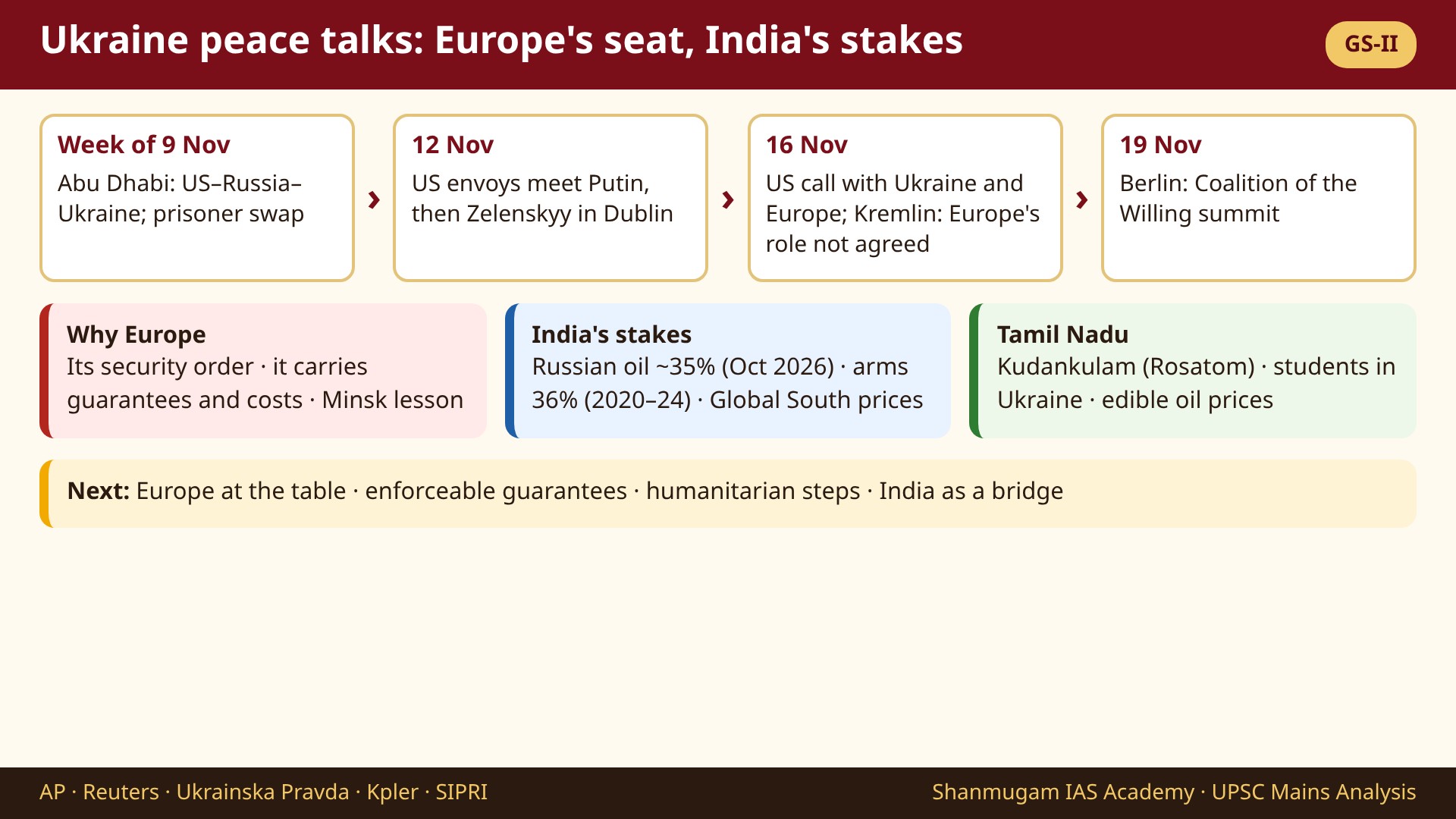
- US-brokered Ukraine diplomacy sped up in November 2026: an Abu Dhabi round (prisoner swap, no breakthrough), US envoys Witkoff and Kushner meeting Putin (12 November), a Kremlin denial (16 November) that Europe's role had been agreed, and a Coalition of the Willing summit in Berlin (19 November).
- Europe must be at the table because the talks reshape its security order, it would carry the guarantees and the costs, and Minsk showed that deals without enforcement fail; Europe's own disunity on a single negotiator is its weak spot.
- India's stakes: Russian crude about 35% of imports (October 2026, Kpler), Russia 36% of arms imports (SIPRI 2020–24), strategic autonomy and Global South food–fuel prices; India should stay a bridge to both sides. PYQ: Mains GS-II 2023 (NATO and India).

Why in news
A new round of US-brokered diplomacy to end the Russia–Ukraine war – now close to its five-year mark – moved fast in November 2026. Russian, Ukrainian and US officials met together in Abu Dhabi (the first such meeting in nine months; a prisoner exchange was agreed but no breakthrough). US envoys Steve Witkoff and Jared Kushner then met President Putin in Moscow (12 November) and President Zelenskyy in Dublin; Witkoff said "the Europeans will join at the next meeting". On 16 November the US envoys held a call with Ukrainian and European (EU and NATO) representatives, but Kremlin aide Yuri Ushakov said Europe's participation "has not been agreed with us". On 19 November German Chancellor Friedrich Merz hosted the "Coalition of the Willing" – the group of mostly European states backing Ukraine – in Berlin, under the theme "United for Peace in Ukraine and European Security"; Merz had said earlier in November that peace talks are impossible without Europe. The central question: can a deal about Europe's security be made without Europe at the table?
Timeline of the talks
| Date (2026) | Event |
|---|---|
| Week of 9 Nov | Abu Dhabi: US-brokered Russia–Ukraine talks, the first direct talks in nine months; prisoner swap agreed; no breakthrough |
| 12 Nov | Witkoff and Kushner meet Putin in the Kremlin; Putin calls any European troops in Ukraine after a ceasefire "absolutely unacceptable" |
| 12 Nov | European Political Community summit, Dublin – Zelenskyy meets the US envoys; Witkoff says Europeans will join the next meeting |
| 16 Nov | US call with Ukrainian and European (EU, NATO) representatives; Kremlin aide Yuri Ushakov says Europe's role "has not been agreed with us" |
| 19 Nov | Coalition of the Willing summit, Berlin (host: Merz); the same day Trump, Xi and Putin meet in Shenzhen on the sidelines of APEC |
No agreed peace text has been published; reported positions change daily. Write only what is confirmed.
Background: why Europe distrusts a deal made over its head
| Year | Lesson |
|---|---|
| 1945 | Yalta – great powers divided post-war Europe; Ukraine has warned against a "second Yalta" today |
| 1975 | Helsinki Final Act – inviolability of frontiers, basis of the OSCE |
| 1994 | Budapest Memorandum – Ukraine gave up the nuclear weapons on its soil in return for security assurances from Russia, the US and the UK |
| 2014–15 | Crimea annexed; Minsk I and II (Normandy format: France, Germany, Russia, Ukraine) – ceasefires without enforcement that collapsed |
| 2022 | Full-scale invasion (24 February); Russia claims annexation of Donetsk, Luhansk, Zaporizhzhia and Kherson (September) |
Analysis: why Europe must be at the table
- It is Europe's security order: Russia's demands go beyond Ukraine – Putin has revived his 2021 proposals asking NATO to roll back deployments in Central and Eastern Europe. Those are decisions only Europeans and NATO can take.
- Europe carries the guarantees: any ceasefire needs monitoring and security guarantees; the Coalition of the Willing has planned a multinational force for that role. A deal that Europe has not shaped is a deal Europe may not enforce.
- Europe pays: sanctions relief, frozen Russian assets and Ukraine's reconstruction and budget gap sit largely in European hands.
- The Minsk lesson: agreements without strong guarantees and buy-in from all who must implement them buy time, not peace.
- Europe's own problem: the EU has 27 members and has not agreed on one negotiator – some back the EU's Antonio Costa and Kaja Kallas, others prefer an E3/E5 group of big states. Unity is the price of a seat.
India's stakes
| Area | Why it matters to India |
|---|---|
| Energy | Russia remains a top crude supplier: about 1.97 million barrels a day in October 2026, roughly 35% of India's crude imports (Kpler ship-tracking data). From August 2025 the US imposed an additional 25% duty on Indian goods over these purchases. A settlement could ease sanctions risk and price shocks |
| Defence | Russia supplied 36% of India's arms imports in 2020–24 (SIPRI, March 2025); spares and deliveries (for example, S-400) depend on Russia's ability to supply |
| Strategic autonomy | India abstained on UN votes, called for dialogue ("this is not an era of war", Samarkand, 16 September 2022), attended the Bürgenstock peace summit (June 2024) without signing its communiqué, and its Prime Minister visited both Moscow (July 2024) and Kyiv (23 August 2024) |
| Global South | The war pushed up food, fuel and fertiliser prices; the Black Sea Grain Initiative (July 2022 – July 2023) showed how a narrow deal can feed the world. India's G20 presidency (2023) built consensus on the Ukraine paragraph in the New Delhi Declaration |
| Europe and the US | India needs Europe (trade, technology) and the US as partners; a durable peace removes a constant source of friction with both |
| China factor | A Russia dependent on China is not in India's interest; a deal shaped in a US–Russia–China setting (Trump, Xi and Putin met in Shenzhen on 19 November, the day of the Berlin meeting) could sideline middle powers |
Static syllabus link
- GS-II: effect of policies and politics of developed and developing countries on India's interests; important international institutions (UN, OSCE, NATO, EU).
- GS-III: energy security, defence indigenisation (Atmanirbhar Bharat in defence reduces dependence on any one supplier).
- Geography link: Ukraine borders Russia, Belarus, Poland, Slovakia, Hungary, Romania and Moldova; front line of about 1,200 km.
Tamil Nadu angle
- Kudankulam Nuclear Power Project (Tirunelveli district) is built with Russia's Rosatom – sanctions and payment issues around Russia matter to its new units.
- Students: many Tamil Nadu medical students studied in Ukraine; under Operation Ganga (2022) India brought home its nationals, and the State set up help desks for returning students – a reminder of human stakes.
- Prices: cooking oil (sunflower oil came largely from the Black Sea region) and fertiliser prices hit Tamil Nadu households and farmers when the war began.
Faculty view
Two demands in one question are common: "why Europe must be included" and "what it means for India". Structure: (1) the talks in two lines; (2) three reasons Europe matters – security order, guarantees, money – with Budapest 1994 and Minsk as evidence; (3) India's stakes in a table – energy, defence, autonomy, Global South; (4) way forward – inclusive talks, enforceable guarantees, India as a bridge. Do not take sides; UPSC rewards a balanced, India-centric view. Use numbers sparingly and only verified ones (SIPRI 36%, about 35% oil share in October 2026).
Way forward
- Inclusive format: US, Russia, Ukraine and Europe at one table; the UN for ceasefire monitoring legitimacy.
- Enforceable guarantees: clear monitoring, a credible security arrangement for Ukraine and arms-control steps that also address Russia's stated concerns.
- Humanitarian first steps: prisoner exchanges, return of children and civilians, energy-infrastructure truce in winter.
- India's role: keep channels open to both sides, offer support for humanitarian and reconstruction work, diversify oil and defence supplies, and speak for the Global South on food and fuel.
Glossary – Strategic autonomy
A country's ability to take foreign-policy decisions on the basis of its own interests, without being bound to the camp of any great power. For India it grows out of non-alignment, but it is not neutrality or isolation: India works closely with the US, Russia, Europe and others at the same time, issue by issue. In the Ukraine war it is visible in India's abstentions at the UN, its call for dialogue and diplomacy, continued energy and defence ties with Russia, and growing partnerships with the US and Europe. Its cost is pressure from all sides; its strength is that India can talk to every party.
Asked before in UPSC
1. "The expansion and strengthening of NATO and a stronger US-Europe strategic partnership works well for India." What is your opinion about this statement? Give reasons and examples to support your answer. – Mains GS-II, 2023.
2. "Consider the following countries: 1. Bulgaria 2. Czech Republic 3. Hungary 4. Latvia 5. Lithuania 6. Romania. How many of the above-mentioned countries share a land border with Ukraine?" – Prelims 2023 (answer: only two – Hungary and Romania).
Mains practice question
"A peace settlement in Ukraine negotiated without Europe is unlikely to last." Examine. What are India's stakes in the outcome of these talks? (15 marks, 250 words)
FAQ
Who are the US envoys in the Ukraine talks?
Steve Witkoff and Jared Kushner. They met President Putin in Moscow on 12 November 2026 and President Zelenskyy in Dublin.
What is the Coalition of the Willing?
A group of countries, mostly European, in which the UK, France and Germany take the lead, that backs Ukraine and has planned a multinational force to help secure a ceasefire. It met in Berlin on 19 November 2026.
Why does Europe want a seat?
Because the talks touch Europe's security order (NATO deployments), Europe would carry the guarantees and the costs of reconstruction, and earlier deals without enforcement (Minsk) failed.
What is India's stated position?
Dialogue and diplomacy; respect for sovereignty and territorial integrity; "this is not an era of war". India keeps ties with both Russia and Ukraine.
What was the Budapest Memorandum?
A 1994 agreement under which Ukraine gave up the nuclear weapons on its territory in return for security assurances from Russia, the US and the UK.
Sources: AP (via NPR), 12–13 November 2026; Reuters/Al Jazeera, 17 November 2026; The Kyiv Independent, 12 and 17 November 2026; Ukrainska Pravda, 3 and 16 November 2026; German Federal Government (deutschland.de), 14 November 2026; ThePrint (Kpler data), 31 October 2026; SIPRI Trends in International Arms Transfers (March 2025); MEA statements; Budapest Memorandum (1994). Analysis is our own.
Related on our site: UPSC Mains Analysis – all articles · UPSC glossary · UPSC Mains answer-writing practice · Free PDF downloads
Add us as a preferred source on Google
Link to this page from your website / blog (HTML code)
TNPSC Achievers
-

SUDALAIPANDI
TNPSC TNPSC
Indian Polity in Tamil | 100 அரசியலமைப்பு வினா விடை | TNPSC Group 4 Preparation 2026
TNPSC குரூப் 1, 2/2A, 4 – நேரடி வகுப்புகள் · கோவை & மதுரை
2006 முதல் சண்முகம் IAS அகாடமி · Classroom & online coaching in Coimbatore and Madurai
