

Mains Analysis: Trump–Xi–Putin summit and the arms-control vacuum
21 November 2026 · English International
⬇ Download this analysis as free PDF
Topics: International Relations – Effect of Policies of Developed Countries on India's Interests; Nuclear Arms Control · GS-II · UPSC Mains Analysis
Key takeaways
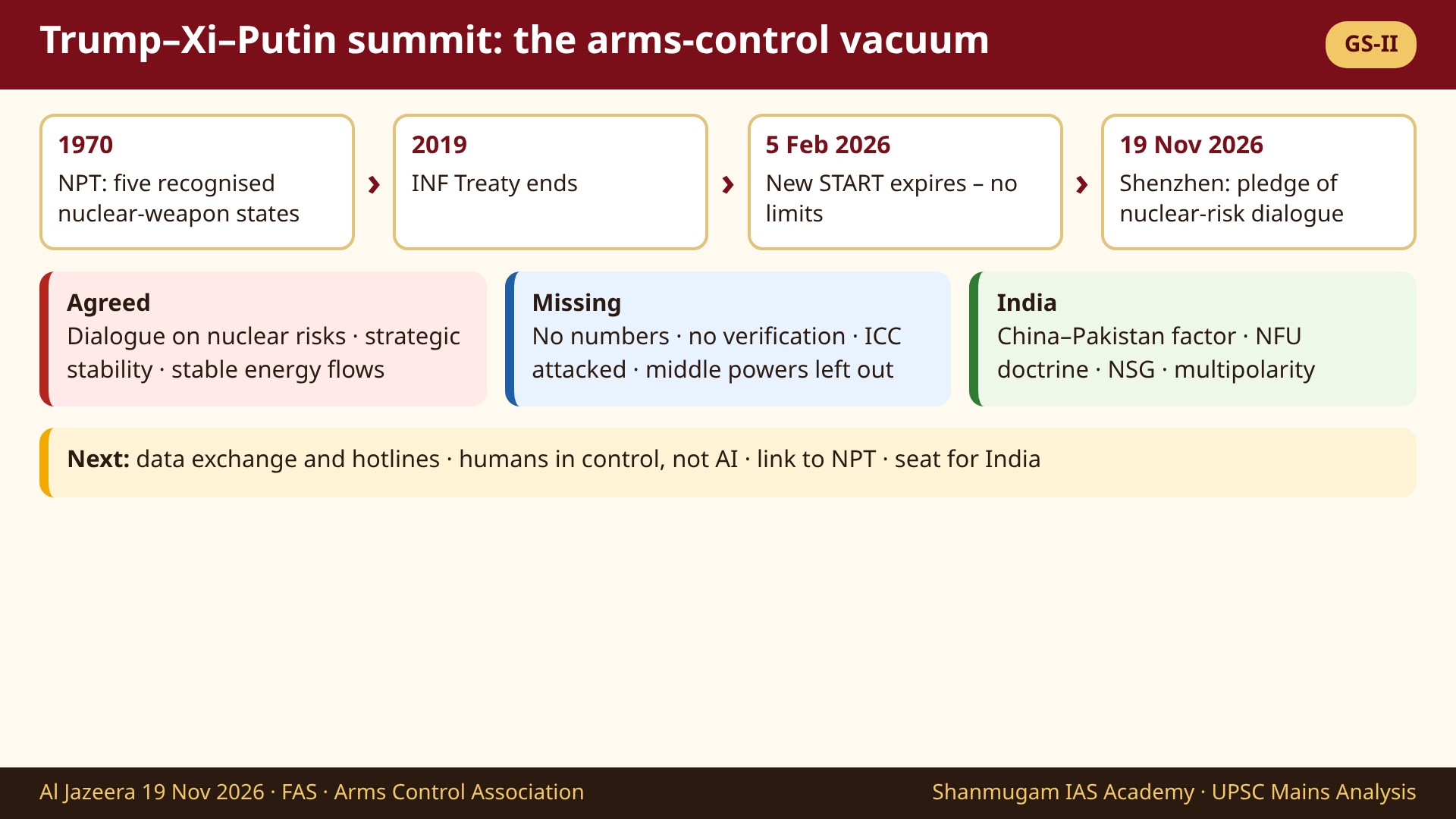
- On 19 November 2026 Trump, Xi and Putin held their first trilateral summit in Shenzhen (APEC sidelines, chaired by Xi) and issued a "peace declaration" pledging a dialogue on reducing nuclear risks and preventing proliferation, strategic stability and stable energy flows.
- It is a pledge, not a framework: no limits, data exchange or verification – and since New START expired on 5 February 2026 there is no treaty cap on US and Russian strategic forces, while China's arsenal grows.
- For India: the China–Pakistan nuclear factor, its no-first-use doctrine, NSG membership and the risk of a G3 that sidelines middle powers. Way forward: risk reduction first, link to the NPT, a seat for other nuclear states. PYQ: Prelims 2015 (NPT nuclear-weapon states).

Why in news
On 19 November 2026, US President Donald Trump, Chinese President Xi Jinping and Russian President Vladimir Putin held their first-ever trilateral summit in Shenzhen, China, on the sidelines of the APEC leaders' meeting. Xi chaired the meeting, which lasted more than an hour. The three issued a joint "peace declaration": they pledged a dialogue on reducing nuclear risks and preventing proliferation, to maintain strategic stability and international security, and reaffirmed the importance of stable energy flows. They also demanded that the International Criminal Court and "similar institutions" not "abuse their positions". Before the meeting Xi said: "Nuclear war cannot be won and must not be fought." No numbers, timetable or verification mechanism were announced (Al Jazeera, 19 November 2026).
Why it matters: the three countries hold the world's three largest nuclear arsenals, and since New START expired on 5 February 2026 there is, for the first time in decades, no treaty limit on US and Russian strategic forces – while China's arsenal keeps growing.
Background: how arms control was built – and unbuilt
| Year | Treaty / event | Status now |
|---|---|---|
| 1968 / 1970 | NPT – only five "nuclear-weapon states" (US, Russia, UK, France, China) recognised | In force; India, Pakistan, Israel never joined |
| 1972 | ABM Treaty (limits on missile defence) | US withdrew in 2002 |
| 1987 | INF Treaty – banned ground-launched missiles of 500–5,500 km range | US withdrew in 2019; ended |
| 1996 | CTBT – bans all nuclear test explosions | Not in force (US, China, India among those that have not ratified/signed) |
| 2010 / 2011 | New START – 1,550 deployed strategic warheads each, on-site inspections | Extended to 2026; expired 5 February 2026 |
| 2026 | Shenzhen trilateral – pledge of a nuclear-risk dialogue | Only a starting point |
Analysis: a pledge, not yet a framework
| What is positive | What is missing |
|---|---|
| China at the table for the first time with both the US and Russia on nuclear risk – Beijing had long said the two biggest arsenals must cut first | No limits, no data exchange, no inspections – the core tools of real arms control |
| Leaders' language ("nuclear war cannot be won") keeps the taboo on use alive | No link to the NPT's disarmament promise (Article VI) or to the 2026 NPT Review Conference process |
| A channel to manage crises and new technology risks (AI, hypersonics, space) | Ukraine was not the central topic; the declaration attacked the ICC – a blow to accountability |
| Energy-flow pledge may calm oil markets | A "G3" style of deal-making can sideline middle powers – India, Europe, Japan, ASEAN |
The core point: arms control is not just goodwill; it is numbers plus verification. Until the dialogue produces at least a data-exchange and notification regime, the world is in an arms-control vacuum with three nuclear powers instead of two – which is much harder to balance.
India's stakes
| Area | Why it matters to India |
|---|---|
| Two-front nuclear neighbourhood | China's build-up affects India directly; Pakistan's arsenal is tied to China. Any great-power deal that ignores China's regional posture leaves India's security unaddressed |
| India's doctrine | No first use and credible minimum deterrence (2003 doctrine); India backs universal, non-discriminatory, verifiable disarmament and a Fissile Material Cut-off Treaty |
| Export-control clubs | India joined MTCR (2016), Wassenaar Arrangement (2017) and Australia Group (2018); its NSG membership has been blocked, with China among the opponents |
| Multipolarity vs G3 | India wants a multipolar order with a voice for the Global South (UNSC reform, G20). A US–China–Russia directorate would cut against that |
| Energy and trade | Stable energy flows help India, the world's third-largest oil consumer; but deals made over India's head can still bring sanctions risk |
Static syllabus link
- GS-II: effect of policies and politics of developed and developing countries on India's interests; important international institutions and treaties (NPT, CTBT, NSG, MTCR).
- GS-III: security challenges; achievements of Indians in science and technology – India's three-stage nuclear programme.
- Essay: "Peace through strength or strength through peace?"
Tamil Nadu angle
- Kudankulam (Tirunelveli district) – India's largest nuclear power project, built with Russia; civil nuclear cooperation is part of India's Russia ties.
- Kalpakkam (Chengalpattu district) – home of the Indira Gandhi Centre for Atomic Research and the Prototype Fast Breeder Reactor, the second stage of India's three-stage programme.
- A world without arms control raises the value of nuclear safety and security standards at such plants – a point for GS-III answers.
Faculty view
Do not write this as "three leaders met". Build the answer on one idea: arms control has collapsed from bilateral to nothing, and the new problem is trilateral. Give the timeline (INF 2019, New START 2026), the Shenzhen pledge, and then the gap (no numbers, no verification). For India, add the China–Pakistan factor, the NFU doctrine and the multipolarity point. One line on the ICC clause shows balance. End with a way forward that India can champion – risk-reduction measures first, numbers later.
Way forward
- Start small, start now: data exchange, launch notifications and hotlines among the three, building on earlier US–Russia practice.
- Keep humans in control: a shared statement that decisions to use nuclear weapons stay with humans, not AI systems.
- Bring in the NPT: tie the dialogue to Article VI disarmament duties so it is not a private club.
- Open the room: a role for other nuclear-armed states, including India, in risk-reduction talks – India can propose regional confidence-building measures.
- Protect accountability: peace efforts should not weaken international courts.
Glossary – Strategic stability
A situation in which no nuclear power has a reason to strike first, even in a crisis, because each side knows the other can still retaliate with a survivable force. It rests on three things: rough balance of forces, transparency (data exchange, inspections, hotlines) and agreed limits on the most destabilising weapons. Treaties such as New START supported it with numbers and on-site checks; when such treaties end, suspicion, worst-case planning and arms racing return. New technologies – hypersonic missiles, missile defence, space and cyber weapons and AI in command systems – make it harder to keep. For India the term matters because its own doctrine (no first use, credible minimum deterrence) is built on the same idea of a stable, survivable deterrent.
Asked before in UPSC
1. "Consider the following countries: 1. China 2. France 3. India 4. Israel 5. Pakistan. Which among the above are Nuclear Weapons States as recognised by the Treaty on the Non-proliferation of Nuclear Weapons, commonly known as Nuclear Non-Proliferation Treaty (NPT)?" – Prelims 2015 (answer: China and France only).
2. The Mains GS-II theme "effect of policies and politics of developed countries on India's interests" is asked almost every year – this summit is a direct example.
Mains practice question
"The end of New START has left the world without nuclear guardrails, and a US–China–Russia dialogue alone cannot fill the gap." Examine, with reference to the Shenzhen trilateral summit (2026) and India's interests. (15 marks, 250 words)
FAQ
When and where did the first Trump–Xi–Putin trilateral summit take place?
On 19 November 2026 in Shenzhen, China, on the sidelines of the APEC leaders' meeting. Xi Jinping chaired it.
What did the three leaders agree?
A joint "peace declaration" pledging a dialogue on reducing nuclear risks and preventing proliferation, maintaining strategic stability, and stable energy flows. No limits or verification were announced.
When did New START expire?
On 5 February 2026. It had capped each side at 1,550 deployed strategic warheads with on-site inspections.
What is India's nuclear doctrine?
No first use and credible minimum deterrence (2003), with a commitment to universal, non-discriminatory and verifiable disarmament.
Why is India not in the NPT?
India sees the NPT as discriminatory because it recognises only five states (those that tested before 1 January 1967) as nuclear-weapon states.
Sources: Al Jazeera, 19 November 2026; The Pioneer (PTI), 18 November 2026; Arab News, 18 November 2026; Federation of American Scientists and Arms Control Association on the expiry of New START (February–March 2026); text of the NPT; Ministry of External Affairs (India's nuclear doctrine, 2003). Analysis is our own.
Related on our site: UPSC Mains Analysis – all articles · UPSC glossary · UPSC Mains answer-writing practice · Free PDF downloads
Add us as a preferred source on Google
Link to this page from your website / blog (HTML code)
TNPSC Achievers
-

KALPANA
TNPSC TNPSC
Indian Polity in Tamil | 100 அரசியலமைப்பு வினா விடை | TNPSC Group 4 Preparation 2026
📚 TNPSC குரூப் 4 / 2 / 2A – பொதுத்தமிழ், பொது அறிவு நூல்கள்
PDF நூல்கள் · ₹149 முதல் · ஒவ்வொன்றுக்கும் 50 பக்க இலவச மாதிரி · UPI-இல் பணம் செலுத்தியதும் உடனே பதிவிறக்கம்
 பொதுத் தமிழ் — முழுமையான கையேடு (TNPSC குரூப் 2 · 2A · 4)
₹199
 TNPSC முழுமையான பாடநூல்கள் – முழுத் தொகுப்பு (9 நூல்கள்)
₹1599
 பொதுத் தமிழ் — முந்தைய ஆண்டு வினா – விடை – விளக்கம் (புதிய பாடத்திட்டம்)
₹199
 TNPSC திறனறிவும் மனக்கணக்கு நுண்ணறிவும் (Aptitude & Mental Ability) – முழுமையான பாடநூல்
₹199
TNPSC குரூப் 1, 2/2A, 4 – நேரடி வகுப்புகள் · கோவை & மதுரை
2006 முதல் சண்முகம் IAS அகாடமி · Classroom & online coaching in Coimbatore and Madurai
