

Mains Analysis: ICJ's Rohingya genocide verdict – justice and limits
21 November 2026 · English International
⬇ Download this analysis as free PDF
Topics: International Relations – International Institutions, India's Neighbourhood (Myanmar); Human Rights · GS-II · UPSC Mains Analysis
Key takeaways
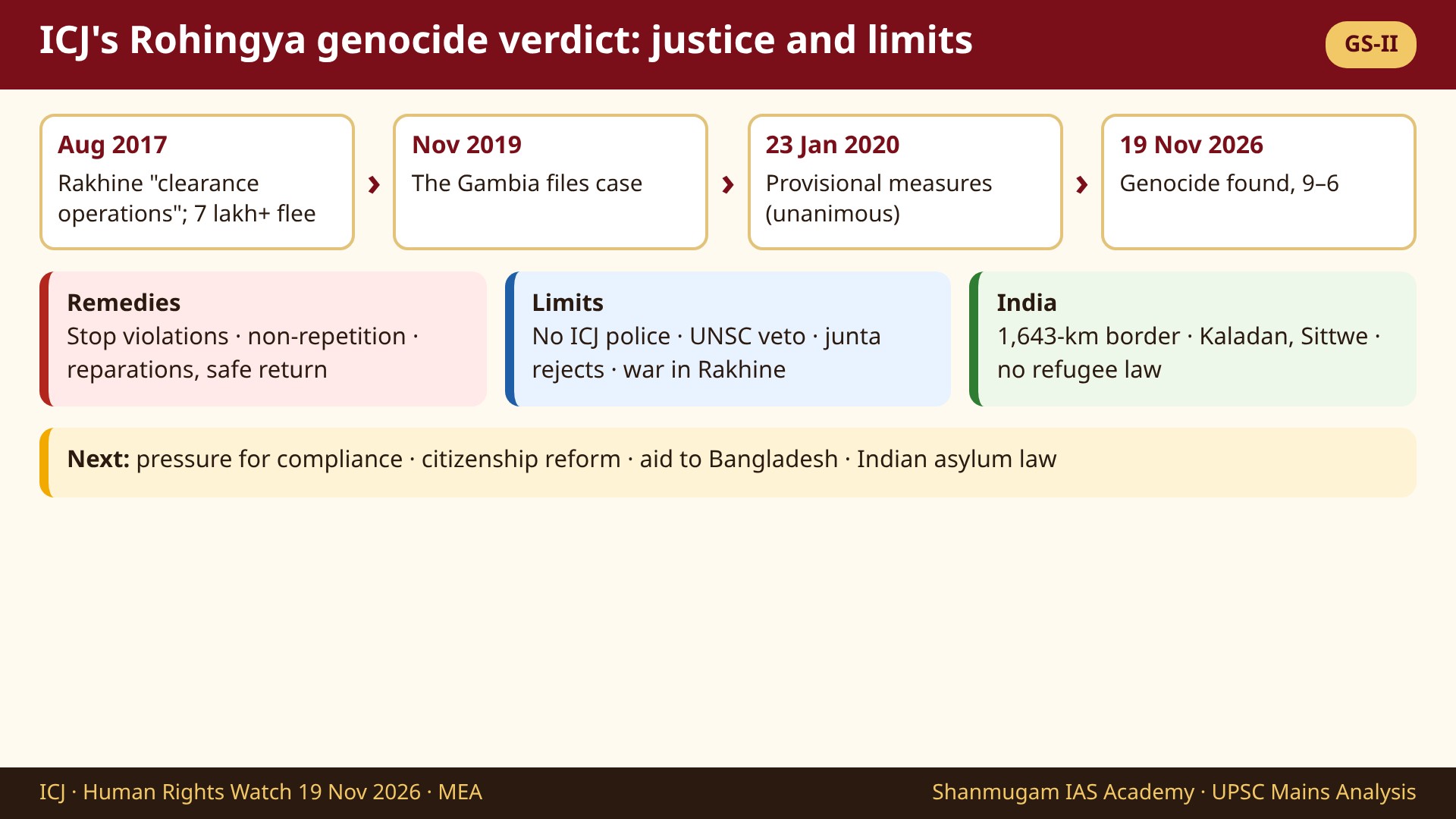
- On 19 November 2026 the ICJ ruled 9–6 in The Gambia v. Myanmar that Myanmar committed genocide against the Rohingya and failed to prevent and punish it – the first time the Court has found a State responsible for committing genocide; the judgment is final.
- Remedies: stop the violations, guarantee non-repetition and give reparations, including safe, voluntary and dignified return. Limits: no ICJ enforcement arm, possible UNSC veto, a junta that rejects the Court and war in Rakhine.
- For India: a 1,643-km border, the Kaladan project through Rakhine, and a refugee policy without the 1951 Convention or a domestic genocide law. PYQ: Prelims 2016 (Rohingya–Myanmar pair).

Why in news
On 19 November 2026, the International Court of Justice (ICJ) at The Hague ruled in The Gambia v. Myanmar that Myanmar committed genocide against the Rohingya and violated its duties to prevent and punish genocide under the 1948 Genocide Convention. The vote was 9–6. The Court found that Myanmar's security forces and other State organs committed killings, caused serious bodily and mental harm and imposed measures to prevent births, with intent to destroy a substantial part of the group; it called genocidal intent "the only reasonable inference" from the evidence and rejected Myanmar's "counter-insurgency" explanation. The judgment is final and cannot be appealed (Human Rights Watch, 19 November 2026). It is the first time the ICJ has found a State responsible for committing genocide.
What the Court ordered
| Remedy | Meaning |
|---|---|
| Cessation | Stop ongoing violations – including the failure to enact laws and to investigate, prosecute and punish genocide |
| Non-repetition | Assurances and steps so that such acts do not happen again |
| Reparations | For Rohingya victims – restitution, including safe, voluntary and dignified return and family reunification; compensation where restitution is impossible |
Background: the road to the verdict
| Date | Event |
|---|---|
| 1982 | Myanmar's Citizenship Law leaves most Rohingya without citizenship – the root of statelessness |
| Aug 2017 | "Clearance operations" in northern Rakhine: massacres, rape, arson; more than 7 lakh Rohingya flee to Bangladesh |
| Nov 2019 | The Gambia, backed by the Organisation of Islamic Cooperation, files the case – the first time a State with no direct link uses the Convention to sue |
| 23 Jan 2020 | ICJ orders provisional measures, unanimously, to protect the Rohingya |
| Feb 2021 | Military coup led by Min Aung Hlaing |
| 22 Jul 2022 | ICJ rejects Myanmar's preliminary objections |
| 19 Nov 2026 | Judgment on merits: genocide found (9–6); 11 Convention parties had intervened on questions of interpretation |
Compare: in Bosnia v. Serbia (2007) the ICJ held that Srebrenica was genocide but found Serbia responsible only for failing to prevent it, not for committing it. The 2026 judgment goes further.
Analysis: a landmark with limits
| Why it is a landmark | Why it may not change much on the ground |
|---|---|
| Sets a precedent: any party can enforce the Convention (erga omnes partes) – no State can say "it is none of your business" | The ICJ has no police; enforcement depends on the UN Security Council, where vetoes can block action |
| Gives the Rohingya legal recognition of what happened – vital for return, citizenship and memory | The junta rejects the Court; most of Rakhine is now held by the Arakan Army, itself accused of abuses |
| Strengthens other cases – the ICC prosecutor sought an arrest warrant for Min Aung Hlaing in November 2024 | Over a million Rohingya remain refugees, mainly in Cox's Bazar, Bangladesh, with shrinking aid |
| A narrow 9–6 vote shows how hard the intent test is – a guide for future cases | Return is impossible while the war in Myanmar continues |
India's stakes
| Area | India's position / interest |
|---|---|
| Neighbourhood | India shares a 1,643-km border with Myanmar (Arunachal Pradesh, Nagaland, Manipur, Mizoram); stability there affects the North-East. In 2024 the Centre announced the end of the Free Movement Regime and border fencing |
| Connectivity | The Kaladan Multi-Modal project runs through Rakhine and Chin; Sittwe port began operations in May 2023 – conflict in Rakhine delays the rest |
| Refugee policy | India is not a party to the 1951 Refugee Convention; it treats Rohingya without valid papers as illegal migrants under the Foreigners Act. In 2021 the Supreme Court refused to stop the deportation of Rohingya held in Jammu, subject to procedure |
| Humanitarian role | Operation Insaniyat (September 2017) sent relief to Rohingya refugees in Bangladesh; India supports "safe, speedy and sustainable" return |
| Legal gap | India ratified the Genocide Convention in 1959 but has no separate domestic law defining genocide |
The balance India must strike: engagement with whoever controls Myanmar (for security and connectivity) and support for accountability and the rights of the Rohingya. The verdict raises the moral cost of silence.
Static syllabus link
- GS-II: important international institutions (ICJ, ICC, UNHCR) – their structure and mandate; India and its neighbourhood; effect of others' policies on India's interests.
- GS-I: issues of displacement and migration; GS-IV: ethics of international relations, duty to protect.
- Facts: ICJ – principal judicial organ of the UN, 15 judges, nine-year terms, judges States; ICC – Rome Statute (1998), tries individuals; India is not a party to the Rome Statute.
Tamil Nadu angle
- Tamil Nadu has long hosted Sri Lankan Tamil refugees in rehabilitation camps run by the State – a ready Indian example of refugee care without a national refugee law.
- This experience strengthens the case for a national asylum framework with clear rules for registration, education and work – a way-forward point in any refugee answer.
Faculty view
Use this case for three kinds of questions: (1) role of international institutions – ICJ vs ICC, strengths and enforcement gap; (2) India and Myanmar – security, Kaladan, the North-East, refugees; (3) ethics – the duty to prevent atrocities. Quote the 9–6 vote, the three remedies and the 2007 Bosnia comparison; they make the answer precise. Keep the tone balanced on India's refugee policy: state the legal position, then suggest a framework.
Way forward
- Global: UN Security Council and ASEAN to press for compliance; targeted sanctions on those responsible; steady funding for refugee aid.
- Accountability chain: support evidence-gathering by the UN Independent Investigative Mechanism for Myanmar and the ICC process.
- Return with rights: citizenship reform in Myanmar (the 1982 law), safe zones and international monitoring before any return.
- India: quiet diplomacy with all Myanmar actors, humanitarian aid to Bangladesh, and a domestic asylum law that balances security and humanity.
Glossary – State responsibility for genocide
The rule that a State – not only individual leaders – can be held legally responsible under the 1948 Genocide Convention when its organs (army, police, officials) commit genocide, or when it fails to prevent or punish it. The case is heard by the International Court of Justice, which judges States, while individuals are tried by courts such as the International Criminal Court. The bar is high: the Court must find specific intent to destroy a group "in whole or in part". Because the duty to prevent genocide is owed to all parties (erga omnes partes), any party – even one with no direct link, like The Gambia – can bring the case. Remedies include stopping the violations, guarantees of non-repetition and reparations.
Asked before in UPSC
1. "Consider the following pairs – Community sometimes mentioned in the news : In the affairs of – 1. Kurd : Bangladesh 2. Madhesi : Nepal 3. Rohingya : Myanmar. Which of the pairs given above is/are correctly matched?" – Prelims 2016 (answer: 2 and 3 only).
2. GS-II asks regularly on "important international institutions" and "India and its neighbourhood" – this verdict links both.
Mains practice question
"The ICJ's Rohingya genocide judgment (2026) is a legal landmark but a practical test of the international order." Discuss, and examine its implications for India. (15 marks, 250 words)
FAQ
What did the ICJ decide on 19 November 2026?
In The Gambia v. Myanmar, by 9 votes to 6, it found that Myanmar committed genocide against the Rohingya and failed to prevent and punish it.
Why could The Gambia bring the case?
Because duties under the Genocide Convention are owed to all its parties (erga omnes partes), any party can sue, even without a direct link.
What is the difference between the ICJ and the ICC?
The ICJ settles disputes between States and judges State responsibility; the ICC, set up by the Rome Statute (1998), tries individuals for crimes such as genocide.
Can the ICJ judgment be appealed?
No. ICJ judgments are final; enforcement can be sought through the UN Security Council.
Is India a party to the 1951 Refugee Convention?
No. India handles refugees through administrative measures and laws on foreigners, without a separate refugee law.
Sources: Human Rights Watch, 19 November 2026; Al Jazeera, 19 November 2026; ICJ orders of 23 January 2020 and judgment of 22 July 2022 (The Gambia v. Myanmar); ICJ judgment in Bosnia and Herzegovina v. Serbia and Montenegro (2007); Convention on the Prevention and Punishment of the Crime of Genocide (1948); Ministry of External Affairs; Supreme Court of India (Mohammad Salimullah v. Union of India, April 2021). Analysis is our own.
Related on our site: UPSC Mains Analysis – all articles · UPSC glossary · UPSC Mains answer-writing practice · Free PDF downloads
Add us as a preferred source on Google
Link to this page from your website / blog (HTML code)
TNPSC Achievers
-

MATHAN
TNPSC TNPSC
Indian Polity in Tamil | 100 அரசியலமைப்பு வினா விடை | TNPSC Group 4 Preparation 2026
📚 TNPSC குரூப் 4 / 2 / 2A – பொதுத்தமிழ், பொது அறிவு நூல்கள்
PDF நூல்கள் · ₹149 முதல் · ஒவ்வொன்றுக்கும் 50 பக்க இலவச மாதிரி · UPI-இல் பணம் செலுத்தியதும் உடனே பதிவிறக்கம்
 பொதுத் தமிழ் — முழுமையான கையேடு (TNPSC குரூப் 2 · 2A · 4)
₹199
 TNPSC முழுமையான பாடநூல்கள் – முழுத் தொகுப்பு (9 நூல்கள்)
₹1599
 பொதுத் தமிழ் — முந்தைய ஆண்டு வினா – விடை – விளக்கம் (புதிய பாடத்திட்டம்)
₹199
 TNPSC திறனறிவும் மனக்கணக்கு நுண்ணறிவும் (Aptitude & Mental Ability) – முழுமையான பாடநூல்
₹199
TNPSC குரூப் 1, 2/2A, 4 – நேரடி வகுப்புகள் · கோவை & மதுரை
2006 முதல் சண்முகம் IAS அகாடமி · Classroom & online coaching in Coimbatore and Madurai
