

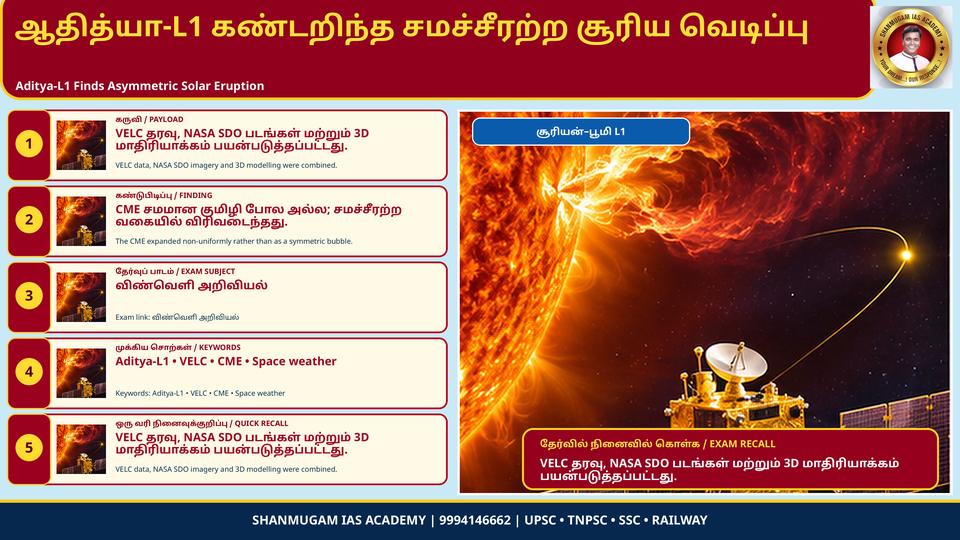
Aditya-L1's VELC finds a solar CME expanding asymmetrically: IIA
3 November 2026 · English Science & Technology
⬇ Download this article as free PDF
Topics: Space · 3 November 2026 Current Affairs (UPSC / TNPSC / SSC / RRB)
News
Scientists of the Indian Institute of Astrophysics (IIA), Bengaluru, using data from Aditya-L1's Visible Emission Line Coronagraph (VELC), found that a coronal mass ejection (CME) launched on 5 Aug 2024 from an active region near the Sun's western limb did not expand evenly like a simple bubble but spread sideways asymmetrically. The spectra showed two branches at once – blueshifted (towards us) and redshifted (away); only a model with a tilted axis and uneven lateral expansion matched them. NASA's SDO images and 3-D models were also used. The study appeared in The Astrophysical Journal Letters; the findings were reported on 3 Nov 2026.
Key facts
| Instrument | VELC – the primary of Aditya-L1's 7 payloads; an internally occulted coronagraph |
| Event | 5 Aug 2024 – CME near the Sun's western limb; observed in the low corona (about 1.05–1.5 solar radii) |
| Method | Spectroscopy of the 530.3 nm green line (highly ionised iron; plasma about 1.8 million K) |
| Authors | Saurabh Tripathi (lead), Tanmoy Samanta, Jayant Joshi – IIA (autonomous body under DST) |
| Journal | The Astrophysical Journal Letters (2026); reported 3 Nov 2026 |
| Significance | A CME's shape affects solar-wind drag and its arrival time at Earth – aids space-weather forecasting |
Background
- What is a CME? A huge burst of magnetised plasma (billions of tonnes) hurled from the Sun's corona into space. If Earth-directed it can trigger geomagnetic storms that disturb satellites, GPS, radio links and power grids, and produce auroras near the poles.
- Aditya-L1: India's first space-based solar observatory; launched Sep 2023, it is in a halo orbit around the Sun–Earth L1 (Lagrange) point. From L1 the Sun is seen continuously, without eclipses or occultation. 7 payloads – 4 remote-sensing (VELC, SUIT, SoLEXS, HEL1OS) and 3 in-situ (ASPEX, PAPA, MAG). ASPEX – Physical Research Laboratory (PRL), Ahmedabad; PAPA – Space Physics Laboratory (SPL), VSSC, Thiruvananthapuram.
- Coronagraph principle: it blocks the Sun's bright disc with an occulter, creating an 'artificial eclipse', to study the faint corona. VELC is internally occulted; its spectra give plasma speed and temperature. Until now a CME's 3-D shape needed several spacecraft imaging from different angles; this method may do it from a single vantage point.
Tamil Nadu link: IIA, which built VELC, also runs the Kodaikanal Solar Observatory in Dindigul district. The liquid engines of the PSLV rocket that launched Aditya-L1 are tested at the ISRO Propulsion Complex (IPRC), Mahendragiri, Tirunelveli district. ISRO's second spaceport is being built at Kulasekarapattinam, Thoothukudi district.
Source: DD India, 3 Nov 2026; Odisha Diary, 3 Nov 2026; Tech Explorist, 3 Nov 2026; ApJ Letters (Tripathi, Samanta & Joshi, 2026, DOI 10.3847/2041-8213/aea295); ISRO (Aditya-L1 payloads)
Join our UPSC classroom or online batch: UPSC coaching in Coimbatore · Fees · Call 99941 46662.
Prepared by the Shanmugam IAS Academy faculty team, Coimbatore (since 2006) · independently checked against primary sources · Our editorial policy
Add us as a preferred source on Google
Link to this page from your website / blog (HTML code)
BANK Achievers
-
RAMYA
BANK BANK
நடப்பு நிகழ்வுகள் 24 நவம்பர் 2026 | Today Current Affairs in Tamil | TNPSC Group 4 வினா விடை
📚 TNPSC குரூப் 4 / 2 / 2A – பொதுத்தமிழ், பொது அறிவு நூல்கள்
PDF நூல்கள் · ₹149 முதல் · ஒவ்வொன்றுக்கும் 50 பக்க இலவச மாதிரி · UPI-இல் பணம் செலுத்தியதும் உடனே பதிவிறக்கம்
 பொதுத் தமிழ் — முழுமையான கையேடு (TNPSC குரூப் 2 · 2A · 4)
₹199
 TNPSC முழுமையான பாடநூல்கள் – முழுத் தொகுப்பு (9 நூல்கள்)
₹1599
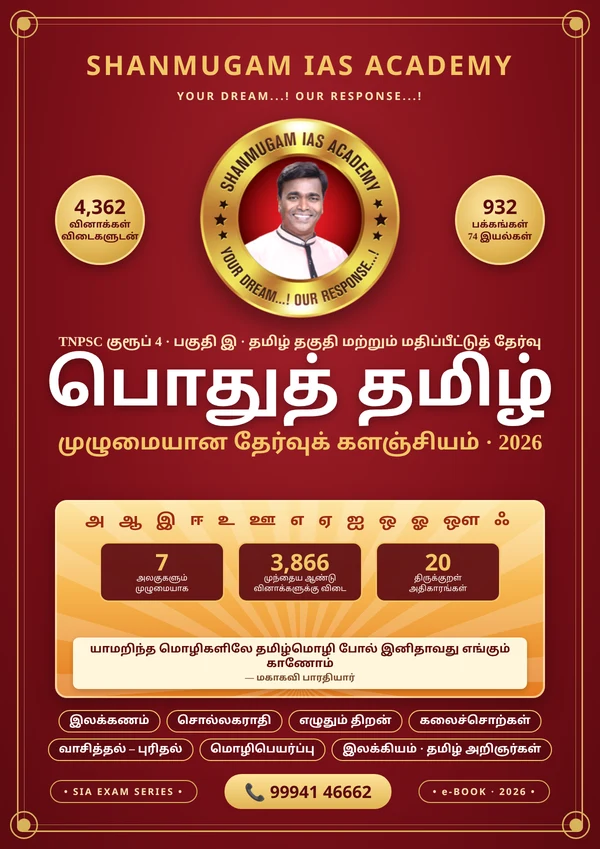 TNPSC குரூப் 4 பொதுத் தமிழ் – முழுமையான தேர்வுக் களஞ்சியம் 2026
₹249
 பொதுத் தமிழ் — முந்தைய ஆண்டு வினா – விடை – விளக்கம் (புதிய பாடத்திட்டம்)
₹199
TNPSC குரூப் 1, 2/2A, 4 – நேரடி வகுப்புகள் · கோவை & மதுரை
2006 முதல் சண்முகம் IAS அகாடமி · Classroom & online coaching in Coimbatore and Madurai
