

Alagankulam: coins from Roman to East India Company times found
16 November 2026 · English History, Art & Culture
⬇ Download this article as free PDF
Topics: History & Archaeology · UPSC Prelims · TNPSC · SSC · Current Affairs
Current affairs of 16 November 2026 (Shanmugam IAS Academy) – explained for UPSC, TNPSC and other competitive exams
News
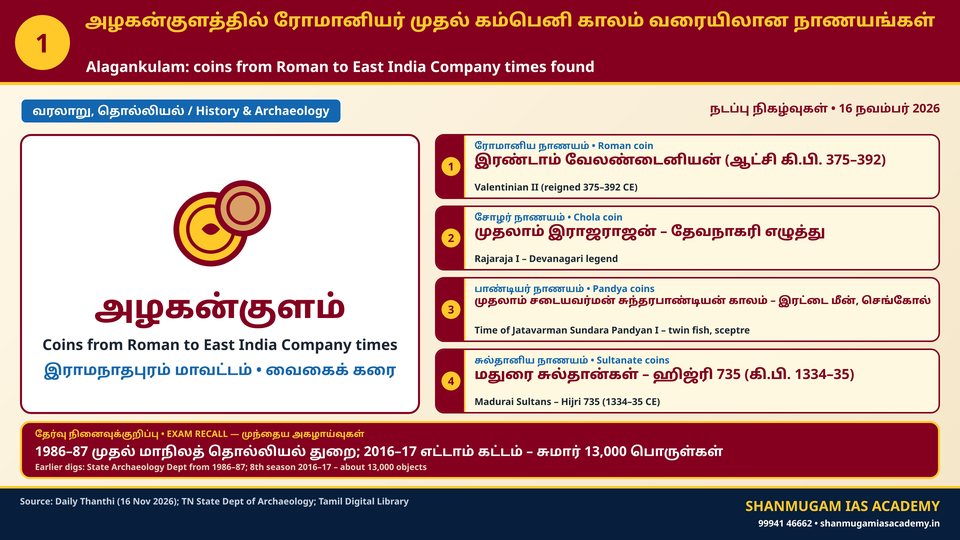
Daily Thanthi reported on 16 November 2026 that students of the International Institute of Tamil Studies (Ulaga Tamil Aaraichi Niruvanam), Chennai, guided by Prof. Mayakrishnan and joined by advocate and former panchayat president Asokan, surveyed earlier excavation areas and the coast at Alagankulam in Mandapam union, Ramanathapuram district. In about three hours they found a coin of the Western Roman emperor Valentinian II, a coin of Rajaraja Chola I bearing Devanagari script, twin-fish-and-sceptre coins of the time of Jatavarman Sundara Pandyan I, copper coins of the Madurai Sultans dated Hijri 735, an East India Company copper coin and metal-smelting debris. The students said the finds show Alagankulam's long history of trade with the wider world. They asked the government to set up a museum to display the antiquities found there.
Key facts for the exam
| Point | Details |
|---|---|
| Place | Alagankulam, Mandapam union, Ramanathapuram district – on the Vaigai, about 3 km from the sea |
| Survey team | Students of the International Institute of Tamil Studies; Prof. Mayakrishnan; Asokan |
| Roman coin | Valentinian II (reigned 375–392 CE) |
| Chola coin | Rajaraja I – Devanagari legend |
| Pandya coins | Time of Jatavarman Sundara Pandyan I – twin fish, sceptre |
| Sultanate coins | Madurai Sultans – Hijri 735 (1334–35 CE) |
| Others | East India Company copper coin; smelting debris |
| Earlier digs | State Archaeology Dept from 1986–87; 8th season 2016–17 – about 13,000 objects |
| Demand | A site museum at Alagankulam |
Background
- Archaeology: Alagankulam lies on the Vaigai, about 3 km from the seashore. The Tamil Nadu State Department of Archaeology dug there in several seasons from 1986–87, finding rouletted ware, fragments of Roman wine jars (amphorae), potsherds with Tamil-Brahmi writing of the 1st century BCE, Roman coins of Valentinian II and beads. The eighth season in 2016–17 yielded about 13,000 antiquities, including burnt-brick structures, a shell-bangle workshop, an iron-smelting area, a terracotta ring well and silver punch-marked coins.
- History – Indo-Roman trade: The 'Periplus of the Erythraean Sea', written in the 1st century CE by an unknown Greek merchant, describes Tamil ports and exports such as pepper, pearls and fine cloth. Pliny complained of Roman gold draining to India. At Arikamedu near Puducherry, Mortimer Wheeler excavated in 1945 and found Roman amphorae and rouletted ware; the site is identified with 'Podouke' of the Periplus.
- Timeline from the coins: Valentinian II ruled the Western Roman Empire in 375–392 CE. Rajaraja Chola I (985–1014 CE) built the Brihadeeswarar temple at Thanjavur. Under Jatavarman Sundara Pandyan I (from 1251 CE) the Pandyas again became the leading power of the South. Around 1335, Jalaluddin Ahsan Shah, a Tughluq governor, declared independence and founded the Madurai Sultanate; it fell to the invasion of Kumara Kampana of Vijayanagara, told in Gangadevi's 'Madhura Vijayam'.
- Geography: The Vaigai rises in the Varusanadu hills of Theni district (Western Ghats), flows past Madurai and Sivaganga and reaches Palk Bay in Ramanathapuram district. Close to the Palk Strait and the Gulf of Mannar, Alagankulam was well placed for sea trade with Sri Lanka, South-East Asia and the West.
What is this news about?
Daily Thanthi reported on 16 November 2026 that students of the International Institute of Tamil Studies (Ulaga Tamil Aaraichi Niruvanam), Chennai, guided by Prof. Mayakrishnan and joined by advocate and former panchayat president Asokan, surveyed earlier excavation areas and the coast at Alagankulam in Mandapam union, Ramanathapuram district.
What are the key facts to remember for the exam?
Place: Alagankulam, Mandapam union, Ramanathapuram district – on the Vaigai, about 3 km from the sea; Survey team: Students of the International Institute of Tamil Studies; Prof. Mayakrishnan; Asokan; Roman coin: Valentinian II (reigned 375–392 CE); Chola coin: Rajaraja I – Devanagari legend.
What is the background to this news?
Archaeology: Alagankulam lies on the Vaigai, about 3 km from the seashore. The Tamil Nadu State Department of Archaeology dug there in several seasons from 1986–87, finding rouletted ware, fragments of Roman wine jars (amphorae), potsherds with Tamil-Brahmi writing of the 1st century BCE, Roman coins of Valentinian II and beads.
Practise more: Weekly current affairs · Daily subject quiz · Knowledge nugget
Sources: Daily Thanthi; Tamil Nadu State Dept of Archaeology; Tamil Nadu State Dept of Archaeology – tnarch.gov.in/node/23; Tamil Digital Library (TN Govt) – 'Alagankulam – a preliminary report'; The New Indian Express (Sept 2017, eighth season – about 13,000 antiquities). Compiled by Shanmugam IAS Academy.
Prepared by the Shanmugam IAS Academy faculty team, Coimbatore (since 2006) · independently checked against primary sources · Our editorial policy
Add us as a preferred source on Google
Link to this page from your website / blog (HTML code)
BANK Achievers
-

N. USHAVALLI
BANK BANK
நடப்பு நிகழ்வுகள் 18 நவம்பர் 2026 | Today Current Affairs in Tamil | TNPSC Group 4 வினா விடை
TNPSC குரூப் 1, 2/2A, 4 – நேரடி வகுப்புகள் · கோவை & மதுரை
2006 முதல் சண்முகம் IAS அகாடமி · Classroom & online coaching in Coimbatore and Madurai
