

India votes against UN draft on death-penalty moratorium
16 November 2026 · English International
⬇ Download this article as free PDF
Topics: International Affairs · UPSC Prelims · TNPSC · SSC · Current Affairs
Current affairs of 16 November 2026 (Shanmugam IAS Academy) – explained for UPSC, TNPSC and other competitive exams
News
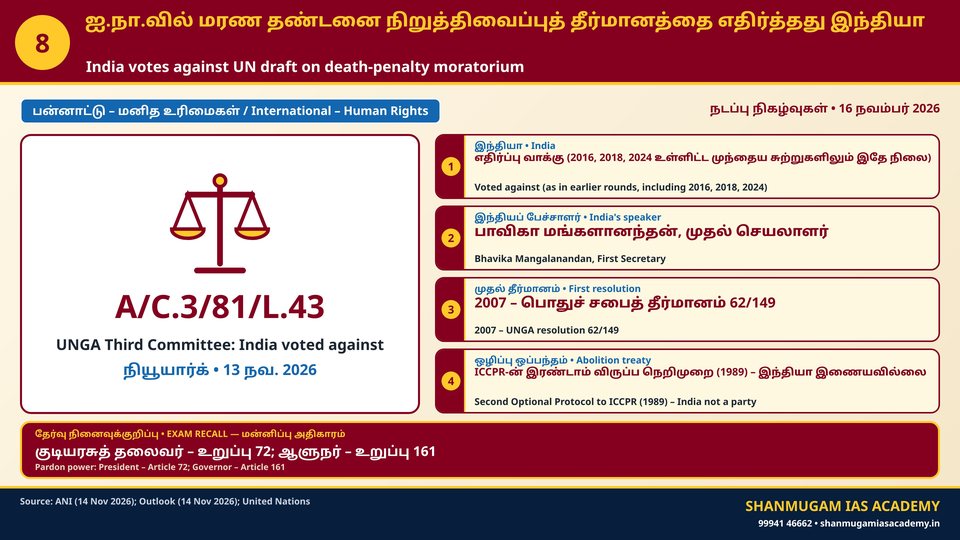
On 13 November 2026 (New York time), the Third Committee (Social, Humanitarian and Cultural) of the 81st UN General Assembly adopted, by 133 votes to 33 with 16 abstentions, the draft resolution on a 'moratorium on the use of the death penalty' (A/C.3/81/L.43); India voted against it. The resolution is moved every two years; according to ANI, India voted the same way in earlier rounds, including 2016, 2018 and 2024. The United States also voted no. India supported another resolution, on extrajudicial, summary or arbitrary executions (L.37), but dissociated itself from its operative paragraph 6 (OP 6). Bhavika Mangalanandan, First Secretary at India's Permanent Mission to the UN, said there is no international consensus against capital punishment, that it is imposed after due legal process, and that calling it 'state-inflicted death' is a travesty. The text adopted by the Third Committee goes to the full General Assembly for a final vote in December; General Assembly resolutions are not legally binding.
Key facts for the exam
| Point | Details |
|---|---|
| Body | UNGA Third Committee (81st session) |
| Date | 13 Nov 2026 (New York) |
| Resolution | A/C.3/81/L.43 – moratorium on death penalty (biennial) |
| India | Voted against (as in earlier rounds, including 2016, 2018, 2024) |
| India's speaker | Bhavika Mangalanandan, First Secretary |
| First resolution | 2007 – UNGA resolution 62/149 |
| Abolition treaty | Second Optional Protocol to ICCPR (1989) – India not a party |
| Law Commission | 262nd Report (2015) – abolish except for terrorism and waging war |
| Pardon power | President – Article 72; Governor – Article 161 |
Background
- The six Main Committees of the UN General Assembly: First – disarmament and international security; Second – economic and financial; Third – social, humanitarian and cultural (human rights); Fourth – special political and decolonisation; Fifth – administrative and budgetary; Sixth – legal. The moratorium resolution was first adopted by the General Assembly in 2007 (resolution 62/149); led by countries including Italy, it now comes up every two years.
- International law: Article 6 of the International Covenant on Civil and Political Rights (ICCPR, 1966) protects the right to life. The ICCPR's 'Second Optional Protocol', aimed at abolishing the death penalty, was adopted on 15 December 1989; India has not joined it. The First Optional Protocol (1966) allows individual complaints.
- Indian law: the Bharatiya Nyaya Sanhita (2023) retains death as a punishment for some offences, including murder and waging war against the State. The 20th Law Commission, chaired by Justice A.P. Shah, recommended in its 262nd Report (August 2015) abolishing the death penalty for all crimes except terrorism and waging war. The President (Article 72) can pardon or commute a death sentence; the Governor has pardoning power under Article 161. In 2014 (Shatrughan Chauhan case) the Supreme Court held that inordinate delay in deciding mercy petitions can be a ground for commutation. The 'rarest of rare' test for the death sentence was laid down in Bachan Singh v. State of Punjab (1980).
What is this news about?
On 13 November 2026 (New York time), the Third Committee (Social, Humanitarian and Cultural) of the 81st UN General Assembly adopted, by 133 votes to 33 with 16 abstentions, the draft resolution on a 'moratorium on the use of the death penalty' (A/C.3/81/L.43); India voted against it. The resolution is moved every two years; according to ANI, India voted the same way in earlier rounds, including 2016, 2018 and 2024.
What are the key facts to remember for the exam?
Body: UNGA Third Committee (81st session); Date: 13 Nov 2026 (New York); Resolution: A/C.3/81/L.43 – moratorium on death penalty (biennial); India: Voted against (as in earlier rounds, including 2016, 2018, 2024).
What is the background to this news?
The six Main Committees of the UN General Assembly: First – disarmament and international security; Second – economic and financial; Third – social, humanitarian and cultural (human rights); Fourth – special political and decolonisation; Fifth – administrative and budgetary; Sixth – legal.
Practise more: Weekly current affairs · Daily subject quiz · Knowledge nugget
Sources: ANI via The Tribune – tribuneindia.com/news/bhavika-mangalanandan/travesty-to-term-capital-punishment-state-inflicted-death-india-votes-against-un-death-penalty-moratorium (14 Nov 2026); Outlook (14 Nov 2026); Open Magazine (vote tally 133–33–16); UN – un.org (GA resolution 62/149) and ohchr.org (ICCPR Second Optional Protocol); Law Commission of India – 262nd Report (lawcommissionofindia.nic.in); Al Jazeera – aljazeera.com/news/2014/2/20/killers-of-india-ex-pm-escape-death-sentence; Reuters (Feb 2014). Compiled by Shanmugam IAS Academy.
Prepared by the Shanmugam IAS Academy faculty team, Coimbatore (since 2006) · independently checked against primary sources · Our editorial policy
Add us as a preferred source on Google
Link to this page from your website / blog (HTML code)
TNPSC Achievers
-

SUDALAIPANDI
TNPSC TNPSC
நடப்பு நிகழ்வுகள் 18 நவம்பர் 2026 | Today Current Affairs in Tamil | TNPSC Group 4 வினா விடை
TNPSC குரூப் 1, 2/2A, 4 – நேரடி வகுப்புகள் · கோவை & மதுரை
2006 முதல் சண்முகம் IAS அகாடமி · Classroom & online coaching in Coimbatore and Madurai
