

Quantum storage: RRI theory shows network links shape magnetic order
21 November 2026 · English Science & Technology
⬇ Download this article as free PDF
Topics: Science & Technology · UPSC Prelims · TNPSC · SSC · Current Affairs
Current affairs of 21 November 2026 (Shanmugam IAS Academy) – explained for UPSC, TNPSC and other competitive exams
News
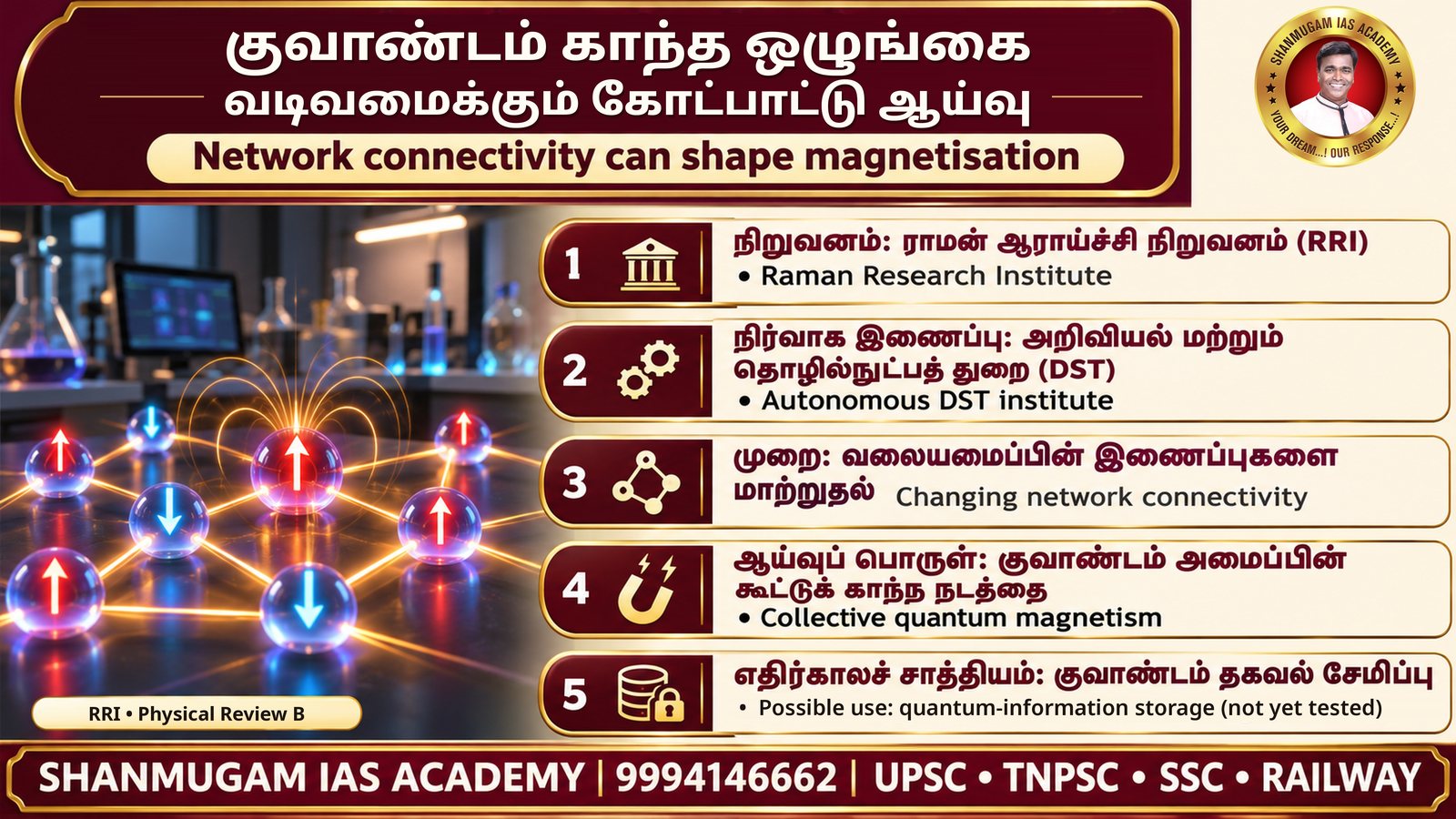
Revathy B. S., a postdoctoral fellow, and Shovan Dutta, an assistant professor in the Theoretical Physics group of the Raman Research Institute (RRI), Bengaluru, have shown theoretically that the magnetic order of a quantum system can be shaped by changing the links between particles in a network. The study, 'Shaping magnetic order by local frustration for itinerant fermions on a graph', was published in Physical Review B; news reports on it appeared on 20–21 November 2026. They studied a square lattice filled with electrons except for one vacant site (a 'hole'); as the hole moves, quantum interference of its paths orders the electron spins – an effect called 'kinetic magnetism'. Adding a diagonal bond between two sites makes the two electrons there form a 'singlet' – an entangled pair with opposite spins – while the other sites keep their ferromagnetic order. The authors report that the effect extends from square grids to random graphs, that the net magnetisation can be tuned this way, and they outline a protocol to test it in cold-atom set-ups. The work is purely theoretical: it has not yet been demonstrated experimentally and no quantum memory device has been built. Because singlets are entangled, it is said that this could in future offer a route to storing quantum information.
Key facts for the exam
| Point | Details |
|---|---|
| Institute | Raman Research Institute (RRI), Bengaluru |
| Researchers | Revathy B. S. (postdoc), Shovan Dutta (Asst Professor) |
| Journal | Physical Review B |
| Type | Theoretical (numerical + analytical) |
| Concept | Kinetic magnetism – a moving 'hole' orders the spins |
| Key result | Diagonal bond → singlet (entangled pair); rest stays ferromagnetic |
| Possible use | Storing quantum information in entangled states – not yet tested |
| RRI | Founded by Sir C.V. Raman, 1948; DST-aided autonomous institute (since 1972) |
Background
- Raman Research Institute: founded in Bengaluru in 1948 by Nobel laureate Sir C.V. Raman; today an autonomous research institute funded by the Union Department of Science and Technology (DST). Its areas include astronomy and astrophysics, light–matter interactions (including quantum technologies), soft condensed matter and theoretical physics.
- Quantum information: a classical computer's basic unit is the 'bit' (0 or 1); a quantum computer's is the 'qubit', which can be in a superposition of 0 and 1. 'Entanglement' is when the states of two or more particles stay linked regardless of distance. The 2022 Nobel Prize in Physics went to Alain Aspect, John Clauser and Anton Zeilinger for experiments with entangled photons.
- Magnetism: in ferromagnetic materials such as iron, nickel and cobalt, atomic spins align in one direction, giving strong magnetisation. Above a certain temperature this order breaks down and the material becomes paramagnetic – the 'Curie temperature' (after Pierre Curie). The equivalent for antiferromagnets is the 'Néel temperature'. Technology that uses spins to carry information is 'spintronics'.
- National Quantum Mission (NQM): approved by the Union Cabinet in April 2023 and implemented by DST for 2023-24 to 2030-31. Thematic hubs (T-Hubs) have been set up for four areas – quantum computing, quantum communication, quantum sensing and metrology, and quantum materials and devices.
What is this news about?
Revathy B. S., a postdoctoral fellow, and Shovan Dutta, an assistant professor in the Theoretical Physics group of the Raman Research Institute (RRI), Bengaluru, have shown theoretically that the magnetic order of a quantum system can be shaped by changing the links between particles in a network.
What are the key facts to remember for the exam?
Institute: Raman Research Institute (RRI), Bengaluru; Researchers: Revathy B. S. (postdoc), Shovan Dutta (Asst Professor); Journal: Physical Review B; Type: Theoretical (numerical + analytical).
What is the background to this news?
Raman Research Institute: founded in Bengaluru in 1948 by Nobel laureate Sir C.V. Raman; today an autonomous research institute funded by the Union Department of Science and Technology (DST).
Practise more: Weekly current affairs · Daily subject quiz · Knowledge nugget
Sources: Physical Review B; arXiv:2507.07886 (authors' affiliation: RRI); RRI – rri.res.in/about/overview; PIB – static.pib.gov.in/WriteReadData/specificdocs/documents/2026/feb/doc202624779701.pdf (NQM T-Hubs); Lok Sabha reply AU2939 – eparlib.sansad.in/bitstream/123456789/2994685/1/AU2939_NuhKD4.pdf; DST – dst.gov.in/cabinet-approves-national-quantum-mission-scale-scientific-industrial-rd-quantum-technologies; nobelprize.org – Physics 2022; NCERT Class XII Physics Part 1, Ch. 5 (Magnetism and Matter – Curie temperature). Compiled by Shanmugam IAS Academy.
Prepared by the Shanmugam IAS Academy faculty team, Coimbatore (since 2006) · independently checked against primary sources · Our editorial policy
Add us as a preferred source on Google
Link to this page from your website / blog (HTML code)
BANK Achievers
-

N. NARMADHA
BANK BANK
நடப்பு நிகழ்வுகள் 24 நவம்பர் 2026 | Today Current Affairs in Tamil | TNPSC Group 4 வினா விடை
📚 TNPSC குரூப் 4 / 2 / 2A – பொதுத்தமிழ், பொது அறிவு நூல்கள்
PDF நூல்கள் · ₹149 முதல் · ஒவ்வொன்றுக்கும் 50 பக்க இலவச மாதிரி · UPI-இல் பணம் செலுத்தியதும் உடனே பதிவிறக்கம்
 பொதுத் தமிழ் — முழுமையான கையேடு (TNPSC குரூப் 2 · 2A · 4)
₹199
 TNPSC முழுமையான பாடநூல்கள் – முழுத் தொகுப்பு (9 நூல்கள்)
₹1599
 TNPSC குரூப் 4 பொதுத் தமிழ் – முழுமையான தேர்வுக் களஞ்சியம் 2026
₹249
 பொதுத் தமிழ் — முந்தைய ஆண்டு வினா – விடை – விளக்கம் (புதிய பாடத்திட்டம்)
₹199
TNPSC குரூப் 1, 2/2A, 4 – நேரடி வகுப்புகள் · கோவை & மதுரை
2006 முதல் சண்முகம் IAS அகாடமி · Classroom & online coaching in Coimbatore and Madurai
