

Lonar Lake added to IUGS 'Third 100 Geological Heritage Sites' list
22 November 2026 · English Environment & Ecology
⬇ Download this article as free PDF
Topics: Environment · UPSC Prelims · TNPSC · SSC · Current Affairs
Current affairs of 22 November 2026 (Shanmugam IAS Academy) – explained for UPSC, TNPSC and other competitive exams
News
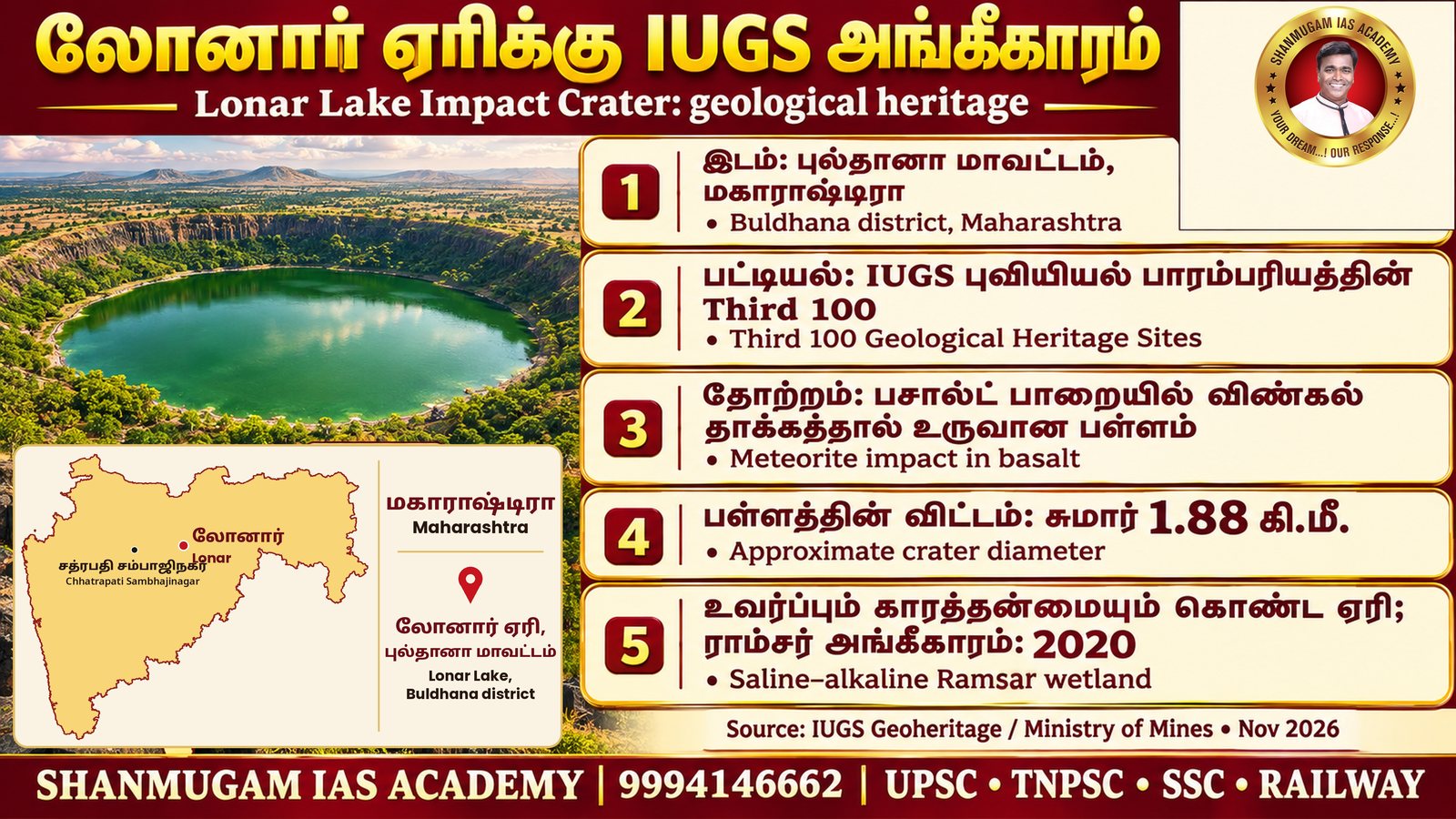
Lonar Lake in Buldhana district, Maharashtra, has been included in the 'Third 100 IUGS Geological Heritage Sites', a list recognised by the International Union of Geological Sciences (IUGS), UNI (17 Nov) and PTI (18 Nov 2026) reported, citing a PIB release of the Ministry of Mines. The Geological Survey of India (GSI) submitted the nomination. The crater, about 1.88 km across, was formed by a meteorite impact and is one of the youngest and best-preserved bowl-shaped hypervelocity impact structures on Earth. The official release puts its age at about 12,000 years, but scientific estimates differ: earlier studies gave 12,000–62,000 years, while 2011 argon (⁴⁰Ar/³⁹Ar) radiometric dating gave about 570,000 years. It is one of only five known hypervelocity impact craters formed in basaltic rock, here the Deccan Traps. A saline-alkaline lake lies at the centre of the crater. The Third 100 list has 100 sites from 47 countries – 34 in Europe, 22 in the Americas, 22 in Asia-Pacific, 11 in Africa, 6 in the Middle East, 2 in Antarctica and 3 in the High Seas – including Mount Fuji (Japan), Norway's fjords, the San Andreas Fault (USA), Mount Aconcagua (Argentina) and the Chocolate Hills (Philippines).
Key facts for the exam
| Point | Details |
|---|---|
| Site | Lonar crater lake, Buldhana district, Maharashtra |
| Recognition | IUGS 'Third 100 Geological Heritage Sites' |
| Nominated by | Geological Survey of India (GSI) |
| Origin | Meteorite impact; age ~12,000 yrs (official release); argon dating ~570,000 yrs |
| Diameter | About 1.88 km |
| Host rock | Deccan Traps basalt (about 65 million years old) |
| Water | Saline-alkaline (soda) lake |
| Ramsar site | From 22 July 2020 (announced Nov 2020); 427 ha |
| Third 100 | 100 sites, 47 countries |
| Earlier lists | First 100 – Zumaia, Spain (2022); Second 100 – Busan, South Korea (2024) |
Background
- The IUGS, founded in 1961, is one of the world's largest scientific bodies. Its Geological Heritage Sites programme recognises outstanding geological features that have advanced our understanding of Earth's history. The First 100 were announced at Zumaia, Spain, in 2022 and the Second 100 at the 37th International Geological Congress in Busan, South Korea, in 2024. For the Third 100, IUGS received 144 proposals from 70 nations, evaluated by a panel of 104 experts (IUGS).
- Geology: the Lonar crater formed in the basaltic lava flows of the Deccan Traps. Because of this basalt setting some geologists first took it for a volcanic crater; the discovery of maskelynite, a glass formed only in very high-velocity impacts, established it as an impact crater (NASA). British officer C.J.E. Alexander identified it in 1823 (NASA). Lonar is also on the GSI's list of national geo-heritage sites (Lok Sabha reply, 2019).
- Ecology: with no outflow, minerals concentrate as the water evaporates, making the lake highly saline and alkaline (Ramsar information sheet). The area is protected as the Lonar Wildlife Sanctuary, and the 427-ha wetland has been a Ramsar site since 22 July 2020 (announced in November 2020). In 2020 the lake turned pink; a probe by the Agharkar Research Institute, Pune, attributed this to salt-loving 'Haloarchaea' microbes (PTI).
- The GSI, founded in 1851, works under the Union Ministry of Mines; identifying and protecting the country's geoheritage sites is one of its tasks. Listing is expected to boost education, research, geo-tourism and conservation.
What is this news about?
Lonar Lake in Buldhana district, Maharashtra, has been included in the 'Third 100 IUGS Geological Heritage Sites', a list recognised by the International Union of Geological Sciences (IUGS), UNI (17 Nov) and PTI (18 Nov 2026) reported, citing a PIB release of the Ministry of Mines.
What are the key facts to remember for the exam?
Site: Lonar crater lake, Buldhana district, Maharashtra; Recognition: IUGS 'Third 100 Geological Heritage Sites'; Nominated by: Geological Survey of India (GSI); Origin: Meteorite impact; age ~12,000 yrs (official release); argon dating ~570,000 yrs.
What is the background to this news?
The IUGS, founded in 1961, is one of the world's largest scientific bodies. Its Geological Heritage Sites programme recognises outstanding geological features that have advanced our understanding of Earth's history.
Practise more: Weekly current affairs · Daily subject quiz · Knowledge nugget
Sources: PIB – Ministry of Mines (Nov 2026); IUGS Geoheritage – iugs-geoheritage.org; ThePrint (PTI), 18 Nov 2026; UNI, 17 Nov 2026; National Herald; NASA Earth Observatory; Jourdan et al., '40Ar/39Ar age of the Lonar crater', Geology 39 (2011); Ramsar RSIS (site 2441); The Tribune (PTI, pink colour), 22 Jul 2020; Lok Sabha USQ 858 (07.02.2019); TN Dept of Geology & Mining. Compiled by Shanmugam IAS Academy.
Prepared by the Shanmugam IAS Academy faculty team, Coimbatore (since 2006) · independently checked against primary sources · Our editorial policy
Add us as a preferred source on Google
Link to this page from your website / blog (HTML code)
BANK Achievers
-

Kousik
BANKING BANKING
Today Current Affairs in Tamil | 23 நவம்பர் 2026 | TNPSC Group 4 முக்கிய வினாக்கள்
📚 TNPSC குரூப் 4 / 2 / 2A – பொதுத்தமிழ், பொது அறிவு நூல்கள்
PDF நூல்கள் · ₹149 முதல் · ஒவ்வொன்றுக்கும் 50 பக்க இலவச மாதிரி · UPI-இல் பணம் செலுத்தியதும் உடனே பதிவிறக்கம்
 பொதுத் தமிழ் — முழுமையான கையேடு (TNPSC குரூப் 2 · 2A · 4)
₹199
 TNPSC முழுமையான பாடநூல்கள் – முழுத் தொகுப்பு (9 நூல்கள்)
₹1599
 பொதுத் தமிழ் — முந்தைய ஆண்டு வினா – விடை – விளக்கம் (புதிய பாடத்திட்டம்)
₹199
 TNPSC திறனறிவும் மனக்கணக்கு நுண்ணறிவும் (Aptitude & Mental Ability) – முழுமையான பாடநூல்
₹199
TNPSC குரூப் 1, 2/2A, 4 – நேரடி வகுப்புகள் · கோவை & மதுரை
2006 முதல் சண்முகம் IAS அகாடமி · Classroom & online coaching in Coimbatore and Madurai
