

Mains Analysis: Green India Mission – why forest targets were missed
23 November 2026 · English Environment & Ecology
⬇ Download this analysis as free PDF
Topics: Environment – Conservation, Forests, Climate Change (NAPCC, NDC) · GS-III · UPSC Mains Analysis
Key takeaways
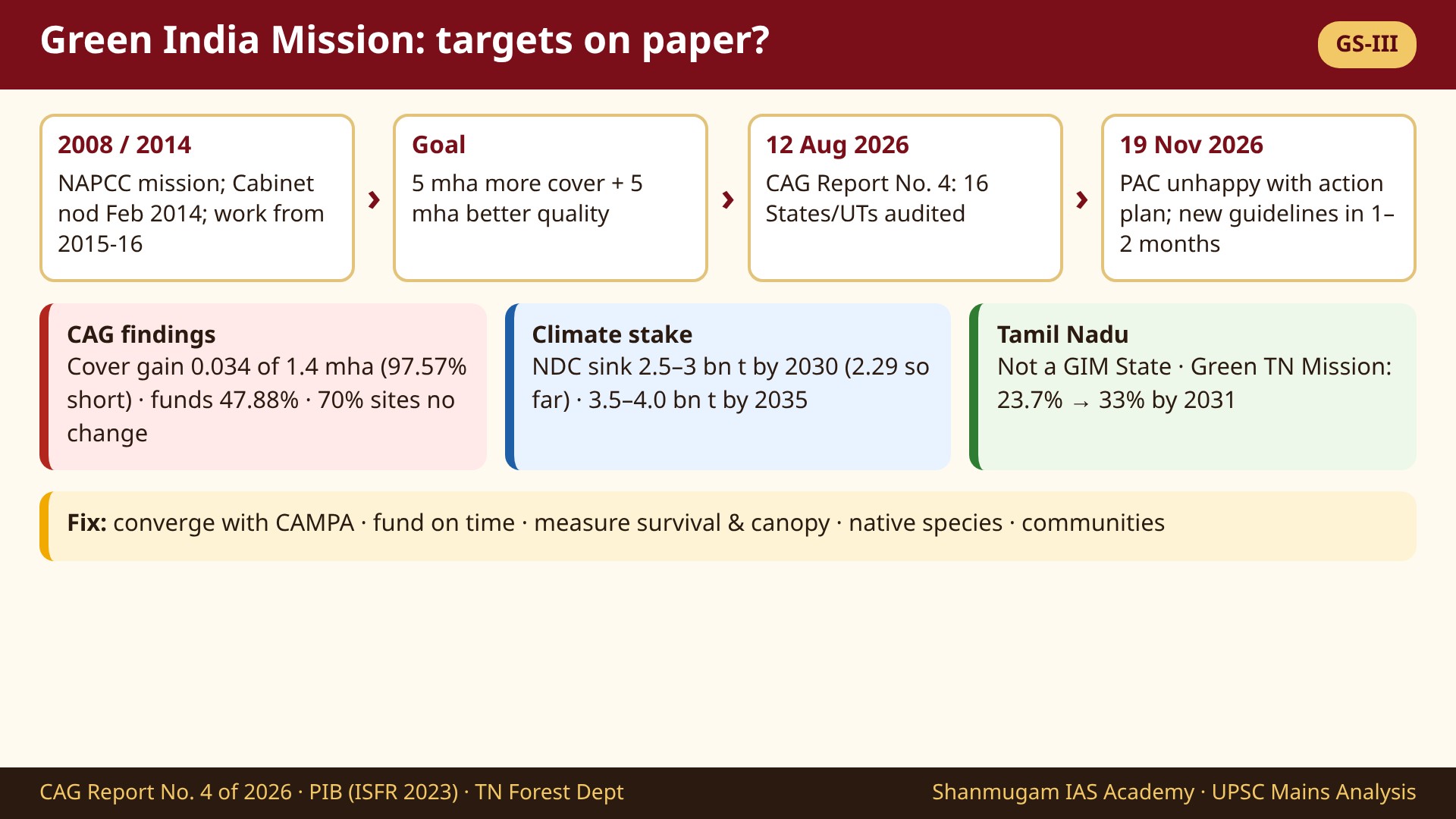
- The CAG's Report No. 4 of 2026 (tabled 12 August 2026) found the Green India Mission increased forest cover by only 0.03409 million hectares against a 1.4 mha target (97.57% short) and improved quality on 0.11384 mha (91.87% short), across 16 States/UTs in 2015-16 to 2024-25.
- Only ₹1,149.14 crore (47.88%) of approved funds arrived in ten years; convergence with CAMPA and MGNREGS failed; maps were not validated and 70% of sampled sites showed no change. On 19 November 2026 the PAC reviewed the audit; PTI reported the Committee was dissatisfied with the Ministry's action plan, with revised guidelines promised in one to two months.
- The stakes: India's NDC sink target of 2.5–3 billion tonnes CO2e by 2030 (2.29 achieved, ISFR 2023), raised to 3.5–4.0 billion tonnes by 2035 in the NDC 2031–35. Fix funding, converge schemes and measure survival and canopy, not saplings. Tamil Nadu runs its own Green TN Mission (33% cover by 2031). PYQ: Prelims 2016.

Why in news
On 19 November 2026, Parliament's Public Accounts Committee (PAC), chaired by K.C. Venugopal, examined the Comptroller and Auditor General's (CAG) Performance Audit Report No. 4 of 2026 on the Green India Mission (GIM), which was tabled in Parliament on 12 August 2026. PTI reported the chairman as saying the Committee was dissatisfied with the action plan of the Ministry of Environment, Forest and Climate Change (MoEFCC), and that the Ministry's Secretary assured that revised guidelines would be finalised within one or two months.
The audit is a test of a larger question: India's climate promises depend heavily on forests – can a mission with a weak budget and weak monitoring deliver them?
Background: what the Green India Mission is
| Feature | Details |
|---|---|
| Parent plan | One of the eight missions under the National Action Plan on Climate Change (NAPCC), 2008 |
| Approval and start | Approved by the Union Cabinet in February 2014; field activities began in 2015-16 |
| Goals | Increase forest/tree cover on 5 million hectares (mha) and improve the quality of cover on another 5 mha of forest and non-forest land; improve ecosystem services; raise forest-based livelihood income of about 3 million households |
| Coverage | 17 States and one UT (Jammu and Kashmir) taken up – Tamil Nadu is not among them |
| Delivery | Landscape-based plans; Joint Forest Management Committees and other community bodies carry out plantation and maintenance under approved Annual Plans of Operation (APOs) |
| Revamp (17 June 2025) | Updated mission document released on the World Day to Combat Desertification and Drought – focus on the Aravallis (including a green buffer belt), Western Ghats, Himalayas, the arid north-west and the North-East |
What the CAG found (2015-16 to 2024-25, 16 States/UTs)
| Indicator | Target | Achieved | Shortfall |
|---|---|---|---|
| Improving the quality of forest cover | 1.4 mha | 0.11384 mha | 91.87% |
| Increasing forest cover | 1.4 mha | 0.03409 mha | 97.57% |
- Money: the Cabinet Committee on Economic Affairs approved ₹2,000 crore from the 12th Plan for the first four years, plus ₹400 crore from 13th Finance Commission grants as the States' share. Over ten years, only ₹1,149.14 crore (47.88%) came as budgetary support. The proposed ₹10,600 crore through convergence with other schemes was not attained.
- Convergence: weak links with CAMPA, MGNREGS and other afforestation schemes; the Nagar Van Yojana and School Nursery Yojana ran in silos.
- Planning: the bottom-up approach for selecting areas was not followed, and low-to-moderate priority landscapes were sometimes chosen over more climate-vulnerable ones. Only 6 of 68 sampled APOs reached the Ministry before the financial year began, and none was approved on time.
- Accounts and transparency: eight States/UTs did not maintain annual accounts; 14 States did not provide the required public web-links.
- Monitoring: achievements were overstated because KML (map) files were not validated; GIS analysis found no noticeable change attributable to the Mission at 70% of sampled sites. Only Madhya Pradesh and Chhattisgarh assessed carbon sequestration, and flux towers set up by ICFRE in those two States (₹3.50 crore) lay idle.
Note the difference between "area treated" and "cover gained". In August 2026 the Government told the Lok Sabha that more than 1.84 lakh hectares have been brought under eco-restoration since 2015-16. The CAG measured something else: the forest cover actually gained, which was only 0.03409 mha (about 34,090 ha) against 1.4 mha. Planting saplings is an input; surviving, measurable cover is the outcome.
Why it matters: the climate arithmetic
| Indicator | Figure | Source |
|---|---|---|
| Forest + tree cover of India | 8,27,357 sq km = 25.17% of geographical area (forest 21.76%, tree 3.41%) | ISFR 2023 (released 21 Dec 2024) |
| Additional carbon sink achieved | 2.29 billion tonnes CO2e over the 2005 baseline | ISFR 2023 |
| NDC targets | 2.5–3.0 billion tonnes CO2e additional sink by 2030; new NDC 2031–35: 3.5–4.0 billion tonnes by 2035 (from 2005 level) | India's NDC; Union Cabinet, 25 March 2026 |
| National Forest Policy goal | 33% of geographical area under forest or tree cover | National Forest Policy, 1988 |
| GIM budget 2026-27 | ₹170 crore (BE), 63% above RE 2025-26 | Demands for Grants 2026-27 (PRS analysis) |
The NDC sink target is within reach on paper, but ISFR counts all land above 1 hectare with more than 10% tree canopy as "forest cover", whatever its ownership or species. Plantations and orchards therefore add to the numbers, while loss of old natural forest may not show. A mission meant to improve the quality of forests – the part the CAG found 91.87% short – is exactly what the headline figures do not capture.
Analysis: why the Mission under-delivered
| Problem | What it shows |
|---|---|
| Chronic under-funding | Less than half of even the initial approved outlay arrived in ten years; ₹170 crore a year is small for a 10 mha mission |
| Scheme overlap | CAMPA (much larger funds), MGNREGS and Nagar Van Yojana work on the same lands without a common plan |
| Top-down targets | Areas picked without village-level plans; late APOs mean planting misses the monsoon window |
| Input-based monitoring | Counting saplings and hectares "treated" instead of survival, canopy gain and carbon – unvalidated maps inflated results |
| Weak governance | Missing accounts and web disclosure reduce accountability to Parliament and the public |
The core point: India's forest-carbon promise cannot rest on a mission that is under-funded, poorly measured and disconnected from bigger schemes. Unless money reaches the field before the planting season and results are checked by someone other than the implementer, hectares will keep growing in reports but not on the ground.
Static syllabus link
- GS-III: conservation, environmental degradation, environmental impact assessment; climate change – NAPCC and its eight missions, NDC, Paris Agreement (Article 5 on sinks and REDD+).
- Laws and institutions: Forest (Conservation) Act, 1980 (renamed Van (Sanrakshan Evam Samvardhan) Adhiniyam in 2023); Compensatory Afforestation Fund Act, 2016 (CAMPA); Forest Rights Act, 2006 (community forest resources); Forest Survey of India and ISFR.
- GS-II link: role of the CAG (Article 148–151) and the Public Accounts Committee in holding the executive accountable for scheme outcomes.
- Essay: "Planting a tree is a promise; growing a forest is its fulfilment."
Tamil Nadu angle
- Tamil Nadu is not among the 17 States and one UT covered by GIM; it runs its own Green Tamil Nadu Mission, formally launched on 24 September 2022, with the goal of raising forest and tree cover from 23.7% to 33% of the State's area by 2031 (Forest Department Policy Note 2024-25).
- As per ISFR 2021 (TN Forest Dept Policy Note 2024-25), the State's forest cover was 20.31% and forest plus tree cover 23.71% of its 1,30,060 sq km – a wide gap to the 33% goal.
- The CAG's lessons – measure survival and canopy, not saplings; publish site-wise data; converge with CAMPA and rural-employment works – apply equally to the State mission.
Faculty view
Do not stop at "the Mission failed". Write in three layers: (1) the numbers – 1.4 mha target vs 0.03409 mha gained; 47.88% of funds; 70% of sites with no change; (2) the reasons – funding, convergence, planning, monitoring; (3) the stakes – the NDC sink of 2.5–3 billion tonnes by 2030 (3.5–4.0 billion tonnes by 2035 in the new NDC) and the gap between "forest cover" and real forest quality. Add one line on the CAG–PAC accountability chain (GS-II) and end with a measurable reform agenda. Examiners reward answers that separate inputs (saplings) from outcomes (surviving cover, carbon).
Way forward
- One forest-restoration framework: merge planning of GIM, CAMPA, MGNREGS works and Nagar Van Yojana at landscape level, with one budget view.
- Fund what is promised: a realistic, multi-year outlay linked to the NDC target, released on time so that planting fits the monsoon.
- Outcome-based monitoring: geo-tagged sites, validated maps, satellite checks of canopy change, 3-year survival audits, and carbon measurement in every State – all published online.
- Native species and ecosystems first: restore degraded natural forests, grasslands and mangroves rather than monoculture plantations.
- Communities at the centre: empower gram sabhas and forest committees under the Forest Rights Act; tie livelihoods (NTFP, agroforestry) to protection.
- Follow through after the PAC review: notify the revised guidelines with time-bound targets and report progress to Parliament.
Glossary – Carbon sink
Anything that absorbs more carbon dioxide from the atmosphere than it releases – forests, soils, wetlands and oceans. A carbon stock is the total carbon stored at a point in time; a sink refers to the addition to that store. In its Nationally Determined Contribution (NDC) under the Paris Agreement, India has committed to create an additional carbon sink of 2.5–3 billion tonnes of CO2-equivalent through additional forest and tree cover by 2030. The India State of Forest Report 2023 estimates that 2.29 billion tonnes have been added over the 2005 baseline. India's next NDC for 2031–35, approved by the Union Cabinet on 25 March 2026, raises this to a carbon sink of 3.5–4.0 billion tonnes of CO2e through forest and tree cover by 2035 from the 2005 level. A forest becomes a carbon source instead of a sink when it is degraded, burnt or cleared.
Asked before in UPSC
1. "Which of the following best describe/describes the aim of the 'Green India Mission' of the Government of India? 1. Incorporating environmental benefits and costs into the Union and State Budgets thereby implementing the 'green accounting' 2. Launching the second green revolution to enhance agricultural output so as to ensure food security to one and all in the future 3. Restoring and enhancing forest cover and responding to climate change by a combination of adaptation and mitigation measures" – Prelims 2016 (answer: 3 only).
2. We did not find a Mains question on the Green India Mission by name in our records; GS-III regularly asks about conservation, climate change commitments and environmental governance, and this topic fits those themes.
Mains practice question
"The Green India Mission shows that climate targets fail without adequate funds and credible monitoring." Critically examine in the light of the CAG's 2026 audit and India's forest-carbon commitments. (15 marks, 250 words)
FAQ
What is the Green India Mission?
One of the eight missions under the National Action Plan on Climate Change. It aims to increase forest/tree cover on 5 million hectares, improve the quality of cover on another 5 million hectares, and raise the livelihood income of about 3 million forest-dependent households. Field work began in 2015-16.
What did the CAG audit find?
In Report No. 4 of 2026, covering 2015-16 to 2024-25 in 16 States/UTs, the CAG found a 97.57% shortfall in increasing forest cover (0.03409 of 1.4 million hectares) and a 91.87% shortfall in improving forest quality; only 47.88% of the approved funds were received.
Why did the Public Accounts Committee discuss it?
The PAC examines CAG reports. On 19 November 2026 it reviewed the GIM audit; according to PTI, the chairman said the Committee was dissatisfied with the Environment Ministry's action plan and that the Secretary assured revised guidelines within one or two months.
What is India's forest carbon sink target?
An additional carbon sink of 2.5–3 billion tonnes of CO2-equivalent through additional forest and tree cover by 2030; ISFR 2023 estimates 2.29 billion tonnes achieved over the 2005 baseline. The new NDC for 2031–35 (approved by the Cabinet on 25 March 2026) sets a carbon sink of 3.5–4.0 billion tonnes CO2e through forest and tree cover by 2035 from the 2005 level.
Is Tamil Nadu part of the Green India Mission?
No. Tamil Nadu is not among the 17 States and one UT under GIM; it runs its own Green Tamil Nadu Mission to raise forest and tree cover to 33% by 2031.
Sources: Comptroller and Auditor General of India, Report No. 4 of 2026 – Performance Audit of the Green India Mission (tabled 12 August 2026) and CAG press brief; Deccan Herald (19 November 2026) and NewsGram (20 November 2026) on the PAC meeting; PIB – Rajya Sabha reply on GIM (21 December 2023), factsheet on forests and GIM goals, and PIB factsheet (27 December 2024) on ISFR 2023, released by MoEFCC on 21 December 2024; Union Cabinet decision on India's NDC 2031–35 (PM India, 25 March 2026); PTI/DT Next (19 November 2026) on the PAC meeting; Lok Sabha reply on GIM (PTI, 10 August 2026); revamped GIM (PTI, 17 June 2025); Demands for Grants 2026-27 analysis (PRS); Tamil Nadu Forest Department Policy Note 2024-25; National Forest Policy, 1988. Analysis is our own.
Related on our site: UPSC Mains Analysis – all articles · UPSC glossary · UPSC Mains answer-writing practice · Free PDF downloads
Add us as a preferred source on Google
Link to this page from your website / blog (HTML code)
BANK Achievers
-

ABILAASH
BANK BANK
Today Current Affairs in Tamil | 23 நவம்பர் 2026 | TNPSC Group 4 முக்கிய வினாக்கள்
📚 TNPSC குரூப் 4 / 2 / 2A – பொதுத்தமிழ், பொது அறிவு நூல்கள்
PDF நூல்கள் · ₹149 முதல் · ஒவ்வொன்றுக்கும் 50 பக்க இலவச மாதிரி · UPI-இல் பணம் செலுத்தியதும் உடனே பதிவிறக்கம்
 பொதுத் தமிழ் — முழுமையான கையேடு (TNPSC குரூப் 2 · 2A · 4)
₹199
 TNPSC முழுமையான பாடநூல்கள் – முழுத் தொகுப்பு (9 நூல்கள்)
₹1599
 பொதுத் தமிழ் — முந்தைய ஆண்டு வினா – விடை – விளக்கம் (புதிய பாடத்திட்டம்)
₹199
 TNPSC திறனறிவும் மனக்கணக்கு நுண்ணறிவும் (Aptitude & Mental Ability) – முழுமையான பாடநூல்
₹199
TNPSC குரூப் 1, 2/2A, 4 – நேரடி வகுப்புகள் · கோவை & மதுரை
2006 முதல் சண்முகம் IAS அகாடமி · Classroom & online coaching in Coimbatore and Madurai
