

IASST's nanowire-MOF uses light to break down pollutant pyrene
24 November 2026 · English Science & Technology
⬇ Download this article as free PDF
Topics: Science & Technology · UPSC Prelims · TNPSC · SSC · Current Affairs
Current affairs of 24 November 2026 (Shanmugam IAS Academy) – explained for UPSC, TNPSC and other competitive exams
News
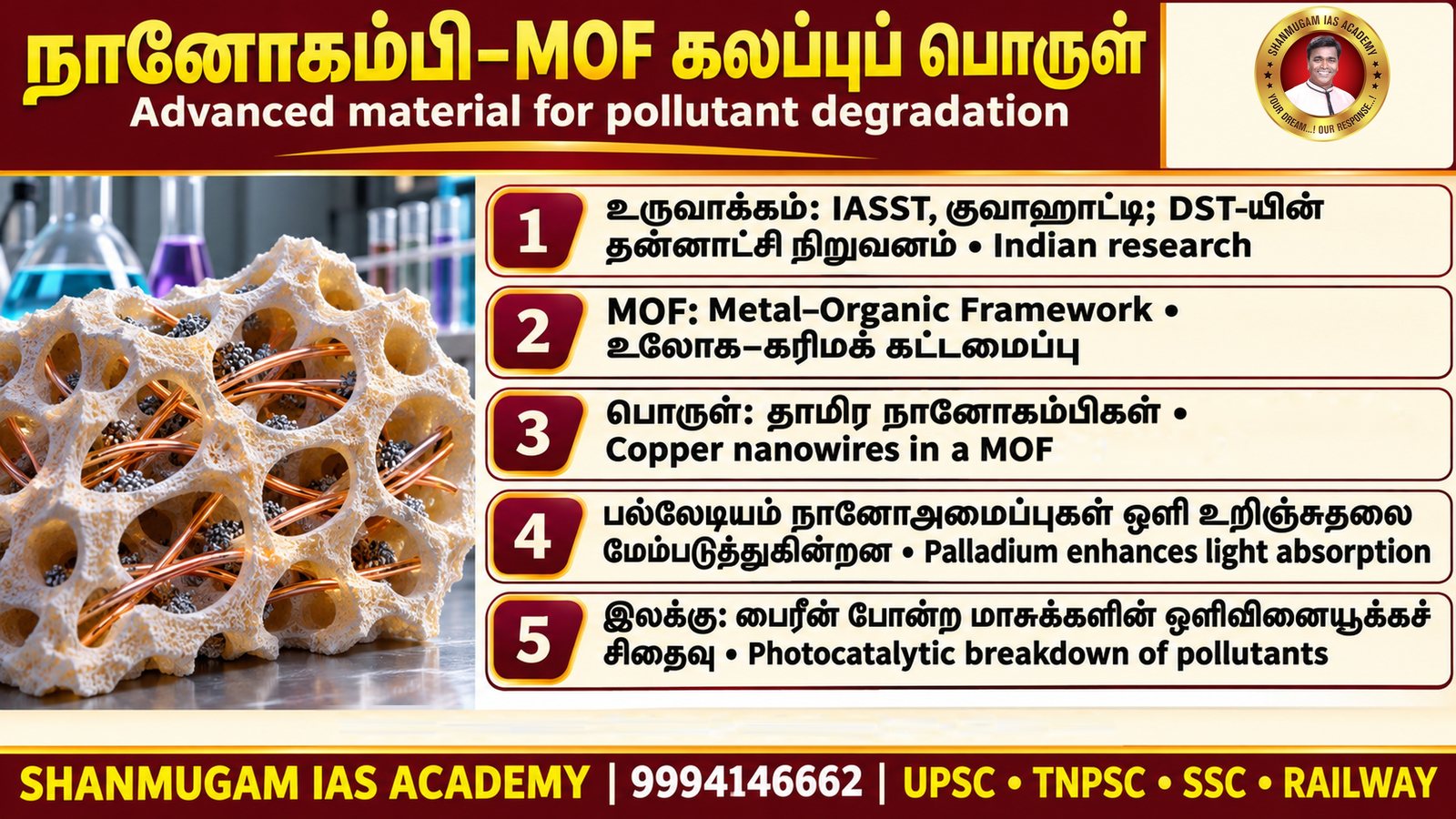
Scientists at the Institute of Advanced Study in Science and Technology (IASST), Guwahati, an autonomous institute of the Department of Science and Technology (DST), have built a metal–organic framework (MOF) integrated with copper nanowires and palladium nanostructures. In the laboratory it removed 99% of pyrene, a persistent toxic pollutant; a cheaper aluminium version removed 85% (reported 23 Nov 2026; study by Prof. Devasish Chowdhury and Netra Prova Baruah, journal ACS Applied Energy Materials). It works by photocatalysis: the metallic nanowires help the material absorb a broad range of light, including visible and near-infrared, and the excited electrons drive the breakdown of the pollutant. Using cheap, plentiful aluminium in place of costly palladium makes the approach more affordable.
Key facts for the exam
| Point | Details |
|---|---|
| MOF | Porous "cage" with a huge surface area that traps pollutant molecules |
| Copper nanowires | Thin conducting wires that carry electrons quickly |
| Palladium nanostructures | Boost light absorption and catalytic activity |
| Target pollutant | Pyrene, a polycyclic aromatic hydrocarbon (PAH) |
| Result | 99% (palladium), 85% (aluminium) – a laboratory result; field use is still to be tested |
Background
- MOFs are crystals in which metal ions or clusters are joined by organic linker molecules, leaving regular pores; one gram can have a surface area of thousands of square metres. They are used for gas storage, carbon capture, water harvesting from air and pollutant removal.
- The 2025 Nobel Prize in Chemistry went to Susumu Kitagawa, Richard Robson and Omar M. Yaghi for developing MOFs.
- A nanometre is one-billionth of a metre; nanowires are only tens of nanometres thick.
- Pyrene is a polycyclic aromatic hydrocarbon (PAH) formed by incomplete burning of coal, oil, wood and vehicle fuel; many PAHs are carcinogenic. Titanium dioxide (TiO₂) is the classic photocatalyst; since it uses mainly ultraviolet light, catalysts that use visible light make better use of sunlight.
What is this news about?
Scientists at the Institute of Advanced Study in Science and Technology (IASST), Guwahati, an autonomous institute of the Department of Science and Technology (DST), have built a metal–organic framework (MOF) integrated with copper nanowires and palladium nanostructures.
What are the key facts to remember for the exam?
MOF: Porous "cage" with a huge surface area that traps pollutant molecules; Copper nanowires: Thin conducting wires that carry electrons quickly; Palladium nanostructures: Boost light absorption and catalytic activity; Target pollutant: Pyrene, a polycyclic aromatic hydrocarbon (PAH).
What is the background to this news?
MOFs are crystals in which metal ions or clusters are joined by organic linker molecules, leaving regular pores; one gram can have a surface area of thousands of square metres.
Practise more: Weekly current affairs · Daily subject quiz · Knowledge nugget
Prepared by the Shanmugam IAS Academy faculty team, Coimbatore (since 2006) · independently checked against primary sources · Our editorial policy
Add us as a preferred source on Google
Link to this page from your website / blog (HTML code)
TNPSC Achievers
-

KALPANA
TNPSC TNPSC
நடப்பு நிகழ்வுகள் 26 நவம்பர் 2026 | Today Current Affairs in Tamil | TNPSC Group 4 வினா விடை
📚 TNPSC குரூப் 4 / 2 / 2A – பொதுத்தமிழ், பொது அறிவு நூல்கள்
PDF நூல்கள் · ₹149 முதல் · ஒவ்வொன்றுக்கும் 50 பக்க இலவச மாதிரி · UPI-இல் பணம் செலுத்தியதும் உடனே பதிவிறக்கம்
 பொதுத் தமிழ் — முழுமையான கையேடு (TNPSC குரூப் 2 · 2A · 4)
₹199
 TNPSC முழுமையான பாடநூல்கள் – முழுத் தொகுப்பு (9 நூல்கள்)
₹1599
 TNPSC குரூப் 4 பொதுத் தமிழ் – முழுமையான தேர்வுக் களஞ்சியம் 2026
₹249
 பொதுத் தமிழ் — முந்தைய ஆண்டு வினா – விடை – விளக்கம் (புதிய பாடத்திட்டம்)
₹199
TNPSC குரூப் 1, 2/2A, 4 – நேரடி வகுப்புகள் · கோவை & மதுரை
2006 முதல் சண்முகம் IAS அகாடமி · Classroom & online coaching in Coimbatore and Madurai
