

Group 2A Mains – Daily Practice 18 (19 November 2026)
Group 2A Mains – Daily Practice 18 (19 November 2026) – 30 வினாக்கள், பாடம்: குரூப் 2A Mains. ஒவ்வொரு வினாவுக்கும் சரியான விடையும் இரண்டு வரி விளக்கமும் உண்டு; "Show Answer" அழுத்திப் பாருங்கள். TNPSC குரூப் 1, 2, 2A, 4, SI, TET தேர்வுகளுக்கான இலவசப் பயிற்சி – சண்முகம் ஐ.ஏ.எஸ். அகாடமி, கோயம்புத்தூர்.
உங்கள் இணையதளம் / Blog-இல் இணைக்க (HTML code)
1. The Venetian traveller Marco Polo visited the Pandya country (Kayal) during the reign of Maravarman Kulasekara Pandya I.
2. Malik Kafur, the general of Alauddin Khalji, invaded Madurai in 1311.
3. The Madurai Sultanate was founded by Malik Kafur.
Which of the above are correct?
Correct Answer: B [1 and 2 only]
விளக்கம்:
1 and 2 are correct. Marco Polo landed at the port of Kayal around 1292–93 and wrote about the pearl fishery and the horse trade of the Pandya country. Taking advantage of the war of succession between Kulasekara's sons Sundara Pandya and Vira Pandya, Malik Kafur raided up to Madurai in 1311. The Madurai Sultanate was founded in 1335 by Jalaluddin Ahsan Shah, who declared independence from the Delhi Sultan – not by Malik Kafur; it was ended by the campaign of the Vijayanagara prince Kumara Kampana. So 3 is wrong.
(a) Kanpur – 1. Begum Hazrat Mahal
(b) Lucknow – 2. Rani Lakshmibai
(c) Jagdishpur (Bihar) – 3. Nana Saheb
(d) Jhansi – 4. Kunwar Singh
Correct Answer: C [(a)-3, (b)-1, (c)-4, (d)-2]
விளக்கம்:
Kanpur – Nana Saheb, adopted son of the last Peshwa Baji Rao II; Lucknow (Awadh) – Begum Hazrat Mahal, who proclaimed her son Birjis Qadr the Nawab of Awadh; Jagdishpur (near Arrah, Bihar) – Kunwar Singh, a zamindar then about 80 years old; Jhansi – Rani Lakshmibai, whose State had been annexed under the Doctrine of Lapse; she died fighting near Gwalior in June 1858. The revolt broke out at Meerut on 10 May 1857.
Reason (R): The Act empowered the government to imprison political suspects without trial for up to two years.
Correct Answer: A [Both (A) and (R) are true and (R) is the correct explanation of (A)]
விளக்கம்:
Both are true and (R) correctly explains (A). The Anarchical and Revolutionary Crimes Act, passed in March 1919 on the recommendation of the Sedition Committee headed by Justice S.A.T. Rowlatt, allowed detention without trial and denied the right of appeal ('no vakil, no appeal, no daleel'). Gandhiji's satyagraha day was 6 April 1919; the Jallianwala Bagh massacre of 13 April 1919 followed. It was Gandhiji's first all-India struggle.
1. The Chittagong Armoury Raid
2. Founding of the Ghadar Party
3. The Kakori train action
4. Founding of the Hindustan Socialist Republican Association (HSRA)
Correct Answer: A [2, 3, 4, 1]
விளக்கம்:
Ghadar Party – 1913, USA, headquartered at San Francisco (Lala Har Dayal, Sohan Singh Bhakna); Kakori action – 9 August 1925 (Ram Prasad Bismil, Ashfaqulla Khan); HSRA – September 1928 at Feroz Shah Kotla, Delhi (Chandrashekhar Azad, Bhagat Singh); Chittagong Armoury Raid – 18 April 1930 (Surya Sen). So 2, 3, 4, 1.
Correct Answer: B [He was the Chief Minister when Madras State was renamed Tamil Nadu]
விளக்கம்:
When Madras State was renamed Tamil Nadu on 14 January 1969, the Chief Minister was C.N. Annadurai (Arignar Anna) – not Rajaji. Rajaji (1878–1972) was Premier of the Madras Presidency in 1937–39 and Chief Minister of Madras State in 1952–54; he was the only Indian and the last Governor-General of India; he received the first Bharat Ratna awards in 1954 along with Dr S. Radhakrishnan and Sir C.V. Raman; he founded the Swatantra Party in 1959.
1. In the Lok Sabha, the first hour of every sitting is normally the Question Hour.
2. A starred question is answered orally in the House, and supplementary questions may be asked on it.
3. The 'Zero Hour' is formally provided for in the Lok Sabha Rules of Procedure.
Which of the above are correct?
Correct Answer: A [1 and 2 only]
விளக்கம்:
1 and 2 are correct. Under the Lok Sabha Rules of Procedure, unless the Speaker directs otherwise, the first hour of every sitting is available for questions. A starred question gets an oral answer and supplementaries are allowed; an unstarred question gets a written answer with no supplementaries. The 'Zero Hour', which starts at 12 noon right after Question Hour, is an informal Indian practice and is not mentioned in the Rules. So 3 is wrong.
(a) Balwant Rai Mehta Committee – 1. 1985
(b) Ashok Mehta Committee – 2. 1957
(c) G.V.K. Rao Committee – 3. 1986
(d) L.M. Singhvi Committee – 4. 1977
Correct Answer: D [(a)-2, (b)-4, (c)-1, (d)-3]
விளக்கம்:
Balwant Rai Mehta Committee (1957) – a three-tier Panchayati Raj ('democratic decentralisation'); the first Panchayati Raj was launched at Nagaur, Rajasthan, on 2 October 1959. Ashok Mehta Committee (1977) – a two-tier system (Zila Parishad and Mandal Panchayat). G.V.K. Rao Committee (1985) – the district as the basic unit of development planning. L.M. Singhvi Committee (1986) – constitutional recognition for panchayats, achieved by the 73rd Amendment (1992).
Reason (R): The writ aims to protect personal liberty by ordering anyone who holds a person in unlawful detention to produce that person before the court.
Correct Answer: A [Both (A) and (R) are true and (R) is the correct explanation of (A)]
விளக்கம்:
Both are true and (R) correctly explains (A). 'Habeas Corpus' means 'to have the body'. Whether the detainer is the State or a private person, the court examines whether the detention is lawful and orders release if it is not. The Supreme Court issues writs under Article 32 and the High Courts under Article 226. By contrast, Mandamus does not lie against a private individual.
Correct Answer: D [When a case referred by a court is settled in a Lok Adalat, the court fee already paid is not refunded]
விளக்கம்:
Under Section 21 of the Legal Services Authorities Act, 1987, when a case referred by a court is settled in a Lok Adalat, the court fee paid is refunded – so the last statement is wrong. A Lok Adalat award is deemed to be a decree of a civil court; it is final and binding on the parties, and no appeal lies against it. Free legal aid is a Directive Principle under Article 39A; 9 November, the day the Act came into force in 1995, is observed as National Legal Services Day.
Correct Answer: B [Article 131]
விளக்கம்:
Article 131 – only the Supreme Court can hear Centre–State and inter-State disputes at first instance (its role as the federal umpire). Article 32 – writs for enforcing Fundamental Rights; Article 136 – appeal by special leave (SLP); Article 143 – reference by the President for the Court's opinion (advisory jurisdiction).
1. Insulin is secreted by the beta cells of the islets of Langerhans in the pancreas.
2. Adrenaline (epinephrine) is secreted by the pituitary gland.
3. Deficiency of iodine in the diet causes goitre.
Which of the above are correct?
Correct Answer: C [1 and 3 only]
விளக்கம்:
1 and 3 are correct. Insulin lowers blood sugar; its deficiency causes diabetes. Adrenaline is secreted by the adrenal medulla – not the pituitary; it is the 'emergency' or 'fight-or-flight' hormone. Iodine is needed to make thyroxine in the thyroid; its deficiency enlarges the thyroid (goitre) – hence iodised salt. So 2 is wrong.
(a) Brass – 1. Iron, chromium, nickel (with a little carbon)
(b) Bronze – 2. Copper and zinc
(c) Solder – 3. Lead and tin
(d) Stainless steel – 4. Copper and tin
Correct Answer: A [(a)-2, (b)-4, (c)-3, (d)-1]
விளக்கம்:
Brass is copper and zinc, bronze is copper and tin, solder is lead and tin, and stainless steel is iron, chromium and nickel with a little carbon, which gives (a)-2, (b)-4, (c)-3, (d)-1. The chromium in stainless steel forms a thin oxide layer that stops rusting.
Reason (R): Iron rusts only in the absence of moisture.
Correct Answer: C [(A) is true but (R) is false]
விளக்கம்:
(A) is true but (R) is false. Rusting of iron needs both oxygen and water (moisture); rust is hydrated iron oxide (Fe₂O₃·xH₂O). In coastal areas the high humidity and the salt in the air (which acts as an electrolyte) speed up rusting. Painting, oiling/greasing and galvanising (zinc coating) prevent rust.
Correct Answer: D [Centrioles are found only in plant cells and are absent in animal cells]
விளக்கம்:
It is the reverse: centrioles occur in animal cells (they help form the spindle during cell division) and are absent in most higher plant cells. So the last statement is wrong. Mitochondria produce energy as ATP; ribosomes make proteins; lysosomes are 'suicide bags' because their enzymes can digest the cell itself if they burst. Features peculiar to plant cells: cell wall, chloroplasts and a large vacuole.
Correct Answer: A [The structure of proteins – the 'Ramachandran plot' and the triple-helix model of collagen]
விளக்கம்:
G.N. Ramachandran (1922–2001), while at the Department of Physics, University of Madras, proposed the triple-helical structure of collagen with Gopinath Kartha in 1954; the 'Ramachandran plot', published in 1963 with V. Sasisekharan and C. Ramakrishnan, is still used worldwide to study protein structure. Raman effect – Sir C.V. Raman; white-dwarf mass limit – Subrahmanyan Chandrasekhar; Green Revolution – M.S. Swaminathan.
1. On the commencement of the Act, the bonded labour system stood abolished and every bonded labourer was freed from any obligation to render bonded labour.
2. Vigilance Committees are to be constituted at the district and sub-divisional levels.
3. Offences under the Act are non-cognizable.
Which of the above are correct?
Correct Answer: B [1 and 2 only]
விளக்கம்:
1 and 2 are correct. Section 4 abolishes the bonded labour system, and bonded debts are deemed extinguished. Section 13 provides for Vigilance Committees for each district and sub-division. Under Section 22, every offence under the Act is cognizable and bailable – so 3 is wrong. The constitutional basis is Article 23, which prohibits forced labour. Rescued labourers get rehabilitation assistance under the Union Government's scheme for the rehabilitation of bonded labourers.
(a) Jawahar Rozgar Yojana – 1. 2011
(b) Swarnajayanti Gram Swarozgar Yojana (SGSY) – 2. 1989
(c) Mahatma Gandhi National Rural Employment Guarantee Scheme (implementation) – 3. 2006
(d) National Rural Livelihoods Mission (NRLM – Aajeevika) – 4. 1999
Correct Answer: C [(a)-2, (b)-4, (c)-3, (d)-1]
விளக்கம்:
Jawahar Rozgar Yojana began in 1989, SGSY in 1999, MGNREGA implementation in 2006 and NRLM (Aajeevika) in 2011, which gives (a)-2, (b)-4, (c)-3, (d)-1. MGNREGA was enacted in 2005 but implemented from 2 February 2006 in 200 districts, and NRLM replaced SGSY.
Reason (R): The Indian rupee was devalued in two steps in July 1991.
Correct Answer: B [Both (A) and (R) are true but (R) is not the correct explanation of (A)]
விளக்கம்:
Both are true, but (R) does not explain (A). After devaluation one dollar buys more rupees, so Indian goods become cheaper in dollar terms while imports become dearer – that is the explanation of (A). (R) is only a historical fact: during the balance-of-payments crisis the rupee was devalued on 1 July and 3 July 1991, followed by the New Economic Policy of 1991 (liberalisation, privatisation, globalisation).
Correct Answer: C [Remittances sent home by Indians working abroad are recorded in the capital account]
விளக்கம்:
Remittances sent home by Indians abroad are unilateral (private) transfers and are recorded in the current account – not the capital account; so the third statement is wrong. India is the world's largest recipient of remittances, and these inflows offset much of its large trade deficit, narrowing the current account deficit. FDI, foreign portfolio investment and external borrowings go into the capital account. India's balance-of-payments data are compiled and released by the RBI.
Correct Answer: A [18 to 50 years]
விளக்கம்:
PMJJBY – launched on 9 May 2015; open to people aged 18–50 with a bank or post-office savings account; annual premium ₹436 (from 1 June 2022; earlier ₹330), auto-debited from the account; cover continues up to age 55 if the premium is paid. Compare: PMSBY (accident cover) – 18–70 years; Atal Pension Yojana – 18–40 years.
1. The crust is the thinnest of the Earth's layers.
2. The boundary between the crust and the mantle is the Gutenberg discontinuity.
3. The outer core of the Earth is in a liquid state.
Which of the above are correct?
Correct Answer: C [1 and 3 only]
விளக்கம்:
1 and 3 are correct. The crust is on average about 30 km thick under the continents and only about 5 km under the oceans. The crust–mantle boundary is the Mohorovičić discontinuity ('Moho'); the Gutenberg discontinuity is the mantle–core boundary at about 2,900 km depth – so 2 is wrong. Because seismic S-waves cannot pass through liquids, the outer core is known to be liquid; the inner core is solid owing to enormous pressure. The core is made mainly of nickel and iron (NIFE).
(a) Jog Falls – 1. Indravati
(b) Dudhsagar Falls – 2. Sharavathi
(c) Athirappilly Falls – 3. Chalakudy
(d) Chitrakote Falls – 4. Mandovi
Correct Answer: B [(a)-2, (b)-4, (c)-3, (d)-1]
விளக்கம்:
Jog Falls is on the Sharavathi, Dudhsagar on the Mandovi, Athirappilly on the Chalakudy river and Chitrakote on the Indravati, which gives (a)-2, (b)-4, (c)-3, (d)-1. Chitrakote in Bastar, Chhattisgarh, is called the 'Niagara of India' for its broad horseshoe shape, and Athirappilly is in Thrissur district of Keralam.
Reason (R): The Earth's axis is perpendicular to the plane of its orbit.
Correct Answer: C [(A) is true but (R) is false]
விளக்கம்:
(A) is true but (R) is false. The Earth's axis is tilted about 23½° from the perpendicular, i.e. it makes an angle of 66½° with the orbital plane; this tilt causes the seasons and the variation in day length at higher latitudes. But the circle of illumination always bisects the equator, so day and night there are about 12 hours each. On the equinoxes (21 March and 23 September) day and night are equal everywhere.
Correct Answer: B [Molten rock that reaches the Earth's surface and flows out is called magma]
விளக்கம்:
Molten rock beneath the surface is magma; once it reaches the surface and flows out it is called lava – so the second statement is wrong. Composite volcanoes are cone-shaped, built of alternating layers of lava and ash (Fuji); shield volcanoes are broad and gently sloping, built of fluid basaltic lava (Mauna Loa). About three-quarters of the world's active volcanoes lie on the Ring of Fire along the plate boundaries around the Pacific Ocean.
1. The State animal of Tamil Nadu is the Nilgiri tahr.
2. In 2019 the Tamil Yeoman (Tamil Maravan) was declared the State butterfly of Tamil Nadu.
3. The State bird of Tamil Nadu is the peacock.
Which of the above are correct?
Correct Answer: A [1 and 2 only]
விளக்கம்:
1 and 2 are correct. The Nilgiri tahr is endemic to the Western Ghats; its main habitats include Eravikulam (Keralam), Mukurthi and the Anamalais. The Tamil Yeoman is also endemic to the Western Ghats; Tamil Nadu was the fifth Indian State to declare a State butterfly. The State bird of Tamil Nadu is the Emerald Dove – not the peacock (the peacock is India's national bird). State flower – Gloriosa lily (Senthandhu/Kanthal); State tree – Palmyra; State fruit – Jackfruit. So 3 is wrong.
2, 10, 30, 68, 130, ?
Correct Answer: B [222]
விளக்கம்:
Each term is n³ + n: 1³+1 = 2, 2³+2 = 10, 3³+3 = 30, 4³+4 = 68, 5³+5 = 130. The next is 6³+6 = 216 + 6 = 222.
Correct Answer: A [₹6,000]
விளக்கம்:
Amount = P × (1 + 10/100)² = P × 1.21. So P = 7,260 ÷ 1.21 = ₹6,000. Check: 6,000 → 6,600 (first year) → 7,260 (second year).
Correct Answer: B [30 days]
விளக்கம்:
One day's work: (A + B) = 1/10, A = 1/15. So B = 1/10 − 1/15 = (3 − 2)/30 = 1/30. B alone takes 30 days.
Correct Answer: C [35]
விளக்கம்:
1,000 ÷ 45 = 22, remainder 10 (45 × 22 = 990). The next multiple is 45 × 23 = 1,035. So the least number to add is 1,035 − 1,000 = 35 (i.e. 45 − 10).
Correct Answer: A [DIFOOBJ]
விளக்கம்:
Each letter is replaced by the next letter of the English alphabet (+1): M→N, A→B, D→E, R→S, A→B, S→T. So C→D, H→I, E→F, N→O, N→O, A→B, I→J = DIFOOBJ.
Today Current Affairs in Tamil | 23 நவம்பர் 2026 | TNPSC Group 4 முக்கிய வினாக்கள்
📚 TNPSC குரூப் 2 / 2A Mains – மாதிரி விடைகளுடன் நூல்கள்
PDF நூல்கள் · ₹149 முதல் · ஒவ்வொன்றுக்கும் 50 பக்க இலவச மாதிரி · UPI-இல் பணம் செலுத்தியதும் உடனே பதிவிறக்கம்
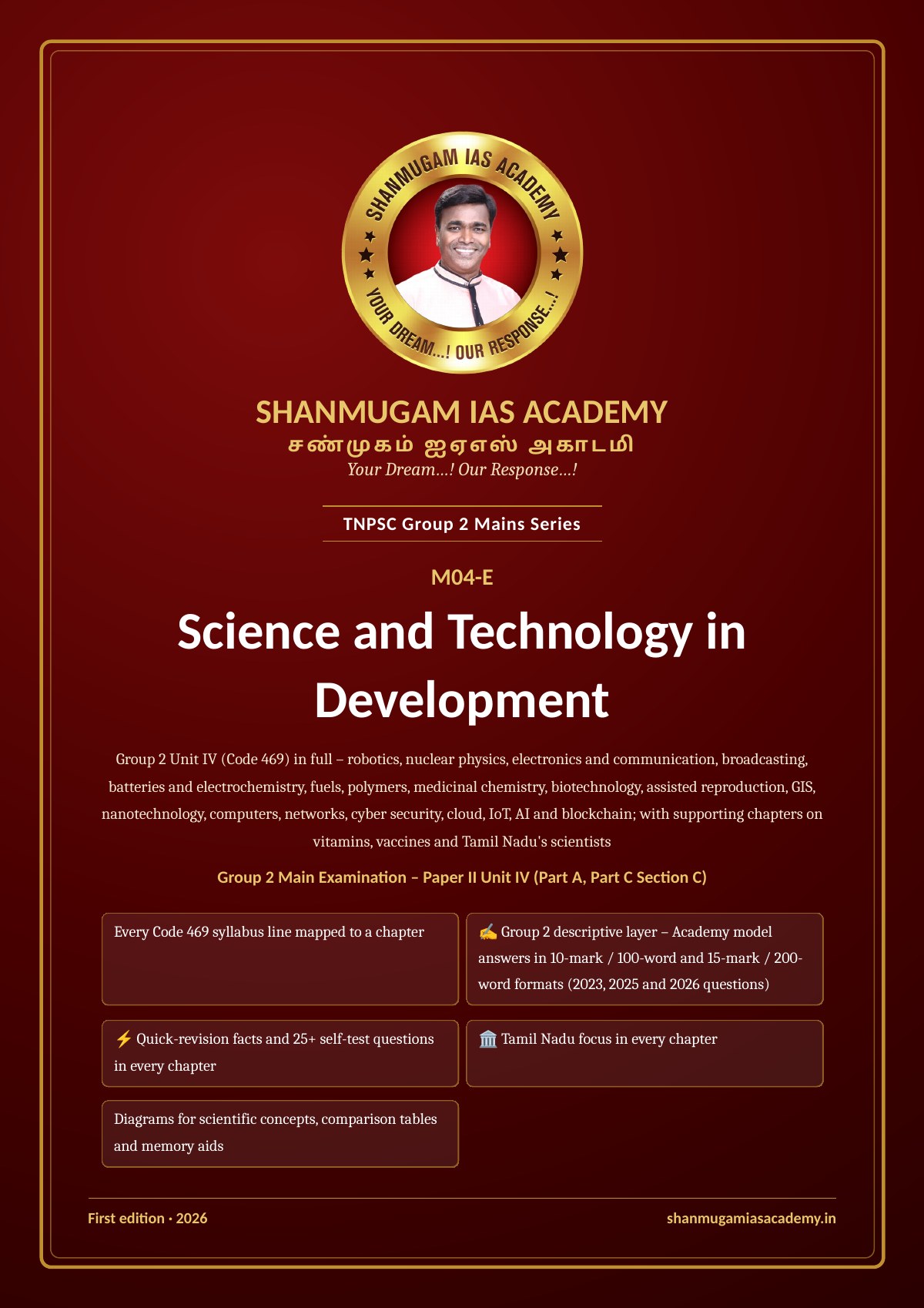 M04-E · Science & Technology – TNPSC Group 2/2A Mains (English)
₹249
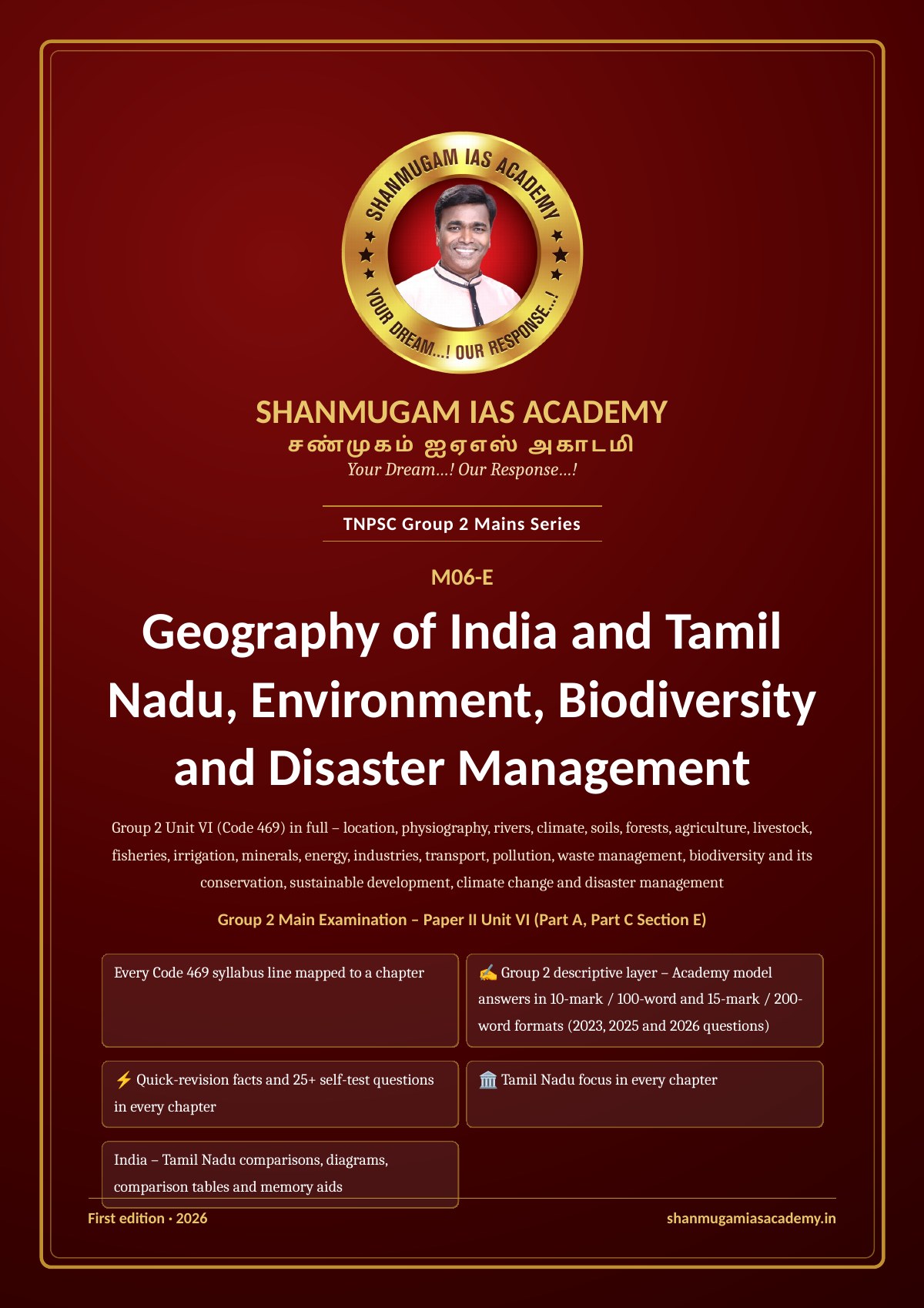 M06-E · Geography & Environment – TNPSC Group 2/2A Mains (English)
₹249
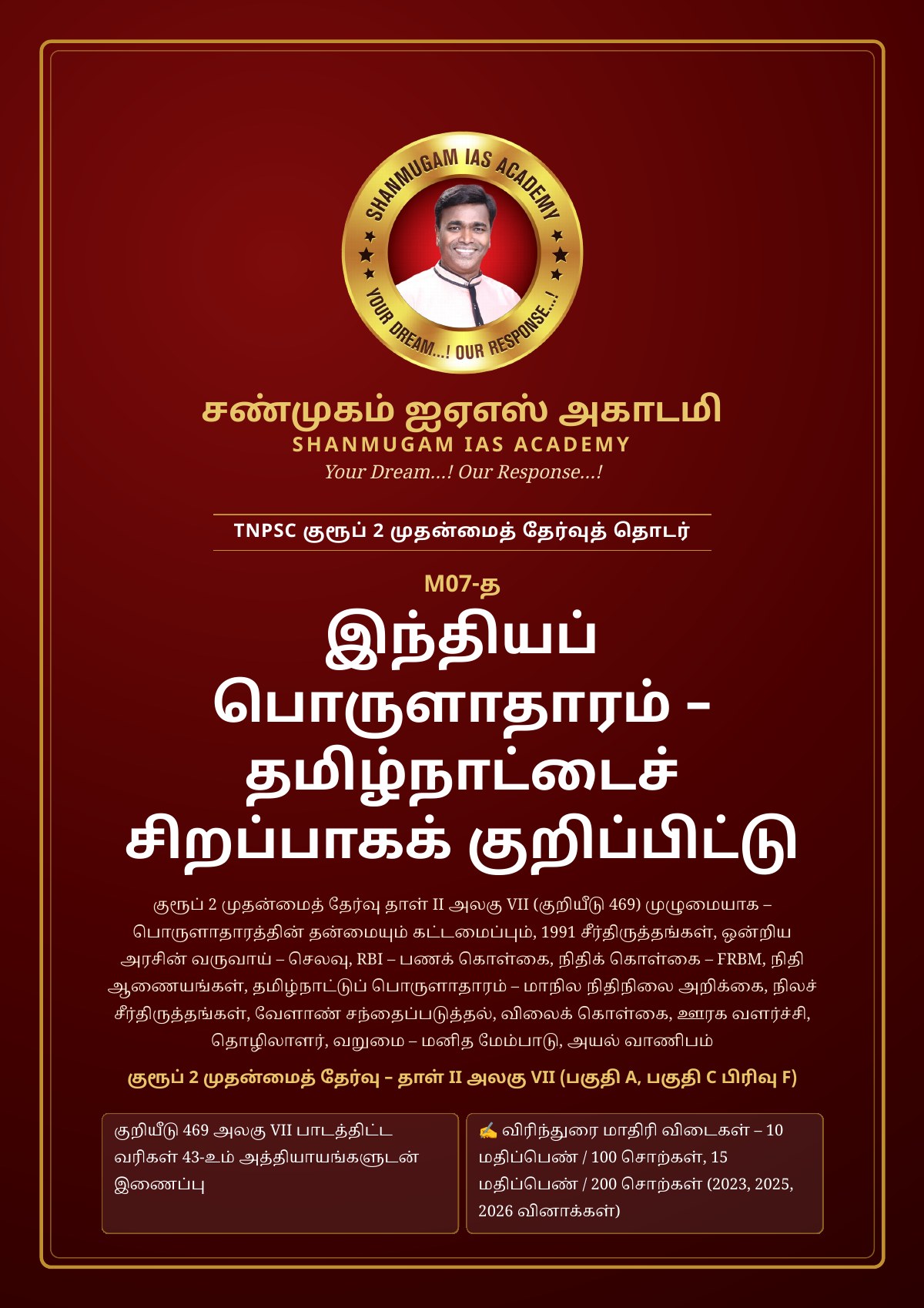 M07-த · இந்தியப் பொருளாதாரம் – TNPSC குரூப் 2/2A Mains (தமிழ்)
₹249
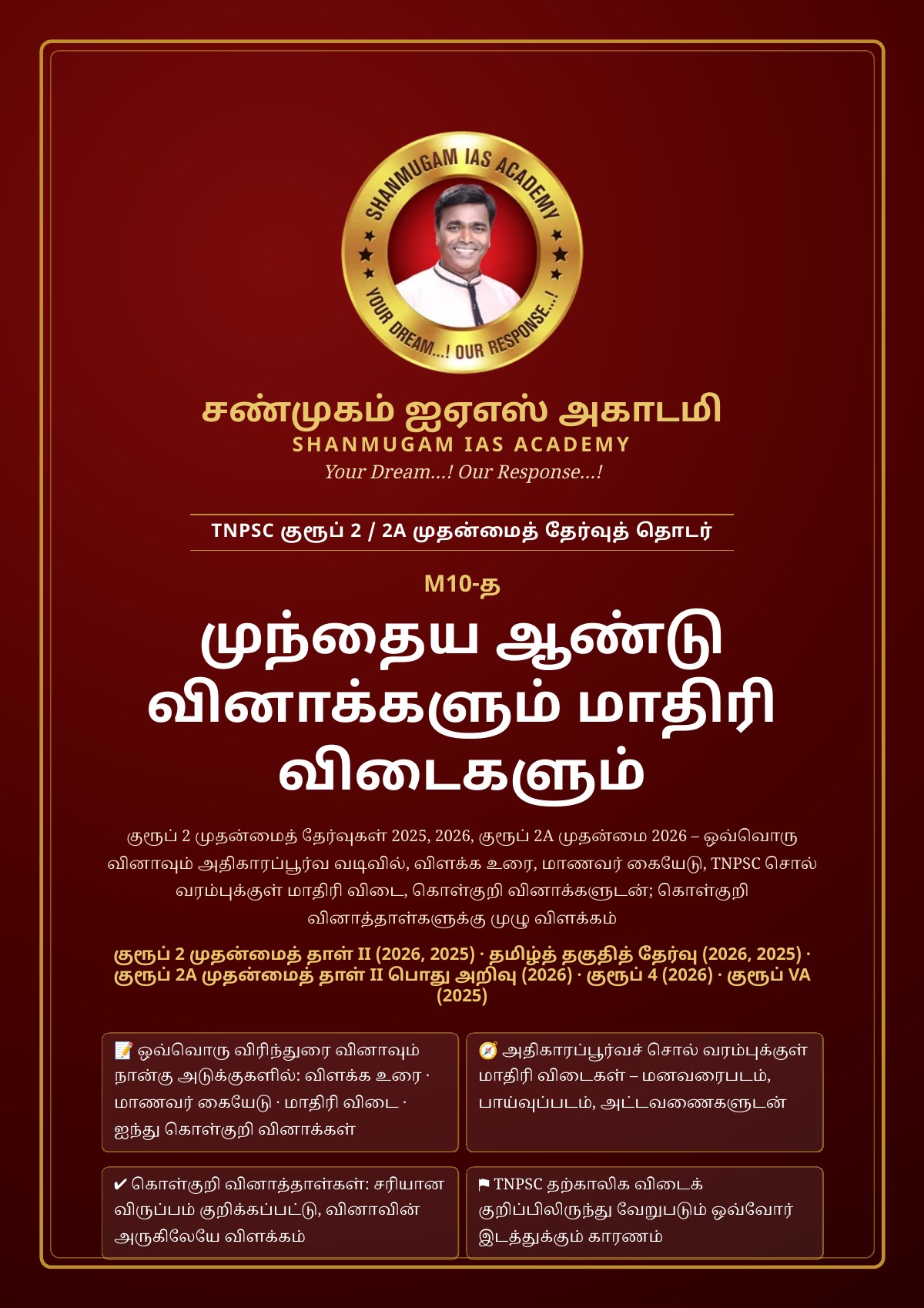 M10-த · குரூப் 2/2A Mains முந்தைய வினா & மாதிரி விடை (தமிழ்)
₹249
TNPSC குரூப் 1, 2/2A, 4 – நேரடி வகுப்புகள் · கோவை & மதுரை
2006 முதல் சண்முகம் IAS அகாடமி · Classroom & online coaching in Coimbatore and Madurai
