

Group 2A Mains – Daily Practice 21 (22 November 2026)
Group 2A Mains – Daily Practice 21 (22 November 2026) – 30 வினாக்கள், பாடம்: குரூப் 2A Mains. ஒவ்வொரு வினாவுக்கும் சரியான விடையும் இரண்டு வரி விளக்கமும் உண்டு; "Show Answer" அழுத்திப் பாருங்கள். TNPSC குரூப் 1, 2, 2A, 4, SI, TET தேர்வுகளுக்கான இலவசப் பயிற்சி – சண்முகம் ஐ.ஏ.எஸ். அகாடமி, கோயம்புத்தூர்.
உங்கள் இணையதளம் / Blog-இல் இணைக்க (HTML code)
1. It was introduced in 1883 during the viceroyalty of Lord Ripon.
2. It sought to allow Indian judges to try Europeans in criminal cases.
3. After strong European protest it was passed in a compromise form that let Europeans claim a jury of which half were Europeans.
Which of the above are correct?
Correct Answer: D [1, 2 and 3]
விளக்கம்:
All three are correct. The European agitation against the bill of Law Member C.P. Ilbert exposed racial discrimination. Under the 1884 compromise Europeans could demand a jury half of whose members were Europeans; the episode sharpened Indian political awareness.
1. Korkai was the chief port of the Pandyas and was famous for pearl fishing.
2. Puhar (Kaveripoompattinam) was the port of the Cholas and is described in the Pattinappalai.
3. Musiri was a Pandya port on the east coast.
Which of the above are correct?
Correct Answer: B [1 and 2 only]
விளக்கம்:
Statement 3 is wrong: Musiri (Muziris) was a Chera port on the west coast and a centre of Roman trade. The statements on Korkai (Pandyas, pearls) and Puhar (Cholas; Pattinappalai, Silappathikaram) are correct.
(a) First council – 1. Kashmir (Kundalavana)
(b) Second council – 2. Pataliputra
(c) Third council – 3. Vaishali
(d) Fourth council – 4. Rajagriha
Correct Answer: A [(a)-4, (b)-3, (c)-2, (d)-1]
விளக்கம்:
First council – Rajagriha (Ajatashatru), second – Vaishali (Kalashoka), third – Pataliputra (Ashoka), fourth – Kundalavana in Kashmir (Kanishka). After the fourth council Buddhism divided into Mahayana and Hinayana.
1. Gandhara sculptures show Greco-Roman influence and mostly used grey schist and stucco.
2. The Mathura school used spotted red sandstone.
3. The Amaravati school developed in Kashmir under the Kushanas.
Which of the above are correct?
Correct Answer: B [1 and 2 only]
விளக்கம்:
Statement 3 is wrong: the Amaravati school grew in the Andhra region (Krishna valley) in the Satavahana period. Gandhara – Greco-Roman influence, grey schist; Mathura – red sandstone and an indigenous tradition.
1. Narasimhavarman I captured the Chalukya capital Vatapi and took the title 'Vatapikonda'.
2. Earlier, Pulakeshin II had defeated Harsha on the banks of the Narmada.
3. The Aihole inscription of Ravikirti records the achievements of Pulakeshin II.
Which of the above are correct?
Correct Answer: D [1, 2 and 3]
விளக்கம்:
All three are correct. Narasimhavarman I captured Vatapi in 642 CE; Mamallapuram is named after his title 'Mamalla'. The Aihole inscription composed by Ravikirti records Pulakeshin II's victory over Harsha.
1. The proclamation must be approved by both Houses of Parliament within two months.
2. Once approved, it continues indefinitely until it is revoked.
3. A Financial Emergency was proclaimed in India once, in 1991.
Which of the above are correct?
Correct Answer: B [1 and 2 only]
விளக்கம்:
Statement 3 is wrong: a Financial Emergency has never been proclaimed in India, not even during the 1991 balance-of-payments crisis. Approval within two months and no maximum period are correct.
1. For Parliament to make a law on a State List subject in the national interest, the Rajya Sabha must pass a resolution supported by two-thirds of the members present and voting.
2. The resolution remains in force for up to one year and can be extended by one year at a time.
3. A law made under it ceases to have effect six months after the resolution lapses.
Which of the above are correct?
Correct Answer: D [1, 2 and 3]
விளக்கம்:
All three are correct. Article 249 is a special power of the Rajya Sabha – the House of the States gives consent, which keeps the federal balance. The law lapses six months after the resolution ceases.
Correct Answer: D [It examines the Budget estimates before they are voted by the Lok Sabha]
விளக்கம்:
The fourth is wrong: the PAC examines the appropriation accounts and CAG reports after the money is spent (a post-mortem). The estimates are examined by the Estimates Committee; since 1967 the PAC chairman has by convention come from the Opposition.
Correct Answer: C [The Speaker]
விளக்கம்:
Under Article 94 the Deputy Speaker resigns by writing to the Speaker, and the Speaker to the Deputy Speaker. Both are elected by the Lok Sabha from among its members (Article 93).
1. There shall be a Council of Ministers with the Chief Minister at the head to aid and advise the Governor, except where he is required to act in his discretion.
2. If a question arises whether a matter is one in which the Governor is required to act in his discretion, the decision of the Governor is final.
3. Courts may inquire into what advice the Ministers tendered to the Governor.
Which of the above are correct?
Correct Answer: B [1 and 2 only]
விளக்கம்:
Statement 3 is wrong: Article 163(3) says no court shall inquire whether, and if so what, advice was tendered by the Ministers to the Governor. Statement 1 is Article 163(1) and statement 2 is Article 163(2).
1. Microwaves
2. X-rays
3. Infrared rays
4. Ultraviolet rays
Correct Answer: C [2, 4, 3, 1]
விளக்கம்:
Increasing wavelength: gamma < X-rays < ultraviolet < visible < infrared < microwaves < radio waves. As wavelength rises, frequency and energy fall – so X-rays carry far more energy than microwaves.
Reason (R): The core of the fibre has a higher refractive index than the surrounding cladding, so light inside undergoes total internal reflection.
Correct Answer: A [Both (A) and (R) are true and (R) is the correct explanation of (A)]
விளக்கம்:
Both are true and (R) explains (A). Light going from a denser to a rarer medium at an angle greater than the critical angle is wholly reflected back inside. That is why optical fibres are used in the internet, telecom and endoscopy.
1. It was developed by the National Payments Corporation of India (NPCI).
2. NPCI is an initiative of the Reserve Bank of India and the Indian Banks' Association.
3. UPI was launched in 2016.
Which of the above are correct?
Correct Answer: D [1, 2 and 3]
விளக்கம்:
All three are correct. NPCI was set up as an initiative of the RBI and the IBA under the Payment and Settlement Systems Act, 2007, and launched UPI in 2016. UPI links several bank accounts to one mobile app for instant transfers.
1. Chlorophyll has magnesium at its centre.
2. Haemoglobin contains iron.
3. Vitamin B12 contains zinc.
Which of the above are correct?
Correct Answer: B [1 and 2 only]
விளக்கம்:
Statement 3 is wrong: the metal in vitamin B12 is cobalt (hence the name cyanocobalamin). Chlorophyll – magnesium; haemoglobin – iron, which carries oxygen.
Reason (R): The bicarbonates that cause temporary hardness decompose on boiling – Ca(HCO₃)₂ gives insoluble CaCO₃ and Mg(HCO₃)₂ gives insoluble Mg(OH)₂.
Correct Answer: A [Both (A) and (R) are true and (R) is the correct explanation of (A)]
விளக்கம்:
Both are true and (R) explains (A). On boiling, Ca(HCO₃)₂ gives insoluble CaCO₃ and Mg(HCO₃)₂ gives insoluble Mg(OH)₂, which can be filtered off. Permanent hardness (chlorides and sulphates) is not removed by boiling and needs methods such as ion exchange.
1. It was enacted in 2003.
2. The FRBM Review Committee (N.K. Singh, 2017) recommended a general government debt-to-GDP ratio of 60% as the main anchor.
3. FRBM was brought in through a constitutional amendment.
Which of the above are correct?
Correct Answer: B [1 and 2 only]
விளக்கம்:
Statement 3 is wrong: FRBM is an ordinary Act of Parliament (2003), not a constitutional amendment. The N.K. Singh Committee made debt the anchor, with a 60% target (Centre 40%, States 20%).
Reason (R): The Gini coefficient is derived from the Lorenz curve; it is the ratio of the area between the line of equality and the Lorenz curve to the total area under the line of equality.
Correct Answer: A [Both (A) and (R) are true and (R) is the correct explanation of (A)]
விளக்கம்:
Both are true and (R) explains (A). Under perfect equality the Lorenz curve coincides with the line of equality, so the area between them – and the coefficient – is 0. If one person had all the income, it would be 1 (perfect inequality).
1. They consist of 17 goals and 169 targets.
2. They were adopted by the UN General Assembly in September 2015 as part of the 2030 Agenda.
3. In India, NITI Aayog publishes the SDG India Index.
Which of the above are correct?
Correct Answer: D [1, 2 and 3]
விளக்கம்:
All three are correct. The SDGs, which followed the Millennium Development Goals (2000–2015), rest on the pledge to 'leave no one behind'. NITI Aayog has published the SDG India Index since 2018 to compare States' progress.
1. The Commission for Agricultural Costs and Prices (CACP) is a statutory body.
2. MSP is announced for 22 crops, and a Fair and Remunerative Price (FRP) for sugarcane.
3. The Cabinet Committee on Economic Affairs (CCEA) takes the final decision on the CACP's recommendations.
Which of the above are correct?
Correct Answer: C [2 and 3 only]
விளக்கம்:
Statement 1 is wrong: the CACP is not a statutory body; it is an attached office of the Ministry of Agriculture (it began in 1965 as the Agricultural Prices Commission). The CCEA approves MSP for the 22 crops on its recommendation.
1. It reserves one-third of the seats in the Lok Sabha, the State Legislative Assemblies and the Delhi Assembly for women.
2. It also reserves one-third of the seats in the Rajya Sabha for women.
3. The reservation takes effect only after delimitation based on the first census held after the Act comes into force.
Which of the above are correct?
Correct Answer: B [1 and 3 only]
விளக்கம்:
Statement 2 is wrong: the quota does not apply to the Rajya Sabha or Legislative Councils. One-third of seats in the Lok Sabha (Article 330A), the Assemblies (Article 332A) and the Delhi Assembly – including within SC/ST seats – for 15 years after delimitation.
1. It rises in the Velliangiri hills of the Western Ghats in Coimbatore district.
2. It flows through Coimbatore and Tiruppur, and the Orathupalayam dam is built across it.
3. It is a tributary of the Vaigai.
Which of the above are correct?
Correct Answer: B [1 and 2 only]
விளக்கம்:
Statement 3 is wrong: the Noyyal is a tributary of the Cauvery. It rises in the Velliangiri hills and flows through Coimbatore and Tiruppur; pollution from Tiruppur's dyeing effluents, which made the Orathupalayam dam water unfit for irrigation, is a well-known environmental issue.
Correct Answer: D [La Niña years are usually associated with drought in India]
விளக்கம்:
The fourth is wrong: La Niña years are usually linked with normal or above-normal monsoon rain in India; the drought risk is higher in El Niño years. Together they are called ENSO (El Niño–Southern Oscillation).
1. The National Biodiversity Authority (NBA) is headquartered in Chennai.
2. Biodiversity Management Committees (BMCs) are set up at the level of local bodies.
3. The Act was enacted to give effect to India's obligations under the Convention on Biological Diversity (CBD).
Which of the above are correct?
Correct Answer: D [1, 2 and 3]
விளக்கம்:
All three are correct. Three tiers: the NBA (Chennai, 2003), State Biodiversity Boards and local-level BMCs, which maintain People's Biodiversity Registers. Fair sharing of the benefits of biological resources (access and benefit sharing) is at the heart of the Act.
(a) Loo – 1. Evening thunderstorms in West Bengal and Assam
(b) Mango showers – 2. Winter rain in north-west India
(c) Kalbaisakhi – 3. Hot, dry summer winds over the north Indian plains
(d) Western disturbances – 4. Pre-monsoon showers in Keralam and coastal Karnataka
Correct Answer: C [(a)-3, (b)-4, (c)-1, (d)-2]
விளக்கம்:
Loo – the hot summer wind of the northern plains; mango showers – pre-monsoon rain in Keralam and coastal Karnataka that helps mangoes ripen; Kalbaisakhi – evening storms of Bengal and Assam; western disturbances – systems from the Mediterranean region that bring winter rain to the north-west (useful for the rabi wheat crop).
1. Ploughing along contour lines on slopes reduces run-off.
2. Shelter belts of trees are planted to check wind erosion in dry areas.
3. Gully erosion is caused mainly by wind.
Which of the above are correct?
Correct Answer: B [1 and 2 only]
விளக்கம்:
Statement 3 is wrong: gullies are cut by running water – the ravines of the Chambal valley are the classic example. Contour ploughing, terrace farming and shelter belts are key soil-conservation methods.
Correct Answer: D [364]
விளக்கம்:
Each term = previous term × 3 + 1: 1×3+1 = 4, 4×3+1 = 13, 13×3+1 = 40, 40×3+1 = 121; so 121×3+1 = 364.
Correct Answer: A [D is B's grandfather]
விளக்கம்:
A and B are siblings, so C is the mother of both. D is C's father – that is, the father of B's mother. So D is B's (maternal) grandfather.
Correct Answer: C [19,800]
விளக்கம்:
Year 1: 20,000 × 110/100 = 22,000. Year 2: 22,000 × 90/100 = 19,800. An equal percentage rise and fall always gives a net loss (here 1%).
Correct Answer: C [1 hour]
விளக்கம்:
At 3/4 of the speed, time becomes 4/3 of the usual time. The extra time = 1/3 of the usual time = 20 minutes, so the usual time = 60 minutes = 1 hour.
Correct Answer: A [₹32]
விளக்கம்:
For 2 years the difference = P × (R/100)² = 5,000 × (8/100)² = 5,000 × 0.0064 = ₹32. Check: simple interest ₹800; compound interest ₹832.
Today Current Affairs in Tamil | 23 நவம்பர் 2026 | TNPSC Group 4 முக்கிய வினாக்கள்
📚 TNPSC குரூப் 2 / 2A Mains – மாதிரி விடைகளுடன் நூல்கள்
PDF நூல்கள் · ₹149 முதல் · ஒவ்வொன்றுக்கும் 50 பக்க இலவச மாதிரி · UPI-இல் பணம் செலுத்தியதும் உடனே பதிவிறக்கம்
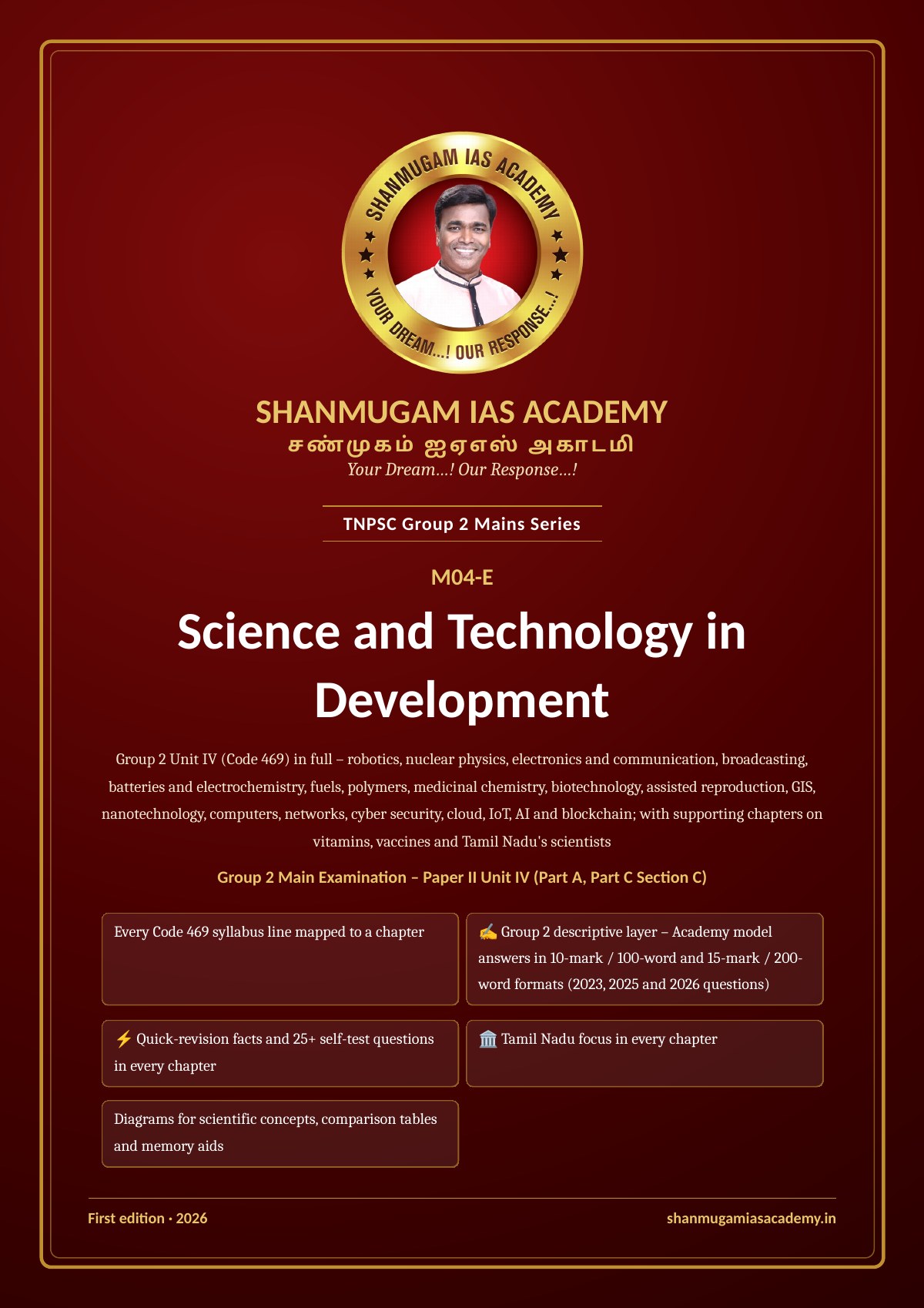 M04-E · Science & Technology – TNPSC Group 2/2A Mains (English)
₹249
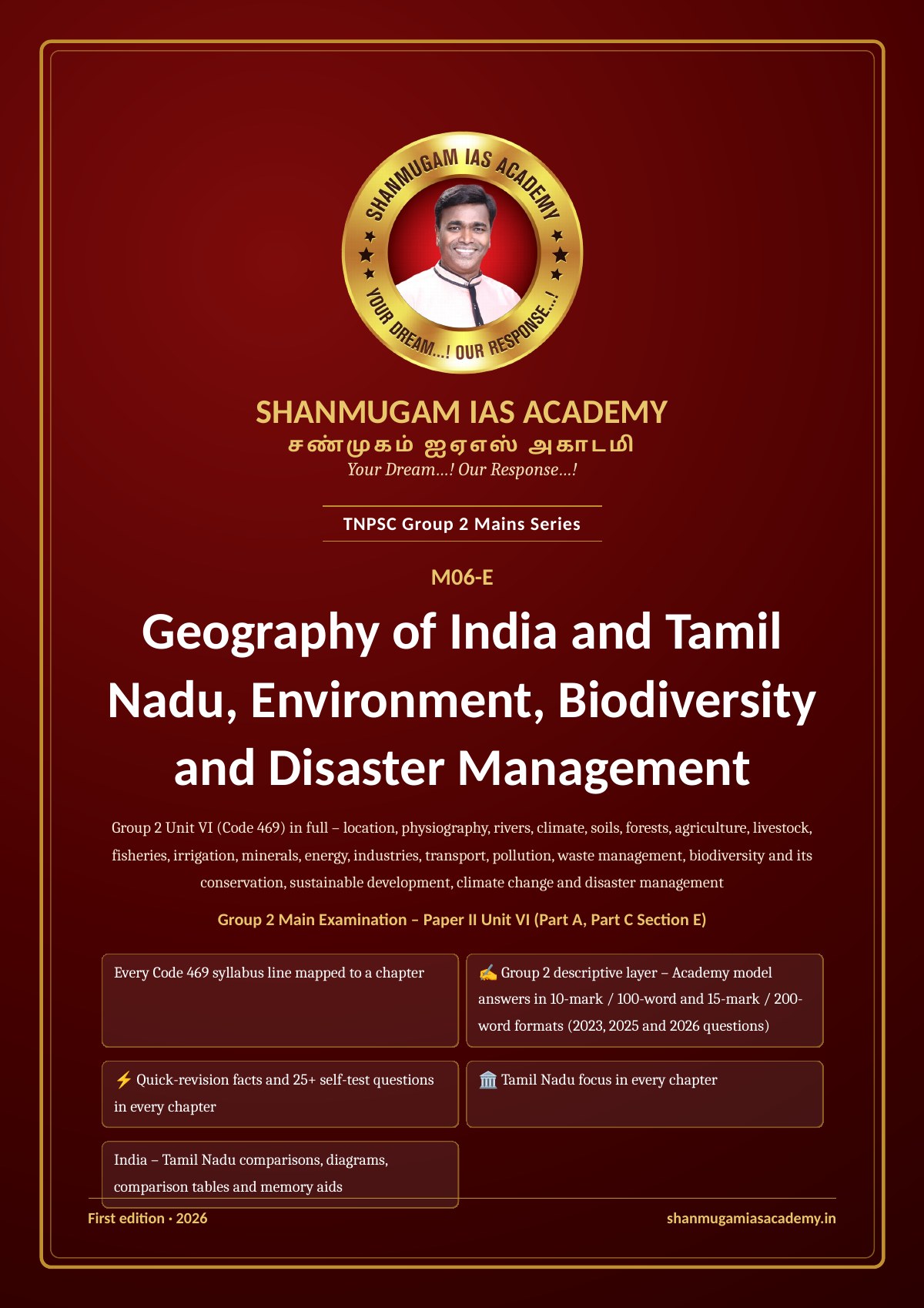 M06-E · Geography & Environment – TNPSC Group 2/2A Mains (English)
₹249
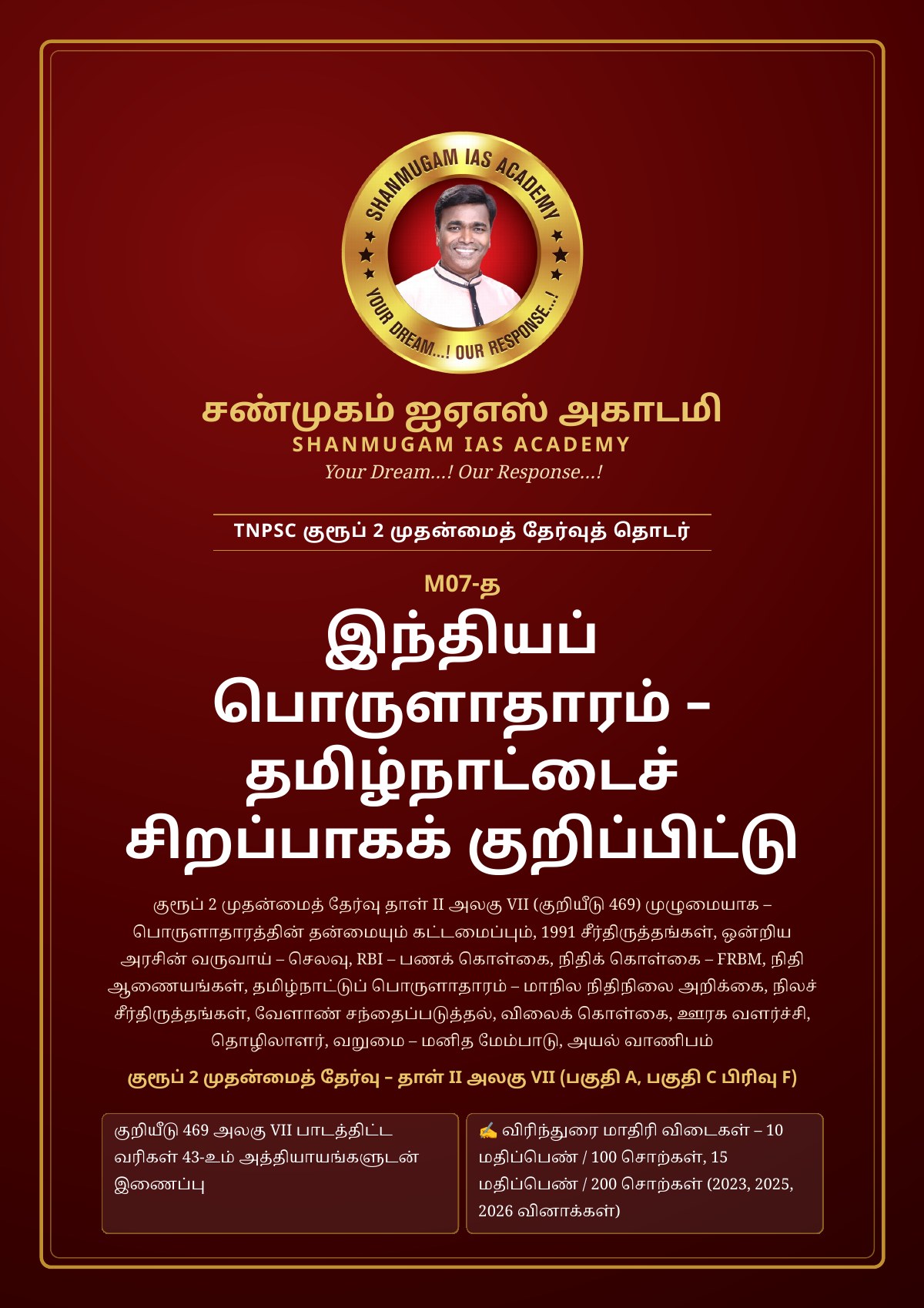 M07-த · இந்தியப் பொருளாதாரம் – TNPSC குரூப் 2/2A Mains (தமிழ்)
₹249
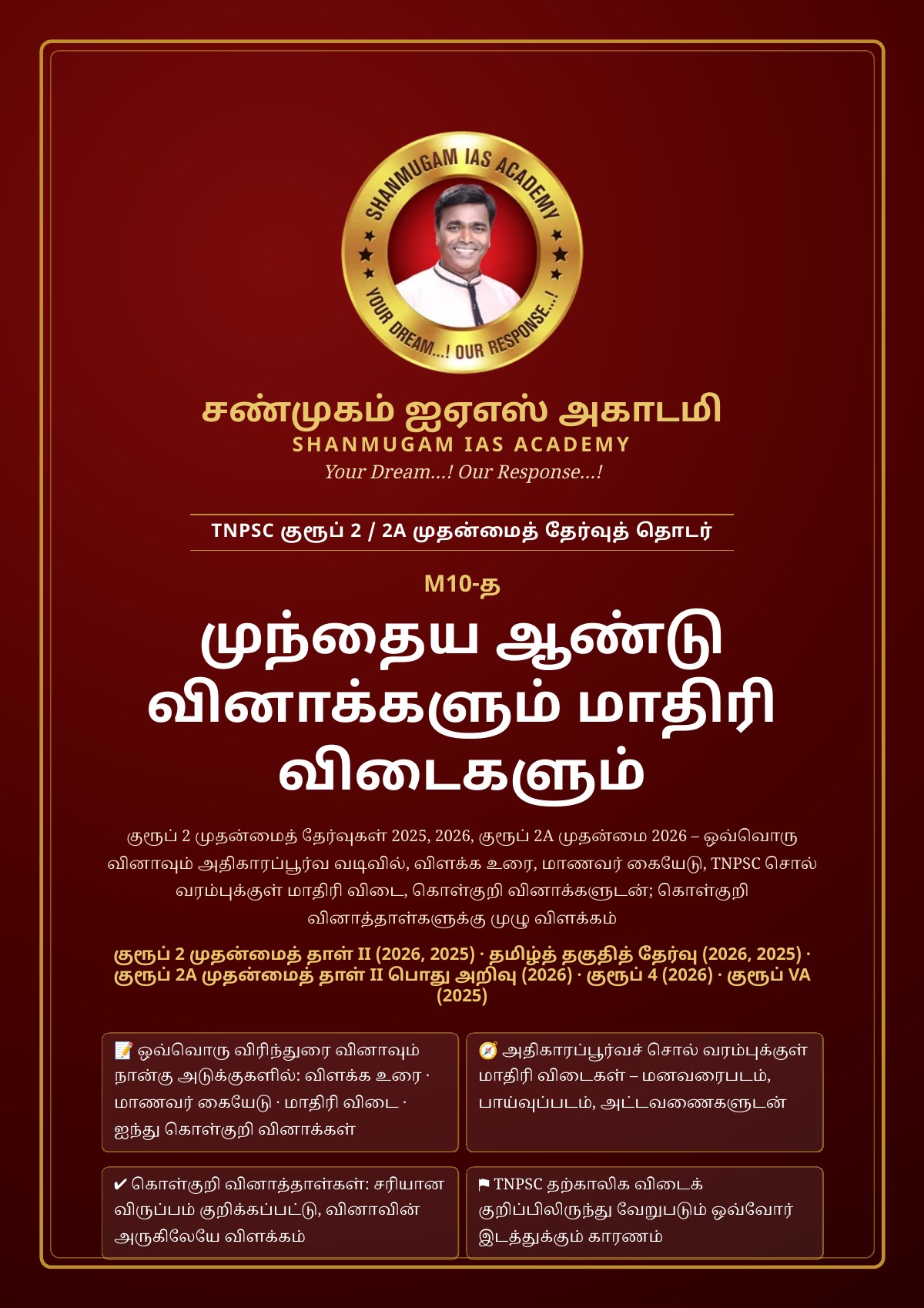 M10-த · குரூப் 2/2A Mains முந்தைய வினா & மாதிரி விடை (தமிழ்)
₹249
TNPSC குரூப் 1, 2/2A, 4 – நேரடி வகுப்புகள் · கோவை & மதுரை
2006 முதல் சண்முகம் IAS அகாடமி · Classroom & online coaching in Coimbatore and Madurai
