

Group 2A Mains – Daily Practice 5 (6 November 2026)
Group 2A Mains – Daily Practice 5 (6 November 2026) – 29 வினாக்கள், பாடம்: குரூப் 2A Mains. ஒவ்வொரு வினாவுக்கும் சரியான விடையும் இரண்டு வரி விளக்கமும் உண்டு; "Show Answer" அழுத்திப் பாருங்கள். TNPSC குரூப் 1, 2, 2A, 4, SI, TET தேர்வுகளுக்கான இலவசப் பயிற்சி – சண்முகம் ஐ.ஏ.எஸ். அகாடமி, கோயம்புத்தூர்.
உங்கள் இணையதளம் / Blog-இல் இணைக்க (HTML code)
1. The First Anglo-Maratha War ended with the Treaty of Salbai (1782).
2. The Treaty of Bassein (1802) brought the Second Anglo-Maratha War to an end.
3. After the Third Anglo-Maratha War (1817–1818), the office of the Peshwa was abolished.
Which of the above are correct?
Correct Answer: B [1 and 3 only]
விளக்கம்:
1 and 3 are correct. The Treaty of Bassein (1802), by which Peshwa Baji Rao II accepted the subsidiary alliance, led to the Second War; that war ended with the Treaties of Deogaon and Surji-Arjungaon (1803). So 2 is wrong.
1. G.U. Pope's English translation of the Thirukkural
2. Printing of Ziegenbalg's Tamil New Testament at Tranquebar
3. Robert Caldwell's 'A Comparative Grammar of the Dravidian or South-Indian Family of Languages'
4. Compilation of Veeramamunivar's (Beschi's) Tamil dictionary 'Chathurakarathi'
Correct Answer: C [2, 4, 3, 1]
விளக்கம்:
Ziegenbalg's Tamil New Testament – 1714–15; Beschi's Chathurakarathi – compiled 1732; Caldwell's Comparative Grammar – 1856; Pope's Kural translation – 1886. Hence 2, 4, 3, 1.
(a) 1887 – 1. Rash Behari Ghosh
(b) 1894 – 2. Dr. M.A. Ansari
(c) 1908 – 3. Badruddin Tyabji
(d) 1927 – 4. Alfred Webb
Correct Answer: A [(a)-3, (b)-4, (c)-1, (d)-2]
விளக்கம்:
1887 – Badruddin Tyabji (first Muslim president); 1894 – Alfred Webb (Irish); 1908 – Rash Behari Ghosh (after the Surat split); 1927 – M.A. Ansari (session that passed Nehru's complete-independence resolution).
Reason (R): Under the Ryotwari system, land revenue was settled directly with the individual cultivator (ryot).
Correct Answer: A [Both (A) and (R) are true and (R) is the correct explanation of (A)]
விளக்கம்:
Both are true; because revenue was settled directly with the ryot, there were no intermediaries, so (R) explains (A). Begun by Alexander Read and Thomas Munro in the Baramahal (1792), it was extended across the Presidency by Munro as Governor (1820).
Correct Answer: D [He founded the Dravida Munnetra Kazhagam (DMK) in 1949]
விளக்கம்:
The DMK was founded in 1949 by Arignar Anna after breaking away from the Dravidar Kazhagam. Periyar renamed the Justice Party as the Dravidar Kazhagam at the Salem conference (1944). The other three are correct.
1. The 44th Amendment (1978) removed the right to property from the Fundamental Rights and made it a legal right under Article 300A.
2. Article 21A on the right to education was inserted by the 86th Amendment (2002).
3. Article 17 abolishes 'untouchability' and forbids its practice in any form.
4. Dr. B.R. Ambedkar described Article 32 as the 'heart and soul' of the Constitution.
Which of the above are correct?
Correct Answer: D [1, 2, 3 and 4]
விளக்கம்:
All four are correct. Property is now a constitutional (legal) right under Article 300A; Article 21A (free and compulsory education for children aged 6–14) came by the 86th Amendment; Ambedkar called the right to constitutional remedies (Article 32) the 'heart and soul' of the Constitution.
(a) Directive Principles of State Policy – 1. Canada
(b) Federation with a strong Centre; residuary powers with the Centre – 2. United States of America
(c) Fundamental Rights and judicial review – 3. United Kingdom
(d) Parliamentary system of government and rule of law – 4. Ireland
Correct Answer: B [(a)-4, (b)-1, (c)-2, (d)-3]
விளக்கம்:
Directive Principles came from Ireland, a federation with a strong Centre from Canada, Fundamental Rights and judicial review from the USA, and parliamentary government and rule of law from the UK – so the match is (a)-4, (b)-1, (c)-2, (d)-3. Most of the administrative structure itself came from the Government of India Act, 1935.
Reason (R): Article 75(5) provides that a Minister who for any period of six consecutive months is not a member of either House of Parliament shall, at the expiration of that period, cease to be a Minister.
Correct Answer: A [Both (A) and (R) are true and (R) is the correct explanation of (A)]
விளக்கம்:
Both are true; the Prime Minister is also a Minister, so the six-month rule of Article 75(5) applies to him. Hence (R) explains (A). (The State-level equivalent is Article 164(4).)
Correct Answer: C [Under Article 243F, a person must have attained 25 years of age to be chosen as a member of a Panchayat]
விளக்கம்:
Article 243F says no person shall be disqualified for being under 25 if he has attained 21; so the minimum age is 21. The other three are correct (Tamil Nadu's 50% quota – amendment Acts of 2016).
Correct Answer: B [69th Amendment]
விளக்கம்:
The 69th Amendment (1991) inserted Articles 239AA and 239AB and made Delhi the 'National Capital Territory'. The 70th Amendment (1992) added the elected members of the Delhi and Puducherry Assemblies to the electoral college for the President.
1. One nanometre is one-billionth of a metre (10⁻⁹ m).
2. Richard Feynman's 1959 lecture 'There's Plenty of Room at the Bottom' is regarded as the conceptual origin of nanotechnology.
3. The term 'nanotechnology' was first used by Norio Taniguchi in 1974.
4. Graphene is a single layer of silicon atoms arranged in a hexagonal lattice.
Which of the above are correct?
Correct Answer: B [1, 2 and 3 only]
விளக்கம்:
1, 2 and 3 are correct. Graphene is a single layer of carbon atoms in a hexagonal lattice, not silicon; so 4 is wrong.
(a) Compressed Natural Gas (CNG) – 1. Carbon monoxide + hydrogen
(b) Liquefied Petroleum Gas (LPG) – 2. Carbon monoxide + nitrogen
(c) Water gas – 3. Mainly methane
(d) Producer gas – 4. Mainly propane and butane
Correct Answer: C [(a)-3, (b)-4, (c)-1, (d)-2]
விளக்கம்:
CNG is mainly methane, LPG mainly propane and butane, water gas is CO + H₂ and producer gas is CO + N₂ – so the match is (a)-3, (b)-4, (c)-1, (d)-2. Water gas is made by passing steam over red-hot coke, and producer gas by passing air over it.
Reason (R): Light travels inside an optical fibre by total internal reflection.
Correct Answer: A [Both (A) and (R) are true and (R) is the correct explanation of (A)]
விளக்கம்:
Both are true; since the core has a higher refractive index than the cladding, light undergoes repeated total internal reflection and does not escape. Hence (R) explains (A).
Correct Answer: D [Phishing is a method of encrypting data so that only authorised users can read it]
விளக்கம்:
Phishing is a fraud that steals passwords or bank details through fake e-mails or websites. Scrambling data so that only authorised users can read it is encryption. The other three are correct.
1. The addresses of recipients in the 'Cc' field are visible to all recipients of the e-mail.
2. The addresses of recipients in the 'Bcc' field are not visible to the other recipients.
3. The POP3 protocol is used to send e-mail, while SMTP is used to retrieve e-mail from the mail server.
Which of the above are correct?
Correct Answer: C [1 and 2 only]
விளக்கம்:
1 and 2 are correct. SMTP is used to send e-mail and POP3 or IMAP to retrieve it; statement 3 reverses them, so it is wrong.
1. Article 24 of the Constitution prohibits the employment of children below 14 years in factories, mines or any other hazardous employment.
2. Under the Child and Adolescent Labour (Prohibition and Regulation) Act, an 'adolescent' is a person who has completed 14 years but not 18 years of age.
3. Adolescents may be employed in hazardous occupations such as mines if a parent gives written consent.
Which of the above are correct?
Correct Answer: A [1 and 2 only]
விளக்கம்:
1 and 2 are correct. Since the 2016 amendment, employing adolescents (14–18) in hazardous occupations (mines, inflammable substances, explosives, etc.) is completely prohibited; there is no exception for parental consent. So 3 is wrong.
(a) Dr. Muthulakshmi Reddy Ninaivu scheme – 1. Remarriage of widows
(b) Dr. Dharmambal Ammaiyar Ninaivu scheme – 2. Marriage of orphan girls
(c) Annai Teresa Ninaivu scheme – 3. Inter-caste marriage
(d) E.V.R. Maniammaiyar Ninaivu scheme – 4. Marriage of daughters of poor widows
Codes: (a) (b) (c) (d)
Correct Answer: B [3 1 2 4]
விளக்கம்:
Muthulakshmi Reddy Ninaivu – inter-caste marriage assistance; Dharmambal Ammaiyar Ninaivu – widow remarriage assistance; Annai Teresa Ninaivu – orphan girls' marriage assistance; E.V.R. Maniammaiyar Ninaivu – marriage of poor widows' daughters (Social Welfare Department).
Reason (R): In Uzhavar Sandhais, farmers sell their produce directly to consumers without middlemen.
Correct Answer: A [Both (A) and (R) are true and (R) is the correct explanation of (A)]
விளக்கம்:
Both are true; removing the middlemen's margin is what gives farmers a higher price and consumers a lower one. Hence (R) explains (A). The first Uzhavar Sandhai opened in Madurai in 1999.
Correct Answer: D [Navarai is a long-duration season sown during the South-West monsoon (June)]
விளக்கம்:
Navarai is a short-duration season (under 120 days) sown in December–January; the long-duration season is Samba (over 145 days). The other three are correct.
1. The Khadi and Village Industries Commission (KVIC) is the nodal implementing agency of the Prime Minister's Employment Generation Programme (PMEGP) at the national level.
2. Deen Dayal Upadhyaya Grameen Kaushalya Yojana (DDU-GKY) is a placement-linked skill training programme for rural poor youth.
3. The Deendayal Antyodaya Yojana – National Rural Livelihoods Mission (DAY-NRLM) is implemented by the Union Ministry of Labour and Employment.
Which of the above are correct?
Correct Answer: C [1 and 2 only]
விளக்கம்:
1 and 2 are correct. DAY-NRLM (launched as 'Aajeevika' in 2011) is a scheme of the Union Ministry of Rural Development; in Tamil Nadu it is implemented through the TN State Rural Livelihoods Mission (Mahalir Thittam). So 3 is wrong.
(a) Cauvery – 1. Varusanadu Hills
(b) Vaigai – 2. Nandi Hills (Karnataka)
(c) Thamirabarani – 3. Brahmagiri Hills, Kodagu (Talakaveri)
(d) Thenpennai – 4. Pothigai Hills (Agasthyamalai)
Codes: (a) (b) (c) (d)
Correct Answer: C [3 1 4 2]
விளக்கம்:
The Cauvery rises at Talakaveri in the Brahmagiri Hills (Kodagu), the Vaigai in the Varusanadu Hills, the Thamirabarani in the Pothigai Hills and the Thenpennai in the Nandi Hills of Karnataka – so the code is 3 1 4 2. The Thamirabarani is a perennial river that both rises and reaches the sea within Tamil Nadu.
1. Tamil Nadu receives nearly half (about 48%) of its annual rainfall during the North-East monsoon (October–December).
2. The South-West monsoon contributes more than half of Tamil Nadu's annual rainfall.
3. The Coromandel coast, including Chennai, receives its heaviest rainfall during the North-East monsoon season.
Which of the above are correct?
Correct Answer: B [1 and 3 only]
விளக்கம்:
1 and 3 are correct. The South-West monsoon gives only about 35% of the State's annual rainfall (Tamil Nadu lies in the rain shadow of the Western Ghats); so 2 is wrong.
Reason (R): Strong winds blow during the South-West monsoon through gaps in the Western Ghats such as the Palghat, Shencottah and Aralvaimozhi passes.
Correct Answer: A [Both (A) and (R) are true and (R) is the correct explanation of (A)]
விளக்கம்:
Both are true; the strong winds funnelled through these passes explain the concentration of wind farms at places such as Muppandal near the Aralvaimozhi pass (Kanyakumari district). Hence (R) explains (A).
Correct Answer: D [SDG 14 is 'Life on Land']
விளக்கம்:
SDG 14 is 'Life below Water'; 'Life on Land' is SDG 15. The other three are correct.
1. The Pichavaram mangrove forest is in Cuddalore district.
2. The Muthupet mangrove forest is in Ramanathapuram district.
3. Shola forests (montane wet temperate forests) are found at the higher altitudes of the Nilgiris, Anamalai and Palani hills.
Which of the above are correct?
Correct Answer: B [1 and 3 only]
விளக்கம்:
1 and 3 are correct. The Muthupet mangrove forest is in Tiruvarur district (southern end of the Cauvery delta), not Ramanathapuram; so 2 is wrong.
Correct Answer: C [5]
விளக்கம்:
6 and 3 are common to both positions. Only two faces are adjacent to both 6 and 3, and these two are opposite each other; they are 2 and 5. So 5 is opposite 2.
3, 4, 25
5, 12, 169
6, 8, ?
Correct Answer: C [100]
விளக்கம்:
In each row the third number is the sum of the squares of the first two: 3² + 4² = 25 and 5² + 12² = 169. So the missing number = 6² + 8² = 36 + 64 = 100.
Correct Answer: A [4% decrease]
விளக்கம்:
Take the number as 100. A 20% increase gives 120; a 20% decrease on 120 gives 120 – 24 = 96. Net change = 4% decrease.
Correct Answer: D [15]
விளக்கம்:
B = 2, A = 1, D = 4 → 2 + 1 + 4 = 7. Likewise F = 6, A = 1, C = 3, E = 5 → 6 + 1 + 3 + 5 = 15.
Today Current Affairs in Tamil | 23 நவம்பர் 2026 | TNPSC Group 4 முக்கிய வினாக்கள்
📚 TNPSC குரூப் 2 / 2A Mains – மாதிரி விடைகளுடன் நூல்கள்
PDF நூல்கள் · ₹149 முதல் · ஒவ்வொன்றுக்கும் 50 பக்க இலவச மாதிரி · UPI-இல் பணம் செலுத்தியதும் உடனே பதிவிறக்கம்
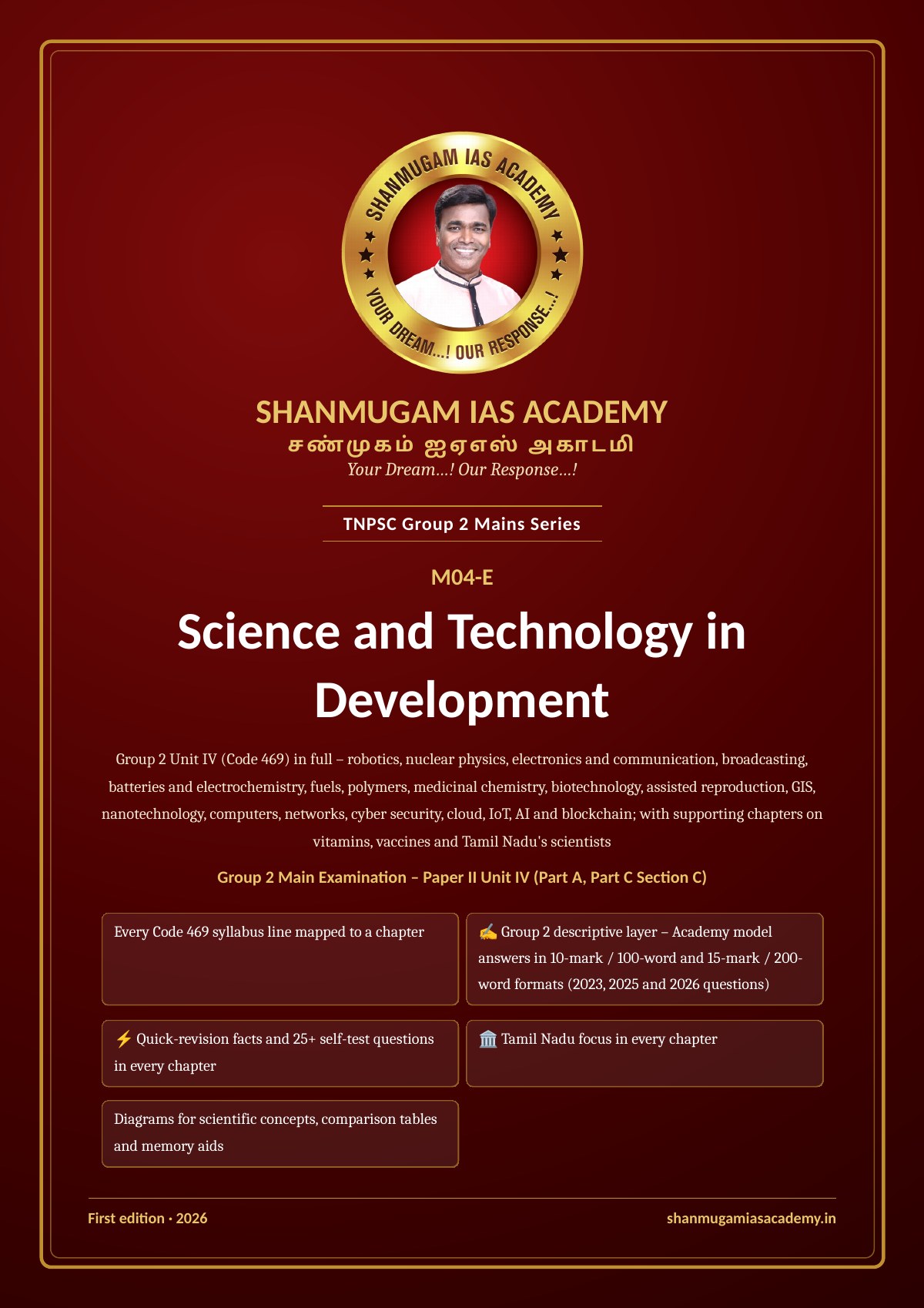 M04-E · Science & Technology – TNPSC Group 2/2A Mains (English)
₹249
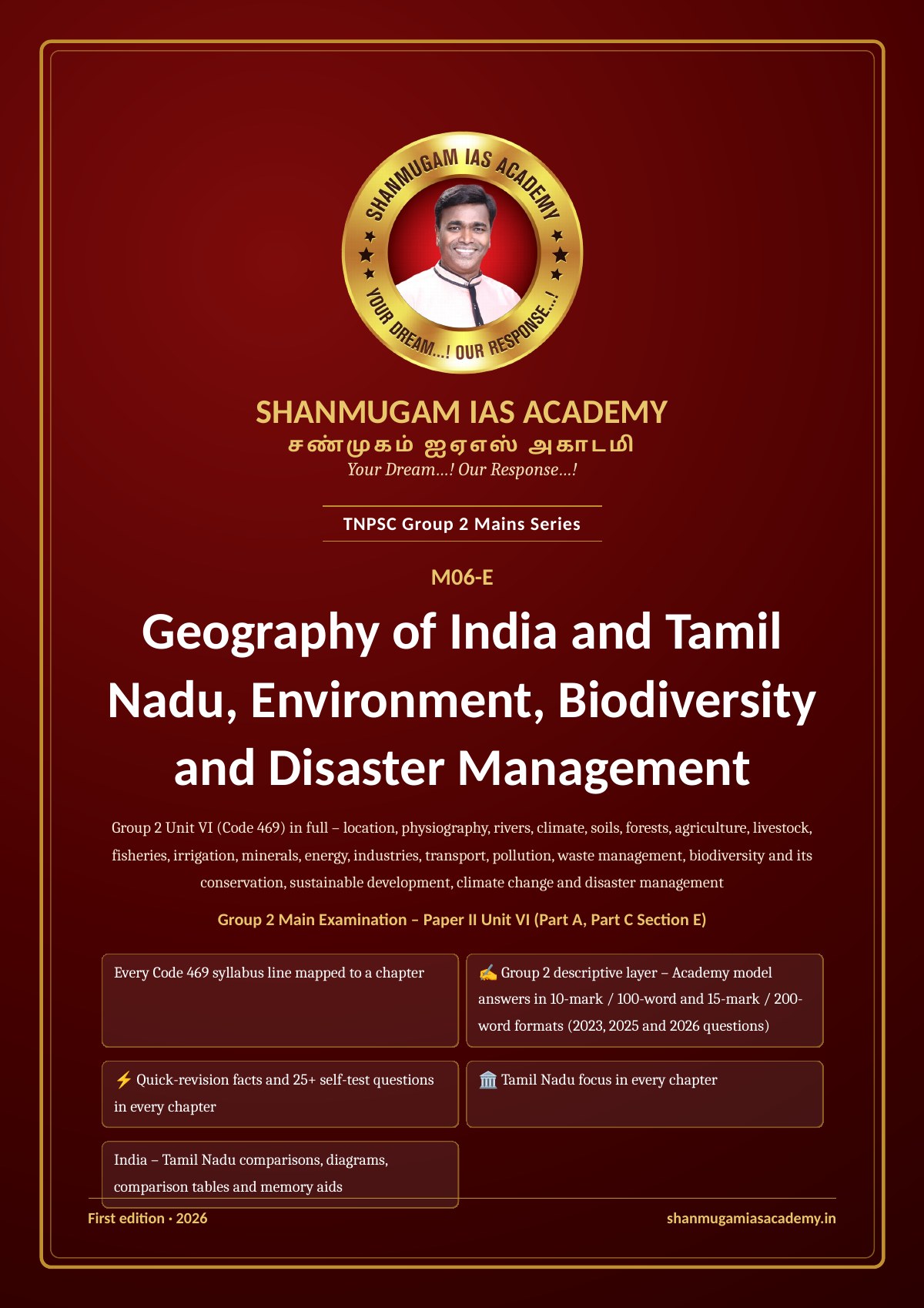 M06-E · Geography & Environment – TNPSC Group 2/2A Mains (English)
₹249
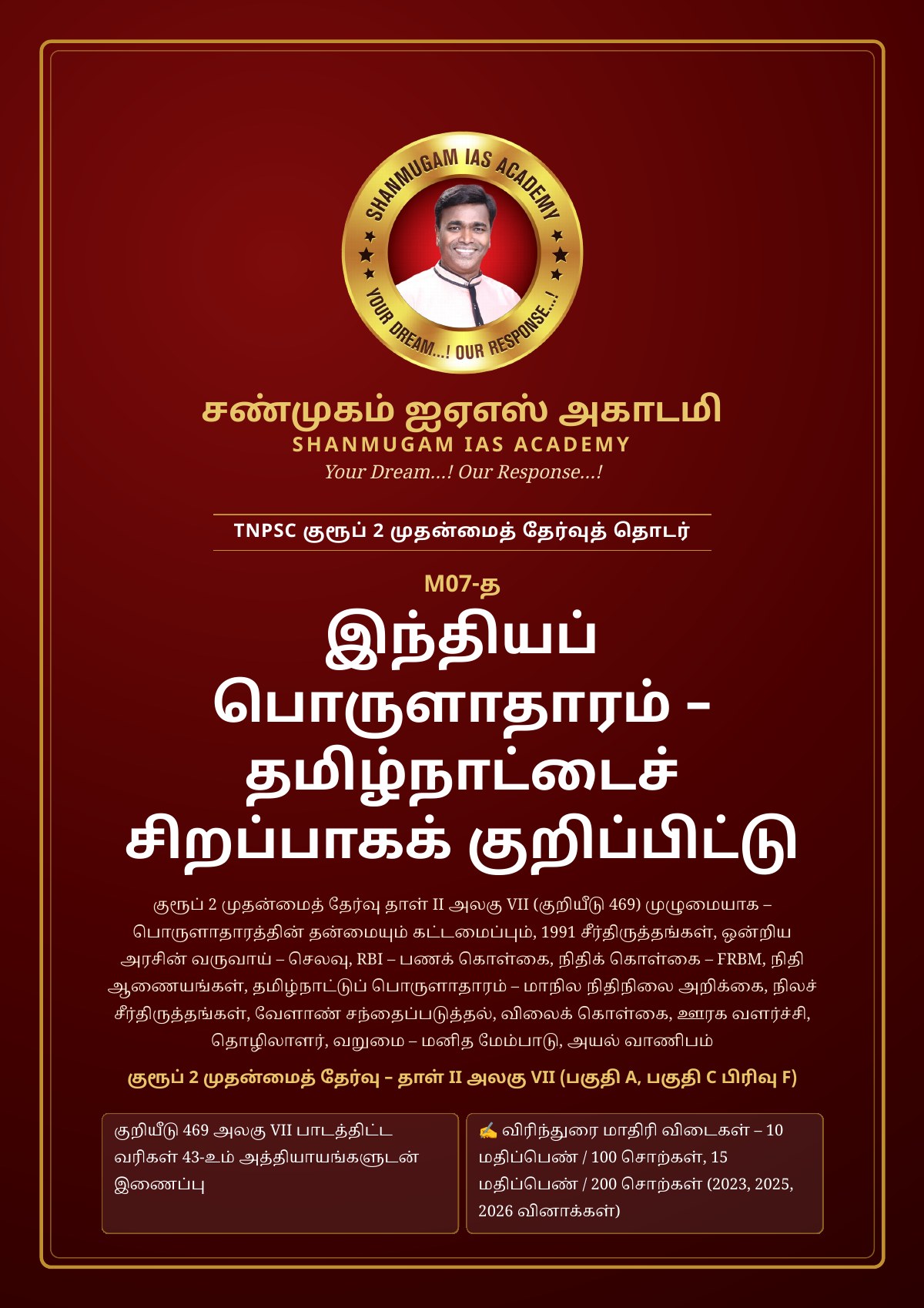 M07-த · இந்தியப் பொருளாதாரம் – TNPSC குரூப் 2/2A Mains (தமிழ்)
₹249
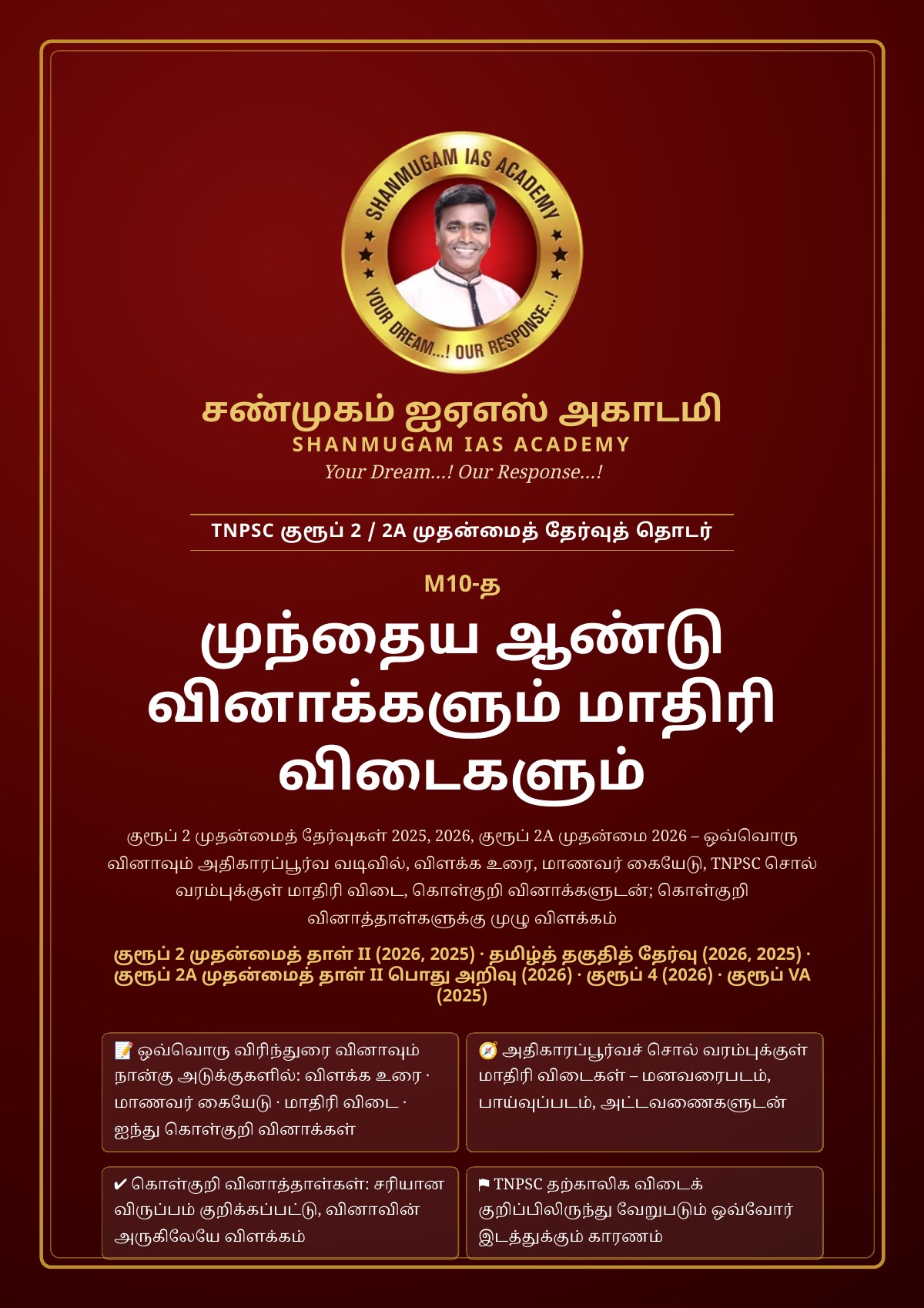 M10-த · குரூப் 2/2A Mains முந்தைய வினா & மாதிரி விடை (தமிழ்)
₹249
TNPSC குரூப் 1, 2/2A, 4 – நேரடி வகுப்புகள் · கோவை & மதுரை
2006 முதல் சண்முகம் IAS அகாடமி · Classroom & online coaching in Coimbatore and Madurai
