

IBPS Clerk Quant – Mains Sectional Mock 1 – Quantitative Aptitude – Mains Sectional Mock 1 · Quantitative Aptitude
IBPS Clerk Quant – Mains Sectional Mock 1 – Quantitative Aptitude – Mains Sectional Mock 1 · Quantitative Aptitude – 29 questions, subject: Quantitative Aptitude. Every question has the correct answer with a two-line explanation; tap "Show Answer". Free practice for IBPS Clerk, IBPS PO, SBI, RRB exams – Shanmugam IAS Academy, Coimbatore.
Link to this page from your website / blog (HTML code)
Directions (1–5): Practice data (hypothetical). A bank branch has 2,400 customers; each has exactly one type of account – savings, current or fixed deposit (FD). 55% of the customers have savings accounts; the rest have current accounts and FDs in the ratio 5 : 7. 40% of the savings account holders are women; 30% of the current account holders are women; half of the FD holders are women.
Correct Answer: E [978]
Explanation:
Savings = 55% of 2,400 = 1,320 and the rest 1,080 split 5 : 7 gives current 450 and FD 630. Women = 40% of 1,320 + 30% of 450 + 50% of 630 = 528 + 135 + 315 = 978.
Correct Answer: D [45 : 176]
Explanation:
Current accounts = 45% of 2,400 x 5/12 = 450, of which 30% = 135 are women; savings = 1,320, of which 40% = 528 are women. So the ratio is 135 : 528 = 45 : 176.
Directions (6–10): Practice data (hypothetical). The pie chart shows the distribution of a company's expenditure of ₹ 1,200 crore in 2024 among six heads. The bar chart shows the percentage change in the expenditure on each head in 2025 over 2024.
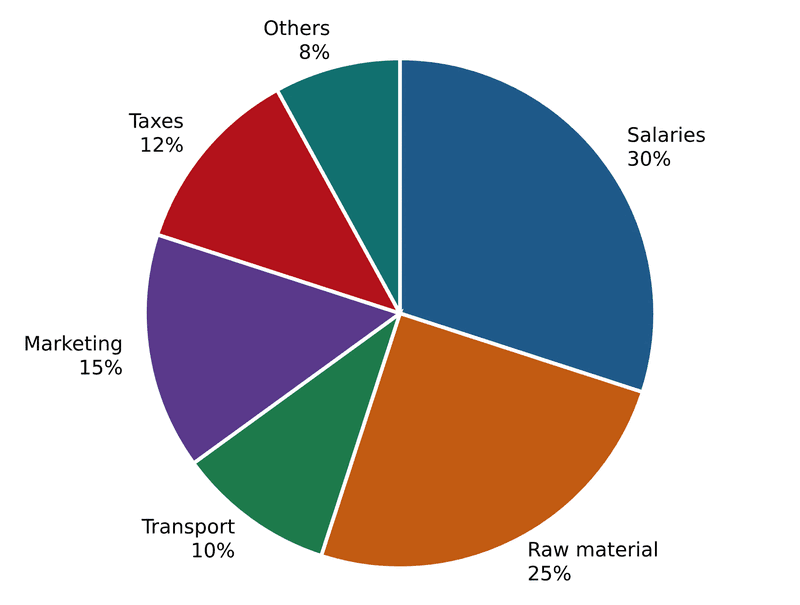
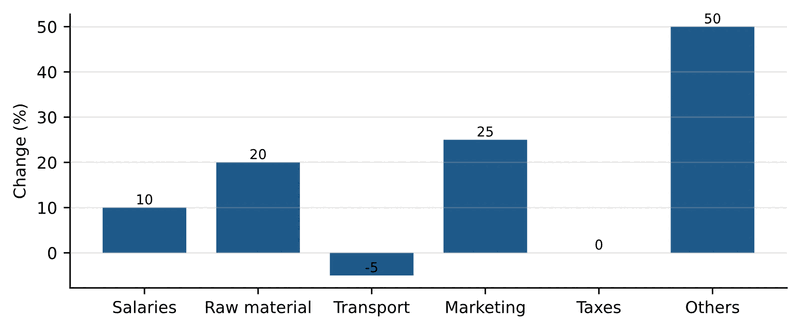
Correct Answer: B [225]
Explanation:
Marketing was 15% of 1,200 crore = 180 crore in 2024. A 25% rise gives 180 x 1.25 = 225 crore in 2025.
Directions (11–15): Practice data (hypothetical). The radar chart shows the number of loans (in hundreds) sanctioned by Bank A and Bank B in six regions.
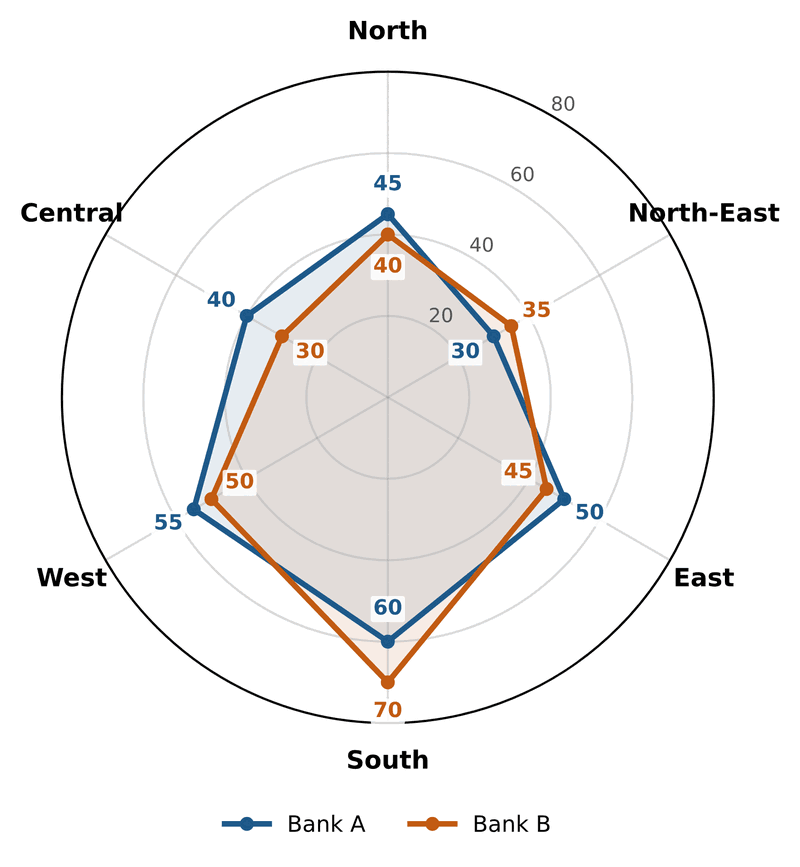
Correct Answer: D [280]
Explanation:
Bank A sanctioned 45, 30, 50, 60, 55 and 40 hundred loans in the six regions. The total is 280 hundred.
Directions (16–19): In each question two equations I and II are given. Solve them and choose: A) x > y, B) x < y, C) x ≥ y, D) x ≤ y, E) x = y or the relation cannot be established.
Correct Answer: A [x > y]
Explanation:
x = 3, 8; y = −6, 2. All pairs → x > y.
Correct Answer: B [x < y]
Explanation:
x = −9, −5; y = −4, 3. All pairs → x < y.
Correct Answer: E [x = y or the relation cannot be established]
Explanation:
x = 1/2, 7; y = 3, 7. All pairs → x = y or the relation cannot be established.
Correct Answer: D [x ≤ y]
Explanation:
x = 4/3, 2; y = 2, 5. All pairs → x ≤ y.
Directions (20–24): Compare Quantity I and Quantity II and choose: A) Quantity I > Quantity II, B) Quantity I < Quantity II, C) Quantity I ≥ Quantity II, D) Quantity I ≤ Quantity II, E) Quantity I = Quantity II or the relation cannot be established.
Correct Answer: B [Quantity I < Quantity II]
Explanation:
Simple interest = 12,000 x 10% x 2 = Rs 2,400, while compound interest = 12,000 x (1.21 - 1) = Rs 2,520. So Quantity I < Quantity II.
Correct Answer: A [Quantity I > Quantity II]
Explanation:
The train covers 300 + 200 = 500 m in 25 s, i.e. 20 m/s. 20 x 18/5 = 72 km/h, which is more than 70 km/h.
Correct Answer: A [Quantity I > Quantity II]
Explanation:
A total of 7 with two dice has 6 favourable outcomes out of 36, i.e. 1/6. A head and a 3 has probability 1/2 x 1/6 = 1/12, so Quantity I > Quantity II.
Correct Answer: C [Quantity I ≥ Quantity II]
Explanation:
x squared - 15x + 56 = 0 factorises as (x - 7)(x - 8) = 0, so x = 7 or 8. Since 7 = 7 and 8 > 7, Quantity I >= Quantity II.
Correct Answer: E [Quantity I = Quantity II or relation cannot be established]
Explanation:
Area of a square with diagonal d is d squared / 2 = 196 / 2 = 98 square cm. The rectangle's area is 14 x 7 = 98 square cm, so the quantities are equal, which is option E.
Directions (25–27): Each question has two statements. Choose: A) Statement I alone is sufficient, B) Statement II alone is sufficient, C) Either statement alone is sufficient, D) Both statements together are needed, E) Both statements together are not sufficient.
I. It passes a pole in 10 seconds.
II. It is 150 m long.
Correct Answer: D [Both statements together are needed]
Explanation:
Statement I gives only the time to pass a pole (length / speed) and II gives only the length, so neither is enough alone. Together speed = 150 m / 10 s = 15 m/s (54 km/h), so both statements are needed.
I. A is 25% older than B.
II. The sum of their ages is 54 years.
Correct Answer: A [Statement I alone is sufficient]
Explanation:
If A is 25% older than B, then A = 1.25B, so A : B = 5 : 4; Statement I alone gives the ratio. Statement II gives only the sum, which cannot fix the ratio.
I. The simple interest on it for 2 years at 10% per annum is ₹ 1,200.
II. The compound interest on it for 2 years at 10% per annum (compounded annually) is ₹ 1,260.
Correct Answer: C [Either statement alone is sufficient]
Explanation:
From I, P = SI x 100 / (R x T) = 1,200 x 100 / 20 = Rs 6,000. From II, CI for 2 years at 10% is 21% of P, so P = 1,260 / 0.21 = Rs 6,000; either statement alone is sufficient.
Directions (28–31): Find the missing term (28, 29) or the wrong term (30, 31).
4, 6, 12, 30, 84, ?
Correct Answer: B [246]
Explanation:
The differences 2, 6, 18, 54 are each multiplied by 3. The next difference is 162, so the term is 84 + 162 = 246.
1, 3, 10, 41, 206, ?
Correct Answer: D [1,237]
Explanation:
The rule is x2+1, x3+1, x4+1, x5+1: 1, 3, 10, 41, 206. The next term is 206 x 6 + 1 = 1,237.
5, 10, 30, 120, 600, 3,500
Correct Answer: C [3,500]
Explanation:
The terms are multiplied by 2, 3, 4, 5 and 6 in turn: 5, 10, 30, 120, 600. The last term should be 600 x 6 = 3,600, so 3,500 is wrong.
2, 3, 7, 16, 31, 57
Correct Answer: A [31]
Explanation:
The differences should be 1, 4, 9, 16, 25 (squares): 2, 3, 7, 16, 32, 57. The fifth term should be 16 + 16 = 32, so 31 is wrong.
Directions (32–33): Find the approximate value of the question mark (?).
Correct Answer: E [1,168]
Explanation:
45% of 1,600 = 720 and 32 x 14 = 448. Adding them gives 720 + 448 = 1,168.
Correct Answer: E [375]
Explanation:
Round the values: 2,450 / 49 = 50 and 50 x 12 = 600. Then 600 - 15 squared (225) = 375.
Directions (34–40): Answer the following questions.
Correct Answer: B [20 days]
Explanation:
With A = 2B and A + B = 1/18, B = 1/54 and A = 1/27 a day; A alone does 6/27 = 2/9 of the work in 6 days. The remaining 7/9 at 1/18 a day takes 14 days, so the work ends in 6 + 14 = 20 days.
Correct Answer: D [200 m]
Explanation:
Passing the man, the train covers its own length L in 12 s; passing the platform it covers L + 300 in 30 s, so 300 m takes 18 s and speed = 50/3 m/s. L = 12 x 50/3 = 200 m.
Correct Answer: C [64.8 litres]
Explanation:
After each replacement milk remains at (1 - 8/80) of its amount. After two operations milk = 80 x 0.9 x 0.9 = 64.8 litres.
Correct Answer: A [30%]
Explanation:
Let cost be Rs 1 per kg; he sells at 1.3 x 0.9 = Rs 1.17 for what he calls 1 kg but gives only 900 g costing Rs 0.90. Profit = 0.27 / 0.90 x 100 = 30%.
Correct Answer: D [₹ 9,000]
Explanation:
Capital x time: A = 20,000 x 12, B = 30,000 x 8 and C = 40,000 x 6, each equal to 2,40,000, so the ratio is 1 : 1 : 1. C's share is one-third of Rs 27,000 = Rs 9,000.
Correct Answer: A [1/221]
Explanation:
There are 4C2 = 6 ways to choose two kings out of 52C2 = 1,326 ways to choose any two cards. The probability is 6 / 1,326 = 1/221.
Correct Answer: C [240]
Explanation:
Treat the vowels A and E as one unit, giving 5 units (B, N, K, R, AE) arranged in 5! = 120 ways. The vowels can swap among themselves in 2! ways, so 120 x 2 = 240.
நடப்பு நிகழ்வுகள் 24 நவம்பர் 2026 | Today Current Affairs in Tamil | TNPSC Group 4 வினா விடை
📚 IBPS Clerk 2026 Books
PDF நூல்கள் · ₹149 முதல் · ஒவ்வொன்றுக்கும் 50 பக்க இலவச மாதிரி · UPI-இல் பணம் செலுத்தியதும் உடனே பதிவிறக்கம்
 IBPS Clerk 2026 – Complete Set (5 Books, Prelims + Mains)
₹599
 IBPS Clerk 2026 – Quantitative Aptitude (Prelims + Mains)
₹149
 IBPS Clerk 2026 – Reasoning Ability (Prelims + Mains)
₹149
 IBPS Clerk 2026 – English Language (Prelims + Mains)
₹149
TNPSC குரூப் 1, 2/2A, 4 – நேரடி வகுப்புகள் · கோவை & மதுரை
2006 முதல் சண்முகம் IAS அகாடமி · Classroom & online coaching in Coimbatore and Madurai
