

SSC CGL Geography – Atmosphere – Structure, Pressure Belts & Winds – Level 2 · Exam Level · Tier I Sprint
SSC CGL Geography – Atmosphere – Structure, Pressure Belts & Winds – Level 2 · Exam Level · Tier I Sprint – 13 questions, subject: Geography – India & World. Every question has the correct answer with a two-line explanation; tap "Show Answer". Free practice for TNPSC, UPSC, SSC, Bank and RRB exams – Shanmugam IAS Academy, Coimbatore.
Link to this page from your website / blog (HTML code)
I. The troposphere is thicker over the equator than over the poles.
II. Temperature rises with height in the mesosphere.
Which is/are correct?
Correct Answer: B [Only I]
Explanation:
Only statement I is correct: the troposphere is about 18 km thick over the equator but only about 8 km over the poles, because strong heating lifts the air higher at the equator. Statement II is wrong because temperature falls with height in the mesosphere, its top being the coldest part of the atmosphere.
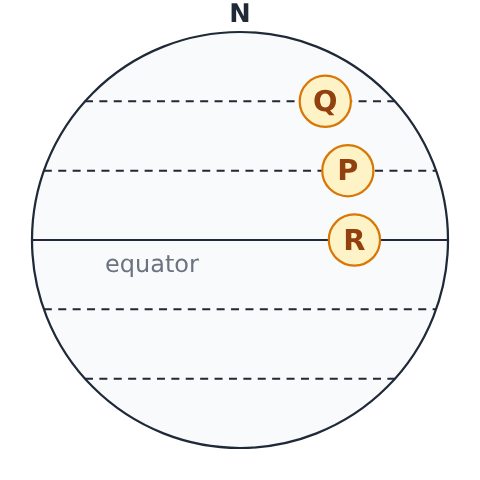
Correct Answer: A [P]
Explanation:
Moving from the equator, the belts are the equatorial low (0 degrees), the subtropical high (about 30 degrees) and the subpolar low (about 60 degrees). P marks about 30 degrees, so it is the subtropical high-pressure belt.
Quantity I: temperature (°C) 3 km above a place where the ground is at 25 °C (normal lapse rate)
Quantity II: 5 °C
Correct Answer: A [Quantity I > Quantity II]
Explanation:
At the normal lapse rate of 6.5 °C per km, the fall over 3 km is 6.5 × 3 = 19.5 °C, giving 25 − 19.5 = 5.5 °C. Since 5.5 °C is more than 5 °C, Quantity I is greater.
Correct Answer: C [troposphere, stratosphere, mesosphere, thermosphere]
Explanation:
From the Earth's surface upward the layers are the troposphere, stratosphere, mesosphere and thermosphere, followed by the exosphere. The ozone layer lies in the stratosphere, and the mesosphere is the coldest layer of the atmosphere.
Correct Answer: D [Bora]
Explanation:
The Bora is a cold, dry north-easterly wind blowing down to the Adriatic coast, while the Sirocco, Chinook and Loo are hot or warm winds. The Sirocco blows from the Sahara towards southern Europe, the Chinook down the Rockies and the Loo over the north Indian plains.
A: The highest insolation at the surface is received over the subtropical deserts rather than at the equator.
R: Cloud cover is least over the subtropical deserts.
Correct Answer: B [Both A and R are true and R explains A]
Explanation:
The highest surface insolation is received over the subtropical deserts, not at the equator, because these deserts have the least cloud cover, so R explains A. At the equator thick clouds reflect and absorb a large part of the incoming sunlight.
Correct Answer: A [Kalbaisakhi – West Bengal]
Explanation:
The Kalbaisakhi (Nor'wester) is a violent evening thunderstorm of West Bengal in the hot season, useful for the tea, jute and rice crops. The other pairs are wrong: the Loo blows over the north Indian plains, the Chinook in the Rockies and the Mistral in southern France.
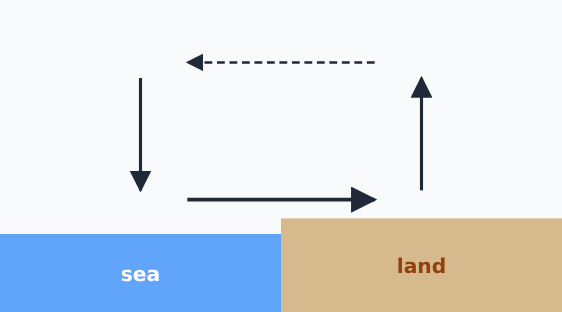
Correct Answer: A [It is a sea breeze, which blows by day]
Explanation:
Surface air blows from the sea towards the land and rises over the warmer land. This is a sea breeze, which blows during the day when the land heats faster than the sea.
Correct Answer: B [980 mb]
Explanation:
At about 1 mb fall for every 10 m of height, a rise of 300 m lowers pressure by 300 ÷ 10 = 30 mb. So the pressure at 300 m is about 1,010 − 30 = 980 mb.
Correct Answer: D [Inter-Tropical Convergence Zone (ITCZ)]
Explanation:
The Inter-Tropical Convergence Zone (ITCZ) is the low-pressure zone near the equator where the north-east and south-east trade winds meet and the air rises. It lies within the equatorial low (doldrums) and shifts north and south with the Sun.
Correct Answer: C [Low pressure is on your right]
Explanation:
By Buys Ballot's law, in the Southern Hemisphere a person standing with the back to the wind has low pressure on the right. The rule is reversed in the Northern Hemisphere, where low pressure lies on the left, because the Coriolis force deflects winds in opposite directions.
Correct Answer: D [Carbon dioxide]
Explanation:
Carbon dioxide is a greenhouse gas because it absorbs the long-wave (infrared) radiation given out by the Earth and re-radiates part of it back, warming the lower atmosphere. Nitrogen, oxygen and argon, the main gases of the air, do not absorb infrared radiation significantly.
Correct Answer: C [there is very little land to slow them by friction]
Explanation:
Open ocean from about 40° S to 60° S.
➤ Full notes, shortcuts and every answer explained – SSC CGL 2026 Geography – India & World book (₹149): www.shanmugamiasacademy.in/study-materials/ssc-cgl-geography-india-world
நடப்பு நிகழ்வுகள் 25 நவம்பர் 2026 | Today Current Affairs in Tamil | TNPSC Group 4 வினா விடை
📚 SSC CGL 2026 Books
PDF நூல்கள் · ₹149 முதல் · ஒவ்வொன்றுக்கும் 50 பக்க இலவச மாதிரி · UPI-இல் பணம் செலுத்தியதும் உடனே பதிவிறக்கம்
 SSC CGL 2026 – Statistics (Tier II Paper II)
₹149
 SSC CGL 2026 – Full Mock Test Papers (Tier I + Tier II – 38 Full Mock Papers)
₹149
 SSC CGL 2026 – Quantitative Aptitude (Tier I + Tier II)
₹149
 SSC CGL 2026 – General Intelligence & Reasoning (Tier I + Tier II)
₹149
TNPSC குரூப் 1, 2/2A, 4 – நேரடி வகுப்புகள் · கோவை & மதுரை
2006 முதல் சண்முகம் IAS அகாடமி · Classroom & online coaching in Coimbatore and Madurai
