

SSC CGL Geography – Earth – Shape, Motions, Latitudes, Longitudes & Time – Level 3 · Challenge
SSC CGL Geography – Earth – Shape, Motions, Latitudes, Longitudes & Time – Level 3 · Challenge – 8 questions, subject: Geography – India & World. Every question has the correct answer with a two-line explanation; tap "Show Answer". Free practice for TNPSC, UPSC, SSC, Bank and RRB exams – Shanmugam IAS Academy, Coimbatore.
Link to this page from your website / blog (HTML code)
Correct Answer: B [4:00 a.m.]
Explanation:
The longitude difference is 85 - 40 = 45 degrees, which equals 45 x 4 = 180 min = 3 hours. A lies west of B, so its time is behind: 7:00 a.m. - 3 h = 4:00 a.m.
I. On an equinox day, day and night are nearly equal all over the Earth.
II. On 22 December the North Pole is in continuous darkness.
Which is/are correct?
Correct Answer: A [Both I and II]
Explanation:
On an equinox the Sun is overhead at the Equator, so day and night are nearly equal everywhere, and on 22 December the North Pole is tilted away from the Sun and stays in continuous darkness. Hence both statements are correct.
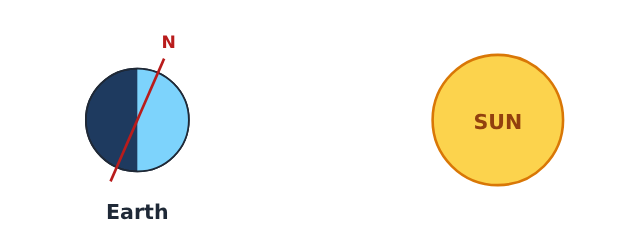
Correct Answer: C [21 June]
Explanation:
The northern end of the Earth's axis is tilted towards the Sun, so the Sun is overhead at the Tropic of Cancer. This happens at the summer solstice on 21 June.
Correct Answer: A [70°N]
Explanation:
Twenty-four hours of daylight on 21 June and 24 hours of darkness on 22 December occur only north of the Arctic Circle (66.5N), so 70N fits. At 70S the pattern is reversed, and 20N and 60N always have both day and night.
Correct Answer: B [1:00 a.m. Monday]
Explanation:
9 p.m. IST = 3:30 p.m. GMT; + 9 h 30 min = 1:00 a.m.
Correct Answer: D [6 h]
Explanation:
The Earth turns 1° in 4 minutes, so a 90°E meridian gives 90 × 4 = 360 minutes = 6 hours ahead of GMT. The actual IST meridian of 82°30′E gives 330 minutes, that is 5 hours 30 minutes.
Correct Answer: A [1 h 2 min]
Explanation:
The longitude difference is 88 deg 15' - 72 deg 45' = 15 deg 30' = 15.5 degrees, and each degree equals 4 minutes of time. So the time difference is 15.5 x 4 = 62 min = 1 h 2 min.
Correct Answer: C [perihelion, summer solstice, aphelion, autumnal equinox]
Explanation:
3 Jan perihelion → 21 Jun solstice → 4 Jul aphelion → 23 Sep equinox.
➤ Full notes, shortcuts and every answer explained – SSC CGL 2026 Geography – India & World book (₹149): www.shanmugamiasacademy.in/study-materials/ssc-cgl-geography-india-world
நடப்பு நிகழ்வுகள் 25 நவம்பர் 2026 | Today Current Affairs in Tamil | TNPSC Group 4 வினா விடை
📚 SSC CGL 2026 Books
PDF நூல்கள் · ₹149 முதல் · ஒவ்வொன்றுக்கும் 50 பக்க இலவச மாதிரி · UPI-இல் பணம் செலுத்தியதும் உடனே பதிவிறக்கம்
 SSC CGL 2026 – Statistics (Tier II Paper II)
₹149
 SSC CGL 2026 – Full Mock Test Papers (Tier I + Tier II – 38 Full Mock Papers)
₹149
 SSC CGL 2026 – Quantitative Aptitude (Tier I + Tier II)
₹149
 SSC CGL 2026 – General Intelligence & Reasoning (Tier I + Tier II)
₹149
TNPSC குரூப் 1, 2/2A, 4 – நேரடி வகுப்புகள் · கோவை & மதுரை
2006 முதல் சண்முகம் IAS அகாடமி · Classroom & online coaching in Coimbatore and Madurai
